

Sofa Bed Frame Guide for Support and Comfort
Posted by Meliusly
The guest leaves at nine. By ten you've stripped the bed and found the problem. Under a thin mattress, a metal bar crosses the middle of the frame at exactly hip height, and the section on the left sits a finger lower than the section on the right. Nothing is broken. Nothing looks worn. Yet nobody slept well.
Sofas that convert sit at the meeting point of two jobs that pull in opposite directions. A seat wants a firm, continuous platform close to the floor. A bed wants a flat, level surface long enough for a body to lie across for seven hours. Most sleeper mechanisms solve the storage problem first and the sleeping problem second, and the compromise shows up as bars, seams, and dips that no mattress alone can hide.
That's the part most buying advice skips. Comfort in a sofa bed is a geometry problem before it's a padding problem. Fix the deck and the sleeping surface changes. Buy a thicker mattress on a warped deck and you've paid for foam over a gap.
Furniture damage is common enough that this isn't a niche worry. Forty percent of Americans surveyed said sofas, couches, or loveseats were the furniture they had most recently damaged in 2024, according to an Allstate Protection Plans survey reported by the Press-Leader. Most of those sofas stayed in the house. The useful repair usually costs a fraction of replacement.
Identify Your Sofa Bed Frame Type
Name the mechanism before you judge the mattress. Open the bed fully, step back, and watch what moved. A frame that slides out in linked sections behaves nothing like one that folds the back down onto the seat, and the two fail in different places.
Match what you see to a row below, then read the last column first.
| Frame type | How it converts | Support surface | Best suited to | First weak point |
|---|---|---|---|---|
| Pull-out four-section | Head, body, intermediate, and foot sections pivot out of the sofa | Linked metal sections, bars, or a thin deck | Guest or regular sleep on a standard sleeper | Hinge play, bar feel, and dips between sections |
| Click-clack or jackknife | The back folds down onto the seat into one plane | Seat and back cushions on a simple frame | Occasional guests in a small room | Cushion crush and a ridge at the fold |
| Futon frame | Seat and back tilt on side rails toward flat | Wood or metal slats under a futon mattress | Studio sitting and sleeping | Slat gaps and mattress slide |
| One-piece sofa bed | Seat and back, upholstered as one unit, swing down together | One continuous upholstered deck | A smoother uninterrupted surface | The whole panel must stay aligned as it rotates |
| Two-piece sofa bed | Separate seat and back pieces meet when opened | Two decks joined at a seam | Classic sleeper layouts | Looseness, a step, or deflection at the joint |
The pull-out four-section is the reference design for most sleepers sold today. It stores the head, body, intermediate, and foot sections inside the sofa and swings them outward until the deck lies roughly flat. You sleep across the joints, which is why a bar or a small step lands under a hip instead of under your feet. The click-clack avoids bars by folding the back down onto the seat, but it asks seat cushions to do the work of a mattress, and cushions compress under a body in a way a foam slab doesn't.
Futons tilt seat and back on side rails until the platform is flat. What sits underneath is usually slats, and slat spacing is where futons lose people. A gap wider than the mattress can bridge leaves a soft spot that never fully recovers. The upholstered types round out the list, and the federal rules describe them more precisely than furniture marketing does.
What the federal rules call a sofa bed
The U.S. flammability regulations that cover this furniture define a sofa bed as seating in which the sofa back swings down flat with the seat to create a sleeping surface. Those same rules split the category in two. A one-piece sofa bed upholsters the seat and back as one unit to provide an uninterrupted sleep surface. A two-piece sofa bed upholsters them separately, which means a joint exists where the two decks meet, as set out in the federal flammability rules for sofa beds and mattress foundations.
The split matters at inspection time. On a one-piece model, the frame must support a continuous surface as the back rotates into position, so alignment across the whole panel is what you're checking. On a two-piece model, the joint between the sections is the critical area, and a step there is a defect rather than a cushioning complaint.
The same rule defines a mattress foundation broadly as a structure used to support a mattress or sleep surface, including frames, foam, box springs, or combinations of materials. Your sleeper deck is a mattress foundation by that definition. Judge it the way you'd judge a bed base, not the way you'd judge a sofa seat.
Why the type decides the fix you need
A topper can pad a bar. It can't level a stepped frame, because it takes the shape of whatever sits beneath it. If the left section sits lower than the middle, no amount of foam changes the plane your spine has to lie on.
If you're shopping rather than repairing, sort by mechanism first and mattress depth second. Retailers that publish both let you check the two facts that predict how a sleeper feels after a year of use, and the guest-ready sofas at Vinson Fine Furniture is one place where the mechanism style and mattress depth sit side by side in the listing.
Mechanism names get used loosely, so our breakdown of the types of sleeper sofas is a useful cross-check when a listing calls everything a pull-out.
Your next move isn't a purchase. Lift the mattress off and look at the deployed surface, because that tells you what's failing.
How the Folding Mechanism Carries Weight
A sleeper can feel firm when you sit on it and still have a problem when it unfolds. The open bed carries weight through a chain of connected parts, much like a folding ladder: rails and legs support the structure, while joints let it collapse for storage. Each joint also creates a point where the frame can flex or lose alignment.
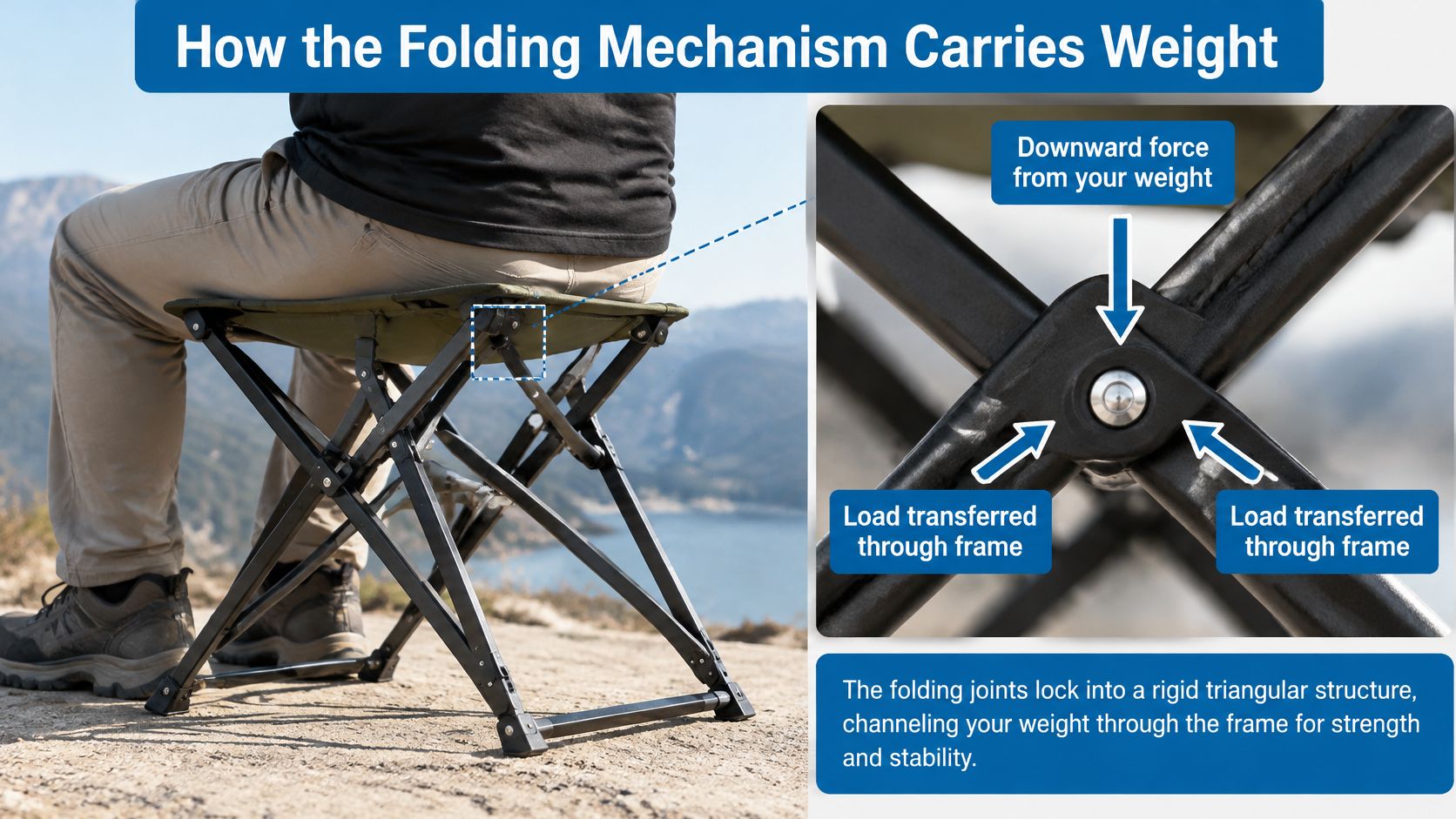
A four-section pull-out shows how that balance works. A sofa-sleeper frame patent granted in 1986 describes head, body, intermediate, and foot sections joined by pivots. The sections move from inside the sofa to an extended position that forms the bed, as shown in the 1986 sofa-sleeper frame patent. Mechanisms vary, so identify how your frame opens before deciding what kind of support it needs.
Follow the load path
- Legs and perimeter rails transfer weight to the floor. If they rock, the deck can twist.
- Pivots and locks connect the folding sections and carry load where those sections meet.
- Center supports help hold the middle of the deck, where hips often press down.
- Bars, slats, or the deck support the mattress and spread pressure across its surface.
The gaps between bars are a trade-off: the frame needs room to fold, but the mattress must span those spaces. A thin mattress can dip between bars under concentrated pressure, making the support feel uneven. A thicker mattress may soften that sensation, but it cannot correct a section that sits out of line.
Open and close the bed once with the mattress off. Check whether each section returns to the same height, and whether every lock engages. Note what you see before choosing a retrofit.
A support board may help spread pressure across the frame, but it cannot repair a loose pivot or a lock that fails to engage. For a closer look at capacity figures and how sleeper sofas carry weight, read the guide to how much weight a sleeper sofa can hold.
Durability Checks Before You Add Support
A sleeper can feel solid during a seating test, then loosen as its folding mechanism is opened and closed over time. Seating tests check the assembled sofa under repeated loads on the seat, back, arms, and legs. They do not show how well a convertible mechanism's hinges, pivots, and locks will hold up through repeated use.
Read the claim for force, hold time, and set-up
A weight rating means little without the conditions behind it. ISO 19833 specifies that static forces should be applied slowly to minimize dynamic impact, typically held for about 10 seconds with a force tolerance of plus or minus 5 percent. When a mattress, bed base, and frame are supplied together, they should be tested as one bed set, according to the ISO 19833 standard.
Durability programs can cover frame strength, fabric wear, seam durability, structural integrity, and simulated usage cycles. Eurofins reports that seating assessments commonly use static loads of at least 110 kg in its furniture and decor testing overview. These checks address different stresses: sitting loads the frame, while opening and closing repeatedly moves the joints. A sofa may feel firm yet develop looseness at the rails, hinge plates, or deck joints.
Inspect the whole load path
Remove the mattress and check each part in order. The goal is to distinguish a weak sleeping surface from a problem in the frame or folding mechanism.
| Check | What failure looks like | What to do first |
|---|---|---|
| Legs and perimeter rails | Rocking, cracked joints, or a twist when opened | Repair the base before adding any deck |
| Hinges, pivots, and locks | Play, grinding, or a frame that will not return to shape | Repair the mechanism; a board cannot replace a failed hinge |
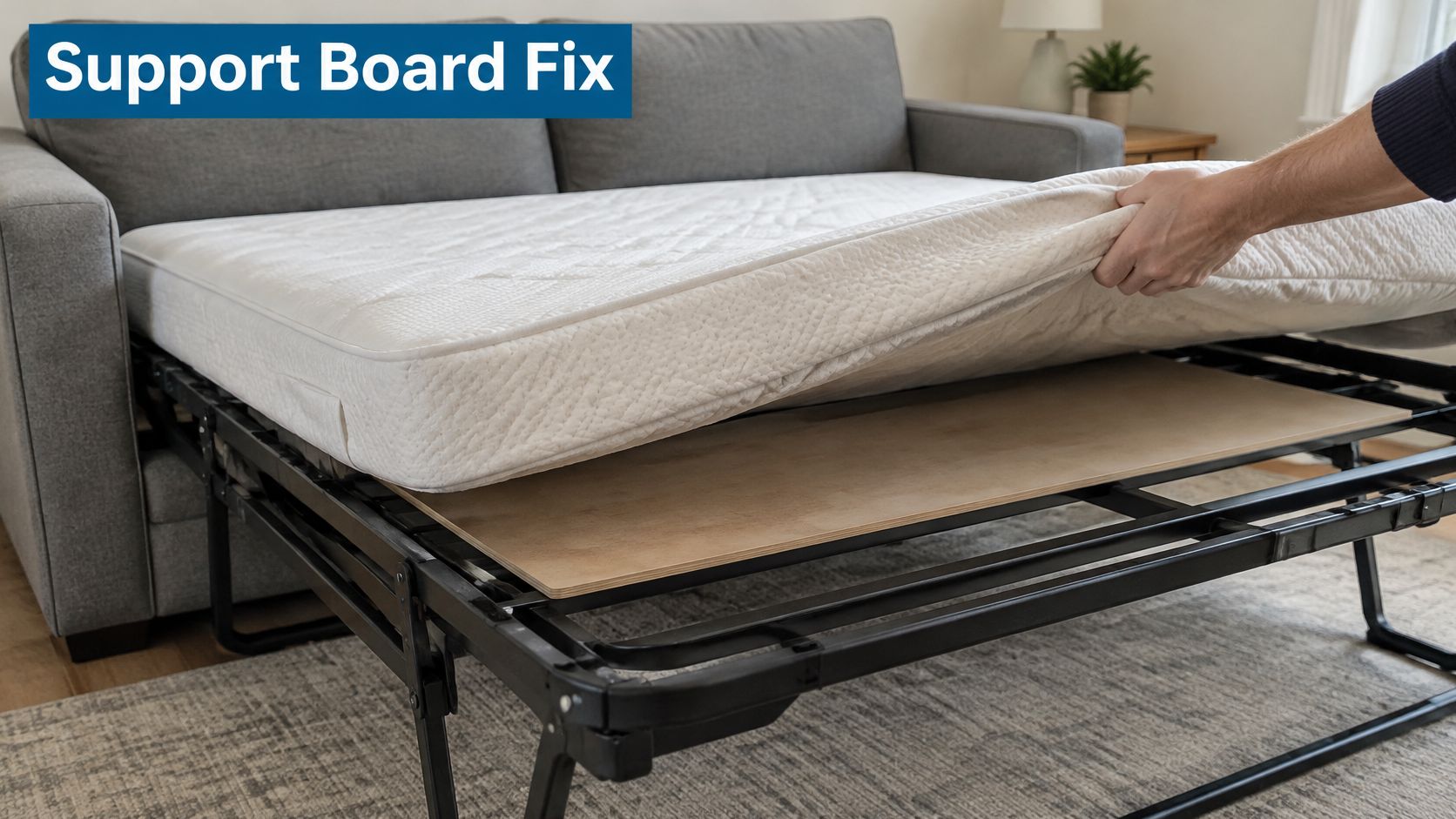
| Deck, slats, or bars | Gaps, broken slats, or bars felt through the mattress | Use a fitted support board only if folding and clearance stay free |
| Section heights | A step between head, body, and foot | Correct distortion before trying to hide it with padding |
| Seating proof versus mechanism | Firm to sit on, loose once folded | Ask for separate evidence on the conversion hardware |
A support component can spread weight across weak or widely spaced slats, reducing local bending. It cannot repair a failed hinge or a distorted mechanism.
For a sleeper used regularly, keep a short record of inspections, opening and closing cycles, and any changes you notice. That history helps track wear more clearly than a capacity claim alone.
Comfort Firmness and Mattress Fit
The most common advice for an uncomfortable sleeper is to buy a thicker mattress. Thickness adds padding and nothing else. An uneven or unstable support structure can compromise spinal alignment no matter how deep the foam is, a point independent commentary on sleeper sofas makes plainly, including in the Globe and Mail's guide to couch sitting and sofa-bed sleeping. The hardware under that mattress exists to fold, not to hold a body for eight hours a night.
What seating research says about sinking
Cornell University's ergonomics guidance gives numbers you can use. It recommends seat cushioning roughly 1.5 to 2 inches thick, arranged as a softer top layer at about 25% ILD over a firmer bottom layer at about 65% ILD, and notes that a ratio greater than 2.6 can provide better support, according to Cornell's ergonomics notes on sitting. The same guidance warns that excessive cushioning lets the body sink, restricts movement, reduces circulation, and increases compression beneath the thighs.
That's the mechanism behind a bad sleeper. If the deck, webbing, or springs flex underneath, a soft top layer bottoms out and your hips end up riding the frame. Sinking isn't a sign you need more foam. It's usually a sign the layer below the foam has given up.
Match the mattress to the deck
| Mattress type | Deck it needs | Gap or ridge risk |
|---|---|---|
| Memory foam | Flat continuous surface | Molds into gaps between bars |
| Latex | Flat continuous surface | Molds into gaps between bars |
| Hybrid | Flat continuous surface | Same gap risk as foam |
| Innerspring | Bridges small gaps | Telegraphs a high bar or section step |
Memory foam and latex take the shape of whatever is under them, so a set of bars becomes a set of ridges in the mattress by the second night. A hybrid behaves the same way because its comfort layer does the conforming. An innerspring can bridge a small gap on its own, but it still passes a high bar or a section step straight up into your back.
Know the worst gap and the worst step on your deck before you shop for a mattress. Those two conditions decide whether a soft mattress survives, and the closing clearance decides whether any added layer can stay in place at all.
Target, not maximum: controlled support restores a stable base. A rock-hard surface that turns the deck into a plank creates its own pressure points and can jam the fold.
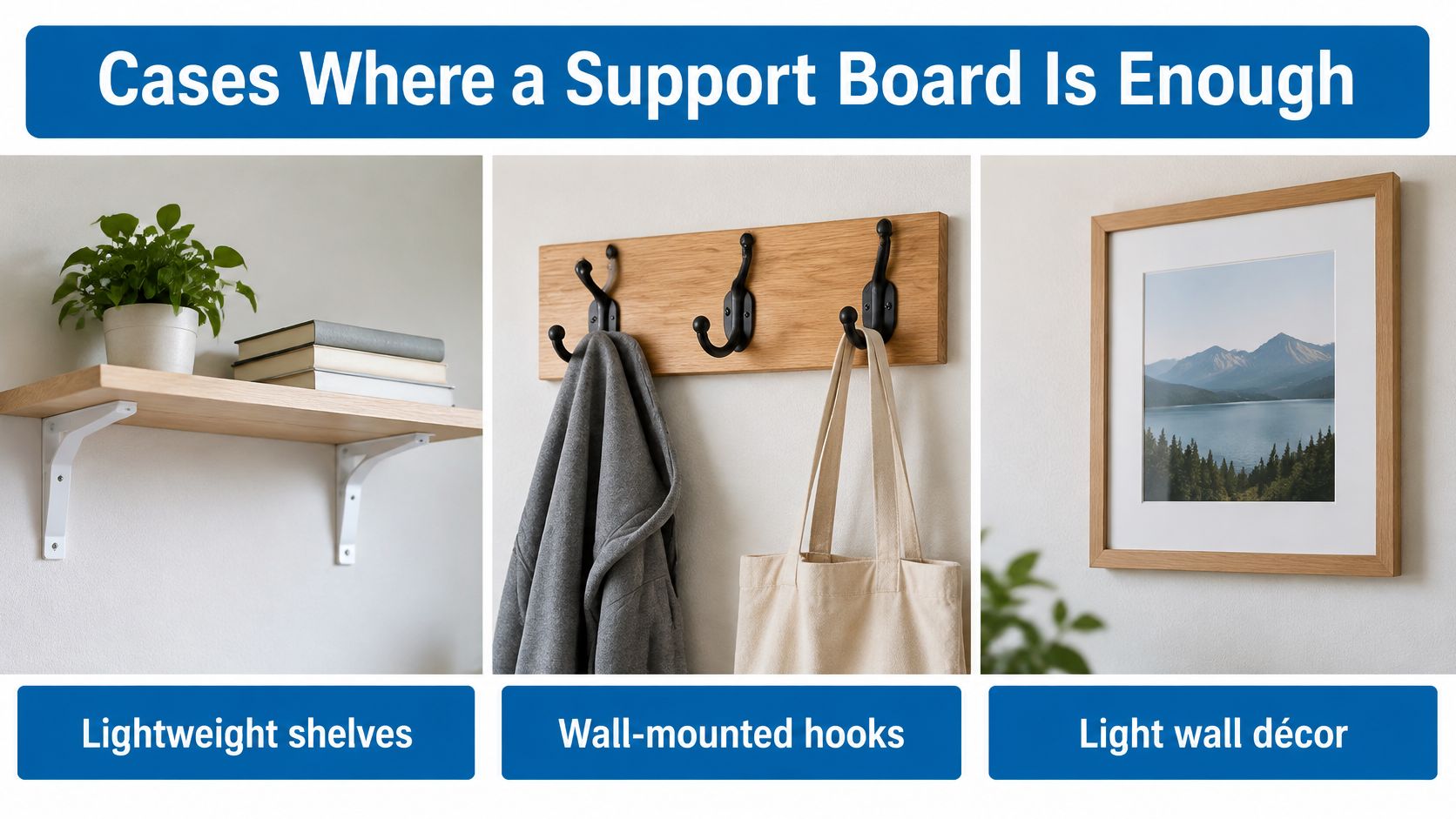
Cases Where a Support Board Is Enough
One question decides most of these. Is the mechanism sound with a weak deck, or is the mechanism itself failing? Four owners, four answers.
The renter with a standard pull-out. Bars come through a memory foam mattress, but the hinges lock cleanly and the sections sit level. A removable board laid on the frame under the mattress spreads the load with no screws and nothing permanent. Yes to a board.
The Airbnb queen used several nights a week. Same sound frame, different constraint. A board that lifts out will end up in a closet, so the support has to stay with the bed through folding and closing. Yes, if it collapses with the mechanism.
The futon with wide slats. If the mattress sags between slats, it needs a continuous layer rather than thicker stuffing. That only works while the side rails still hold the tilt and the frame isn't racked. Yes, conditionally.
The click-clack with a crushed seat. The frame is straight and the fold is clean, but the seat has lost its loft. That's a cushion-support problem, not a sleeper-deck problem. No board fixes it, and adding one wastes the money.
Where the answer turns into no
A bent foot section, a hinge that flops under load, a pinch point that catches fingers, or a board that stops the sofa closing fully. Any one of those ends the conversation, because the mechanism comes first and a support layer can't substitute for it.
Retrofitting also carries obligations that comfort guides rarely mention. Upholstered sofa beds fall under different flammability regimes by market: EN 1021-1 and EN 1021-2 testing in the EU, the Furniture and Furnishings (Fire) (Safety) Regulations in the UK, and 16 CFR Part 1640 in the US, which incorporates California TB 117-2013, as summarized in Eurofins' overview of flammability rules for bedding and upholstered furniture. UK trading guidance also requires that sofa beds, cushions, mattresses, and beds meet applicable flammability requirements and carry the required labeling.
Practical rules follow from that. Preserve mechanism clearance. Don't block vents or emergency egress. Follow the sofa maker's weight and opening instructions. Check local requirements before any permanent change, especially in hotels, vacation rentals, and furnished apartments.
A firmer surface is not a success if it hides a fire label or jams the fold.
Measure the Sleeper Before You Buy
Take five measurements with the bed open and the mattress off. Write them down, because a board that fits the sleeping width but fails the fold clearance is the wrong board no matter how good the material is.
- Sleeping width. Measure between the inside faces of the side bars or rails at the head, middle, and foot. If those three numbers disagree, the frame is out of square and that comes first.
- Unsupported span. Measure the gap between bars or slats the mattress will cross, and flag any spot wider than the rest. Your worst gap decides the thickness you need.
- Section step. Lay a straight edge across each joint and measure the height difference between head, body, and foot. A straight edge shows a step your hand misses.
- Fold clearance. Close the sofa with a sample board or a tape outline of its footprint in place. Confirm nothing pinches, jams, or blocks the hinges at any point in the travel.
- Ventilation and labels. Check that whatever you add leaves vents, emergency exits, and fire or care labels visible and readable.
Sizing is where most first purchases go wrong, and it's worth confirming the frame's own dimensions before you cut anything. Miller Waldrop's sleeper sofa sizing guide sets out how sleeper dimensions are specified, which helps you separate the mattress size from the frame footprint. Our own walkthrough of sleeper sofa dimensions covers the same ground for people measuring a room at the same time.
With numbers in hand, the choice narrows to two: a removable layer that lifts out, or a fixed support that stays with the frame. Fold clearance decides between them.
Decide Whether to Reinforce or Replace
Start with the mechanism check, not the cushion. If a section is bent, a lock won't engage, or the head end sits at a visibly different height than the foot, the mechanism is the problem. Padding over it hides a failure that gets worse with every use.
If the frame returns to its original shape and your complaint is bars, gaps, or a deck that flexes between supports, the sofa is sound and the surface is weak. That's a reinforcement job, and it's usually the cheapest repair in the house.
Match the support to how the bed is used. An occasional guest bed that has to stay unaltered suits a board that unfolds onto the frame with no tools and no permanent modifications, which is how the SleeperSaver Lite works. A deck that needs real stiffness calls for a heavy duty sofa bed support board like the SleeperSaver Classic. For nightly use or a short-term rental where nobody will reinstall anything, the SleeperSaver Pro sits between the sofa frame and the mattress and collapses together with the bed.
Then compare the cost of that support against replacing the sofa at local prices, because the gap is usually wider than people expect. If the reinforced deck comes out flat and the mattress is worn through, the mattress is your next purchase. If the mechanism is distorted and the mattress is finished, replacement is the honest answer.
A sagging sleeper is usually a sound sofa with a weak deck, and that's a fix, not a funeral. Meliusly builds sleeper sofa support boards and bunkie boards that sit between the frame and the mattress, spread weight across the bars, and turn a dip you can feel into a flat surface you can sleep on. Measure your frame with the bed open, match the support to how often the bed gets used, and visit Meliusly when you're ready to choose the board that fits.