

Lift Chair Recliners: How They Work and How to Choose
Posted by Meliusly
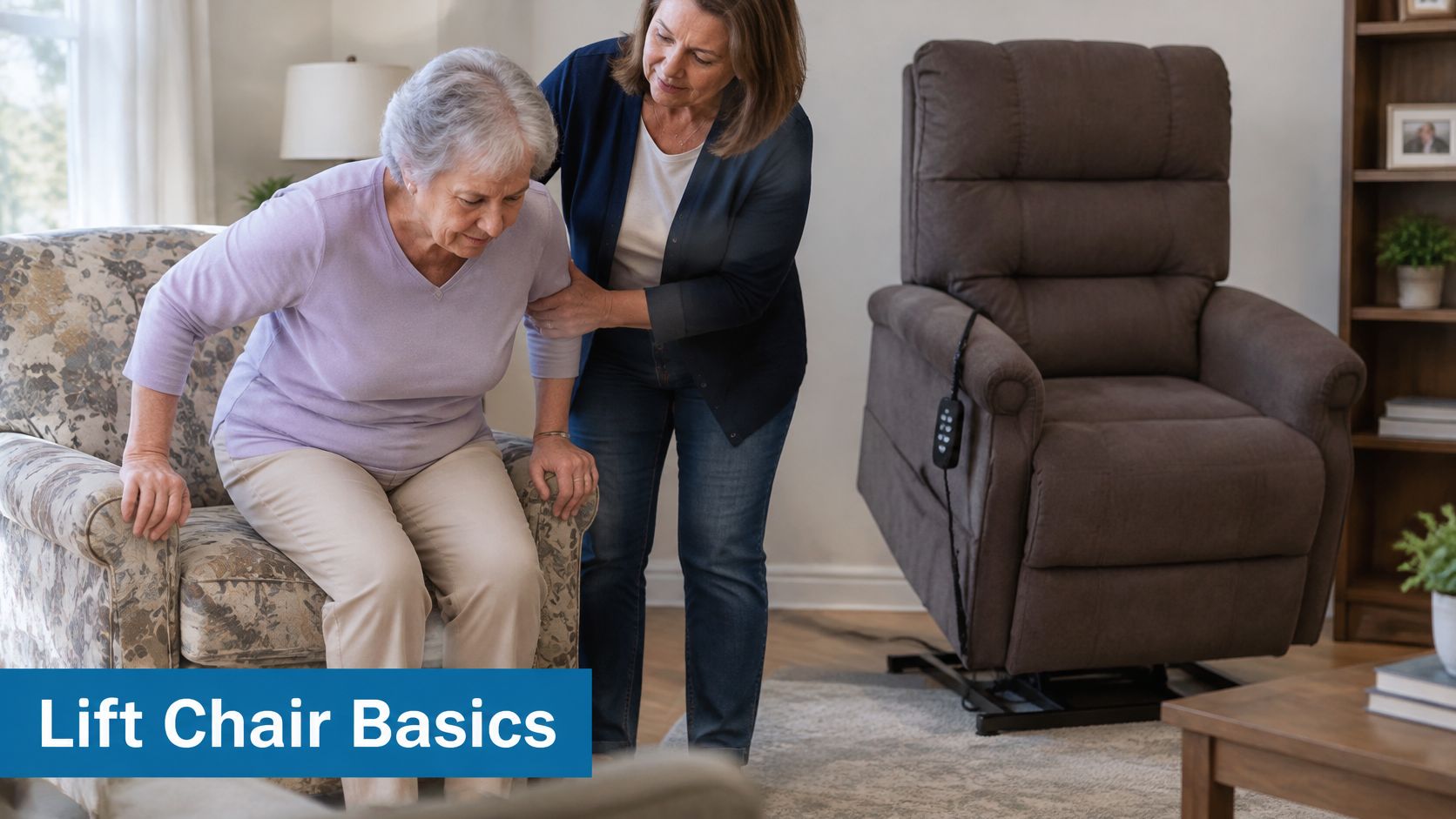
Your parent pushes against the armrests, rocks forward, then settles back into the seat. You're wondering whether the chair is too low or whether standing now requires more help. A lift chair recliner can assist with that transition, but choosing one means looking beyond soft cushions and a convenient remote. The user, the moving mechanism, the room and the power supply all need to work together.
What a Lift Chair Recliner Is and How It Differs
Say someone can walk around the living room but struggles to rise from a deep armchair. A firmer seat might improve their starting posture, yet it won't necessarily provide the assistance they need. A lift chair recliner adds a powered movement that raises and tilts the seat toward standing.
It combines a motorized lifting frame with recline actuators, allowing the user to command sitting, reclining and lifting movements through a hand control. Think of it as a recliner with a built-in ramp: instead of only changing the resting position, it raises the seated person toward their feet. It assists the transition; it doesn't establish balance or decide when the person is ready to step away.
More than a powered recliner
An ordinary powered recliner changes the backrest and leg-support positions. A lift model also moves the occupied seat through a controlled lifting path. The lifting frame and its linkage, not just a stronger motor, distinguish the two.
That distinction matters when diagnosing an uncomfortable chair. Sagging upholstery, an unsuitable seat height and difficulty standing are different problems. Buying a lifting mechanism to address worn seat support can be an expensive mismatch, while adding firmness won't solve a genuine need for powered standing assistance.
Start with the task: Does the person need better support while seated, assistance rising, or help transferring between surfaces?
Who needs to evaluate the chair
Homeowners managing their own mobility or a parent's needs should consider daily routines, not just showroom comfort. Caregivers need predictable movement and enough room to assist without reaching awkwardly around furniture. Operators furnishing seating for guests also need clear operating instructions and a way to assess whether an unfamiliar user can operate the chair safely.
A lift chair isn't a substitute for clinical patient-transfer equipment. If someone needs to be lifted between a bed and another surface, seek an individualized equipment assessment rather than assuming a reclining chair can perform that task.
The useful buying questions are straightforward: How is it built? Does it support the body throughout recline? Can this person use it safely and reliably in this room?
Lift Chair Configurations Compared by Motors and Movement
A chair that raises the legs while holding the torso upright suits a different user than one where the backrest and footrest always travel together. Motor count and linkage decide which movement combinations a chair can offer.
Lift chair configurations and what each one changes
| Configuration | Motor or actuator setup | Backrest and footrest movement | Base |
|---|---|---|---|
| Single synchronized actuator | One drive motor | Linked; both follow one motion path | Fixed |
| Dual actuator | Two actuators | Independent; each adjusts separately | Fixed |
| Dual motor, separate lift and recline | Two motors, one per function | Varies by design; the label doesn't guarantee independent control | Fixed |
| Powered swivel-base lift recliner | Powered swivel drive plus a recline mechanism | Determined by the paired recline mechanism | Powered swivel |
These descriptions aren't interchangeable product grades. The power-operated-chair patent record documents linked multifunction mechanisms, separately controlled lift and recline arrangements, and powered swivel designs, which is why a motor count alone can't describe everything a chair can do.
A single synchronized mechanism suits someone comfortable with the backrest and footrest following a shared motion path. It also offers the simplest control scheme, which matters for a user who gets confused by multiple buttons. The limit appears when the user wants leg elevation at a backrest angle the linkage doesn't offer.
A dual-actuator chair suits someone who wants leg elevation while keeping the torso more upright, for instance a user managing daytime leg swelling who still needs to sit alert. Independent adjustment gives more posture choices, and it also gives a caregiver more to manage: more combinations, and more chances of the chair being left in an unusual position between uses.
A dual-motor chair with separate lift and recline assigns one motor to each function. That label doesn't by itself establish independent backrest and footrest control, so have the seller demonstrate precisely what each button moves.
A powered swivel-base model can help someone turn toward conversation or toward a walker positioned at their side. I treat any powered swivel as a fall-risk check first and a convenience second: confirm how firmly the base resists unwanted rotation during entry, lifting and exit, since a seat that can turn is a seat that can shift under someone mid-transfer.
Compare movements, not marketing labels
Position labels such as two-position, three-position or infinite-position tell you less than a demonstration with the intended user in the seat. Have the person reach the posture they need, hold it, and return to seated or standing without confusion.
The working check is the same for each row in the table: sit in the chair, run every control, and watch what moves. Swivel capability can't be judged from a chair's appearance, and separate lift and recline motors don't guarantee every adjustment combination.
For comfort additions once the mechanism is chosen, our guide to recliner chair accessories covers the options. Accessories can improve a well-chosen chair; they can't supply a movement the mechanism doesn't produce. Confirm the required control and movement first, then assess comfort, safe operation and power arrangements.
How the Lift and Recline Mechanism Works
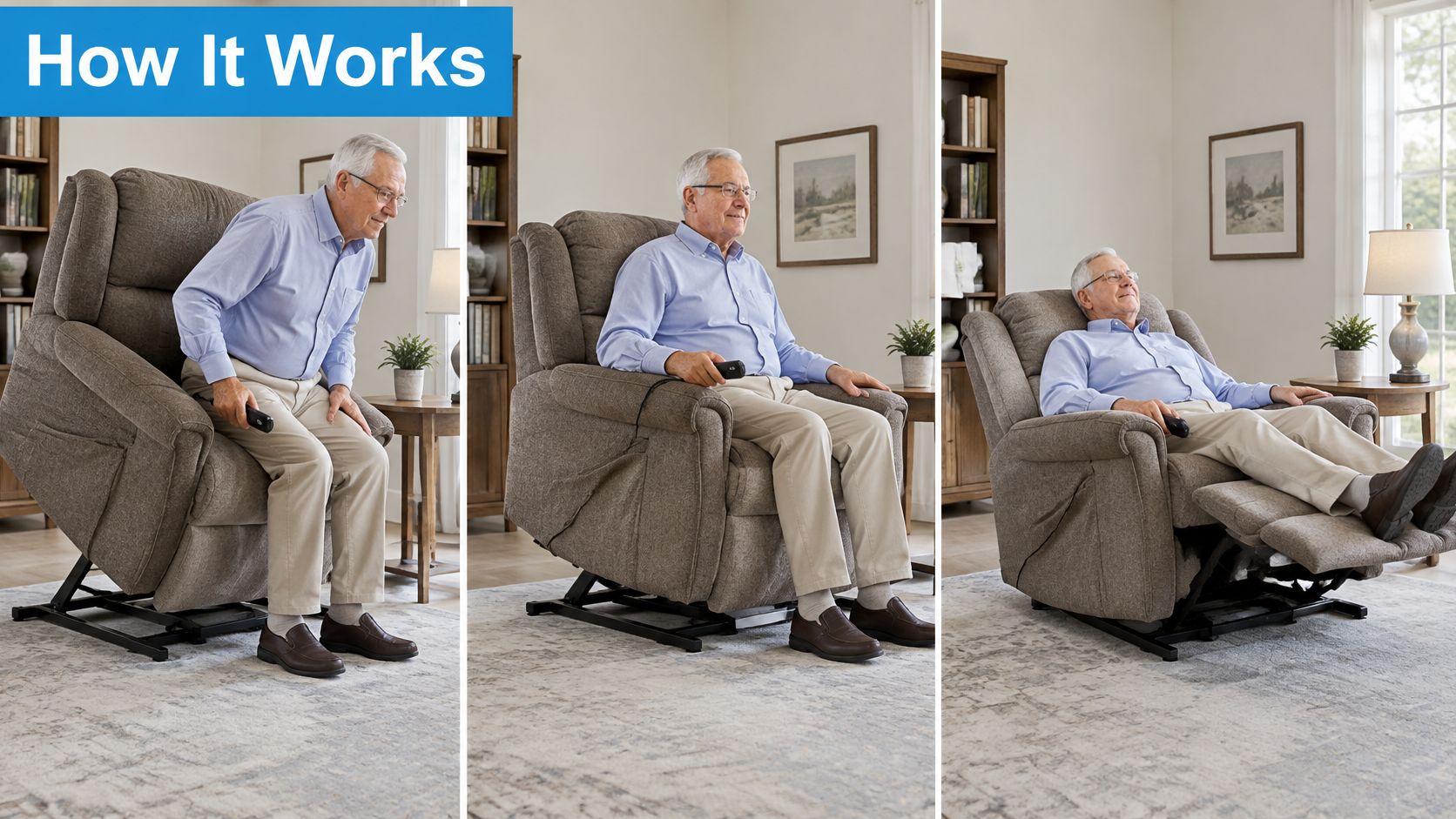
Pressing the hand control sends a command to the powered mechanism. An actuator converts motor rotation into controlled movement, and the connected frame or linkage changes the chair's position. The user experiences a moving seat, backrest or footrest rather than the mechanism underneath.
A representative design described in an FDA device submission uses welded-steel construction, converts household AC input into low-voltage DC motor power, and uses a hand control for lift and recline commands. That's an example of the architecture, not a specification that should be assumed for every chair.
Follow the load through the chair
During lifting, the frame carries the occupied seat upward and forward through its designed travel. The structural load passes through the lifting frame into the base, rather than relying on upholstery to hold the user in position.
When the command ends and the mechanism settles, the chair should feel supported, not perched on an uneven corner. A level base matters because uneven floor contact can introduce rocking and uneven frame loading during elevation.
Independent backrest and footrest actuation allows finer posture adjustment because changing one support doesn't necessarily force the other to follow. The practical benefit is reduced compromise between torso angle and leg elevation, rather than a longer feature list.
Checks that reveal more than upholstery does
Before buying, inspect the technical information and watch the occupied chair move:
- Actuator arrangement: Match the specification sheet to the motions demonstrated by the seller.
- Rated user capacity: Obtain the exact model's rating rather than relying on a general product-family description.
- Cycle reliability: Ask whether durability testing is documented, what it covers and whether replacement actuators remain available.
- Stability throughout travel: Watch for rocking, uneven lifting or a base that loses consistent floor contact.
Don't confuse a brief demonstration with proof of long-term reliability. It can reveal poor setup or an obvious movement problem, but it can't establish service life. Keep the model identification, operating manual and electrical-component details with the household's care information so future troubleshooting starts with the correct equipment.
Comfort and Posture Across Recline Positions
Reclining changes where the chair supports your body. Upright sitting concentrates support beneath the sitting bones, while reclining transfers meaningful support toward the lower and upper back, as described in Herman Miller's pressure-distribution white paper.
That's why extra-soft padding isn't a reliable answer to every discomfort. As the backrest angle changes, the chair needs to maintain contact with the torso and accommodate changing spinal curvature. A gap behind the lower back can leave the user slumped or concentrating pressure elsewhere.
Judge support through movement
A suitable lift recliner provides continuous back support, a seat depth that doesn't press excessively behind the knees, and enough footrest length to support the lower legs without pushing the pelvis forward. Our explanation of seat-depth ergonomics can help distinguish a supportive seat from one that feels spacious.
The seat-back movement path matters too. A well-matched mechanism preserves body contact as the user reclines; a poorly matched pivot can let the body slide relative to the upholstery, creating shear or losing lumbar support.
A chair that feels comfortable while upright hasn't passed a recline test.
Use the three-position test
- Sit upright. Check contact at the lower back and upper back, support beneath the thighs, and the position of the feet. Notice whether the user must scoot forward to sit naturally.
- Stop at an intermediate recline. Repeat those checks while the chair supports the legs, watching whether the pelvis slides or the torso loses contact with the backrest.
- Recline fully within the intended operating range. Check again, paying particular attention to a lumbar gap, pressure behind the knees and unsupported lower legs.
Perform the test in a showroom or during an agreed home evaluation before committing. Wear the footwear normally used at home, and let the intended user operate the controls where possible.
If discomfort appears only during movement, don't judge the chair solely by its final resting position. Ask for another demonstration and identify when support changes. Adding loose cushions immediately can hide a poor fit and alter the person's position relative to the armrests and controls.
Pinch Points, Capacity and Fall Risk Checks
A lift chair isn't automatically safe because it looks like familiar living-room furniture. Beneath the upholstery, powered scissor and lifting mechanisms create pinch and crush hazards. The Pride Mobility lift-chair owner's manual directs users to keep clear of these mechanisms and check maximum capacity in the model-specific appendix.
Keep hands, feet, pets, blankets and objects away from the underside, and leave the entire movement path unobstructed. The space beneath the chair isn't storage, even when an item appears to fit while the chair is stationary.
Capacity is a model-specific limit
Compare the user's weight with the exact rating in the manual. A wide seat, substantial upholstery or heavy-looking base doesn't establish how much load the lifting mechanism is rated to carry. Exceeding the rating places loads on the assembly beyond its stated limit.
No cushion, board or support accessory may obstruct the lift path or substitute for compliance with that limit. If an addition changes seat height or foot contact, it also changes the starting conditions for standing.
Assess the person as carefully as the mechanism
The College of Occupational Therapists of Ontario's response to a coroner's report describes three fatal cases involving older adults with cognitive decline who raised their chairs using the remote, then fell while attempting to stand. The chairs came from different manufacturers, indicating that brand selection alone doesn't address the risk.
Remote access, obstacles, judgment, transfer technique and supervision all deserve attention. Use this protocol with the user and care team:
- Assess standing ability without provoking an unsafe attempt. Establish whether the person can safely initiate standing without powered help through observation and professional assessment, not an unsupported test.
- Restrict or supervise remote access when necessary. Ask whether the exact model offers an appropriate control lockout, and agree who will operate it.
- Clear the path in front. Remove footstools, loose objects and other barriers, leaving room for the person and any prescribed walking aid.
- Review transfer technique. Have an occupational therapist or other qualified clinician assess foot placement, stopping height, timing and caregiver assistance.
Care-environment rule: If the user can raise the chair but can't reliably judge when or how to stand, independent remote operation needs reassessment.
Arrange an occupational-therapy home assessment when cognition, balance or transfer ability changes. A familiar chair doesn't remain suitable automatically as the person's needs evolve.
Backup Power and Outage Behavior
A built-in battery doesn't guarantee full operation during an outage. The La-Z-Boy operating manual describes limited backup functions and warns that the supplied system may not achieve full elevation.
Outage functions and what to verify
| Backup function | Behavior on referenced models | What to verify |
|---|---|---|
| Return from reclined to home position | Supported | Confirm that your model's battery covers this return |
| Lift or lower the chair once | Supported as an emergency movement, not a universal performance guarantee | Test the permitted movement with main power off in a safe, clear space |
| Multiple lifts or repeated reclining | May need a separately purchased backup | Ask whether a backup system is sold for your model |
| Reaching the fully raised position | May not reach full elevation | Don't assume full lift during an outage |
| Battery type and location | Some models use replaceable batteries in the external transformer | Check battery count, location and replacement schedule |
Some models use two 9-volt batteries installed in the external transformer, not supplied with the chair, according to a Pride Mobility operating manual. That manual describes emergency return to an upright or semi-upright position rather than normal extended use.
Treat the battery as safety equipment
A chair can operate normally from the outlet while having no usable outage protection. Check that the required batteries are installed, and maintain them according to the exact manual rather than assuming household power keeps every backup charged.
For rechargeable or aftermarket packs, compatibility requires more than a matching plug. Confirm the model approval, voltage, connector and charging requirements before purchase.
- Charging location: Use a ventilated location permitted by the manufacturer, away from upholstery and covered spaces.
- Condition: Inspect for swelling, unusual heat, damaged wiring or charging failures.
- Cable routing: Keep wiring out of walkways and moving mechanisms; don't chain extension cords.
- Abnormal operation: Stop using a suspect pack. If it smokes or ignites, move away and contact emergency services rather than handling it.
Check recalls and rehearse the permitted return
The CPSC's 2026 Blue Cactus battery-pack recall covers fire and burn hazards and reports four incidents involving overheating, smoke or ignition. Check the battery's identification against official recall information, including replacement packs.
Periodically test the manufacturer-permitted backup movement with mains power disconnected, a clear surrounding space and assistance available. Position the chair so a failed cord or exhausted backup won't prevent someone from reaching the user, and agree on how help will be summoned.
Confirm Fit, Safety and Coverage Before You Buy
A lift chair that looks right on the showroom floor can still fail at home. The backrest hits a wall at full recline, the seat edge crowds a walker, or the only reachable outlet forces a cord across a walkway. Bring a tape measure, the user's requirements and a written list of the functions that matter, then compare chairs against that list before comparing discounts.
Complete the buying checks in order
- Measure the room through the full movement envelope. Allow the manufacturer's required clearance behind the backrest and in front of the lifting seat, plus working room for a caregiver and a walking aid, so the chair never presses a wall or blocks the exit route.
- Map the power connection. Confirm a suitable outlet is within reach and plan a cord path that stays out of traffic, because a chair that fits physically can still force an unsafe electrical layout.
- Match the user to the exact rated capacity. Record the model number and its documented limit. The rating printed on a similar-looking chair does not carry over.
- Test upright, intermediate and fully reclined positions before buying. Have the intended user run the controls and perform their normal sit-to-stand in each position, because showroom appearance cannot establish personal fit.
- Get the outage behavior in writing. Ask the seller to document what the occupied chair does when mains power drops and which power components the model accepts. A verbal promise of backup answers neither question.
- Check Medicare eligibility before budgeting around reimbursement. Under Medicare's seat-lift coverage rule, coverage may apply when a physician prescribes a therapeutically beneficial mechanism for severe hip or knee arthritis, muscular dystrophy or another neuromuscular disease, and the beneficiary is completely unable to stand from a regular armchair or another chair in the home but can walk independently or with an aid after standing.
For that coverage, the mechanism must operate smoothly, be user-controllable and assist standing and sitting without help. Sudden, catapult-like spring-release systems are excluded, and payment for a combined lift-and-recline chair is limited to the amount payable for the lift mechanism, not the additional reclining feature.
Separate comfort guidance from transfer suitability
Comfort advice and transfer assessment answer different questions. Woodstock Furniture's guide to recliner comfort covers general seating preferences, and our guide to furniture for elderly users adds the household perspective. A chair can feel comfortable in a five-minute trial and still be wrong for a user who depends on the lift to stand safely.
Request the model specification sheet from the seller before comparing prices. Ask for the operating manual alongside it, and hold off committing until the movement configuration, room fit, rated capacity, outage arrangements and user controls are all confirmed on paper.
Meliusly designs furniture-support products, including sofa cushion support boards, sleeper sofa support boards, bunkie boards and bed slats. If the problem is sagging support rather than powered transfer assistance, visit Meliusly to explore practical ways to extend your furniture's life, and confirm manufacturer clearance before adding any support to a moving lift chair.