

High Seat Sofa Guide: Height, Comfort and Fit
Posted by Meliusly
What is the one number a sofa listing almost never gives you? Not the width, not the depth, not the price. It's the height of the seat once a body is on it. Every other dimension on the spec sheet stays put, while seat height drops the moment someone sits down, because foam compresses and the figure printed in the listing describes the sofa before that happens.
That gap explains why two people can share a couch and disagree about whether it's comfortable. The U.S. sofa market generated USD 62,466.9 million in revenue in 2025, according to Grand View Research, and most of those purchases get decided on style, fabric and depth. Almost none get decided on the measurement that determines how hard it is to stand up.
Seat height isn't a style preference. It's a body-fit measurement, taken on the cushion under load. What follows is how to read the numbers, understand what a high seat sofa is, and fix the right layer when the height goes missing.
How High a High Seat Sofa Should Be
A high seat sofa is one whose seat sits above ordinary sofa height, so the body starts the standing movement from a higher position. That's the entire definition. How much higher, where the extra height comes from, and whether it suits a particular person all come down to numbers you can measure on the furniture itself.
The baseline is well documented. A typical living-room sofa seat height is 16 to 18 inches, about 41 to 46 cm, according to HomeStyler's 2024 sofa-design guidance. Chair seats usually run a touch higher at 40 to 45 cm, while a comparative review of furniture dimensions puts a conventional sofa seat at about 42 cm and traces a long climb from the roughly 37 to 40 cm seats of the 16th and 17th centuries to the 45 to 50 cm furniture sold today. Seating has been rising for centuries because people prefer furniture that lets them leave.
For anyone who finds standing a struggle, the target sits higher than the standard, and it has to be measured in the right place. A cushion sinks under a body, so a frame that looks generous on paper can put you almost back at standard height once you're on it. Compressed cushion height is the number that decides what your hips, knees and feet do.
| Seat type | Typical height | How to use it |
|---|---|---|
| Standard living-room sofa | 16 to 18 in (about 41 to 46 cm) | Baseline for ordinary seating |
| Typical chair seat | 40 to 45 cm | Comparison for a higher sofa seat |
| High seat working range, compressed cushion | 430 to 470 mm | Target for users who need extra help rising |
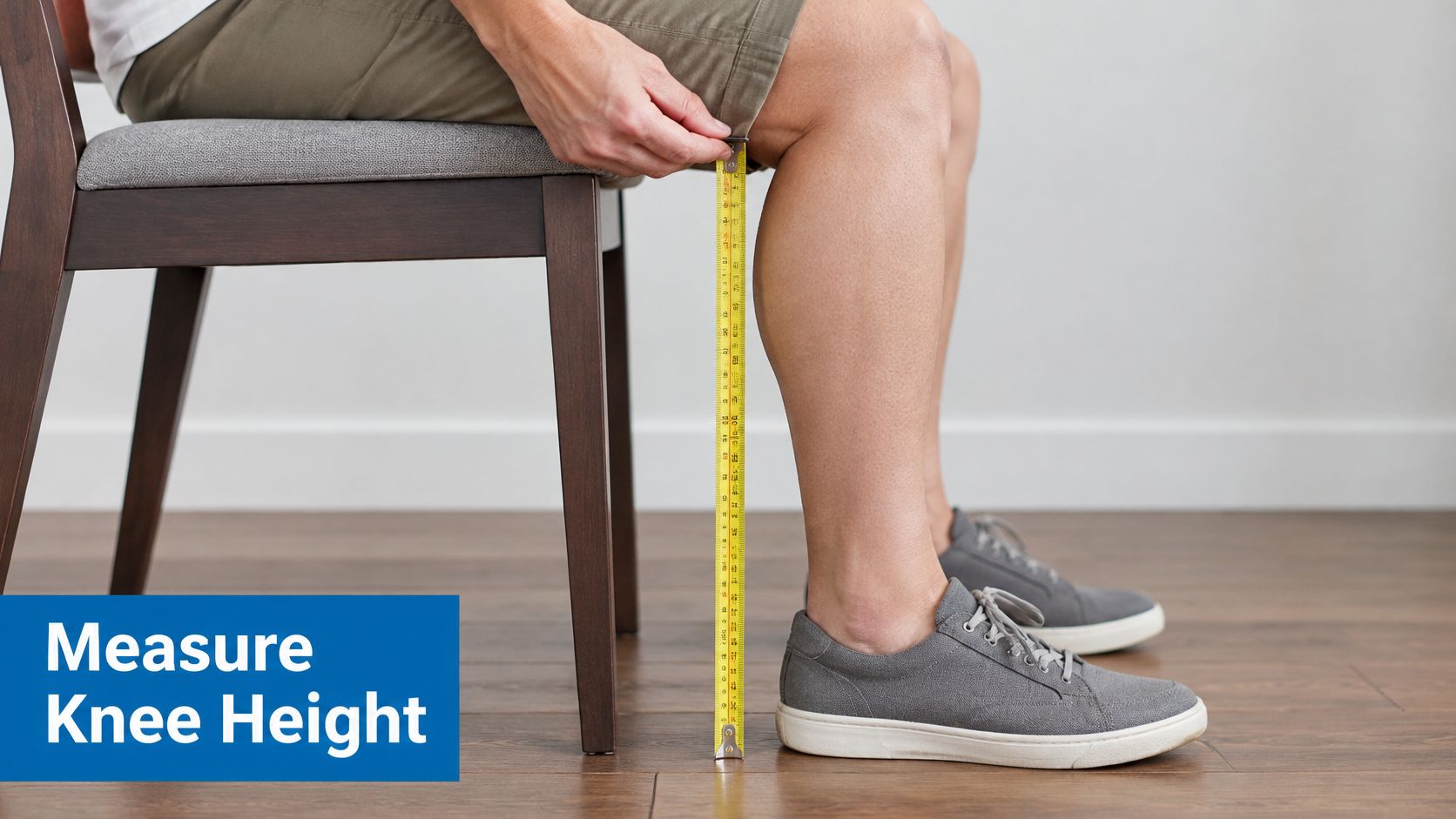
The second number you need is personal. Seat height matches the vertical distance from the floor to the underside of your knee, not a universal specification, and that measurement takes about a minute with a tape and a firm chair.
Rule of thumb: if a sofa measures below 430 mm at the top of the compressed cushion and standing up takes real effort, treat it as low seating that needs attention rather than a sofa you have to live with.
Features That Set a High Seat Sofa Apart
A high seat sofa behaves a little like a dining chair. Sit down and stand up on a dining chair and the movement is brief: your hips start close to knee height, your feet stay planted, and there's very little travel between the two positions. A deep, low lounge sofa asks for a different sequence, a forward slide, a bigger push, and often a hand on the arm to finish the job.
The reference point for every feature below is your own knee height, taken like this.
Seat height is measured from the floor to the top of the cushion, not to the sofa's frame. The distance between those two figures is the foam that disappears when you sit, and it's often the whole argument in a sofa that felt fine in a showroom.
Seat depth is the run from the front edge of the cushion to the back. A deep seat pushes your hips rearward, which moves your knees further from the front edge and lengthens the push. Pair a deep seat with a low one and you've built the hardest possible arrangement for standing.
Cushion firmness decides how much of the stated height survives. Soft foam gives way within seconds of a body landing on it, while a firm cushion holds its shape and keeps your hips near the height the manufacturer advertised.
Backrest angle sets your starting position. A backward-sloped back leans you away from your feet, so standing begins with a swing forward before any upward force happens.
Arm height gives you something to push against. An arm you can reach without leaning sideways turns a difficult rise into a two-second movement.
Under all five sits the structure. Decking, springs and webbing set the baseline, and no cushion can hold a height the foundation underneath no longer provides.
What a listing usually leaves out
Sofas and couches accounted for 21.8% of the global furniture market in 2025, according to Straits Research, yet most product pages publish an uncompressed frame height and nothing else. Ask for five things instead: the stated seat height, the compressed height if the seller has it, a description of cushion firmness, the arm height measured from the top of the seat, and the foundation type, whether sinuous springs, webbing or a solid deck.
How to Check a Sofa's Seat Height Against Your Body
Seat height is a fit measurement, so no single specification suits everyone. The dimension to match is your popliteal height, the vertical distance from the floor to the underside of the knee, which seating research treats as the reference point for seat height rather than a universal number, as a peer-reviewed review of seating research sets out. Take it once and you can judge any sofa in any showroom.
Here's the full sequence, with the reason behind each measurement.

- Measure your popliteal height. Sit in a firm chair with your feet flat and your back against the backrest. Run a tape from the floor to the underside of your knee, at the crease behind the kneecap. You're looking for the height where your feet stay flat without your thighs tipping up or your toes reaching for the ground.
- Measure the sofa on the cushion. Have someone sit on the seat for a minute, then measure from the floor to the top of the cushion where your hips land. Foam recovers slowly, so a cold cushion overstates the height you'll sit at.
- Compare the two numbers. The best combination of comfort and pressure uniformity in a study of 20 adults aged 61 to 70 came at a seat height equal to popliteal height or up to 25 mm below it, paired with a backrest angle near 105 degrees. A separate dimensional analysis puts the seat about 30 to 50 mm below the knee bend. Depth matters here too, because a deep seat changes how far you lean before you can push, and seat depth ergonomics covers that trade-off.
- Check the target range for rising. For anyone who needs extra help getting up, aim for a compressed cushion height of about 430 to 470 mm. The same review identifies roughly 430 mm as optimal for some older users and 470 mm when a footrest is provided.
- Add a footrest if the seat has to sit above the knee. A high seat that leaves your feet without floor contact removes the base you push from, so the extra height stops helping.
- Press the centre of the cushion with a flat hand. If it sinks fast and your hips drop well below your knees when you sit, firmness is the problem and the frame may be perfectly sound.
- Decide what you're dealing with. Inside the range and easy to leave, keep the sofa. A few centimetres low, restore the support. Far below and hard to rise from, plan for a higher seat or a different piece.
Whatever a seller quotes, ask whether the figure is compressed or raw frame height. Only one of them describes the seat you'll sit on.
How Seat Height Changes the Effort of Standing Up
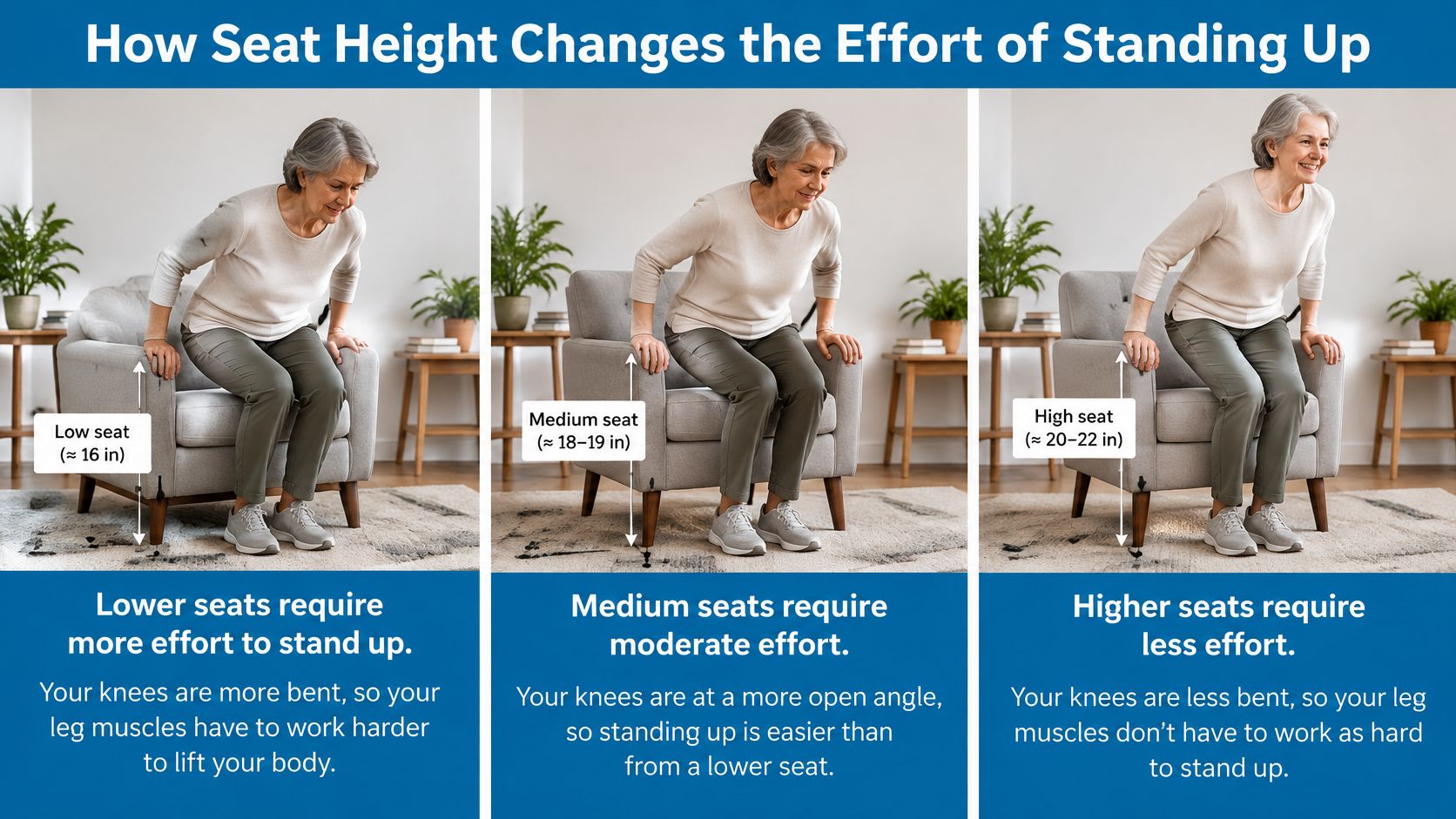
Standing up carries a measurable cost, and seat height changes how that cost is paid.
In a controlled study of 27 healthy older adults tested from three seat heights, researchers publishing in Sensors found that lower seats produced a significantly larger angular range during the standing motion (p = 0.003), and participants with weaker handgrip strength used a greater angular range again (p < 0.001). Total sit-to-stand duration didn't differ significantly by seat height (p = 0.097). The extension phase, the push itself, tended to take longer from lower seats, and for participants with lower handgrip strength that effect was significant (p = 0.003).
A second controlled comparison of 10 older and 10 younger adults found that normal-height seating produced greater hip and knee flexion moments, larger peak joint angles, and higher peak and integrated muscle activity than raised seating, as reported in the study's analysis of sit-to-stand transfers. Older adults already showed 27% to 125% greater activation across most measured muscles than the younger group. Raising the seat reduced the demand on the lower limbs and the muscle work required.
The difference isn't a feeling. It's a change in how much joint movement and muscle activity the task demands.
What this means on an actual sofa
Neither study tested sofas, so the translation is an inference rather than a measured result. It's a well-grounded one. A sofa typically combines a low seat with a backward slope and a soft, compliant cushion, and the same research team noted that low-seat standing commonly happens when people rise from sofas. Put those conditions together and the push phase gets longer while the starting position gets worse.
A test you can run today: stand from your sofa three times without using your arms. If the second and third repetitions feel harder than the first, or you find yourself rocking forward to build momentum, the seat is asking more of you than it should.
For anyone weighing options, a powered lift mechanism is one route, and recliner chairs that help you stand explains how those compare with a simple change in seat height. Restoring the height of an existing sofa is the cheaper experiment, and it's reversible.
Who Gets the Most Benefit From a Higher Seat
A daughter watches her father push twice before he clears the couch. He's been on the same sofa for a decade, nothing has broken, and the seat has compressed. The household has two options: buy a higher seat, or put back the height the current one has lost.
Older adults in multigenerational homes are the largest group facing this. One sofa works for a 30-year-old and fails a 78-year-old, and the fix has to serve both without turning the living room into a waiting room.
Caregivers who help someone rise several times a day need a seat that behaves the same way every time. A cushion that bottoms out unpredictably turns a routine transfer into a two-person job.
People with reduced lower-limb strength, including those following medical advice after a knee or hip problem, should check their specific needs with their clinician before changing furniture height. General fit rules point in a direction; a clinician knows the individual case.
Tall adults meet a different version of the problem. On a low, deep sofa their knees finish above their hips, so standing starts from behind the feet rather than over them.
Here's the arithmetic that turns a vague complaint into a decision. Say a couch's cushion has compressed to about 380 mm, and the person using it has a popliteal height of 450 mm. That puts the seat about 70 mm below the knee, well beyond the 25 mm tolerance a good fit allows. The gap is the number to act on, and it doesn't automatically mean a new sofa. It means restoring cushion support or adding height until the seat lands near the knee again.
Measure one person and one sofa in your own household, then set the two numbers side by side. The pattern above is the one most sagging couches follow.
Why a High Seat Sofa Loses Height and How to Fix It
A sofa seat can lose height in three different layers: the cushion, the deck or springs beneath it, and the frame that holds everything together. Finding the failing layer first helps you choose a repair that restores support instead of masking the problem.
Upholstered furniture durability tests apply repeated loads to seats and assess changes such as indentation, height loss and firmness. These effects can feel like the same kind of sagging, but they point to different causes.
Diagnose in this order
- Compare the cushions. Look for a dip where someone usually sits. Compare that cushion with one that gets less use, such as a cushion at the end of a loveseat.
- Inspect the deck. Remove the cushions, press the deck and look underneath for sagging webbing, a bent or detached spring, or a cracked support rail.
- Check the frame. Rock the sofa gently from one corner. If movement travels through the whole piece, a joint or frame may be the problem.
Each layer needs its own fix. Foam that has lost resilience may stay indented even when you press it flat. If the deck has dropped, new foam will sink along with it.
| Symptom | Likely cause | Fix |
|---|---|---|
| Seat dips a few centimetres after months of use | Foam or cushion has lost resilience | Replace the cushion or add a firmer support layer |
| Cushions look full but the seat feels low | Deck or springs sagging underneath | Inspect the foundation and reinforce it with a support board |
| One side sinks or squeaks | Uneven loading, broken spring or joint | Repair the failed component before adding support |
| Seat feels soft and hard to rise from | Firmness lost under load | Fit a firmer cushion or board, then retest the height |
| Frame cracked, mechanism unsafe or mould present | Structural or contamination damage | Replace the piece, since reinforcement isn't enough |
Repeated, uneven pressure can strain springs and frame joints. The Purdue Extension guide to upholstered furniture testing describes cyclic seat tests and lists broken springs and structural frame failures among possible failure points. If the deck is sound but the seat has lost height, a support board can spread the load across the frame. Check the seat height again after fitting it.
For cushion foam and wrap, revive a sinking luxury sofa explains the cushion work, while this guide to fixing sagging sofa cushions covers support beneath them.
A cracked frame, unsafe mechanism or mould calls for replacement. Added support cannot make a damaged structure safe.
Choose the Right Seat Height Before You Buy or Repair
Three outcomes, one decision rule. Measure the compressed seat height, compare it with popliteal height, and let that comparison decide what you spend.
Keep the sofa if the compressed height lands within range and standing feels easy. Nothing needs fixing, and the measurement you took becomes your reference for next time.
Restore the support if the seat is a few centimetres low, the frame is sound, and the cushion or deck has lost height or firmness. Our Heavy Duty Sofa Cushion Support Board is built for exactly this job, a couch support for sagging cushions, and it's currently on sale at $29.99. Fit it, then recheck the height against your popliteal measurement instead of trusting the first impression.
Replace the piece if the frame is cracked, the mechanism is unsafe, mould is present, or the structure has failed. Repair doesn't solve those problems, and it can leave something dangerous in the room.
The repair-first instinct has a measurable basis. A peer-reviewed life-cycle study of 25 furniture pieces found the pre-production stage created the largest environmental impact in every case, ranging from 42.25% to 99.98% of total impact and averaging 76%. Extending the life of a frame avoids repeating that stage. It doesn't make every repair worthwhile, since a failed structure or a health hazard still justifies replacement.
Judge the result the way a durability test would. The U.S. General Services Administration upholstered furniture test method applies force at 20 cycles per minute for 25,000 cycles at each level, increasing the load until the product reaches its target or a component fails, which is a reminder that a fix only works if it restores stable load distribution across the seat foundation. A cushion that sits higher for a week and then sinks again hasn't fixed anything.
Measure popliteal height and compressed cushion height today, write both numbers down, and compare them with the reference figures before you buy a replacement or order a part.
Meliusly designs the support layer that puts a low seat back where your knees need it, from heavy duty sofa cushion support boards to sleeper sofa boards, bunkie boards and bed slats, each built to restore height and spread load across the frame rather than propping up one spot. If your sofa measured short, take the number with you and match it to the right support instead of shopping for a replacement. Visit Meliusly to find the board that fits your sofa, chair or sleeper.
Share this post
- Tags: high seat sofa, sagging sofa cushions, sit to stand sofa, sofa seat height, sofa support board