

Chair Cushion Support Straps: How to Choose and Fit Them
Posted by Meliusly
The cushion on your kitchen chair slides forward every time you stand. You shove it back, sit down, and twenty minutes later it's creeping toward the front edge again, leaving a gap at the back where the seat dips under you. Or the cushion stays put but the middle has gone soft, so you feel the frame through it. Both are fixable with a few dollars of webbing and an hour of your time.
Chair cushion support straps are the cheapest tool in that repair. They hold a cushion where it belongs and spread load across the seat instead of letting it pool in one spot. They aren't a cure for a broken chair, and they aren't automatically a safety upgrade for a frail user. The order matters: check the frame, fit the strap, then check how the finished seat works for the person sitting in it.
Movement in furniture is worth taking seriously. The U.S. Consumer Product Safety Commission estimated that hospital emergency departments treated an average of 17,800 people a year for furniture, television and appliance tip-over injuries during 2020–2022, per its 2023 annual tip-over report. A sliding cushion isn't a tip-over, but the instinct is the same one: deal with the movement before someone leans hard on it.
Strap Types Compared at a Glance
Chair cushion support straps are a low-cost retrofit. They keep a loose or sagging cushion aligned and spread its load across the seat. They only do that job when the frame rails underneath are sound. Three materials cover almost everything sold, and they feel very different under a sitter.
| Chair cushion support strap types compared | |||
|---|---|---|---|
| Strap type | Typical width | Stretch and feel | Best fit |
| Jute webbing | About 90 mm (3.5 in) | Firmer, steady tension | Sound rails and an even, supportive seat |
| Elastic webbing | Match the gap between the rails | Stretches and recovers, springier response; can sag if permanently stretched | Lightweight cushions where a flexible hold is enough |
| Synthetic webbing | Match the gap between the rails | Lighter, springier response than jute | Light-use seating; recheck tension regularly |
Three criteria settle the choice faster than any spec sheet.
Feel under the sitter. A firm strap reads as support in a dining chair or a seat someone uses for reading. A springy one suits a cushion you want to sink into slightly. Match the feel to what the chair is for, not to what looks strongest.
Usable width between the rails. Measure rail to rail, not the cushion's outer edge. A strap narrower than the gap concentrates load in the middle of the seat. One cut too wide will not sit flat against the rails.
Occasional or daily sitting. An occasional chair can live with a lighter webbing. A daily-use chair rewards firmer tension and a material you are willing to re-tension twice in the first month.
Treat the strap as one step in a fit-and-safety sequence, not the whole repair. The frame gate comes first. Press down hard in the centre of the seat and watch the rails. If they flex, or the whole chair rocks on a level floor, stop. No webbing fixes a moving frame. Straps hold cushions, not chairs. Only after the rails stay still do you cut and tension a strap. After it is on, the sit-to-stand check is the last gate: the person has to get up without the cushion sliding forward or the seat dropping under them. I would rather leave a chair unstrapped than strap a frame that already moves.
Frame and Fit Checks Before You Strap
The most common mistake with this repair is a strap fitted over a chair that was never sound enough to hold one. The cushion stops sliding, the homeowner considers the job done, and the cracked rail underneath keeps spreading. International seating guidance warns that an improperly fitted cushion can contribute to instability, falls or pressure injuries, and recommends evaluating seated stability whenever a support surface is added, per the international seating guideline on fit and stability.
Work through six checks before any fastener goes in.
- Cushion against deck: the cushion should sit inside the seat deck without overhanging the front edge. If you're working with a deep or oversized cushion, check its footprint against the deck first, as covered in fitting a large chair cushion.
- Attachment points: you need solid rail underneath at both ends of every strap. Mark those spots with a pencil before you cut webbing.
- Upholstery condition: fabric that's papery, split or lifting won't hold a staple. Reinforce it or anchor into the rail itself.
- Frame rigidity: rock the chair, then twist it corner to corner. Any movement means joints or rails need attention before straps.
- Clearance underneath: check that fasteners and strap tails won't catch on the floor, a rug edge or the frame's cross rail.
- Removal for laundering: if the cushion comes off regularly, plan the strap layout so it doesn't have to be unpicked each time.
One distinction matters for expectations. Domestic seating standards such as EN 1022:2023 test for strength, durability, shear and finger entrapment, and they explicitly do not cover ergonomics, ageing or material degradation. A chair that passes structural testing is not thereby a well-fitted chair.
Distinguish low-risk occasional seating from a chair used for long sitting, assisted transfers or pressure-injury prevention. The second group deserves a professional look before you change anything. Recheck the whole setup whenever the person using the chair changes, since a fit that suits one sitter can be wrong for the next.
How a Strap Holds a Cushion and Why Tension Matters
Picture a hammock. Two anchor points, a fabric that dips in the middle, and a body that rolls toward the lowest part. A slack chair strap does the same thing to a cushion: it lets the middle drop, the foam follows, and the sitter slides toward the dip and eventually onto the frame beneath.
The strap is part of the seat's suspension layer. It carries the sitter's load while the foam distributes that load across the contact area. That division of labour is why a strap's performance depends on tension and attachment geometry rather than on width alone.
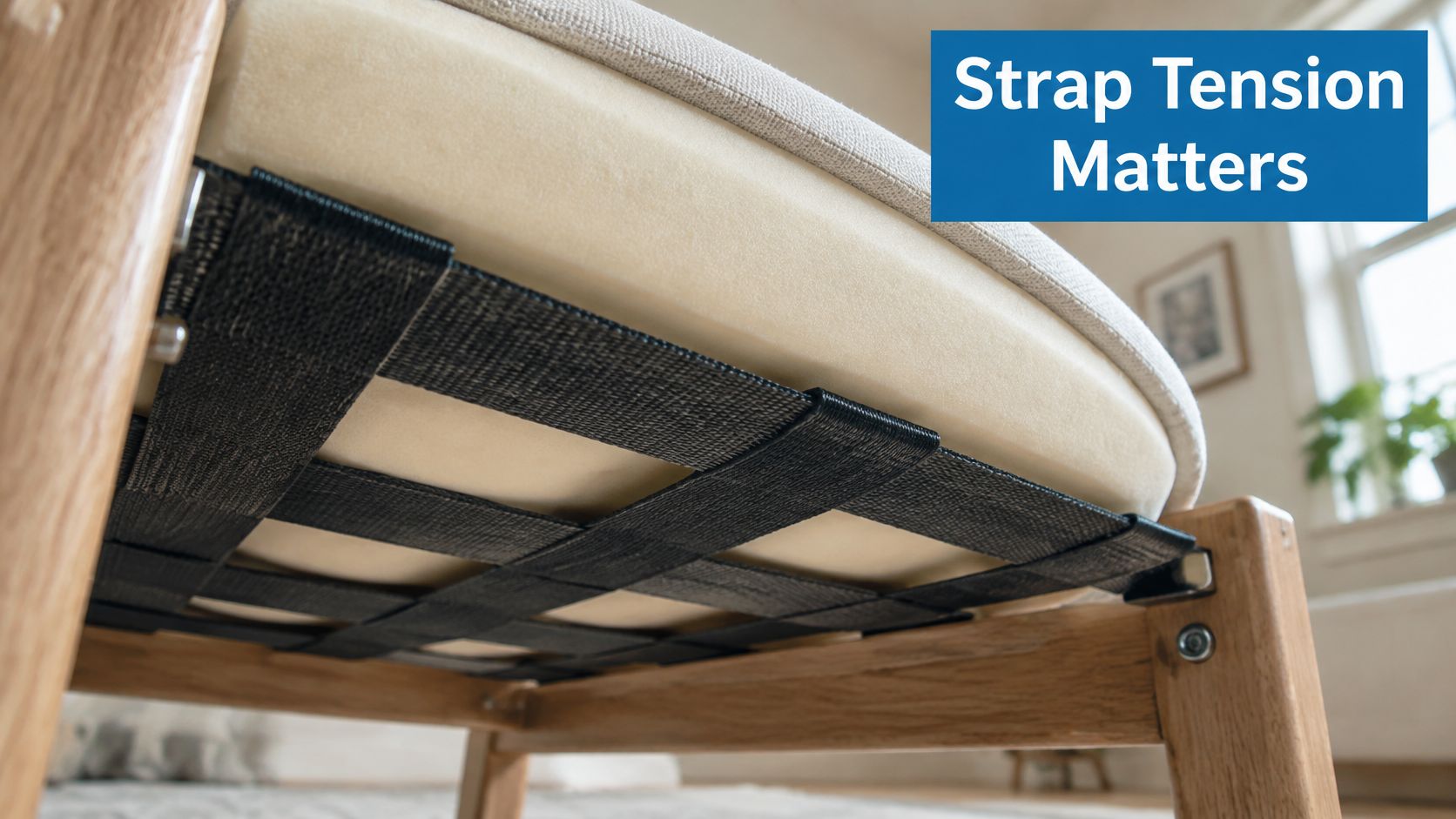
Webbing is a suspension material whose stretch and recovery govern how evenly a cushion gives and rebounds. A permanently stretched strap creates exactly the low area described above, while correctly tensioned webbing produces uniform support, according to a technical comparison of seat suspension systems.
Load sharing is the design principle that makes multiple straps better than one. Several parallel straps each carry a smaller share of the force and resist local deformation, but only when their spacing and tension are reasonably consistent. Two straps at different tensions move the dip sideways.
Even pressure matters because the area under the sit bones takes far more load than the rest of the seat. A published cushion design study divides contact into zones, including a 4 cm × 4 cm region under the sciatic bones and a surrounding 10 cm × 10 cm area, and measures evenness with SPD%, where a smaller value means a more uniform spread, as described in research on seated pressure distribution. A strap that sits flat, aligned with the seat base, protects that evenness. One that bunches or creates a ridge works against it.
Tension rule: firm enough that the seat is level under a hand press, never so tight that the rails bow.
More tension is not better. Excess force pushes higher continuous loads into weak rails and fasteners and speeds up the failure you were trying to avoid. The signs of correct tension are simple: the cushion sits level, no dip shows in the centre, and the frame stays straight when you press down.
How to Install Straps on a Chair Frame
A strap performs as part of the seat-suspension layer, so both tension and attachment geometry decide whether it works. Upholstery guidance treats approximately 90 mm (3.5 in) jute webbing as a conventional suspension dimension, with elastic and synthetic webbing giving a lighter, springier response, per this guide to upholstery joining and webbing. Because the suspension carries the sitter's load and the foam only distributes it, a loose or badly anchored strap lets the cushion deflect further and bottom out against the frame.
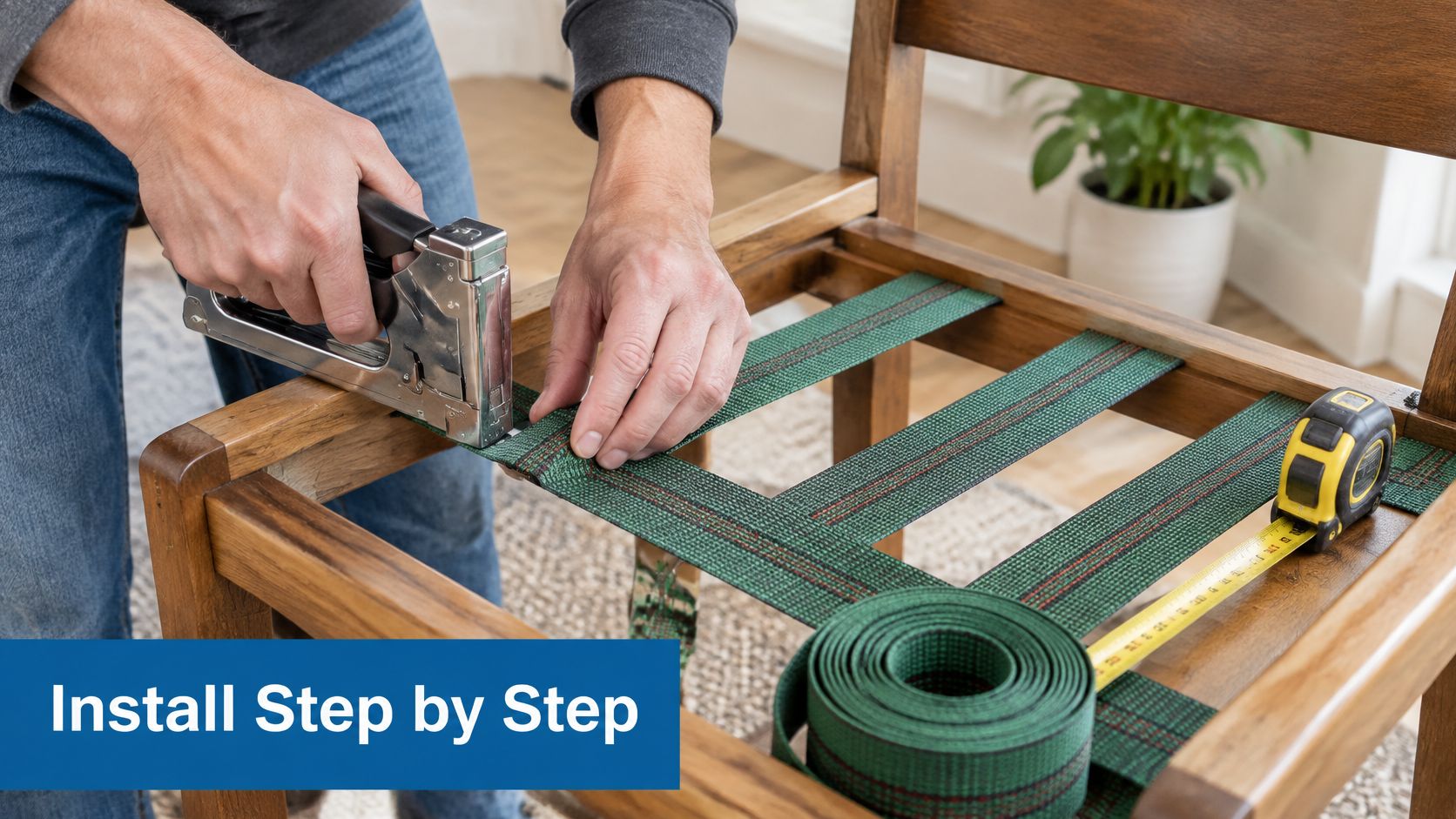
- Strip the seat down and inspect the rails. Take the cushion off and look at every rail and joint before you buy anything, because a strap can only hold to structure that's intact. Push a screwdriver handle against each rail; flex or a dull crack means stop here.
- Measure the usable width between the rails. Not the cushion's outer width. The strap spans rail to rail, and a measurement taken from the cushion will leave you short at both ends.
- Cut to length with an allowance. Add a few centimetres at each end for wrapping and fastening. Cut square across the webbing so the edge doesn't pull loose under tension.
- Anchor into the rails, never into end grain. End grain and damaged panel material split and let go. Fasten into the long grain of a sound rail, and pre-drill if the timber is hardwood.
- Keep straps parallel and evenly spaced. Consistent spacing lets each strap carry a similar share of the load.
- Tension until the seat is level and firm. Stop before the rails bow; a straight frame is the check that you haven't overdone it.
- Refit the cushion and sit on it. Run a hand across the seat looking for a centre dip or a gap at the front edge, then shift your weight side to side.
- Recheck at one week and again at one month. Elastic webbing creeps and fasteners work loose with use. Both visits take two minutes and catch problems while they're still small.
A finished seat looks unremarkable, which is the point: even contact across the whole surface, no ridges under your hand, and no movement in the cushion when you press it firmly toward the front edge.
Sit-to-Stand Safety for Older Adults
An older adult pushes off the armrests, leans forward, and the newly strapped cushion stays put. The seat can still be the wrong height, too deep, or tipped so the pelvis has to climb out of it. A strap that changes effective seat height or pelvic tilt changes how hard standing is, and that knee load matters more than how stable the cushion feels under a hand.
Research on seated transfers in older adults found that thicker cushions can increase trunk lean and knee-extensor loading. In one study, three of 14 participants had difficulty rising when the cushion contoured the pelvis, as reported in research on seated transfers in older adults. Extra softness or height can raise fall risk for someone with weak knee extensors.
Older sitters often struggle when a chair is too deep for their feet to reach the floor. They slump, then add a cushion to shorten the seat, which puts height back in. Cushion stability and a sense of security rank high for this group, and armrests plus anti-slip features are valued with that stability. Straps still belong in the repair. Check the finished seat instead of treating a firmer cushion as a safer one.
I would not sign off a strap job until the sitter has stood up from it. Run these five checks after installation.
- Seat height: measure from floor to the top of the compressed cushion, not the bare seat.
- Foot contact: both feet flat on the floor, no dangling, no toes-only contact.
- Armrests: still fully reachable and usable for a push-off.
- Movement: watch for the cushion sliding forward or shifting side to side as the sitter rises.
- Effort: if standing takes more effort than before the strap went on, the setup needs rethinking.
When to bring in help: significant leg weakness, balance impairment or pressure-injury risk is a professional assessment, not a weekend job.
For that group, the pressure question is real. A 2025 international seating guideline reported a relative risk of 0.86 for pressure-redistributing seating surfaces compared with standard surfaces, in its seating guidance summary. Hold stability and pressure relief in balance. A room-by-room look at trip hazards, chair heights and transfer routes belongs with the chair itself, and the Carevo Home Health Care assessment guide covers it in practical detail. For seating choices that suit older users, see our notes on furniture for elderly users.
Fixing Straps That Slip, Sag or Loosen
Most strap repairs fail in one of four visible ways. Each has a specific cause and a specific fix, and none of them is "add more tension".
- The strap slips sideways off the rail. It's usually running at an angle rather than across the rails at right angles. Reposition the anchors so the webbing crosses square, into solid rail wood.
- A fastener pulls out or the wood splits. Stop tightening immediately. Look for splitting or an anchor that landed in end grain, then move the fastening point to sound timber a couple of centimetres away.
- The cushion dips again within a week. Re-tension all the straps evenly first. If the dip returns after that, the foam has compressed and the cushion needs replacing, not more webbing.
- The strap frays at the edges or stays stretched after you release it. Replace it. Elastic webbing that no longer recovers cannot hold tension, and a frayed edge will tear through the fastening line.
There's a stop rule worth writing on the toolbox. If the frame moves, a rail cracks, or a fastener won't hold after two attempts, stop and go back to the frame checks. A chair used for assisted transfers or pressure-injury prevention belongs with a professional rather than a staple gun.
Choose the Right Fix for Your Chair
Decision first, tools second. The situation you're in tells you which repair you need.
| Fix by situation | |
|---|---|
| Situation | Action |
| Cushion slides or dips, frame rigid, rails sound, occasional use | Fit a correctly tensioned strap and recheck |
| Frame rocks, rails crack or foam badly compressed | Repair the structure or replace the cushion first |
| Long sitting, transfers or pressure-injury prevention | Get a professional assessment before changing seat height |
The base chair does more for comfort than any accessory. A 2024 survey of 217 professionals, published in the Journal of Clinical and Diagnostic Research, measured mean ergonomic discomfort at 32.49% for static chairs, 66.3% for revolving chairs and 25.26% for wooden chairs. Get the chair broadly right and a strap finishes the job. Get it wrong and the strap is cosmetic.
Keep two repair goals separate. Cushion retention stops movement; structural stability keeps the chair safe. The ISO 7173:2023 test categories cover static loads on seats, backrests and armrests plus cyclic durability, and the standard explicitly excludes ageing, degradation and ergonomic evaluation. A strap that ends the sliding doesn't certify the chair, and a chair that passed a load test isn't automatically comfortable five years later.
If your frame is sound and the cushion still slides, the next step is small. Measure rail to rail, pick your webbing from the comparison above, install it in the order given, then recheck at one week and one month. If the sagging seat is a sofa, a rigid board is the better tool than webbing. Our Heavy Duty Sofa Cushion Support Board, on sale at $29.99, is a couch support for sagging cushions that sits under the cushion and restores a flat, even base. For a chair seat with tired foam and split upholstery, recovering the seat is the repair that lasts.
Meliusly builds support systems for the furniture that sags before it breaks, from sofa cushion boards to sleeper sofa and bed slat supports, all tested and approved by Prüfengel, the German testing institute. If the problem you found today is under a sofa or a sleeper sofa mattress rather than a dining chair, our range covers that too, with the same approach of fixing the structure before the surface. Visit Meliusly to see the full lineup and match the right support to your furniture.
Share this post
- Tags: chair retrofit, chair seat repair, cushion support straps, sagging chair cushion, seat support