

How Much Weight Can a Sleeper Sofa Hold? Ratings Explained
Posted by Meliusly
Sleeper-sofa capacities range from 250 pounds per person to 660 pounds total in published listings, but those figures aren't interchangeable. A number only answers how much weight a sleeper sofa can hold once you know whether it applies per seat, per person, or to the whole sofa.
The difference matters more than the size of the number. A seating rating doesn't automatically cover the fold-out bed, and a support board can't turn an unrated sleeping mechanism into a rated one. Before replacing an uncomfortable sleeper, separate a support problem from a structural problem, because the affordable fix depends on which one you've got.
Typical Sleeper Sofa Weight Ratings at a Glance
The Everything Depot's guide lists 661 pounds for Milo and Dresden, 507 pounds for Berlin, 440 pounds for Mea, and 300 pounds per seat for Mala; only Mala states the basis. That is the first check: the bigger number is not automatically the stronger sleeper.
Published specifications use different denominators. Some describe individual seating positions, others give a combined load, and some leave the configuration unstated, which makes two similar-looking numbers unsafe to compare directly.
Published sleeper-sofa weight ratings and their basis
| Rating source | Stated figure | Basis of the rating |
|---|---|---|
| BuyAdvanced 2026 range | 250 lb per person to 660 lb total | Per person and total, mixed across models |
| Slumberland pull-out sleeper listing | 250 lb per seat | Per seat; product weight 112 lb |
| Everything Depot: Rove Concepts Milo and Dresden | 661 lb | Listed weight limit; basis not stated |
| Everything Depot: Berlin | 507 lb | Listed weight limit; basis not stated |
| Everything Depot: Mea | 440 lb | Listed weight limit; basis not stated |
| Everything Depot: Mala | 300 lb per seat | Per seat |
| Cozey sleeper sofas | About 350 lb per person | Recommended maximum long-term load |
| Koala sofa beds, two adults | 150 to 250 kg | Combined use by two adults |
| Koala queen sofa beds | 200 to 250 kg | Commonly rated for queen models |
| Amazon Canada SUNWAVE 60-inch Queen pull-out | 362.87 kg | Maximum weight capacity listing |
The 2026 BuyAdvanced sleeper-sofa report gives the broadest shopping range here: 250 pounds per person to 660 pounds total, including models rated at 500 and 600 pounds. The Slumberland pull-out sleeper listing is clearer than most because it separates 250 pounds per seat from 112 pounds of product weight, two figures that describe entirely different things.
Cozey recommends approximately 350 pounds per person as a maximum long-term load, while Koala describes 150 to 250 kilograms for combined two-adult use and commonly 200 to 250 kilograms for queen models. The Amazon Canada SUNWAVE 60-inch Queen pull-out listing specifies 362.87 kilograms maximum capacity. A listing that gives only one maximum still leaves the sleeping-surface basis undefined.
Read the basis before comparing the number
- Compare like with like. A per-person figure is not directly comparable with a complete-sofa maximum.
- Treat the maximum as a ceiling. Don't choose furniture with the intention of routinely loading it right to its limit.
- Don't invent an unrated capacity. An absent rating doesn't mean the sofa holds nothing, but it leaves you without a verified safe load.
Keep the model name and configuration attached to every specification you save. A retailer's general buying guide is a starting point; the exact manufacturer's documentation should settle the purchase.
Whether the Rating Covers the Seat, Bed or Whole Frame
Per-seat, opened-bed, and whole-frame ratings describe different systems. The mistake is assuming that a number printed beside a sofa photograph covers every way the furniture can be used.
A per-seat rating applies to an intended seating position. The Mala example belongs in this category. Empty cushions beside a heavier occupant don't necessarily increase the capacity of the occupied position, because the local seat supports still carry that person's load.
An opened-bed rating applies to the converted sleeping platform. Weight passes through the mattress into the deck, rails, hinges, and deployed legs. Those components aren't necessarily the same supports used when the sofa is closed.
A complete-sofa limit needs clarification
The published sofa instruction-manual example, together with the separate manual example, illustrates maximums of 620 pounds and 850 pounds (385 kilograms). A maximum for the complete sofa doesn't establish a separate allowance for each mattress side or prove that the folding mechanism carries the same load.
That ambiguity also affects bedding and accessories. If the manual doesn't say whether its limit covers occupants alone or the full added load, don't exclude a mattress topper, support insert, or heavy bedding from your assessment.
Product weight and seating count aren't occupant ratings. A heavy sofa may have a modest sleeper mechanism, and space for several sitters doesn't establish a combined sleeping limit. Our guide to whether sleeper sofas are comfortable to sit on helps distinguish seating comfort from the performance of the bed underneath.
Ask the manufacturer these questions:
- Which part is rated? The seats, extended bed, or complete furniture assembly?
- What's the basis? Per person, per seat, or combined total?
- What counts toward the load? Occupants only, or bedding and accessories too?
- Does the mechanism have its own limit? Request the rating for the exact converted configuration.
Default rule: If there's no sleeper-bed figure, treat the seat and bed as separate systems. Confirm the sleeping limit with the maker before accommodating another adult.
How Manufacturers Test Sleeper Sofa Loads
A capacity rating is a tested-use limit, not a prediction of the exact weight at which furniture breaks. The figure only describes what the assembly survived under defined conditions: where the force landed, how fast it arrived, and how often it repeated. A sofa seat and an extended bed deck can carry the same printed number while tolerating very different real loads.
Eurofins' furniture quality-control guidance describes BIFMA-related functional loading with a 225-pound (102-kilogram) mass, proof loading with a 300-pound (136-kilogram) mass, and an impact drop of approximately 6 inches (152 millimeters). Proof loading is an overload check, so a frame that survives 300 pounds once is not rated for a 300-pound sleeper. These are test inputs, not universal sleeper-sofa occupant allowances.
Furniture test loads and what each one checks
| Test or standard | Load or cycle | What it checks |
|---|---|---|
| BIFMA functional loading | 225 lb (102 kg) mass | Strength under representative use |
| BIFMA proof loading | 300 lb (136 kg) mass | Structure beyond normal use |
| BIFMA impact drop | Dropped from about 6 in (152 mm) | Impact resistance of the seat |
| EN 1725:2023 reference occupant | Up to 110 kg (about 243 lb) | Strength and durability basis for bed design |
| EN 1022:2023 stability | Users up to 110 kg; forces applied slowly | Tipping and stability under load |
| European seat static force | 1,300 N (about 292 lbf) | Static seat strength |
| Upholstered furniture load method | 100 lb rear and 50 lb front; increases of 12.5 lb after 25,000 cycles | Frame movement and joint wear under repeated loading |
The EN 1725 bed-safety standard listing identifies an adult-user design basis of up to 110 kilograms, about 243 pounds. That reference helps define testing; it doesn't certify every sofa bed for that occupant weight.
The European standards summary describes EN 1022:2023 stability testing for users up to 110 kilograms, with forces applied slowly to minimize dynamic effects. A Steelcase certification document provides seating-test context, including a 1,300-newton static seat force, approximately 292 pounds-force; it isn't a certification for unrelated sleeper sofas. A seat platform that holds that force in place still says nothing about the folding bed underneath.
Purdue Extension's upholstered-furniture testing document describes 100 pounds at a rear load position and 50 pounds at the front in one procedure, and another sequence with 12.5-pound increases after 25,000 cycles at prior load levels. Loading that climbs after repetition is how testers expose joints that hold once and loosen later.
Several of those figures can sit side by side on one spec sheet while describing three different safe loads.
What those procedures reveal
Static loading exposes bending or permanent deformation. Fatigue testing can reveal loosening joints, damaged webbing, and platform wear that a brief load wouldn't expose. Impact testing challenges the assembly with moving weight rather than a gently placed mass.
Mechanism design matters too. Our explanation of types of sleeper sofas distinguishes configurations whose supports work differently, so the same test outcome can reflect very different hardware.
Before trusting a tested-capacity claim, identify:
- The test method and intended domestic or commercial use.
- The loading location, not just the mass.
- The duration or repetition of the procedure.
- The included components, especially the extended mechanism and its legs.
A lounge-chair test can't establish the capacity of a folding bed.
What Lowers a Sleeper Sofa's Real Limit
The weakest load path matters more than the strongest-looking component. Start at the middle of the opened bed, then follow the supports down to the floor rather than judging the sofa by its upholstery or overall weight.
A bowed center rail, cracked support, or separated attachment changes how the frame carries occupants. Adjacent components may then carry loads they weren't intended to take. You can't calculate a trustworthy reduced capacity by looking at the damage.
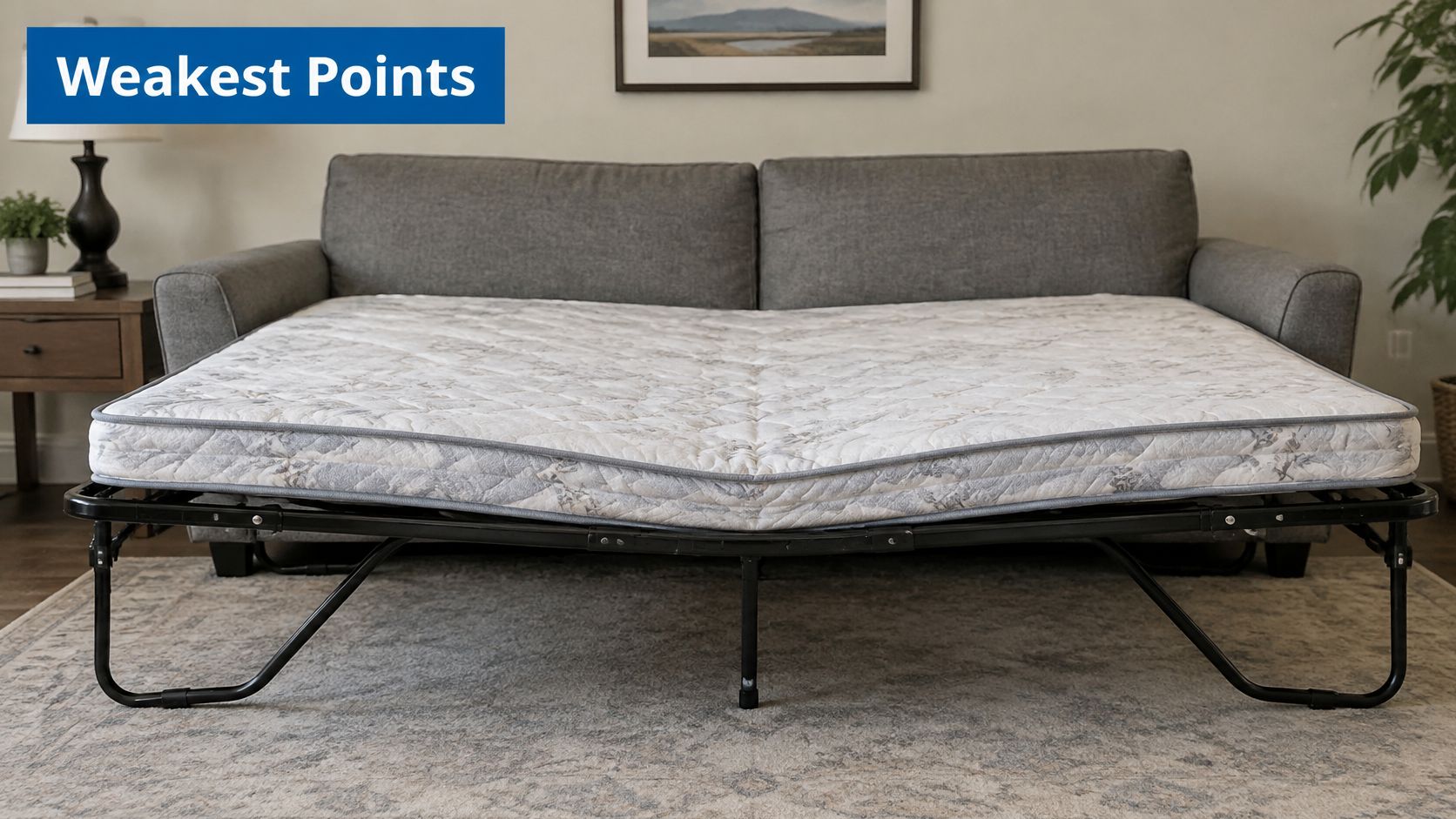
Follow the supports, not the cushion firmness
Inspect the folding mechanism next. Repeated conversion can loosen fasteners and stress hinge attachments or welds. A mechanism that needs forcing may be misaligned; pushing harder isn't a repair.
Legs must deploy correctly and maintain floor contact. If a leg lifts when an occupant changes position, check for an uneven floor, incorrect deployment, or frame distortion before using the bed again.
The mattress and deck affect local pressure as well. A soft or thin mattress can let the sleeper press more directly against bars, while gaps in the platform leave less area carrying the load. Our sofa construction guide explains the frame and support components worth identifying before choosing a fix.
Moving loads aren't equivalent to still loads
POVISON's sleeper-sofa buying guide discusses capacity alongside the practical importance of load distribution and repeated use. Its testing discussion describes BSI-style 1,300-newton seat loading, approximately 1,600-newton static loading, 100,000 fatigue cycles, and a 60-kilogram impact mass, illustrating why durability can't be reduced to body weight alone.
Sitting hard on the front edge, kneeling, jumping, or leaning heavily against the back concentrates force. One person repeatedly dropping onto an edge can be harder on local components than two adults lying still, although design, combined weight, and loading position determine the actual result. That comparison never overrides the bed's stated maximum.
An evenly spread load and an edge impact are different engineering problems, even when the scale reading looks similar.
For Airbnb, hotel, or other short-term rental use, frequent conversion and unfamiliar users make inspection especially important. Ask whether the manufacturer separately rates seating and sleeping, and whether the mechanism underwent fatigue testing.
Stop use when you notice:
- Frame twisting during normal entry or repositioning.
- Mechanism binding or incomplete locking.
- Legs lifting or supports failing to stay deployed.
- Loose fasteners, cracked joints, or damaged welds.
A worn hinge can reduce real capacity below the label. The original maximum isn't a guarantee for damaged furniture.
Safe Loads and the Go or No-Go Check
Use a go or no-go check before adding occupants or accessories. The right sequence prevents a comfort upgrade from concealing a structural fault.
- Find the rating and its basis. Match the manual to the exact model and establish whether the number covers a seat, a person, the complete sofa, or the bed.
- Compare the realistic sleeping load. Add the intended sleepers' body weights and include bedding or accessories when the manufacturer's definition requires it.
- Inspect the deployed structure. Look at the center support, hinges, legs, fasteners, locking points, and platform. Check for gaps, abnormal flex, and loose connections.
- Choose the repair by the fault. A sound frame with a mattress dipping into the bars may benefit from a support board. A twisting frame or binding mechanism needs structural attention first.
Don't assign your own extra capacity because the bed survives a brief trial. Sitting on it without an obvious failure doesn't reproduce durability testing or reveal every damaged connection.
Safe loading checks by use case
| Use case | Rating to look for | Extra check |
|---|---|---|
| One adult sleeper | Bed rating covering the sleeping surface | Confirm the sleeper is within the manufacturer's stated limit |
| Two adults sleeping together | Total bed rating, compared with combined body weight | Keep both sleepers centred and avoid edge sitting |
| Heavier user | Documented rating above the user's weight | Keep a margin below the labelled maximum |
| Caregiver or older adult | Documented rating for the sleeping surface | Check that transfers do not stress the front edge or hinges |
| Hospitality or rental | Documented tested capacity | Inspect hinges, welds and legs on a set schedule |
A testing reference isn't a personal clearance. Use the product's documented sleeping capacity rather than treating a standards-based reference occupant as permission for anyone below or above that reference to use an unspecified sofa.
For shared sleeping, compare the combined load with the total bed rating. Keep occupants over supported areas, and don't assume an unused portion of the mattress increases the allowance at the edge.
Leave practical headroom
For a heavier user, choose a documented rating above the expected load instead of aiming exactly at the maximum. There's no universal percentage margin that can replace model-specific instructions.
Caregivers should also consider how the person enters and leaves the bed. A transfer that requires prolonged front-edge sitting, pushing against an arm, or bracing on a hinge area needs attention beyond the lying-down load. Rental operators should document inspection findings and remove damaged units from service rather than waiting for a guest complaint.
When the frame passes inspection but the sleeping surface lacks support, our SleeperSaver Classic is a heavy duty sofa bed support board made with reinforced plywood panels wrapped in durable industrial-grade fabric. It arrives pre-folded and unfolds in seconds, with no tools or permanent furniture changes. It's a targeted sagging fix, not a substitute for repairing the underlying structure or complying with its load rating.
How Support Boards Protect a Sagging Sleeper Bed
A support board spreads mattress pressure across a supported platform, bridging the spaces where a mattress would otherwise dip between bars. On a sound frame, that can restore a level sleeping surface without replacing an otherwise serviceable sofa.
The trade-off is straightforward: you add a firmer foundation, and you must preserve the clearances and folding action the furniture needs. A board doesn't raise the sofa's tested capacity, straighten a bent rail, or restore a failed locking mechanism.
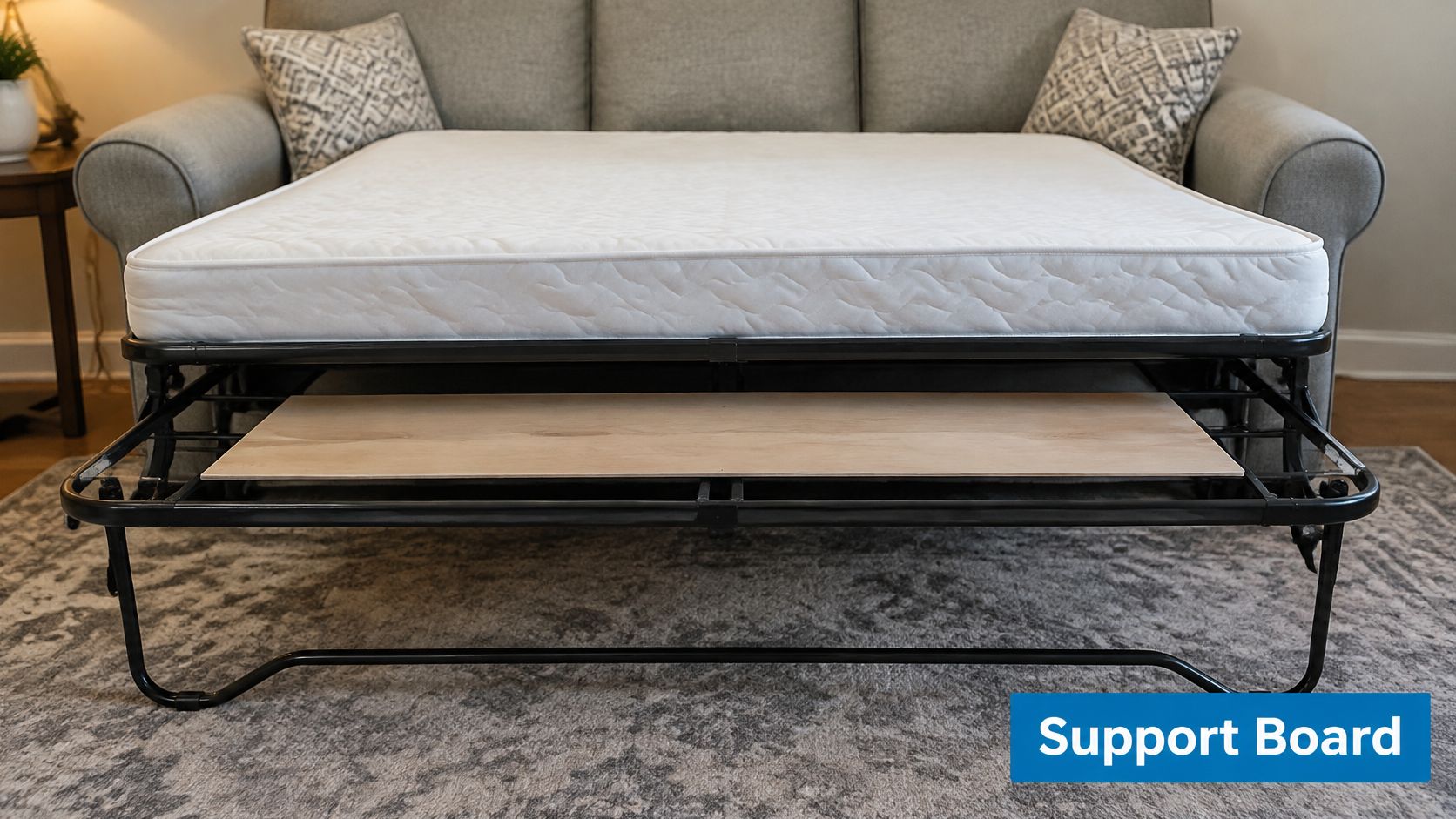
Fit the board to the supported span
Foundation security matters as much as firmness. The ASTM F1427-21 bunk-bed specification requires foundation systems to resist shifting or falling when manipulated and includes a test applying 400 pounds gradually over a plywood sheet for at least five minutes. That procedure applies to bunk beds rather than sleeper sofas, and it still shows why a foundation that can't shift matters under sustained and moving loads.
Fit a compatible board in this order:
- Clear the bed frame. Remove cushions and the mattress so you can inspect the deck and see the intended bearing surfaces. Keep fingers away from folding joints.
- Measure the bar-to-bar span. Use a tape measure across the supported area, not the outside sofa dimensions. Match the board's listed dimensions and placement instructions to the frame and mattress size.
- Check how the board bears on the frame. Choose a design intended to sit between the relevant bars rather than perching insecurely on top of them. Don't improvise unsupported edges.
- Verify mechanism clearance. Keep hinges, springs, and locking hardware unobstructed. Removable boards come off before you close the sofa; permanently installed designs are built to collapse together with the bed.
- Replace the mattress and check gently. Sit down gradually near the front edge while staying within the furniture's rating. Watch for unusual flex or movement rather than bouncing to test strength.
Decide whether the board is enough
Before overnight use, inspect the hinges, center supports, legs, locks, and platform again. The board should lie level, stay securely positioned, and leave the operating hardware free.
A firmer, level bed with no abnormal movement is encouraging. It isn't proof of structural certification. If the frame twists, legs lift, or the mechanism binds, stop and address the frame before adding weight.
If the depression may be in the mattress rather than the deck, SouthShore Fine Linens' guidance to check your mattress base for support offers a useful diagnostic starting point. Compare the mattress on a suitable flat foundation before buying a replacement.
Repair boundary: A board improves support on a sound structure. A twisted frame or a failed lock needs repair first.
For sizing, match the supported span, mattress dimensions, and folding requirements before ordering. I'd measure the frame itself rather than trusting the size label on the sofa or mattress, because a board sized to the wrong span won't bear on the intended bars.
Meliusly sells support products for beds, sofas and sleeper sofas, including cushion supports, sleeper sofa support boards, bunkie boards, and bed slats. If your sleeper's frame is sound but the mattress dips into the deck, visit Meliusly to compare sleeper sofa support boards and confirm sizing and fit details before replacing the sofa.
Share this post
- Tags: sagging sleeper sofa, sleeper sofa limit, sleeper sofa support board, sleeper sofa weight capacity, sofa bed weight