

Hotel Sofa Bed Guide to Comfort and Durability
Posted by Meliusly
You've pulled out the hotel sofa bed, spread the sheets, and pressed a hand into the mattress. There's a hard line where someone's hips will rest, or the middle drops while the edges stay high. The upholstery looks fine, but the sleeping surface doesn't.
Before ordering a thicker mattress or replacing the sofa, separate cushioning problems from support problems. A hotel sofa bed is a sleep system. Its frame, opening mechanism, deck, and mattress have to work together, whether it's in a busy suite, a vacation rental, or your guest room.
What a Hotel Sofa Bed Has to Survive
A sleeper sofa almost always passes the sit test. The failures show up in the lie-down test: a bar line under the shoulder blades, a deck that dips in the middle, a mattress thin enough to transmit every rail beneath it. The furniture does a different job once it opens, so a guest complaint calls for an open-bed inspection rather than another look at the seat cushions.
A hotel sofa bed combines daytime lounge seating with nighttime accommodation for a child, an additional adult, or guests sharing a suite. Its value is usable flexibility: the sitting area becomes sleeping space without permanently occupying the room with another bed.
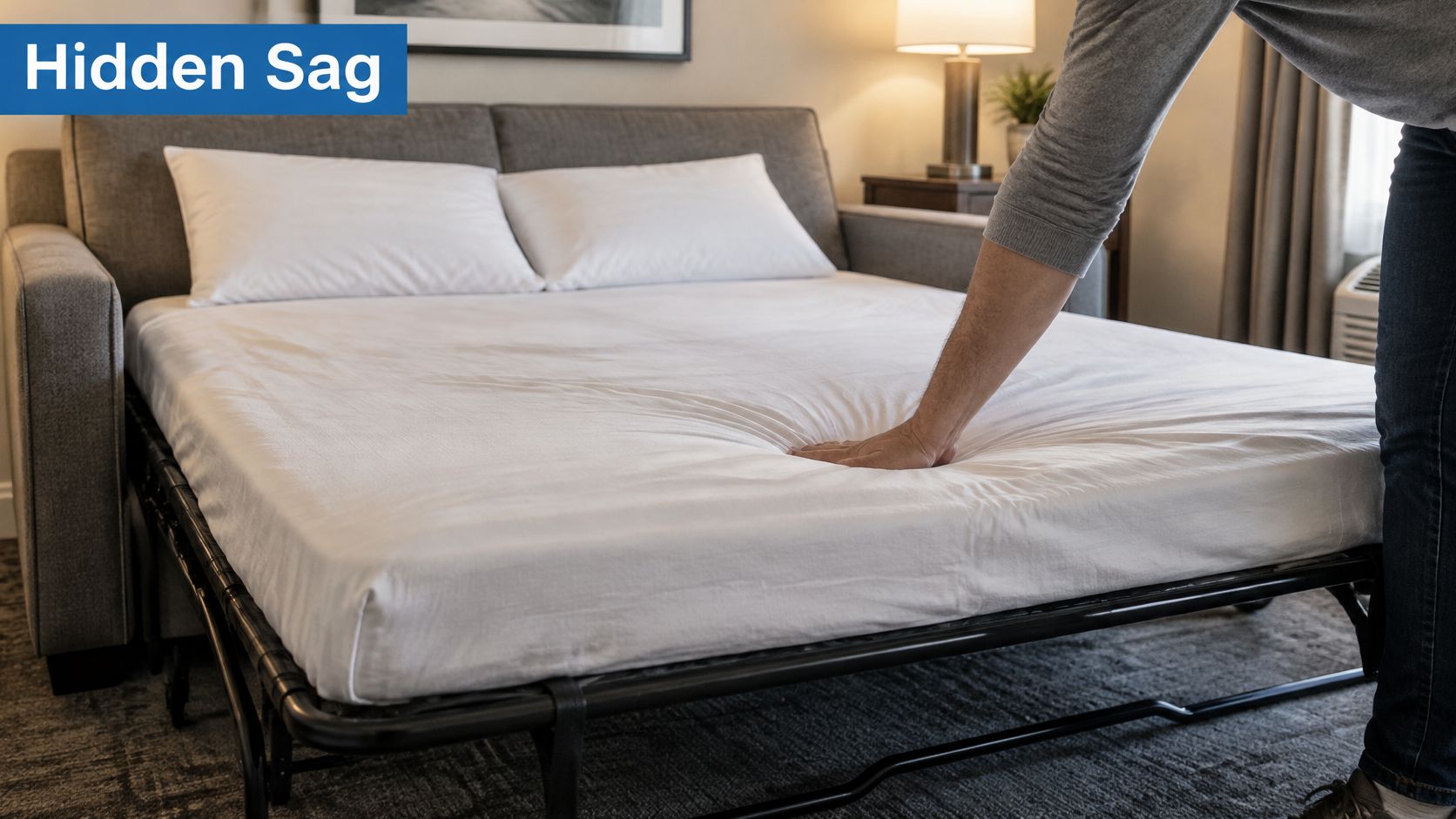
Commercial demand calls for a sleep specification
The MarketIntelo sofa-bed market estimate valued the global category at $12.8 billion in 2025 and placed hospitality applications at 13.1% of demand, implying roughly $1.68 billion of spending across hotels, resorts, short-term rentals, and vacation properties.
That scope matters more than the sales total. Accommodation operators aren't buying only an attractive couch. They're buying a sleeping surface that staff must open, dress, inspect, and close on a daily cycle.
Procurement rule: Evaluate the furniture in the configuration guests will sleep on, not just the configuration shown in the room photograph.
A thicker mattress or a softer topper changes how the bed feels for the first ten minutes. It does not stiffen a deck that bows under a sleeper, and when the opened deck flexes or prints bars through the mattress, added cushioning masks the fault while guest sleep still fails. Buying decisions should therefore start with the mechanism and its mattress limits, then account for room circulation, housekeeping access, and repairability.
The same logic protects a vacation rental or a home guest room. Identify the construction before choosing the remedy: press along the opened deck, find where the frame rails sit relative to hip and shoulder positions, and judge the support before judging the foam.
Hotel Sofa Bed Types and Mattress Limits
| Type | Duty | Mattress thickness | Fold rule | Typical failure |
|---|---|---|---|---|
| Click-clack occasional | Rare extra guest | About 100–120 mm foam, as described in Hotel Furniture Concept's hospitality specifications | Must still fold as a cushion unit | Thin foam transmits the frame |
| Nightly pull-out | Regular guest sleep | About 120–150 mm sprung or hybrid, in the same hospitality specifications | Confirm clearance before adding thickness | Mechanism wear if overfilled |
| Hospitality sleeper mechanism | Hotel replacement mattresses | 4–6 inches, with particular mechanisms accepting 5–5.5 or 5–6 inches, in the Leggett & Platt sleeper brochure | Stay inside the maker's folded profile | Won't close or stresses hinges |
| Many standard pull-outs | Home, rental, and light hotel use | About 4.5–5.5 inches, according to Indian River Furniture's sleeper mattress guide | Test a full open-and-close cycle | Bar ridges if the deck flexes |
Choose for the actual sleeping duty
Click-clack models use the seating surface as part of the bed. They can suit occasional accommodation, but they're the wrong purchase when regular sleepers need a separately replaceable mattress. Inspect the hinge line and cushion junction, since the bed surface includes those transitions.
Nightly pull-outs separate the lounge cushions from the sleeping mattress. That makes independent mattress renewal possible, but it doesn't make every replacement compatible. A thicker mattress can improve cushioning while exceeding the space available when the mechanism folds.
Hospitality sleeper mechanisms require model-specific replacement choices. Treat the mechanism label or manufacturer's drawing as the controlling specification, not the mattress seller's promise of extra comfort. Similar-looking sofas can have different folded cavities and support geometry.
Standard residential pull-outs deserve the same care when used in rentals. A host shouldn't assume a sofa becomes suitable for frequent guest use just because it opens into a bed. Our guide to types of sleeper sofas helps distinguish the constructions before you compare replacements.
Measure before ordering
Use a tape measure with the bedding removed. Record:
- Folded cavity: Identify the available space and any manufacturer clearance requirement.
- Open frame width: Measure bar to bar, noting projecting hinges, brackets, and locking legs.
- Original mattress thickness: Measure an uncompressed edge, not the deepest body impression.
- Sleeping length: Confirm the mattress and any support insert stay within the intended supporting area.
Don't assume a sleeper's size label matches an ordinary bed mattress. Measure the furniture itself, and photograph the mechanism label so a replacement order can be checked against it.
A thinner mattress may preserve closing clearance but allow the support structure to become noticeable. A thicker one may stop the fold, strain hinges, or disturb alignment. Neither is an acceptable trade if it leaves the furniture uncomfortable or difficult to operate.
Buy documented construction, thickness, replacement availability, and mechanism compatibility. A vague high-density foam description doesn't tell you whether the mattress fits or how the complete bed will feel.
Comfort Capacity and Housekeeping Checks
A compatible mattress is only the beginning. The opened hotel sofa bed must also provide an even sleeping surface, leave usable circulation space, and remain practical for staff to service.
Check comfort with the bed fully open
Strip the bedding and press the center, both edges, and each seam. Then lie down carefully, provided the frame appears sound. Hand pressure can locate a ridge, but it doesn't reproduce the way a sleeper loads the whole surface.
A usable bed shouldn't present an obvious hard bar or a deep central trough. Note whether discomfort stays in one location or follows the mattress when it's repositioned according to its care instructions. That distinction helps maintenance avoid replacing the wrong component.
Test the room with luggage present
The Resorts Supplies commercial sofa-bed guide recommends roughly 24–30 inches of clearance at the foot of an opened bed and warns against blocking egress, storage access, or required accessibility routes.
That's planning guidance, not a universal legal minimum. Accessibility and occupancy requirements vary by jurisdiction, and a comfortable passageway isn't necessarily a compliant accessible route.
Check the room in its occupied condition:
- Bathroom access: Can an older guest or wheelchair user reach it after the bed opens?
- Door movement: Do the entry, bathroom, balcony, and connecting doors remain usable?
- Personal belongings: Is there somewhere for luggage and mobility equipment besides the walking route?
- Emergency movement: Can guests leave without climbing over the bed or moving furniture?
Photograph the room folded and open. Add dimensions to a simple sketch, including door swings and the narrowest passage, rather than relying on an attractive floor plan.
Include housekeeping and fire documentation
Housekeeping should be able to strip, dress, and reset the bed without reaching through pinch points or forcing the mechanism. Confirm that mattress replacement is possible without replacing the sofa, and check whether rotation is permitted by the mattress construction.
Fire performance also belongs in the acceptance check. The Arredamento Hotel furniture guide identifies EN 1021, BS 5852, BS 7176, TB117-2013, NFPA 260, and NFPA 261 as referenced frameworks across different markets, while emphasizing the importance of the complete upholstered assembly.
Request documentation for the exact covering, padding, barrier, frame, and relevant sleeping-surface configuration. Changing upholstery can invalidate the existing test documentation because the assembly is no longer identical; a generic fire-resistant label isn't enough.
Don't count a sofa bed toward usable guest capacity while a circulation, folding, or assembly-compliance problem remains unresolved.
That's an operating decision, not a substitute for local occupancy approval. More sleeping positions on a booking page don't necessarily create a more usable room.
Why the Couch Feels Fine and the Bed Does Not
The seat cushions can hide a weakness that becomes obvious only after opening. Seated guests load the sofa through its seating structure; sleepers distribute weight along the extended bed, including its center, edges, and folding sections.
The Neveitalia hospitality sofa-bed specification guide distinguishes daytime seating loads from concentrated point and edge loads across the opened deck. That's why a satisfactory sit test can coexist with an uncomfortable sleeping surface.
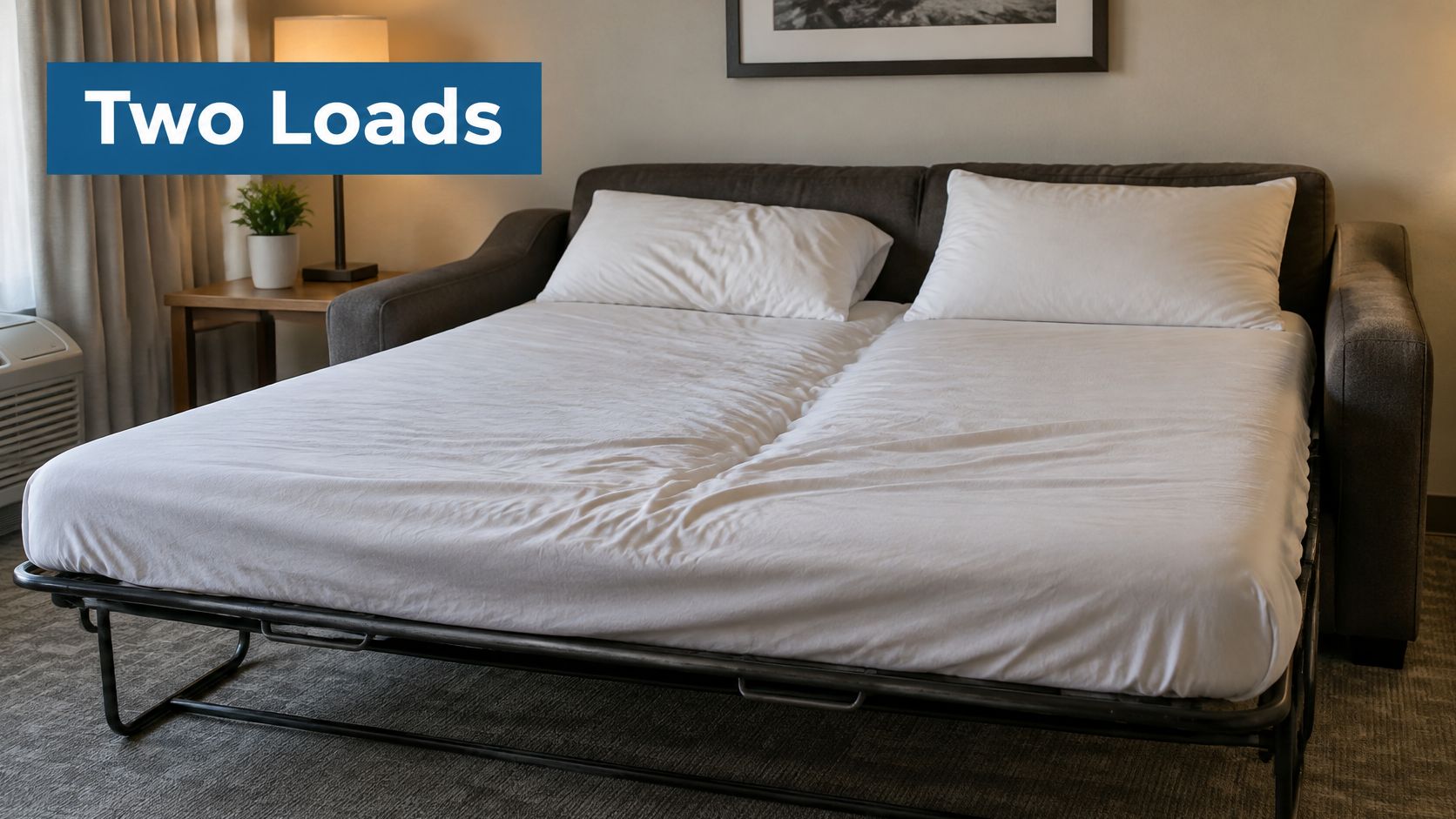
Separate worn foam from movement underneath it
Foam quality matters, but density alone doesn't establish the condition of a complete bed. The Koala sofa-bed mattress guide estimates that foams at or above 40 kg/m³ can retain support for roughly 8–10 years of daily use, while budget foams below 30 kg/m³ may soften within about 2–4 years and develop body impressions.
Treat those figures as material-performance estimates, not warranties. Occupancy, ventilation, compression, and the condition of the support structure affect the result. A mattress over a flexing deck won't perform like the same mattress over a stable foundation.
A thick mattress on a bowing deck is like a firm pillow on a broken chair. The upper layer changes the contact feel, but the underlying bend remains.
Read the visible signs
Remove the mattress before deciding which component has failed. Keep hands away from hinges and don't work beneath an unsupported mechanism.
- Mattress deterioration: Look for persistent body impressions, crushed edges, damaged ticking, or areas that compress much more easily than neighboring foam.
- Deck weakness: Look for center deflection, stretched support material, uneven sections, or an outer edge that drops under careful pressure.
- Mechanism trouble: Check for loose mounting points, uneven leg contact, damaged pivots, and sections that no longer align.
A topper can soften a localized pressure ridge without providing dependable support underneath it. That may be useful after the base is sound, but it's a poor first response to recurring sag.
Don't confuse firmer support with the hardest possible sleep surface, either. Some adults prefer greater stability, while children and lighter sleepers may find the same setup harsh. Aim for an even foundation with appropriate cushioning, not a rigid surface chosen solely because it doesn't move.
The diagnosis determines the expense. An impressed mattress over a level deck points toward mattress renewal. A deck that visibly deflects with the mattress removed needs attention underneath the sleep surface.
How to Stop Sagging Before You Replace It
Work from the structure upward. You'll avoid spending on foam before discovering that the foundation needs repair.
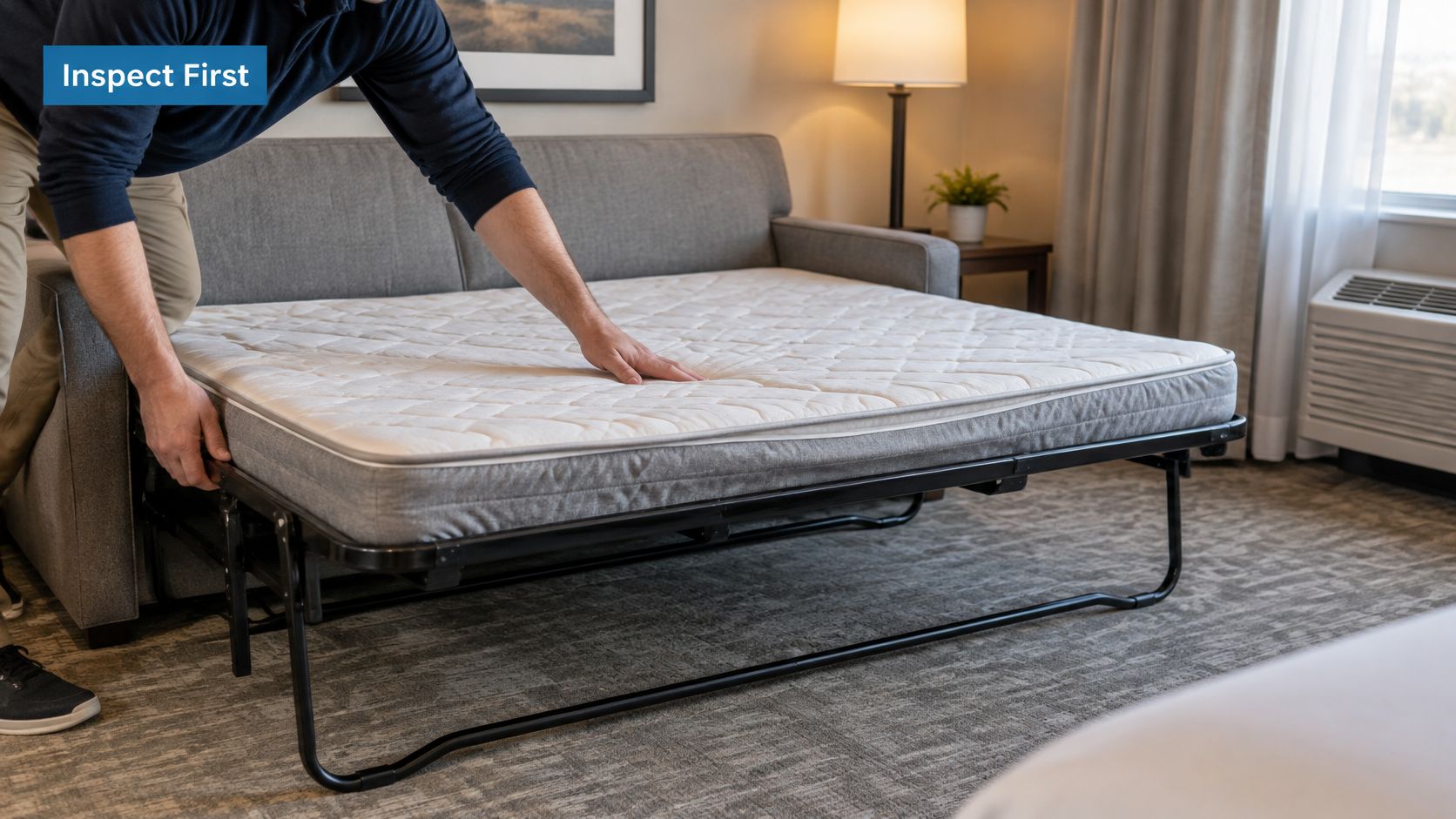
Follow the repair sequence
- Open and inspect. Remove sheets and loose bedding. Check for center sag, a bar or seam ridge, collapsing edges, squeaks, and loose mounts. Take the bed out of service if a leg won't lock or structural damage is visible.
- Remove the mattress and examine the deck itself. A straightedge laid across the supporting sections can help reveal uneven height. Don't mistake the normal shape of an unloaded flexible deck for proof that it needs reinforcement; identify where unwanted movement occurs under appropriate loading.
- Record the existing mattress profile. Compare it with the mechanism specification before considering more thickness. Include protectors and any layer staff routinely leave inside when closing.
- Fit a purpose-designed support board only where the frame is sound and compatible. The board should bridge the intended support area beneath the mattress, with clearance around locking legs and moving joints. Don't balance an improvised panel on projecting crossbars or use reinforcement to disguise a broken frame.
- Test the operating cycle. Open and close the bed slowly, following the support product's removal or folding instructions. Stop at resistance rather than pulling harder, and confirm that legs and latches engage correctly.
- Renew the mattress when the deck is level but the sleep surface remains impressed or deteriorated. Rotate it only if its construction permits rotation; don't flip a mattress with a designated sleeping face.
- Log the repair. Record the insert position, mattress specification, operating instructions, and inspection result. The DataIntelo hospitality-furniture report describes common hotel soft-goods replacement cycles of 6–7 years and full casegoods renovation cycles of 12–14 years, making a documented mid-cycle support repair a reasonable maintenance choice.
Match the symptom to the economical fix
| Symptom | Usual cause | Fix | Avoid |
|---|---|---|---|
| Center hammock only when open | Deck flex under sleep load | Bridge a sound, compatible deck with a fitted support board | A thick topper on the bow |
| Bar or seam line through the mattress | Localized structure without adequate load distribution | Fit the intended board beneath the mattress, spanning the support area | A thicker mattress that may not close |
| Hinges strain or the sofa won't latch | Stack exceeds folded clearance, or mechanism damage | Restore the specified profile and inspect the mechanism | Forcing the fold |
| Edge collapse | Outer deck or leg support, not necessarily the cushion | Check mounts, legs, and the open edge | Only flipping the cushion |
| Body impression and a flat deck | Worn or softened foam | Replace the mattress, or rotate if permitted and still serviceable | Assuming the frame is ruined |
| Squeak or uneven deck height | Loose mounts or worn hardware | Tighten serviceable fasteners, then recheck alignment | Waiting for renovation |
These are starting diagnoses, not automatic verdicts. A squeak can accompany damaged hardware, and an uneven edge can indicate more than a loose screw.
Repair priority: Stabilize serviceable support, restore suitable cushioning, and replace the complete unit only when its structure or mechanism no longer merits repair.
Our sagging sofa-bed repair guide provides another practical route through the diagnosis. Don't stack remedies without testing each change; otherwise, you won't know which layer solved the problem or created closing resistance.
What Replacement Costs Look Like in Real Rooms
Replacement makes sense when the mechanism is beyond economical repair. It's harder to justify when the frame operates properly and the complaint comes from a repairable support surface.
For a commercial price reference, National Hospitality Supply listed the Keystone Full Sleeper at a starting price of USD 1,619 in 2026. That's a product-price benchmark, not an installed replacement budget; confirm freight, delivery access, removal, and installation separately.
A hotel suite with a bar complaint
Say a limited-service suite uses its sleeper for visiting families. The opening action is smooth, the mattress fits correctly, and the guest complaint identifies a hard transverse line rather than worn upholstery or insufficient sleeping space.
Maintenance should check how that area carries load and whether a compatible insert can distribute it. If the frame and mechanism pass inspection, the decision is bridge the serviceable deck, not replace the entire sofa.
A rental with an exhausted mattress
A vacation rental opens its sleeper regularly. The host has been adding softer bedding, but the mattress now retains a body impression even after the bed is stripped.
With the mattress removed, the deck remains even and the mechanism operates properly. The appropriate decision is renew only the mattress, choosing a compatible replacement rather than leaving a plush topper inside the fold and hoping it closes.
A home guest sofa with a failing mechanism
A homeowner's sofa looks presentable and sees less use, but the opened bed sits unevenly and a locking component won't engage reliably. Lower occupancy doesn't make that defect acceptable for the next visitor.
A technician should determine whether approved hardware or mechanism replacement is practical. If structural damage or unavailable parts makes dependable repair unrealistic, the decision is schedule replacement, rather than purchase another comfort layer.
For help deciding who should handle structural work, our furniture repair shop guide explains the repair-service route.
Compare the cost of restoring dependable function, not just the price of a board against the price of a sofa.
Include the mattress, repair labor, delivery constraints, and time the room or guest bed can't be used. Keeping furniture is the better spend only when the result is serviceable, comfortable, and straightforward to maintain.
Reinforce the Deck or Buy Another Sleeper
A hotel sofa bed is a sleep system, so make the call with the mattress off. If the deck sits level and only the foam holds a persistent impression, renew the mattress within the mechanism's specification. If the frame and opening hardware are sound but the support surface flexes or lets a guest feel the bars, a fitted board is the targeted purchase. A thicker mattress or topper only hides that fault, and guest sleep still fails.
A board cannot compensate for a bent mechanism, a failed locking leg, or a damaged mounting point. Those faults need a furniture technician's assessment, and any change to a hotel's documented assembly needs approval before the bed returns to guest use.
Match the support to the way you use the bed
Meliusly is an engineer-founded furniture-support company whose products are tested and approved by Prüfengel, a German testing institute. Its sleeper support boards serve different routines:
- SleeperSaver Lite: Unfolds onto the sofa bed frame with no tools and no permanent furniture modifications, listed at $83.99. An air-gap design resists moisture buildup underneath the mattress, and the removable format suits owners who want a reversible solution.
- SleeperSaver Classic: A heavy-duty board that arrives pre-folded and sits on the frame before the mattress goes on. Prices in USD are $95.99 for Twin (36x48 inches), $107.99 for Full (48x48 inches), and $113.99 for Queen (60x48 inches).
- SleeperSaver Pro: Designed for Airbnb hosts, vacation rentals, and regular sofa-bed users. It is permanently installed between the frame and mattress, collapses together with a compatible bed mechanism, and comes in Queen, Full, and Twin sizes.

Before ordering, record the bar-to-bar width, supported length, and mattress thickness. Match those measurements to the selected board and confirm mechanism compatibility, rather than choosing by the sofa's advertised bed size alone. Advertised sizes describe the mattress. Boards have to fit the frame.
Choose removable support when reversibility matters, a heavy-duty board when that construction suits the frame, or an installed board where the sleeper opens often. If the hardware cannot open, lock, and close reliably, stop shopping for cushioning and arrange structural repair or replacement.
Meliusly offers sleeper sofa support boards, sofa supports, bunkie boards, and bed slats to restore support without replacing serviceable furniture. Measure your opened sofa-bed frame and mattress, then visit Meliusly to choose a support solution that fits your bed and how often you use it.