

Recliner for Seniors: Choosing a Safe, Comfortable Model
Posted by Meliusly
The global population aged 60 and over will rise from approximately 1.2 billion people in 2024 to 2.1 billion by 2050, according to the United Nations World Population Prospects 2024. That's not a niche furniture market. It's a huge share of households needing a chair they can sit in, rest in, and get out of many times a day without a struggle or a wobble.
So don't judge a recliner for seniors by softness first. Judge it as a transfer tool. Can this specific person lower into it under control, place both feet firmly, use the armrests, stop the mechanism where they want, and rise without rocking, sliding, or grabbing nearby furniture? If you can't answer those questions with measurements and a real sit-to-stand test, you aren't ready to buy, keep, or repair the chair.
Recliner Types for Seniors at a Glance
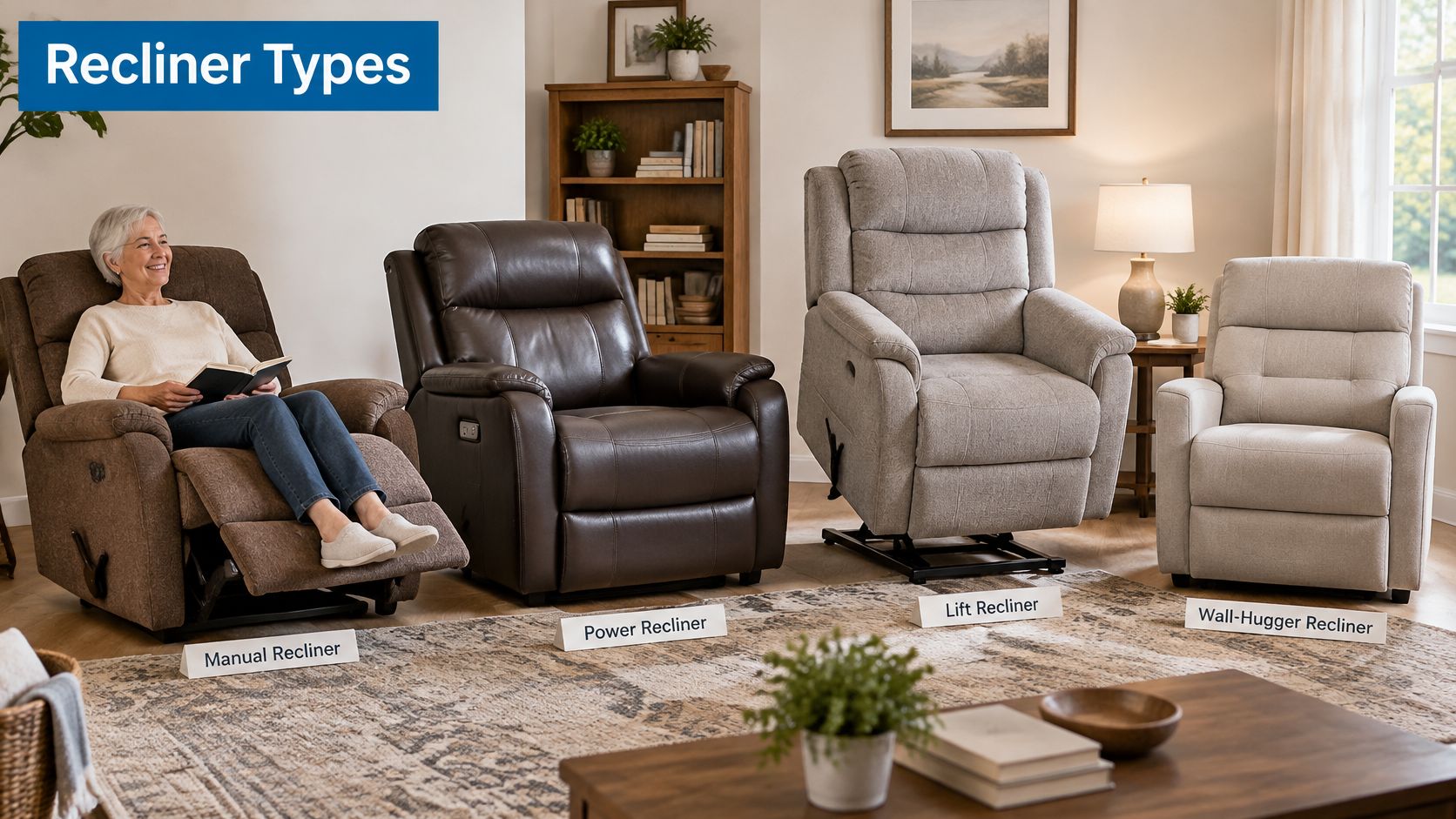
Start by separating movement from lifting. A chair can recline beautifully and still leave the user stranded in a low, soft seat.
Recliner types compared for senior use
| Type | How It Moves | Help Getting Up |
|---|---|---|
| Manual recliner | Lever or pull handle controls recline and footrest | None beyond the user's own strength and the armrests |
| Power recliner | Remote-controlled motor moves back and footrest | None, the motor does not lift the user |
| Lift recliner | Motor tilts the whole chair forward to a standing position | Mechanical lift assists the rise |
| Wall-hugger recliner | Slides forward as it reclines, so it needs less clearance behind it | Saves space only; only some models add a lift function |
A manual recliner is simple and has no cord or motor to manage, but the user supplies all the force to recline, close the footrest, and stand. That's a poor match if hand, leg, or hip strength is the problem.
A power recliner removes the effort of moving the back and footrest. Don't confuse that with standing help. Unless it has a lift function, the user still has to push up from the seat height the chair gives them.
A lift recliner is the only type in the table that mechanically assists the rise by tilting the whole chair forward. Consumer Reports found that lift-chair prices ranged from approximately $300 to more than $2,500 in 2026. That figure covers lift chairs specifically, so I wouldn't use it to price the other three types.
A wall-hugger solves a room problem, not a strength problem. It travels forward as it reclines, so it needs less space behind it. That can matter in an apartment, but you still need clear space in front for feet, a walker, and a straight stand without twisting.
These categories overlap in real products. A chair can be power-operated and a wall-hugger at the same time, and a wall-hugger may or may not carry a lift mechanism. Read the listing for the word "lift" rather than assuming the category name tells you whether it helps the user stand. For orientation on the wider styles beyond these four, Suburban Furniture's recliner guide is a useful overview of how different recliner mechanisms are set up.
Selection rule: Choose by the transfer the user struggles with most, standing up, reclining safely, or fitting the space, then verify the fit with measurements.
Seat Height and Fit Measurements That Matter
Measure popliteal height first. Sit the user on a firm, flat chair in their usual shoes, feet flat, and measure from the floor to the back of the knee. That number is your baseline. Without it, terms like low, high, and supportive mean nothing.
Fit measurements and targets for a senior user
| Measurement | How to Measure | Target for Senior User |
|---|---|---|
| Popliteal height | Floor to back of knee while seated, in usual shoes | Baseline for every seat height target |
| Seat height | Top of the cushion under the user's weight | From popliteal height down to 25 mm below it |
| Seat height gap | Seat height minus popliteal height | Avoid a gap near 20% (about 6.2 cm), where transfer performance declined in one study |
| Backrest angle | Recline angle measured from upright | About 105 degrees, tested range was 90 to 135 degrees |
Always measure seat height under load. A cushion can look right when empty and then sink enough to put the pelvis well below the knees. That compressed height is the height the user has to stand from, and it's where sagging gradually changes a usable chair into a difficult one.
In a study of 52 older and 50 younger adults, sit-to-stand force production and movement speed declined as seat height became lower, and the effect became pronounced when seat height differed from lower-leg length by approximately 20%, about 6.2 cm in that study population, according to the study indexed by PubMed. For a shopper, that means a few centimetres of cushion sag aren't cosmetic. They can change the whole transfer.
A 2025 study of 20 healthy adults aged 61 to 70 tested seat heights from 50 mm below to 50 mm above popliteal height and backrest angles from 90° to 135°, and the strongest combined comfort and objective pressure results occurred around popliteal height to 25 mm below it, paired with a 105° backrest angle, as reported in Applied Sciences.
What those targets can't promise
That second sample was small and healthy, so treat 105 degrees and the 25 mm window as starting points, not prescriptions. A person with knee, hip, breathing, or balance problems may need a different position. If knee discomfort changes how someone sits, seated positioning for knee arthritis relief offers useful context on why joint position during sitting matters alongside chair geometry.
Too high is also a problem. If the user's feet don't make stable contact, sitting down becomes a drop onto the front edge and standing starts with sliding forward. You want firm foot contact, hips fully back, and knees near a comfortable working angle, not the tallest seat you can find.
Seat depth interacts with height, because a seat that's too deep stops the user from getting their back supported while keeping their feet down. Our guide to seat depth and seating ergonomics explains how depth affects posture and pressure behind the knees.
Run this three-row check in a showroom or at home:
- Measure popliteal height: Use usual footwear and write the number down.
- Measure compressed seat height: Have the user sit fully back for a minute, then compare it with the baseline.
- Compare backrest angle: Use about 105 degrees as your upright comfort benchmark, then test sitting down and standing up.
If those three don't line up, upholstery, massage, and cup holders won't fix the chair.
Lift Recliners Versus Standard Recliners
A lift changes how the user rises, but it does not restore the balance and leg strength needed once standing.
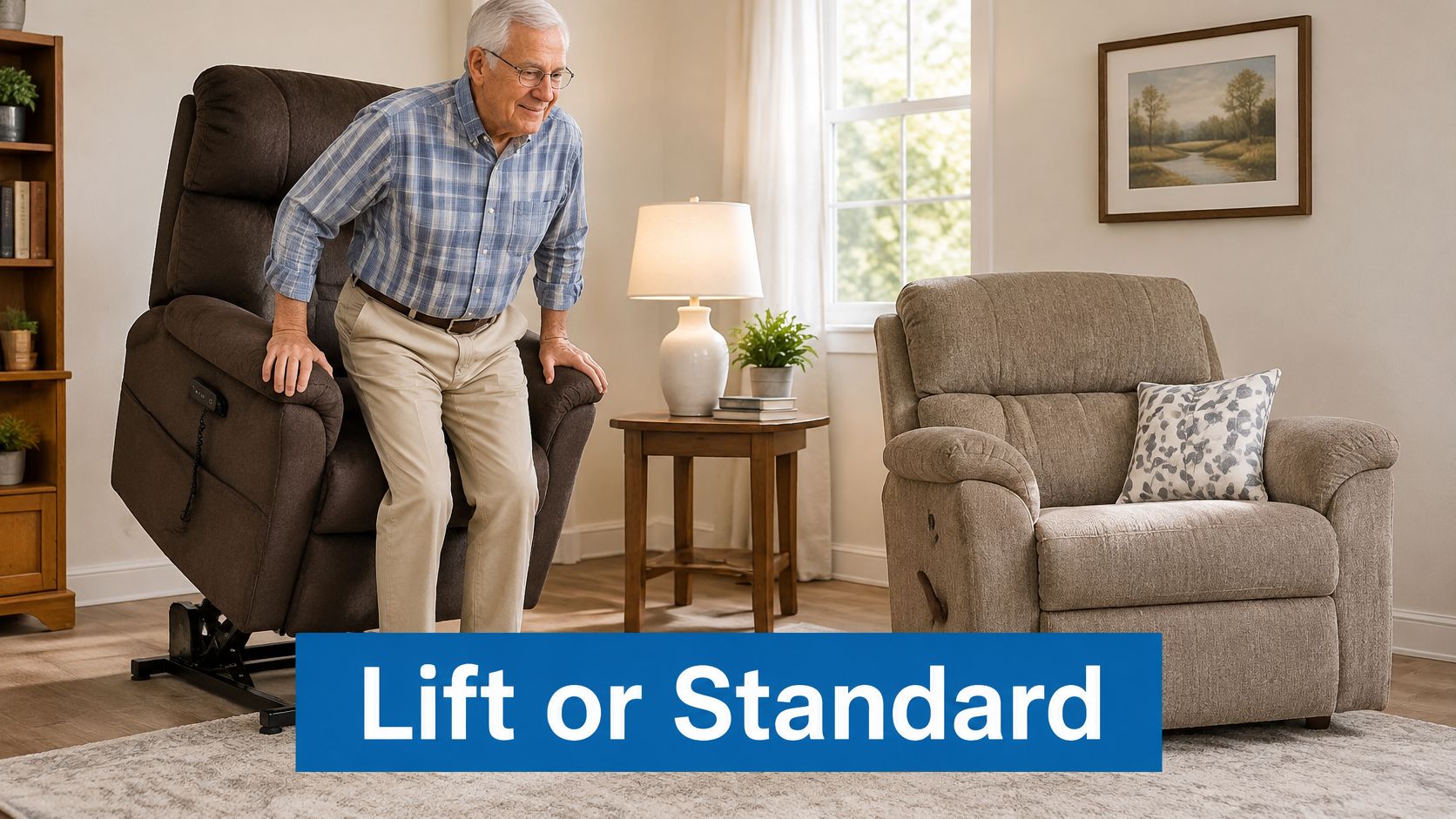
A lift recliner helps most when the user can bear weight through their legs but can't generate enough push to rise from a low or soft seat. The mechanism brings them toward standing. Their legs, balance, footwear, and any walking aid still have to take over at the top.
A standard recliner, manual or powered, can be the better answer when the user can push through firm armrests and the compressed seat height is right. It's simpler, there's less moving hardware, and the user stays in control of the pace of the rise. The trade-off is obvious. If leg strength declines or the cushion sags, that same chair can become hard to exit.
Where a lift can create risk
Powered movement needs judgement and control. A user with cognitive impairment, unreliable balance, or poor ability to stop and stabilise in a moving chair may rise before they're ready or activate the control accidentally. In that situation, I would not treat a lift as automatically safer. I'd want supervision, restricted controls where appropriate, and professional assessment first.
The injury context is sobering. A U.S. Consumer Product Safety Commission report covering 2017–2021 recorded 33.8 fall-related, emergency-department-treated injuries associated with recliner chairs per 100,000 adults aged 65 and older, compared with 2.7 per 100,000 adults aged 25–64, approximately 12.5 times higher for older adults. AARP, citing the same CPSC analysis in the CPSC older adults hazards report, reports an estimated 17,000 annual emergency-room visits among adults 65 and older after falls from recliners.
Those figures don't prove every recliner is unsafe. They do justify checking secure support, predictable reclining action, adequate balance, and a firm surface that doesn't collapse or shift unexpectedly. Softness alone tells you none of that.
Cost sharpens the decision. Lift models occupy the price spread already noted for lift chairs, so compare them against a standard recliner with correct height and a supportive seat, not against a worn-out chair with a failed cushion. For a plain explanation of how lift chairs fit into broader mobility equipment, home mobility support for older adults is a helpful starting point before you talk to an occupational therapist.
My rule is simple. Buy a lift for a specific standing limitation that you've observed and tested. Don't buy it as insurance against every fall risk, and don't let it substitute for an assessment of balance, cognition, leg strength, and the room around the chair.
Safety Features to Check Before You Buy
Test safety with the user in the chair, wearing usual shoes, with any walking aid placed where it will live at home. A showroom glide on a hard floor won't reveal how the chair behaves beside a rug, side table, lamp cord, or walker.
Run this checklist before paying
- Level frame: Push down on each arm and corner. The chair shouldn't rock, twist, or lift a foot, because movement at the base becomes instability during push-off.
- Stoppable recline: Start, stop, and restart the back and footrest at several points. The chair shouldn't lurch or drift during partial recline.
- Reachable controls: The user must reach and operate the remote while seated and reclined, without leaning over an arm or fishing down the side of the cushion.
- Protected activation: Check whether a pet, dropped cushion, or confused hand can press the control. Accidental movement is a real household problem, not a theoretical one.
- Firm armrests: Have the user push down hard enough to begin a rise. Padded arms that compress or flex steal force and can rotate the shoulders at the worst moment.
- Fully closing footrest: Confirm it closes completely before standing. An open or partly open footrest blocks the feet and invites a sideways exit.
- Clear approach: Keep cords, side tables, footstools, and loose rugs out of the path. The user should stand straight ahead, not twist around furniture.
- Sound upholstery: Look for torn edges, loose fabric, and seams that can catch footwear or a walking aid.
Placement is part of the product. The CDC falls facts and statistics page states that more than one in four adults age 65 and older falls each year, and fewer than half of those who fall tell their doctor. Put the recliner for seniors on a stable, level surface with a clear approach and enough room to stand without turning sideways.
The broader trend makes those details harder to dismiss. According to the CDC falls data and research page, the age-adjusted fall death rate increased 21%, from 64.7 per 100,000 older adults in 2018 to 78.4 per 100,000 in 2024. Good lighting, clear pathways, and a footrest that fully closes belong in the same decision as motor power.
For more on arranging seating around older users, see our overview of furniture considerations for elderly users. Then score every checklist item pass or fail. If the chair rocks, can't stop cleanly, or forces a twisted stand, don't explain the failure away because the cushion feels nice.
How to Restore Seat Height on a Sagging Recliner
A sagging cushion lowers the effective seat, so a chair can fail the fit test even when its frame and reclining mechanism still work. Restore height only after you've found out what's giving way.
A numbered restoration check
- Measure both heights: Record the user's popliteal height and the recliner's compressed seat height, because the difference tells you whether sag is large enough to matter.
- Sit and rise five times: Use usual shoes and armrests. Note whether the user sinks, slides, rocks for momentum, or needs several attempts.
- Inspect frame and mechanism: Look and feel for looseness, uneven movement, grinding, one-sided recline, and damaged upholstery that could catch footwear.
- Support a sound frame: If only the cushion has compressed, add a firm support layer under the cushion, matched to the seat dimensions. Don't add a thicker soft pad on top, since it can raise the surface briefly and then compress into the same low, unstable pocket.
- Re-measure under load: Compare the restored compressed height with the target window from your fit measurements. Empty-chair height doesn't count.
- Repeat the controlled rise: The user should sit fully back, place both feet firmly, push through the arms, and stand without sliding or rocking.
- Stop at hardware problems: Loose joints, uneven reclining, or damaged lift parts need a qualified repairer. Don't improvise around a mechanism that carries and moves a person.
That caution matters at population scale. The CDC page on older adult falls reports that in 2024, falls among U.S. adults age 65 and older resulted in approximately 4.5 million emergency-department visits and more than 43,000 deaths. Regular checks for looseness, uneven movement, damaged upholstery, and compressed cushions are basic home maintenance, not overreaction.
If you're deciding what can be added to an existing chair, our roundup of recliner chair accessories and support options helps separate useful support from padding that only changes the surface feel.
A successful fix is measurable. The knees and hips sit at a workable height, both feet stay planted, and the rise is clean and repeatable.
Know the limit. Restoring seat height can't fix balance problems, cognitive impairment, unsafe control use, or failing lift hardware. If the user still can't rise safely after the cushion support is corrected, the chair is no longer the whole problem. Get the user assessed rather than stacking more material under them.
Matching a Recliner to Use Cases and Final Decision
Match the chair to the person's hardest daily transfer. Two people of the same age can need opposite solutions.
Independent senior with arthritis who can push through the armrests. A standard recliner with a firm seat, correct compressed height, and controls or a handle they can operate without a hard grip is often enough. Power recline may reduce effort, though it adds no transfer help when the rise is already controlled and repeatable.
Senior with weak legs who can still bear weight. This is the clearest case for a lift recliner. The user needs help getting from sitting toward standing, then can stabilise and walk away with or without an aid. Test the top of the lift carefully, because that is where the chair hands responsibility back to the user.
Senior with cognitive decline or unreliable balance. Don't hand over an unrestricted powered chair and hope for the best. A caregiver should supervise powered movement, controls should be managed to reduce accidental activation, and the user should be assessed before the chair becomes their main seat. A simpler, stable chair may be safer than a feature-rich one.
Renter in a small apartment. A wall-hugger can solve rear clearance, and a non-permanent cushion support can suit a chair you don't want to modify. Measure the full forward travel and standing zone, not just the distance from the wall. A compact footprint that traps a walker against a coffee table isn't compact in use.
Caregiver-managed home. Put the chair on a monthly check and ask whether transfers have changed. A chair that was safe six months ago can stop fitting as strength, medication, footwear, or mobility aids change.
Challenge the softer is better assumption
More padding can make standing harder. A deep, soft seat lets the pelvis sink, puts the knees higher relative to the hips, and forces the user to climb out of a pocket. It can also make repositioning harder for someone who spends much of the day in the chair. Comfortable for the first ten minutes isn't the same as safe for prolonged use.
Run the fit test before any buy or retrofit decision:
- Hips back: The user sits fully back with back support, not perched on the front edge.
- Knees workable: Knees sit near a right angle and the feet aren't trapped by the footrest.
- Feet supported: Both feet rest firmly on the floor before rising.
- Arms usable: Armrests take push-off force without compressing or flexing away.
- Controlled rise: The user stands in one smooth attempt and can also lower back down without dropping.
Then decide in order:
- Measure: Compare popliteal height with compressed seat height for every chair you consider.
- Test: Run the fit test and the safety checklist with the actual user.
- Buy or keep: If the chair passes and the rise is safe, choose it or keep the existing recliner.
- Restore support: If it fails only because the cushion has sagged and the frame is sound, test a firm cushion support fix. The Heavy Duty Sofa Cushion Support Board is a couch support for sagging cushions and is on sale for $29.99. Confirm its dimensions against the seat before using it in a recliner context.
- Get assessed: If the mechanism is loose or the user can't rise safely, arrange a clinical or occupational-therapy assessment.
Seek clinical review if you see pain, skin redness, repeated sliding in the seat, new swelling concerns, or repeated failed transfers. Those signs point to pressure, posture, strength, or balance problems that a furniture fix can't answer.
I'd start with the cheapest sound fix. Measure first, add support second, replace last, and let the controlled rise test judge every step.
Meliusly makes support products for beds, sofas, and sleeper sofas. If your recliner frame is sound but the cushion has compressed enough to make standing harder, measure the seat, restore its support, and test the rise again. Visit Meliusly to compare support boards and related furniture fixes that help extend the life of the chair you already own.
Share this post
- Tags: fall-safe recliner, lift recliner, recliner for seniors, recliner seat height, senior recliner chair