

How to Use a Couch Repair Kit on a Sagging Sofa
Posted by Meliusly
You sit in the middle seat because it's your spot, and now you sink lower than everyone else. The cushion has a hollow, your knees sit higher than your hips, and a couch repair kit is already in your cart. Don't order yet.
A sag can come from dead foam, a soft deck, a sleeper mechanism, or a frame that's no longer safe. Each one needs a different fix, and the cheapest patch can hide the failure until it gets worse. Start by naming the failed part.
Find What Is Actually Sagging
That middle hollow didn't appear overnight. Years of nightly sitting compress one zone more than the others, so start by looking at the cushion and the base separately. Pull the cushions off and vacuum the deck so crumbs and grit don't fool your hands.
Do the Press Test First
Press firmly into the center of the cushion and release. According to a plain language guide to foam density, a higher-resilience core should rebound promptly and evenly, while a fatigued core may rise slowly or retain a depression. That lasting dent is compression set, which means the foam cells have lost their ability to spring back after load is removed.
A visible dip alone doesn't tell you which part failed. If the cushion stays flattened, it's the insert. If it recovers, your problem is probably underneath it.
Practical rule: If the dent follows the removable cushion to the floor, blame the cushion. If it stays with the sofa, blame what's under it.
Then Sit on the Empty Deck
With the cushions off, sit or press down hard on the empty seat base. A low, spongy feel with a cushion that recovered points to stretched webbing, tired sinuous springs, or a flexible deck. That's the case where a firm support under the cushion can help, and it's different from repairing sagging couch springs themselves.
Watch for warning signs while you test. Uneven movement from side to side, creaking or grinding, rocking, exposed metal, or a joint that shifts under light pressure points to suspension or frame damage. None of those is a cushion insert problem.
Fabric damage needs its own check. A tear under 3 inches on a surface nobody sits on can take a backing patch that extends at least 1 inch past the damage on every side, with rounded corners so the edges don't peel. Don't hand stitch a load bearing tear, because small stitches pull through stressed cloth.
Stop using that seat if wood is cracked or a sleeper mechanism grinds and won't lock. Covering a structural fault with a board or patch doesn't stabilize it. It lets the joint keep moving, which makes the later repair harder and sometimes impossible.
Couch sag symptoms and the right repair path
| What you notice | Failed part | Kit or board | Stop instead |
|---|---|---|---|
| Cushion stays dented after a firm press and release | Foam compression set | Replace the insert; a board cannot revive dead foam | Do not stack boards on collapsed foam |
| Cushion rebounds but the seated surface is still low | Webbing, sinuous springs, or a soft deck | Firm cushion support board under the cushion | Stop if the empty deck rocks or a joint moves |
| Tear under 3 inches away from where people sit | Upholstery only | Backing patch at least 1 inch past the tear, rounded corners | Do not hand-stitch a load-bearing tear |
| Metal bars felt through a sleeper mattress | Sleeper frame, not the cushion | Support board between the bars, under the mattress | Stop if the mechanism grinds or will not lock |
| Creaking, cracked wood, exposed metal, or a shifting joint | Frame or broken suspension | None until the structure is stabilized | Stop using that seat and call an upholsterer |
Pick your row and stay on it. Buying for the wrong row is how a simple sag turns into two purchases and a seat that still sinks.
Materials Tools Time and Cost
Your shopping list follows the diagnosis, not the other way around. A fabric kit won't firm a soft deck, and a thicker board won't revive collapsed foam. Match every item to the part that failed.
For Live Foam Over a Soft Deck
Gather a tape measure, sandpaper, and either a ready made cushion support board or plywood or medium density fiberboard you can cut to size. Add twine or rubber bands if you're using several cut pieces that need to stay aligned under the cushion. That's the whole list for this row.
Cut each DIY piece at least 2 inches longer than the cushion so adjoining boards meet without leaving a gap your weight will find. Sand every cut edge and corner before it meets fabric. A sharp edge will slice a cushion liner or wear through a cover from inside.
- Measure twice: Record cushion length and deck width at front and back, since older frames aren't always square.
- Sand before fitting: Smooth edges protect the liner, and rounded corners are less likely to catch when you slide the board in.
- Keep pieces together: Twine or rubber bands stop separate boards from walking apart under daily use.
For a Sleeper or a Dead Cushion
On a sleeper, measure width from metal bar to metal bar. The board sits between the bars, not on top of them, because bridging the bars creates a hard ridge and can jam the fold. About 48 inches of length usually covers the zone that carries body weight, and common sleeper widths land near 36, 48, or 60 inches.
If your press test left a dent, skip the board aisle and buy replacement foam instead. Willis Furniture's custom upholstery foam reference identifies approximately 1.8–2.5 lb/ft³ as a common residential replacement range and roughly 28–35 ILD as a practical starting point for everyday seating. Density and firmness aren't the same number. Density is pounds per cubic foot and tracks long term breakdown, while ILD or IFD describes how much force it takes to compress the cushion.
A denser foam is not automatically firmer. Buy density for lifespan and ILD for feel, and don't expect one number to do both jobs.
Time follows the path you choose. Measuring and cutting plywood is typically an afternoon once you include sanding and test fitting. Placing a pre sized board is a short sit and check after the diagnosis is done.
Budget the same way. Spend on foam only when the core is dead, and spend on an upholsterer when springs or the frame failed. A single kit price is the wrong budget because the failed part changes the bill.
How to Install a Couch Repair Kit
This procedure assumes a sound frame and a cushion that still rebounds. If either check failed, don't start here. Go back to the row that matches your symptom.
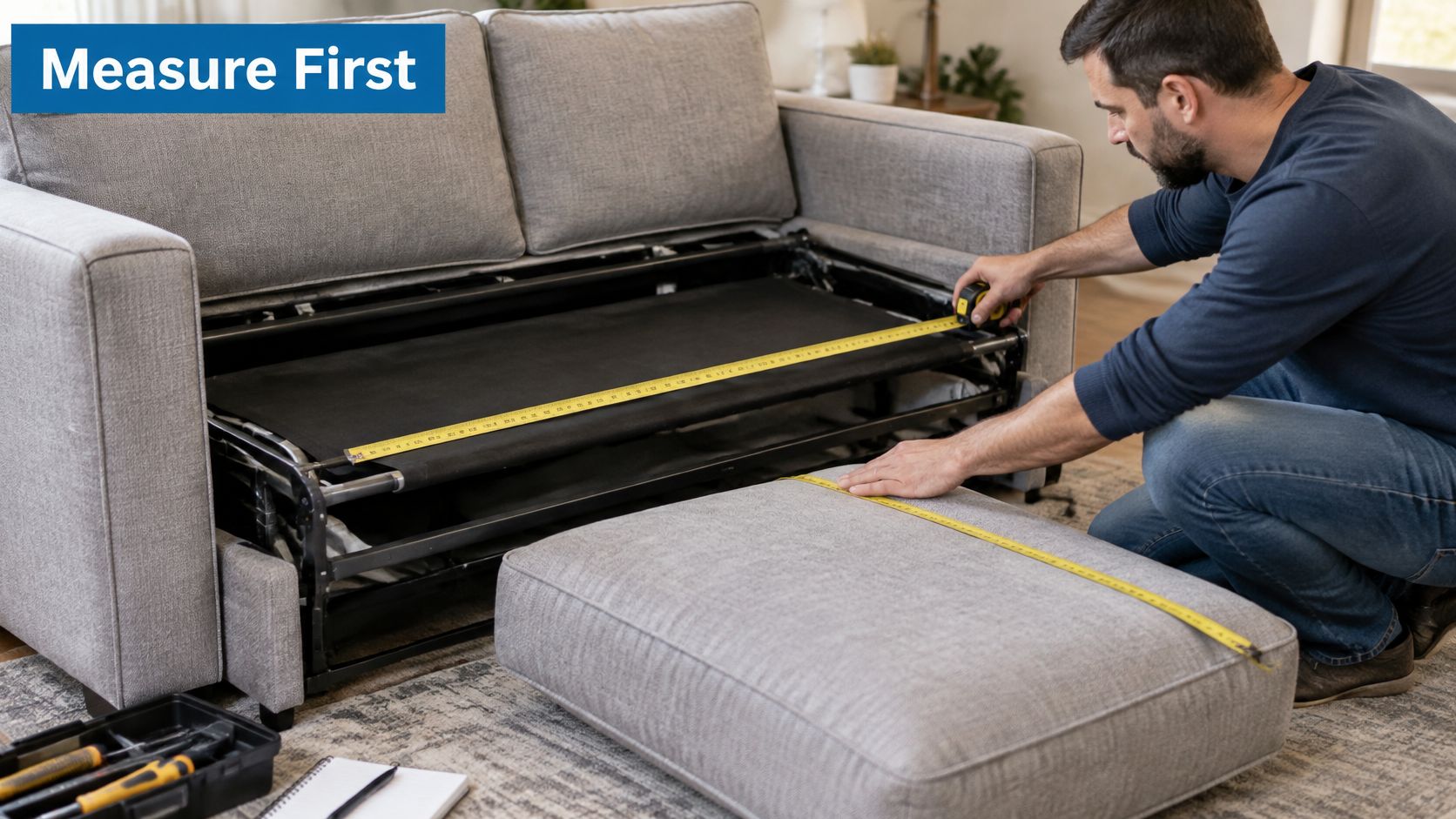
Measure, Sand, and Prep
- Measure cushion length and deck width. Confirm the board is at least 2 inches longer than each cushion so there's no unsupported gap. On a sleeper, remeasure bar to bar and keep the board off the bars. A board sized to the mattress alone can miss the actual load zone or block the fold.
- Sand every cut edge. Run your palm along each side and corner until nothing catches. Skip this and the board will abrade the liner every time someone sits down and shifts.
- Patch fabric only if it passed the earlier test. For a small tear away from the seat, Fix-It Club's upholstered furniture repair guide describes placing an iron-on backing patch behind the opening with its adhesive side against the upholstery, ironing one side first, realigning the edges without puckering, then bonding the remaining side. That guide recommends hand stitching primarily for tears under 3 inches on non-seating surfaces. If the damage is the seat itself, skip cosmetic patching until the support underneath is fixed, or the overloaded cloth will fail again.
Place the Support and Test It
- Slide the board under the cushion. Center it so the extra length is shared front to back. On a sleeper, set the board on the frame before the mattress goes back. If you're fitting a new foam insert instead, don't fold or crush it to force it into the cover, because creased foam can take a set and sit unevenly.
- Tie separate pieces together. If you cut plywood into sections, bind them with twine or rubber bands so they can't drift apart under the cushion. A gap that opens mid seat feels exactly like the sag you just fixed.
- Sit in your usual spot, then stand and check. Look at seat height, left to right level, and any hard ridge where the board ends. Your feet should rest naturally and the front edge shouldn't dig into your thighs. Open and close a sleeper once with the board in place and confirm nothing binds, rubs, or blocks the lock.
- Recheck the next day. Press the cushion again and tug lightly around any patched fabric. Gaping, puckering, or adhesive lift means the underlying stress is still there. A new rock means the same thing.
Don't add another layer to fix a failed test. Remove the board, redo the diagnosis, and fix the part that's actually moving.
That last step is where most home repairs go wrong. People treat a symptom, feel brief improvement, and stack a second product on top. If springs, webbing, or foam are damaged, surface work can't carry the load for long.
Support Boards Foam and a Pro
Four remedies get sold for one word, sagging, but they solve different failures. Pick one based on your test results. Stacking them usually creates a new comfort problem while the original fault keeps going.
What Each Remedy Actually Does
A cushion support board matches live foam over a deck, webbing, or springs that let the seat sink. It's removable and needs no drilling, which suits renters who can't modify furniture permanently. It also has a limit you can feel. If it raises the sit so much that feet dangle or the cushion edge becomes a ridge under your thighs, it's too thick or poorly placed for that seat.
Replacement foam matches a press test that leaves a dent. Fit the insert into the cover without folding it, and check that the closure shuts without straining seams. Learning how couch padding for cushions is layered helps you judge whether batting or the core itself is the flat part. A thin board under dead foam can feel better for a day, then create a hard pressure point and stress the seams around it.
A sleeper support board is its own category. It sits on the frame under the mattress to spread weight across the bars, and a cushion kit won't cover that span or fold with the mechanism. Always check the sleeper open and closed after fitting one.
Call an upholsterer for broken springs, a cracked rail, or a joint that moves. That's structural work, not a shopping problem. For older adults and caregivers, confirm the front edge stays stable and the cushion doesn't slide forward when someone pushes up to stand. Hotels and vacation rentals need the same stability plus a fix staff can inspect quickly without tools.
Which couch fix fits the failure
| Remedy | Choose it when | Do not choose it when | Change to the sofa |
|---|---|---|---|
| Cushion support board | Foam rebounds and the deck or webbing sags | Foam is permanently dented or the frame rocks | Removable, no drilling |
| Replacement foam about 1.8 to 2.5 lb/ft³ | Press test leaves a dent in the cushion | Springs are broken or the cover cannot close | Insert only, cover stays |
| Sleeper support board | Bars are felt through the mattress and the fold still locks | Mechanism grinds, will not lock, or bars are bent | Sits on the frame under the mattress |
| Upholsterer or new sofa | Cracked wood, shifting joints, or exposed broken springs | The only issue is a soft but stable deck | Structural repair, or replacement if unsafe |
Replacing the whole sofa is rational only at the end of that table. If the frame is sound and one component failed, you're paying to discard good wood, fabric, and foam along with the bad part.
Fixes That Keep the Seat Firm
Judge the repair with the same measures you took before it. Write down cushion rebound, seated height, and left to right level before you install anything, then take them again after. On a sleeper, add one full open and close cycle to confirm the board doesn't catch.

What a Good Result Feels Like
A good result feels even, not like a plank. The cushion returns after you stand, both sides sit at the same height, and there's no ridge at the board edge. If a hollow remains in the foam itself, the board was the wrong layer and more board won't correct it.
Density explains why some replacement cushions outlast others by years. LegalClarity's guide to choosing upholstery foam states that foams at or above 1.8 lb/ft³ consistently outperform lighter foams in seating applications, while foam below that level may break down within roughly two to four years of regular use. The same source estimates 2.0–2.4 lb/ft³ foam can provide about a decade of service and foam at 2.5 lb/ft³ or higher may last approximately fifteen to twenty years before noticeable degradation under daily use.
Foam density and how long seating foam tends to last
| Density | How to treat it | Rough daily-use life |
|---|---|---|
| Below 1.8 lb/ft³ | Lower-durability seating foam | About 2 to 4 years |
| 1.8 to 2.0 lb/ft³ | Serviceable residential foam | Outlasts lighter foam; not a decade promise |
| 2.0 to 2.4 lb/ft³ | Stronger choice for daily sitting | About 10 years |
| 2.5 lb/ft³ or higher | High-use seating | About 15 to 20 years |
| Firmness near 28 to 35 ILD | Feel only, separate from density | Not a lifespan rating |
Treat those spans as estimates, not guarantees. User weight, cushion thickness, heat, and a weak deck underneath all change the outcome. A strong insert on a sagging platform still gets worked harder than it should.
Habits That Protect the Repair
- Rotate loose cushions monthly: Swap the middle and end cushions so one seat doesn't take every evening.
- Move the wear around: Keep pets and direct sun off the same corner, since both concentrate damage in one zone.
- Retest every few months: Repeat the press and release check and note any change in rebound.
Watch for reasons to undo the work. A new creak, a board that slides, or an edge that digs into your thigh means reposition or remove it. Don't add a second board to chase comfort.
If the seat rocks after the repair, the frame was never a kit job. Take the board out so it stops masking the movement, and get the structure assessed.
Repair the Sofa or Replace It
A sofa that still has a sound frame may need one part repaired, not a full replacement. Match the fix to the failed part: cushion foam, the support deck, a sleeper mechanism, or the frame.
The Three Exits in Order
If the cushion rebounds but the deck beneath it sags, a support board can help keep the sofa usable. Meliusly's Heavy Duty Sofa Cushion Support Board is designed for sagging cushions and is on sale for $29.99. It suits a sofa with sound foam and frame; it will not restore collapsed foam or repair broken wood.
If the cushion stays dented after you press it, address the foam first. If bars show through a sleeper mattress while the bed still folds and locks, choose a sleeper support board sized for the frame. When springs or joints need assessment, a furniture repair shop can help determine whether repair is practical.
Cracked wood, shifting joints, or broken springs call for professional repair rather than a kit. Replace the sofa if the structural repair is unsafe or no longer worth the cost.
The U.S. Environmental Protection Agency reported that Americans discarded 12.1 million tons of furniture in 2018, with approximately 9.7 million tons, or 80.1%, going to landfills, according to Earth911's reporting on furniture waste. Repairing a sofa with a sound frame can keep it in use instead of sending it to a landfill.
After an install, check the seat again the next day. Keep the repair only if the seat is level, the cushion rebounds, and the frame stays quiet.
Meliusly offers support boards for sagging sofa cushions, sleeper sofa support boards, bunkie boards, and bed slats. If your sofa's foam is sound but its deck sags, compare the cushion and sleeper support options from Meliusly. Measure the furniture and match the support to the part that has failed.