

Upholstery Supplies Guide: Foam, Batting and Webbing
Posted by Meliusly
You sit down on the same end of the sofa you always choose, and it drops lower than it did last month. The cushion looks fine from across the room, but once you're in it, your hips sink, your knees rise, and getting up takes more effort than it should. It's tempting to order new foam that night, or to assume the whole sofa is finished.
Don't buy anything yet. A sag can start in the webbing, the springs, the cushion foam, the deck under the cushions, or several of those layers at once. Ordering the wrong upholstery supplies gives you a firmer version of the same dip. The useful question isn't "what fixes a sofa" in general. It's which layer has failed on yours, what spec that layer needs, and whether the layers above and below it can still do their jobs.
Upholstery Supplies at a Glance
Start by matching your visible symptom to the part most likely causing it. Work in repair order, from cushion down to support, because that is how you'll open and rebuild the piece.
| Supply | Job in the furniture | Spec to check | Replace when |
|---|---|---|---|
| Polyurethane foam | Seat and back cushioning | Density (lb/ft³) and ILD | Cushion has lost height or shows a pancake shape |
| Batting or fiber wrap | Soft layer over foam, arms and backs | Fiber type and loft | Lumps, thin spots or compressed areas |
| Webbing | Support strands across the frame under the seat | Strength and spacing | Strands sag or ends come loose |
| Coil or sinuous springs | Support in the seat base | Gauge and count | Springs are broken or bent |
| Upholstery fabric | Visible cover | Martindale or Wyzenbeek cycles | Cover is worn through or pilled |
| Adhesives and fasteners | Bonding and attaching layers | Bond type and fume rating | Bond peels or staples pull out |
| Board or deck | Flat support under cushions | Thickness and material | Board warps or cracks |
Reading the Table Without Guessing
Polyurethane foam carries your weight and holds the cushion's shape. Check both density in lb/ft³ and ILD, because a cushion that's lost height or flattened into a pancake has a durability problem, not just a softness problem. Batting or fiber wrap sits over foam and around arms and backs to smooth edges and soften the surface. Lumps or thin spots usually mean the wrap has shifted or compressed, but batting alone can't restore a collapsed seat.
Webbing runs across the frame under the seat and spreads the load. If strands sag or stapled ends have come loose, even new foam will settle into the gap. Coil or sinuous springs do a similar support job in the seat base, and a broken or bent spring creates a hollow that cushion changes won't erase. Upholstery fabric is the visible cover, so check its Martindale or Wyzenbeek cycles and replace it when it's worn through or badly pilled. If you're sewing seams or attaching a new cover, choosing thread for upholstery projects is worth sorting before you buy fabric, since thread and needle choices affect seam strength on heavy textiles.
Adhesives and fasteners bond and attach layers, so match the bond type to the materials and check the fume rating before you work indoors. A peeling bond or pulled staple tells you either the product was wrong for the job or the wood underneath couldn't hold it. A board or deck under the cushions provides a flat support surface, and a warped or cracked board needs replacing rather than shimming.
A spec only means something when both products were measured with the same test or method.
That rule runs through every purchase below. Compare density to density, ILD to ILD, and Martindale results only to Martindale results. Find the row that matches your failing symptom first, then use the relevant section to choose the replacement properly.
How the Layers Depend on Each Other
Build the seat from the bottom up in your mind. The frame and deck carry the load, webbing or springs spread that load across the seat, foam gives the seat its shape and resilience, batting smooths the surface, and fabric covers the stack. If the lowest failing layer stays weak, everything you place on top inherits the fault.
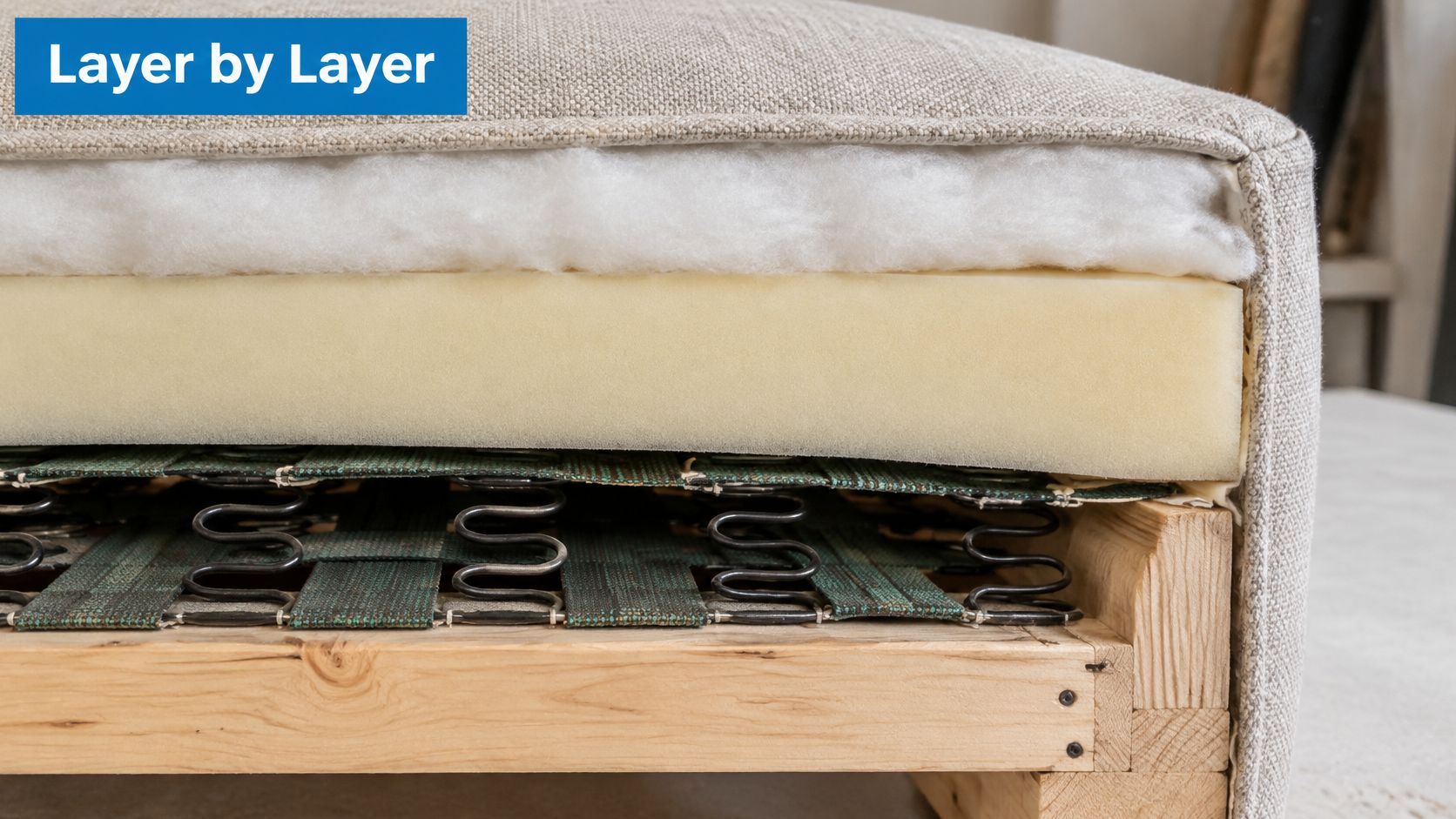
That's why repair works when it's done as a system. The U.S. furniture repair and reupholstery trade classified under NAICS 81142 renews internal elements such as foam, webbing, springs and structural supports as well as visible coverings, according to the IBISWorld furniture repair and reupholstery industry profile. That same profile reports average receipts per employer firm at roughly $415,000. Replacing only the cover while ignoring the suspension underneath skips the part of the job that makes the seat feel right.
Say the cushion feels tired, so you fit a harder foam insert. If the fault is stretched webbing underneath, the new foam bends into the same dip and feels hard and low at the same time. Reverse the mistake and stretch a fresh cover over flattened foam, and the fabric has too little shape to hold, so it wrinkles within weeks.
Failure Signs by Layer
- Batting: Lumps or a gritty, uneven feel under the fabric. Batting adds feel but no structure, so a deep hollow under it usually points to foam or support below.
- Foam: Lost height, a pancake profile, or a cushion that stays indented after you stand up.
- Webbing: Strands with visible slack, staples pulling out, or ends that have come loose from the frame rail.
- Springs: A localized hollow, a tilt to one side, or a broken or bent run you can feel through the deck.
Pull the cushions off and press down across the deck before you buy foam. You can see how the frame, suspension and cushioning stack together in this overview of sofa construction and internal components. Separate reversible fixes, such as re-tensioning webbing or adding a support board while the frame stays intact, from permanent work such as cutting out a spring block. Reversible work comes first because you can test the result. Before you lift any layer, photograph the frame and measure every attachment point, so the rebuilt seat matches its original geometry.
Foam Density and ILD Grades Compared
People mix up density and firmness constantly, and sellers don't always help. Density is the mass of foam in each cubic foot, while ILD describes how firm the cushion feels when you sit on it, as the Coleman Furniture guide explains while setting approximately 1.8 lb/ft³ as a practical baseline for residential sofa seat cushions in its durable sofa buying guide. A foam can feel hard and still be low density. It can also feel comfortable on day one and be built to last, if both numbers suit the seat.
| Foam band | Density (lb/ft³) | ILD | Best use |
|---|---|---|---|
| Baseline residential cushion | 1.8 | 28-35 | Light to moderate daily seating |
| Standard residential replacement | 1.8-2.5 | 28-35 | Everyday family seating |
| Heavy-use replacement | 2.5-3.0 | 35-45 | Frequent use, sleeper sofas and high-traffic seats |
| Very firm, low-density foam | Below the baseline range | Above typical range | Avoid for seats, feels firm at first, breaks down faster |
Willis Furniture describes typical residential replacement cushions in the range of roughly 1.8 to 2.5 lb/ft³ density and 28 to 35 ILD, with heavier-use cushions at approximately 2.5 to 3.0 lb/ft³ and 35 to 45 ILD, in its custom upholstery foam guidance. Use those bands to place a quote, rather than trusting words like premium or high resilience on their own. I would start with the standard band for a family sofa that gets used every evening, then move up only if the seat takes heavier loads or longer sitting sessions.
The mismatch to avoid is the bottom row. A very firm, low-density foam feels reassuringly solid in the shop because your hand reads firmness, not durability. Under repeated compression it breaks down sooner, loses thickness, and produces the pancake effect you were trying to fix. Support needs vary by application too, which is why, for seated mobility use rather than sofa repair, you'd find a Spectrum foam cushion specified for that different job instead of adapting furniture foam at random.
The Test Beyond Density
Density doesn't describe everything. ASTM D3574 includes a compression-set procedure where polyurethane foam is compressed to a specified deflection and then measured for permanent deformation after recovery, and one upholstery-industry guide identifies a compression-set result below 8% after a 40% compression test as a useful durability target for demanding seating in its sofa foam density guide. Ask for the test method alongside the result, because a percentage without its procedure can't be compared fairly.
Before you pay, request three things in writing: density, ILD, and the compression-set result if it's available. Match the cushion to the seat's actual use, not to the cheapest label that feels firm in your hand. A guest chair sat in twice a month doesn't need heavy-use foam. The main sofa in a household with kids, pets and daily sprawling does.
Fabric Abrasion Ratings That Predict Wear
A fabric swatch can look sound and still be the wrong choice for a busy seat. Match its abrasion test method and rating to the expected use; lower-traffic private seating generally needs less abrasion resistance than high-traffic public seating.
ASTM D4966 covers the Martindale method, while ASTM D4157 covers the Wyzenbeek method. They use different equipment and test conditions, so their cycle counts cannot be compared directly. Check the ASTM textile standards listing to identify the methods, and compare fabrics only when they have been tested using the same method.
| Use category | Abrasion rating to compare | Pilling rating (ASTM D3511) |
|---|---|---|
| Lower-traffic private seating | Lower than high-traffic public seating, using one test method | Compare results from the same test method |
| High-traffic or public seating | Higher than lower-traffic private seating, using one test method | Compare results from the same test method |
Specification habit: Record the test method, the pressure or abradant, and the intended use category when comparing samples.
Appearance Is a Separate Test
Abrasion resistance measures surface wear, not whether a fabric will keep a smooth appearance. ASTM D3511 evaluates pilling, the small fiber balls that can make upholstery look worn. Ask for the pilling result separately, and compare fabrics tested by the same method.
A lab cycle count is not a promise of years in service. Fabric construction, frequency of use, cleaning, pet claws, and friction from clothing all affect wear. A sofa used daily by a household with pets needs a more abrasion-resistant fabric than a guest-room chair used occasionally. A higher rating may narrow the choice of fabrics; a lower one may leave more room for softer, decorative options. Treat labels such as “heavy duty” as incomplete unless they include a test method and result.
Adhesives and Tools for Simple Repairs
Most adhesive failures in upholstery come from using a decent product on the wrong materials. Match the bond to the joint first, then worry about brand.
| Adhesive or fastener | Best for | Limit to know |
|---|---|---|
| Spray contact adhesive | Bonding foam to wood or fabric over a broad area | Strong fumes, ventilate and follow the label |
| PVA wood glue | Joining wood boards and frames | Slow to cure, not for flexible foam bonds |
| Hot-melt glue | Quick fixes on fabric edges and trim | Softens with heat, not for load-bearing joints |
| Staples and tacks | Attaching fabric and webbing to wood frames | Can pull through weak or split wood |
Spray contact adhesive earns its place on broad, flat work such as foam to wood, thin foam to a panel, or fabric over a padded board. Apply it evenly, let it reach the tack the label specifies, then press the layers together once, because repositioning after contact usually tears the bond or the foam. Work with ventilation and keep it away from ignition sources.
PVA wood glue is for wood to wood. Use it on frame joints, deck boards and corner blocks, clamp the joint, and give it the full cure time. Don't ask it to hold a flexible foam bond, since foam flexes with every sit and a rigid glue line can't follow that movement. Hot-melt glue handles trim, gimp, fabric edges and small tacking jobs quickly, but it softens with heat and creeps under sustained load, so never let it carry seat weight or webbing tension.
Staples and tacks attach fabric and webbing to wood frames. Match the staple length to the combined thickness of material and frame rail, and check the wood first. Staples driven into split, softened or previously chewed-up rails will pull through again, and adding more staples beside the failed ones only weakens the rail further. If you're re-covering a removable seat pad as part of the job, the sequence in this guide to recovering a chair seat step by step shows the staple pattern that keeps tension even.
Core Tools for a Simple Repair
- Sharp utility knife: Clean foam cuts need a fresh blade and several light passes, not one forced cut that tears the edge.
- Straight edge: Guides long foam and board cuts so they sit flush in the frame.
- Staple gun: Drives consistent fasteners for fabric and webbing, with staples matched to material thickness.
- Tape measure: Records deck and cushion dimensions before anything is removed.
- Clamps: Hold glued wood joints and boards in position while the bond cures.
- Marker: Labels attachment points, orientation and measurements directly on hidden frame faces.
Test any new adhesive on a scrap of the same foam or fabric before you commit the visible cover.
That one habit catches melting, staining and weak bonds while they're still free to fix. Some solvent-based sprays attack certain foams, and some glues bleed through light fabrics. A scrap test takes two minutes and tells you all of it.
Fire-Safety and Indoor-Air Checks Before You Buy
The cover fabric doesn't decide fire safety on its own. In the United States, upholstered furniture is subject to 16 C.F.R. Part 1640, which incorporates California Technical Bulletin 117-2013 for applicable products, according to the U.S. Consumer Product Safety Commission upholstered furniture FAQ. The framework evaluates four components, cover fabric, resilient filling material, barrier material and decking material, for smolder resistance, char length, continued smoldering and transition to open flaming. A fabric that passes on one foam and barrier combination can behave differently on another.
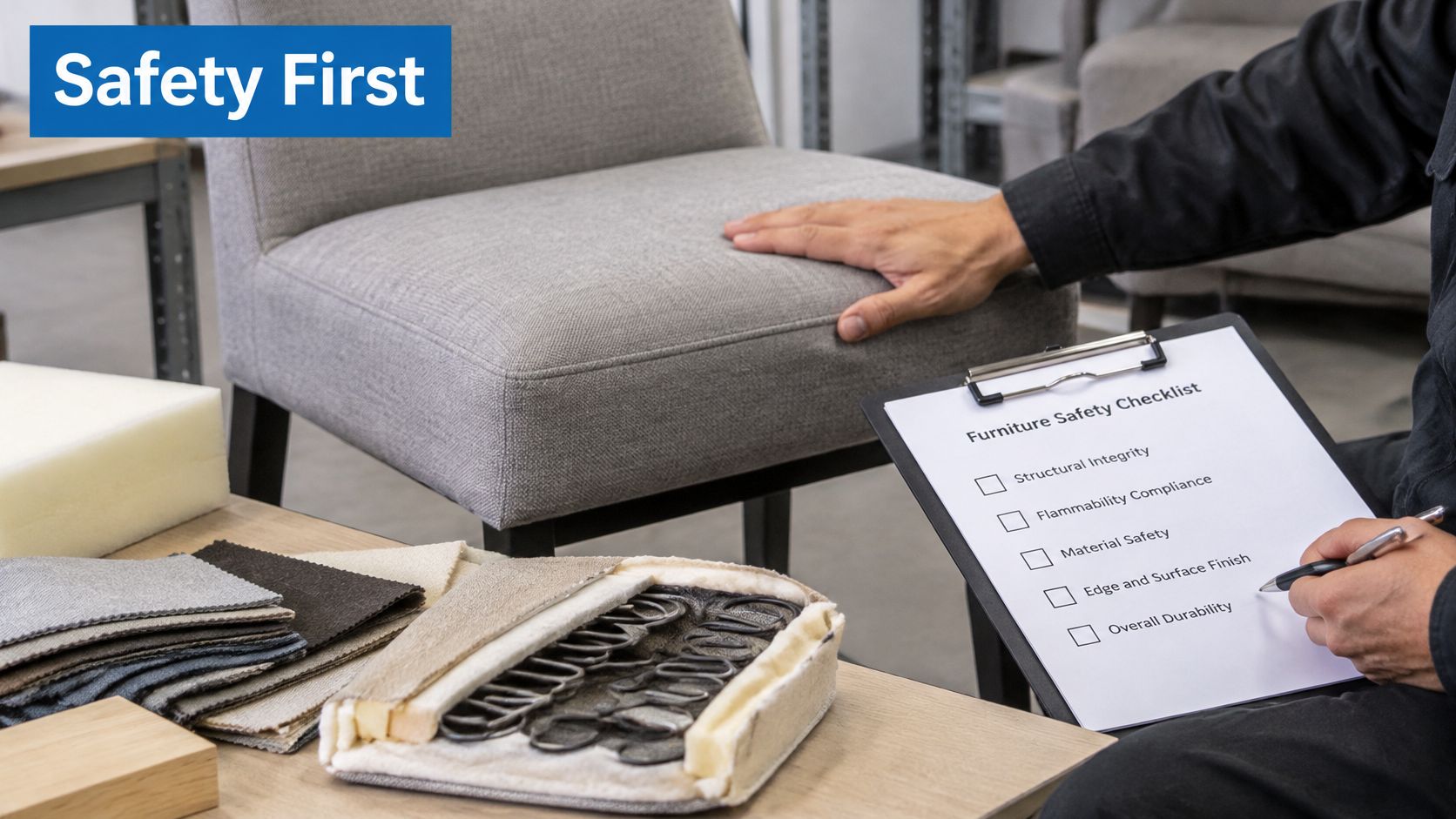
That matters directly for repairs. Substituting a different foam density, barrier, adhesive or fabric can change how the whole assembly performs, so ask for the exact material construction and test status for the filling, barrier layers, decking, thread and cover you're buying. Treat a generic fire retardant claim on a product page as unverified until the documentation names the standard and the component tested. The stakes rise for sleeper sofas, rental properties, hotels and care environments, where repair materials enter an existing assembly and other people's safety depends on it.
Indoor Air Gets Less Attention Than It Deserves
Flame retardants, stain repellents and antimicrobial finishes can release emissions over time, and independent interior-material guidance recommends checking textile certifications, requesting emissions documentation and safety data sheets, and ventilating new materials, as described in the Goodrich Global guide to indoor air quality and interior materials. A heavily treated performance textile isn't automatically the healthiest choice. Flame-resistant fibers can reduce reliance on topical chemical treatments, and low-VOC or harmful-substance certification may matter more than a marketing label.
Know what each certification verifies. OEKO-TEX Standard 100 tests for harmful substances in the textile. GREENGUARD addresses chemical emissions into indoor air. FloorScore applies to flooring, so it may not cover an upholstery textile at all, even if a supplier lists it nearby. None of these, by itself, proves fire compliance for your assembled piece.
Use a short checklist before materials go into a home, and keep it stricter for nurseries, schools, healthcare and rooms for older adults or anyone with allergy concerns.
- Request documentation: Emissions information and safety data sheets for foam, fabric treatments and adhesives.
- Ventilate new materials: Air out foam and fabric before installation where space allows.
- Consider testing: Post-installation air-quality testing in sensitive settings such as childcare or healthcare.
Where to Source Supplies and What to Ask For
Buy foam by specification, not by label. Ask the supplier for density in lb/ft³, ILD, and the compression-set result when available, with the test method named. If a seller can't provide those numbers, treat the product as unverified and price it accordingly, which usually means not putting it in your main seat.
Specialty upholstery suppliers and foam fabricators often cut to size, and that service matters more than a small price difference. A cushion cut even slightly wrong won't sit right in the frame, crowds the neighboring cushion, or leaves a gap that swallows remotes and strains the cover. Send the dimensions you recorded from the frame and deck during your inspection, not measurements taken from the old cushion, since a failed cushion has already compressed and spread.
Fabric, Adhesives and Boards
For fabric, order trade samples first and check the abrasion and pilling values before committing to full yardage. Confirm which test method produced the abrasion number and match it to your use category. Hold the sample against your existing furniture in daylight and lamplight, and flex it over a cushion corner to see how it behaves on a curve. Backing matters here too, since knit, acrylic or latex backings change how stable and stiff a face fabric feels during cutting and stapling.
For adhesives and fasteners, choose products whose labels state the bond type and fume rating, and file the safety data sheet with your repair records. You'll want it later if you need to redo the bond or check what went into a child's room. Buy a support board sized to the frame's deck, not the cushion, because the board has to span the support structure underneath. A board cut to cushion size can bridge over the very gap it was meant to cover.
Purchasing rule: Compare suppliers on documented specs and whether they'll exchange a mis-cut part, not on headline price alone.
A slightly higher price from a fabricator who recuts an error beats a cheap insert you have to trim with a bread knife. Keep receipts, spec sheets and your dimension notes together, so the next repair starts from records instead of guesswork.
Step-by-Step Repair for a Sagging Seat
Work in this order, from diagnosis to recheck. Each step tells you whether the next, more expensive step is even needed.
- Remove the cushion and press the seat. Push down firmly in the dip and across the rest of the deck. Note the exact spot and whether the deck or webbing gives under your hands, because a soft cushion over firm support is a different repair from a firm cushion over failing support.
- Photograph and measure before lifting fabric. Record the seat deck dimensions and mark each attachment point on hidden frame faces. Photos of the underside save real confusion later, especially for webbing patterns and spring clip positions.
- Inspect webbing and springs. Look for stretched or loose webbing strands, pulled staples and bent or broken springs. Re-tension or re-fasten webbing where the frame rail is sound, following the strand layout shown in this sofa webbing replacement walkthrough. If the rail is split, repair the wood first.
- Add flat support if the dip persists. Place a support board on the deck or under the cushion so it spreads the load across the seat frame. Sit-test now, before buying foam. If a board alone restores a level seat, your cushion foam may still have life in it.
- Measure for replacement foam. Compare the cushion against your recorded frame dimensions, then buy foam in the density and ILD band that matches the seat's use. Order dimensions that fill the cover properly, since an undersized insert wrinkles the fabric and shifts with use.
- Attach new foam with suitable adhesive. Use adhesives suited to flexible foam for bonding layers or attaching wrap, and test the bond on a scrap first. Keep rigid wood glue for frame and board joints only.
- Rebuild, sit-test and recheck. Reattach the batting so it lies smooth without bunched corners, pull the cover on evenly, and sit in every position you normally use. Recheck the dip after a week of normal use, because fresh foam and re-tensioned webbing settle slightly as the layers bed in together.
If step three reveals a cracked frame rail or a spring that has torn through its mounting, stop and reassess before spending on foam. Cosmetic layers can't compensate for structure that's letting go.
Decide Whether to Repair, Reinforce or Replace
Diagnose each part separately before you decide anything: frame, webbing, springs, foam, cover and support surface. A single global verdict like "the sofa is worn out" hides the fact that most pieces fail one layer at a time. Write down what's sound and what isn't, because sound layers change the economics completely.
For each failing layer, ask whether the fix is reversible or permanent. Adding a board, re-tensioning webbing and replacing a foam insert are reversible or repeatable. A broken frame rail or springs cut out of their block are permanent problems that demand carpentry or professional work. Then check whether repairing the lowest failing layer costs a sensible share of what the piece is worth to you, in money or in fit for the room. A well-built frame with tired foam is almost always worth repairing. A cracked frame under worn fabric rarely is.
Your situation should shape the choice. Renters should favor reversible reinforcement such as a support board, which improves the seat and leaves the furniture unchanged when you move out. Hospitality operators should standardize on one supply set and record dimensions and attachment points across rooms, because improvised repairs create uneven seating and trip hazards that guests notice. And the greenest supply isn't always the one with the highest recycled content. A durable, accessible, replaceable component often extends a piece's life more effectively than a difficult-to-service material, since a repair you can perform beats a virtuous one you can't.
For a sagging seat or sleeper sofa, I'd buy support before foam. We sell support products for beds, sofas and sleeper sofas, including the Heavy Duty Sofa Cushion Support Board, a couch support for sagging cushions currently on sale for $29.99, and the SleeperSaver Classic for sleeper sofa beds. Check your frame size against your recorded deck dimensions before ordering, since a board only works when it spans the structure it rests on.
If your inspection shows sound foam over a seat that dips, start with support rather than a full rebuild. Meliusly offers sofa cushion support boards and sleeper sofa support boards designed to reinforce the layer your cushions depend on, so you can extend the life of the furniture you already own. Measure your seat deck, compare it with the available sizes, and visit Meliusly to choose the support that fits your piece.