

Best Sofa for Elderly: Seat Height, Firmness and Fixes
Posted by Meliusly
The number of people aged 60 and older is projected to grow from 1.2 billion in 2024 to 2.1 billion by 2050, an increase of approximately 75%, according to United Nations population projections. Choosing suitable seating isn't a niche concern. For many households, the best sofa for elderly family members is the one that makes everyday sitting and standing manageable, not the one with the softest cushions.
Why Seat Height Matters More Than Softness
A sofa is an accessibility decision when its user has reduced leg strength, painful joints, or difficulty balancing. The important question isn't whether sitting feels comfortable. It's whether the person can lower themselves with control, remain supported, and get back up without struggling.
Softness can disguise poor support. A cushion may feel inviting at first, then let the pelvis settle into a hollow that makes leaving the seat difficult. An elderly-friendly sofa needs enough cushioning for comfort, but a dependable surface underneath it.
Judge the whole movement
Start by watching how the person uses their current sofa. Do they drop into it, shuffle repeatedly toward the edge, or pull on nearby furniture? Those movements give you a more useful shopping list than descriptions such as plush or oversized.
Prioritize these features:
- A stable seat: The cushion and its supporting deck shouldn't collapse unevenly.
- Suitable height: The seated position should suit the user's legs rather than the room's styling.
- Supportive arms and back: Contact points should remain dependable as the person changes position.
- Controlled cushioning: The surface should cushion the body without swallowing it.
Practical rule: Buy for the way the user gets out of the sofa, not just the way they settle into it.
That doesn't automatically mean replacing the furniture. A sound sofa with a sagging support deck may be worth restoring, while a structurally intact but badly proportioned sofa may never fit the user well.
Use a tape measure, observe an actual sitting-to-standing movement, and separate poor fit from lost support before spending money. Those checks help you decide whether you need a different sofa, a more suitable individual chair, or a targeted repair.
Best Sofa Types for Older Adults at a Glance
Sofa types compared for older users
| Sofa type | Rising effort | Best for | Main trade-off |
|---|---|---|---|
| High-seat sofa | Low when the seat sits near knee height | Limited leg strength or joint pain | Confirm seat height on the compressed cushion |
| Standard 3-seat sofa | Higher when deep, reclined, and soft seats add effort | Shared living rooms with several users | Deep seats and compliant cushions make rising harder |
| Two-seat sofa with firm cushions | Moderate when cushions remain supportive | Smaller rooms and closer armrest reach | Less seating for guests |
| Power lift-recliner sofa | Reduced by motorized lift assistance | Users who cannot rise unaided, subject to an individual assessment | Higher cost, power supply, and placement space needed |
Treat this as a conditional ranking, not a product guarantee. A high-seat sofa loses its advantage if its front edge collapses, while a conventional sofa can work well when its proportions and support suit the person using it.
The mechanical difference matters. A peer-reviewed study of chair height and standing found that participants increased their trunk-flexion angular velocity as seats became lower, changing how they moved to overcome the greater difficulty. Lift-assistance experiments also support reducing lower-limb demands, but a powered product still needs an appropriate fit, accessible controls, and a workable room layout.
Distinguish reclining from lifting
A power recliner changes the backrest or footrest position. A genuine lift mechanism helps raise the seated user toward standing. Don't assume a sofa provides lift assistance because its listing says power reclining.
Check which seat lifts, whether the user can operate it comfortably, and whether the furniture has space to complete its movement. If the person can't stand safely without assistance, involve an occupational therapist or physiotherapist rather than choosing by mechanism alone.
If the user must push against a loose, soft cushion to stand, remove that sofa from the shortlist unless its support can be corrected.
Type narrows the search. Loaded measurements and a supervised sit test decide fit.
Measure and Test Fit Before You Buy
Bring a tape measure, a notebook, and the footwear the person normally wears at home. Measure the candidate with the intended user seated, because the empty cushion's height doesn't tell you where their body will rest.
New York City's aging-in-place guide recommends seating 17 to 19 inches high, with a seat depth of no more than 24 inches, plus arms, backs, and sturdy, comfortable construction. These are useful comparison benchmarks, not dimensions that suit every body.
Individual proportions deserve equal attention. An experimental seating study involving adults aged 61 to 70 reported its best comfort ratings with a seat equal to popliteal height or 25 mm below it, paired with a 105-degree backrest inclination.
Measure the person before the sofa
Popliteal height means the distance from the floor to the underside of the knee. With the person seated in their normal footwear and their lower legs comfortably upright, measure that distance without pressing the tape into the leg.
Next, measure from the floor to the top of the compressed seat beside the user's hip. Measure usable depth from the supporting face of the back cushion to the front edge, not from the outside of the sofa frame. Our seat-depth ergonomics guide explains why the advertised overall depth isn't the measurement that determines sitting fit.
Sofa measurements and targets for older users
| Measurement | Target | Why it matters |
|---|---|---|
| Compressed seat height | 17 to 19 inches as a starting benchmark | Matches aging-in-place guidance; cushion compression lowers usable height |
| Seat depth | No more than 24 inches as a starting benchmark | Helps the user sit back without excessive reaching |
| Seat height vs popliteal height | Equal to popliteal height or 25 mm below | Produced the best comfort ratings in the older-adult study described above |
| Backrest angle | About 105 degrees | Offers a slightly reclined starting position without an excessively laid-back posture |
| Foot contact | Both feet flat on the floor | Gives the user a stable base for rising |
Record whether the pelvis remains level or slides into a depression. A sofa that meets the table's dimensions can still fail if the back cushion pushes the person forward or the seat edge presses behind their knees.
Run a supervised sit test
Use the following as a practical shopping routine, not an endurance test. Skip repetitions if the person is fatigued or unsteady, and don't remove support they normally need.
- Sit normally. Let the user settle against the back rather than perching at the front.
- Check both feet are flat. As the person prepares to move forward, watch for tipping, cushion movement, or loss of foot contact.
- Observe repeated rises if safe. Aim for three comfortable attempts without pulling on the sofa back, then an attempt using the arms as the push-off points. Don't require hands-free standing.
- Confirm the intended arm supports are reachable from a back-supported position without twisting.
- Allow a longer sit. I recommend at least 10 minutes before checking for uncomfortable pressure at the hips and thighs, especially when sensation is reduced or joints are painful.
- Recheck at home after a few weeks and periodically afterward. Cushion settling and frame movement may become noticeable only with continued use.
A pass looks controlled: the user rises smoothly, keeps their feet planted, and uses accessible support without rocking or sliding. If the test fails, keep shopping or correct the specific support problem, then test again.
Armrests, Width and Firmness Compared
A wider, deeper sofa isn't automatically more comfortable for an older user. Extra room helps only if the person can reposition easily and reach a dependable push-off point.
A behavioral study of older adults using sofas found that wide seating encouraged positions far from armrests, followed by standing without using them, a forward-leaning pattern associated with higher-risk standing behavior. The practical issue is where the person sits, not how many people the sofa accommodates.
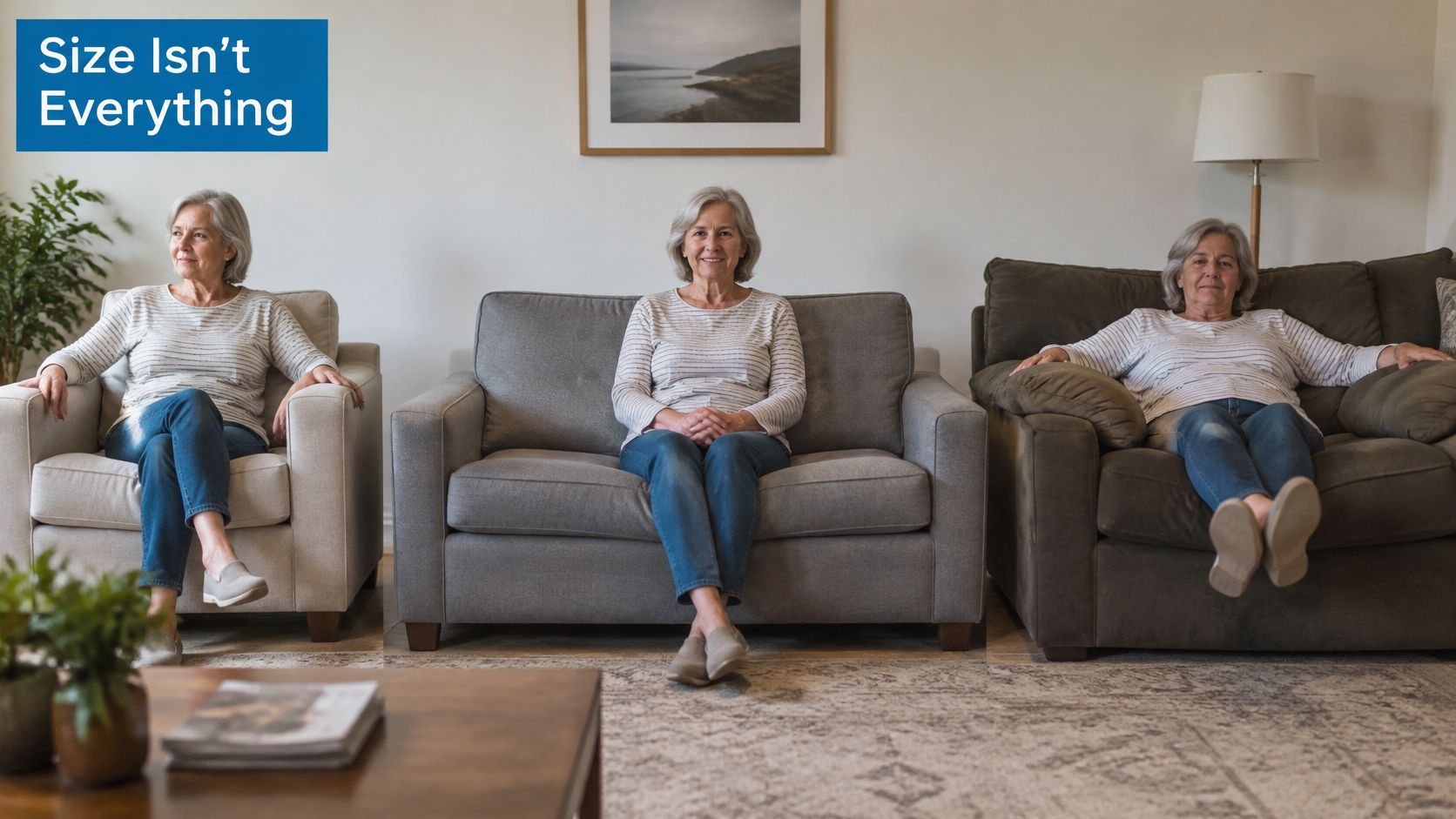
Width and arm access belong together
Compare the user's usual place on a two-seat sofa with their place on a deep three-seat sofa. The smaller unit may put an outer arm closer, but a loveseat doesn't automatically provide access to both arms. Someone sitting at one end may still be too far from the opposite arm to use it.
If bilateral arm support is necessary, an individual chair with arms may be the better choice. Don't try to solve that requirement by asking the user to stretch across an empty cushion.
Check the arms themselves, too:
- Position: The person should find the hand-contact point without searching behind their body.
- Shape: The hand should rest securely without needing a painful grip or awkward wrist position.
- Stability: Downward pressure shouldn't make the arm shift, creak excessively, or move away.
- Surface: Loose padding shouldn't roll beneath the hand during push-off.
A broad upholstered arm may work well for someone who pushes through the palm. A narrower arm may suit another person's grip. The user's movement decides which is useful, not the arm's appearance.
Support isn't the same as hardness
Maximum firmness isn't the target. A seat can resist sinking yet still feel uncomfortable beneath sensitive hips or thighs. Someone with arthritis, neuropathy, or limited sensation needs a comfort assessment as well as a standing test.
Press the cushion near its front edge, then observe it under the user's weight. Does it maintain a usable shape, or fold and pull the person inward? Does a shared cushion slope toward the middle when another person sits down?
Choose a stable support layer with enough surface cushioning for comfort. Don't use a hard surface to compensate for the wrong seat dimensions.
For comparison shopping, separate these questions: can the person tolerate sitting, can they reposition, and can they stand? Passing only the final test isn't enough for furniture they'll use throughout the day.
For many users, a more compact, supportive sofa with reachable arms is a better choice than a larger, softer model. Where arm access remains poor, choose a suitable chair rather than forcing a sofa to do a chair's job.
Which Sofa Fits Which Household Need
Different households need different solutions. These scenarios show how to turn a movement problem into a furniture decision without buying features the user won't benefit from.
A homeowner living alone
Consider a widowed homeowner with reduced leg strength who gets up frequently to answer the door or move between rooms. A generous lounging sofa offers little benefit if leaving it requires repeated effort.
Prioritize a supportive, higher sitting position and an arm within easy reach at the person's preferred seat. A high-seat, firm sofa is a sensible starting point, with a narrower configuration if that improves access.
Hand function also matters. A study of healthy older adults linked weaker grip strength with greater movement and a longer extension phase during standing. Don't select an arm shape the user can't comfortably hold or press against.
A retired couple with different comfort needs
Say one partner has arthritis and the other prefers a softer seat. Buying the plushest shared sofa may leave the first partner struggling, while an excessively hard replacement may create a different discomfort.
Choose a supportive two-seat sofa with a comfortable top layer, or coordinated chairs when their needs differ substantially. Test each person's normal sitting position rather than assuming a shared cushion feels the same everywhere.
For comparing upholstery upkeep after fit is settled, the Interiors by DeX low-maintenance material guide provides a useful companion resource. Cleaning convenience should complement body support, not replace it as the deciding factor.
A caregiver household with limited space
A compact room needs room for both the furniture and the person moving around it. An extended footrest, side table, or power cord can interfere with the space needed to approach and turn.
If lift assistance is appropriate, consider a compact lift-recliner, positioned so the user can stand and turn without immediately negotiating an obstacle. Our guide to recliner chairs that help you stand up helps distinguish supportive seating from actual standing assistance.
A renter keeping the existing sofa
A renter may need a reversible improvement rather than new furniture. If the frame is sound and the main problem is a sagging deck, a support board beneath the cushions is worth evaluating.
Confirm that the resulting sitting position still suits the user and doesn't make the arms effectively too low. For mixed households, plan around the person with the lowest strength, but don't force everyone into identical dimensions when separate seating would fit better.
How to Fix a Sagging Sofa Without Replacing It
Sagging cushions and a sinking support deck can leave the user sitting in a hollow rather than on a level surface. Before replacing the sofa, identify which part has lost support.
Stability deserves attention beyond comfort. The CDC reports that more than 14 million U.S. adults aged 65 and older, about 1 in 4, report falling each year. That doesn't mean a sofa support prevents falls, but it does make rocking frames and shifting cushions problems worth addressing promptly.
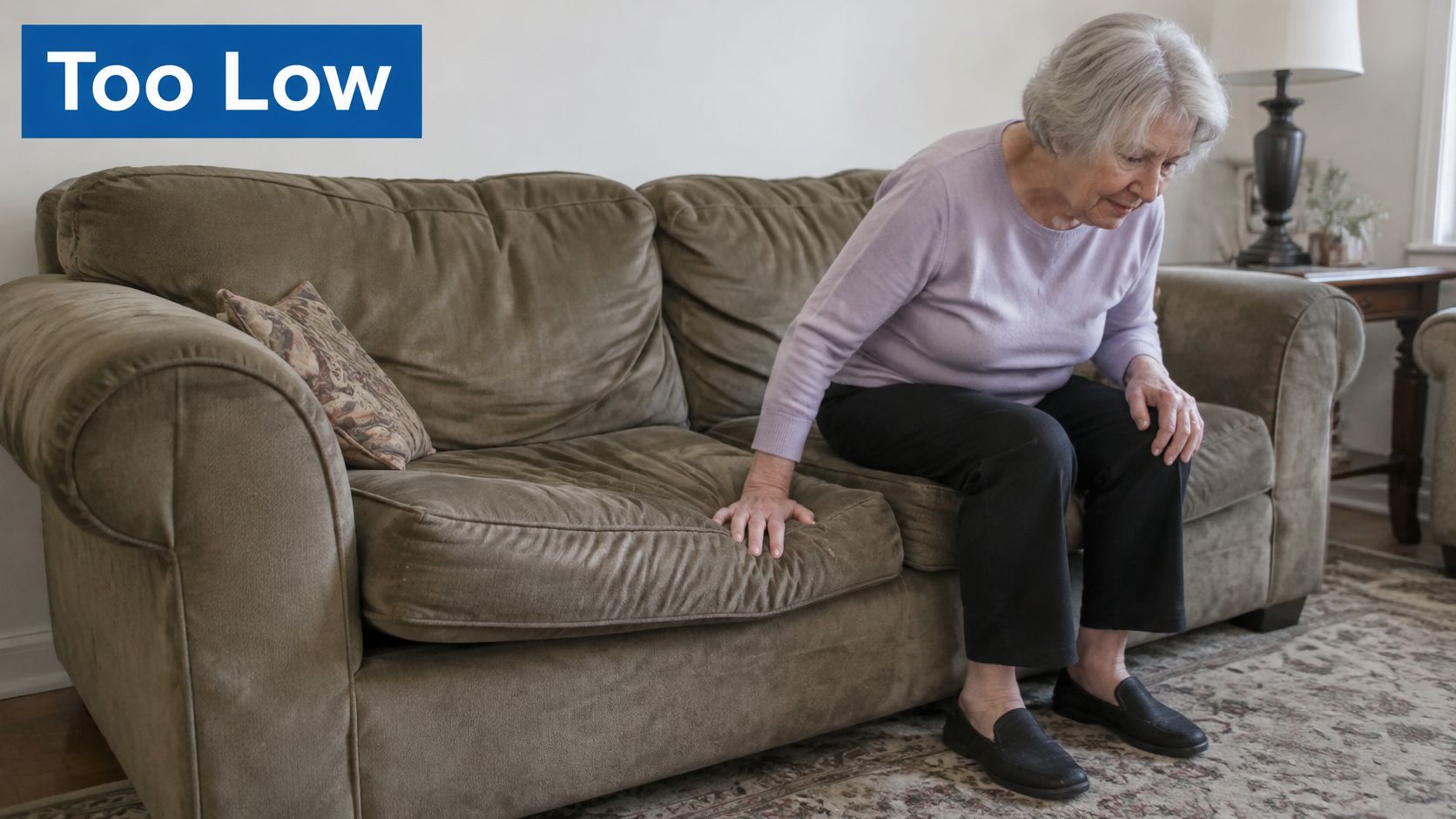
Inspect before adding support
Remove the loose cushions so you can distinguish a deck problem from deteriorated cushion fill. A flat support underneath won't restore the resilience of worn-out foam, and it won't reconnect a broken frame.
- Check the frame, feet, and joints. Look for rocking, loose leg attachments, cracked components, or movement at the arms. Stop using the seat if structural movement makes transfers unreliable; a panel isn't a structural repair.
- Measure the occupied seat and note where the pelvis settles. Compare the depression beneath the cushion with the cushion's own loss of shape.
- Select a correctly sized support panel. Match it to the usable deck and cushion footprint without unsupported gaps or overhanging edges. Verify the material, compatibility, and any published load rating before buying; don't assume all boards have equivalent specifications.
- Place the panel flat beneath the cushions, following the product's fitting instructions. It shouldn't bridge an unsuitable mechanism, interfere with moving parts, or introduce a sliding surface.
- Check the new sitting position. Confirm full-foot contact, comfortable back support, and usable arm height. Restoring support shouldn't leave the user perched too high.
- Repeat the sit test. If rocking or sliding continues, remove the modification and investigate the cause rather than adding more layers.
Our DIY sofa repair guide can help you separate a support upgrade from a repair that needs upholstery or structural work.
Choose the fix that matches the failure
The Heavy Duty Sofa Cushion Support Board is our couch support for sagging cushions. It's on sale for $29.99; check the current listing before ordering because pricing can change. Compare its fit information with your exposed deck measurements rather than ordering from the sofa's overall width.
Keep maintenance separate from reinforcement. For cleaning and upholstery upkeep alongside a support repair, use the furniture care advice from Eco Clean Solutions and follow the sofa's care label.
Repair limit: A support board may restore a flatter sitting surface and recover height lost to deck sag. It can't repair a broken frame or make unsuitable furniture suitable for every mobility need.
If standing remains difficult after the furniture fits and feels stable, seek an individualized assessment. Reinforcement doesn't replace medical advice, appropriate mobility equipment, or professional fall-prevention changes.
Meliusly has served over 400,000 customers with furniture support solutions, including sofa supports, sleeper sofa support boards, bunkie boards, and bed slats. If your sofa's frame is sound but its seat has sagged, visit Meliusly to compare support options against your deck measurements and restore usable comfort before committing to replacement.