

Recliner Chair Pressure Cushion: Does It Really Help?
Posted by Meliusly
You settle into your recliner, raise the footrest, and feel the same sore spot under your hips. A spare pillow helps briefly, then it shifts, your pelvis sinks, and standing up takes a shove off the armrest. Before buying a thicker cushion, work out which problem you have: poor pressure distribution, a seat that has lost support, or a chair that fits you wrong.
Meliusly makes support products that extend furniture life rather than replace usable pieces, and every fix starts by identifying what has failed. A recliner chair pressure cushion earns its place only if it stays put under your weight through every recline position. First-sit softness tells you little; where the cushion sits after an hour tells you more.
How a Pressure Cushion Works Across Recline Positions
A pressure cushion helps when it reduces concentrated loading beneath your sit bones and stays properly positioned throughout reclining. It doesn't repair a sagging seat or remove the need to change position. Judge it by what happens after the chair moves, not just how welcoming it feels when you sit down.
Think of snowshoes on soft snow. Spreading the same load over a wider supporting area reduces how far it sinks into one spot. A seating cushion aims for a similar result, although your body needs both support and controlled immersion, not a larger pad alone.
The Herman Miller pressure-distribution essay describes measures including peak pressure and pressure–time integral, which help distinguish concentrated loading from exposure over time. In practical terms, ask how heavily a spot is loaded and how long it remains loaded.
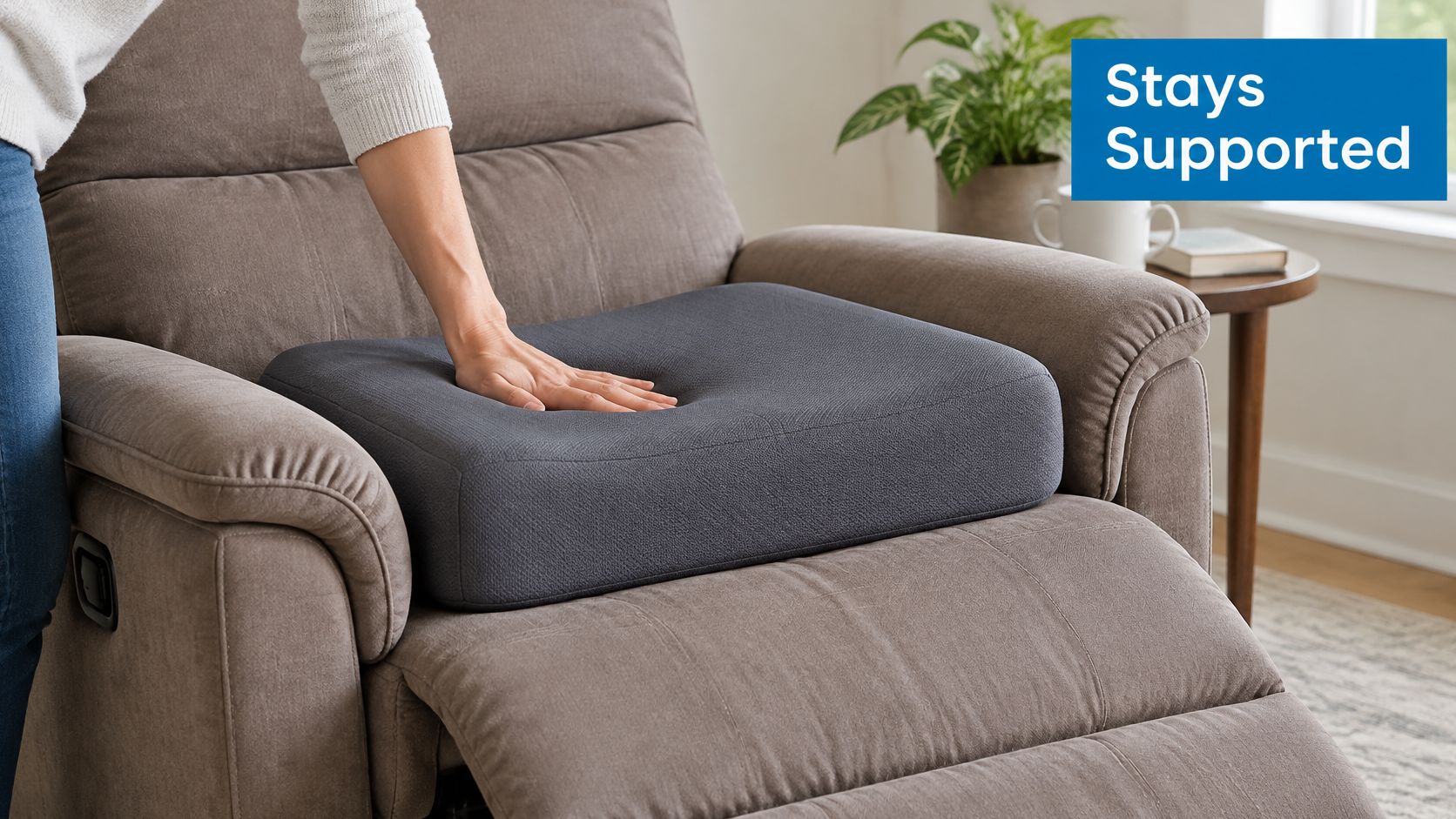
Follow the Load as the Chair Moves
Upright sitting places substantial load beneath the sit bones and thighs. Reclining brings more of the lower back, upper back, and backs of the thighs into the supporting system. A cushion that works upright can therefore leave you uncomfortable elsewhere once the backrest lowers.
Recline positions and where load moves
| Position | Main Load Area | What to Check |
|---|---|---|
| Upright | Sit bones and thighs | Even contact under both sit bones with no sinking |
| Intermediate recline | Sit bones shifting toward lower back and thighs | Cushion stays centered when the back moves |
| Full recline | Lower back, upper back and backs of thighs | Pelvis does not slide forward and footrest does not push the cushion |
| Standing up from recline | Sit bones and front edge of the seat | Stable seat with no tipping or sliding during transfer |
Reclining isn't the same as tilting. The Society of Tissue Viability seating guidelines explain why the interaction between seat, back support, and chair configuration matters: changing the back angle can allow sliding and slumping, increasing friction and shear.
Shear isn't just fabric rubbing against skin. It also involves tissues being distorted as the body moves against the supporting surface. A cushion that grips the upholstery but leaves your pelvis sliding forward hasn't solved the positioning problem.
Run a Position Check
Sit fully back with the cushion centered, then move through upright, intermediate, and full recline. Pause in each position long enough to notice changes rather than cycling straight through. Keep hands and loose fabric away from the mechanism.
Watch whether the cushion creeps, folds, or gets pushed by the footrest. Return upright and confirm that you can place your feet securely and stand without the cushion tipping.
Finish with these questions:
- Pressure location: During a longer sitting session, where does discomfort first appear?
- Weight movement: When you recline, does your weight spread comfortably or does your pelvis slip?
- Seat condition: Does the original seat form a hollow beneath the cushion?
Which Cushion Material Keeps Its Relief
Initial softness doesn't establish lasting pressure relief. In a controlled study of 16 adults using wheelchair cushions, all tested cushions significantly reduced ischial pressure immediately after posture stabilization, but pressure subsequently rose with urethane, air, and urethane-air hybrid cushions, while a three-dimensional thermoplastic-elastomer cushion maintained more stable pressure, according to the published cushion study.
That finding doesn't crown a winning material for household recliners. It shows why a quick showroom sit is an incomplete test. Foam can keep compressing under a settled occupant, and air structures can deform as weight shifts around.
Compare Construction, Not Just Labels
| Cushion design | What to evaluate before choosing |
|---|---|
| Foam | Whether the base retains support instead of compressing into the seat hollow |
| Gel | Whether the complete cushion stays stable and supports the pelvis |
| Air | Setup requirements, adjustment instructions, and stability during transfers |
| Fluid-filled | Whether the cushion maintains its intended shape and positioning under load |
| Honeycomb | Whether the structure supports your weight without excessive collapse |
| Dynamic | Clinical suitability, operating requirements, and compatibility with the chair |
Performance depends on the specific construction, not the material name on the label. Two foam cushions can behave completely differently if one pairs a compliant top layer with a dense supportive base and the other is soft all the way through. Wheelchair-seating research also runs under different loads and positioning than a recliner produces, so results from those tests shouldn't be transferred directly to your chair.
Practical rule: Buy for sustained support and shape recovery, not the deepest first-sit impression.
For an ordinary comfort trial, compare how the cushion feels in the first minute against how it feels later in your usual session. Notice whether your pelvis settles progressively lower or repositioning becomes harder.
After standing, inspect recovery and any persistent compressed areas. A compliant upper surface over a supportive base is worth considering, but the finished cushion still has to work with your body and chair. No material label replaces that fit check.
How to Choose a Recliner Cushion That Fits
| Criterion | What to Check | Why It Matters |
|---|---|---|
| Seat width | Measure arm to arm at the front of the seat and compare with cushion width | A narrow cushion can slide and create edge pressure |
| Seat depth | Measure from the backrest to the front edge and check for overhang | Overhang can push the body forward when the chair reclines |
| Thickness and seat height | Check added height, foot contact with the floor and full footrest closure | Extra height changes hip and knee angles and recline geometry |
| Base firmness | Look for a firm but compliant base that keeps its shape under repeated sitting | Soft foam can sink over time and return load to the sit bones |
| Underside grip | Confirm a non-slip base or fabric that stays in place when standing and reclining | Shifting cushions cause repeated repositioning and hot spots |
| Cover and cleaning | Check whether the cover is removable and the care instructions | Regular use soils covers, and cleaning affects long-term usability |
| Testing documentation | Ask whether the maker documents independent testing and at which recline positions | Comfort claims without test detail cannot be verified |
Measure the Usable Seat
Use a tape measure with the recliner upright and unoccupied. Measure between the arms at the front, then check farther back if the seat narrows. Measure depth from the usable backrest contact point to the seat's front edge, not along an upholstery curve.
Compare those measurements with the cushion's actual dimensions. Don't assume a large cushion will fit because the chair looks oversized. Our guide to large chair cushions provides additional sizing considerations.
Place the cushion flat rather than wedging its edges beneath the arms. Your pelvis should remain supported without your hips resting across a hard edge. The front should stay clear of the moving footrest and shouldn't bunch behind your knees.
Check Height Under Your Weight
Unloaded thickness isn't the same as working height. Sit on the cushion and check where your feet land with the chair upright. Then raise and close the footrest, making sure your legs remain comfortably supported and the mechanism completes its travel without catching the cushion.
Added height can also change your relationship to the armrests. If you must reach down awkwardly to push yourself up, the cushion may have made transfers less manageable even if sitting feels softer.
Don't compensate by stacking loose cushions. That introduces another moving surface and makes it harder to identify which layer is causing instability.
A cushion fits only when the person, cushion, and moving chair work together.
Before purchasing, check the return terms so you can evaluate more than the upright position. Look for a removable cover with clear washing and drying instructions, and confirm that the underside is suitable for your upholstery.
Treat independent testing as something to examine, not a badge that settles every question. Pressure mapping, repeated compression, and slip testing answer different questions. Unsupported medical claims or an unexplained promise of universal comfort aren't substitutes for documented performance.
What a Cushion Can and Cannot Fix
A 2024 University of Nebraska at Omaha study involving 10 healthy adults found that an offloading cushion significantly reduced mean ischio-sacral pressure in upright, reclined, and forward-leaning positions compared with a bare office chair, according to the university's study presentation. That demonstrates a pressure change in that setting, not prevention of pressure injuries in recliner users.
The common assumption is that a softer seat must provide greater relief. It doesn't follow. Comfort, measurable pressure redistribution, and clinical suitability are different outcomes, and a product can improve one without establishing the others.
Separate Surface Discomfort From Furniture Failure
A cushion can modify the contact surface. It may make a sound but uncomfortable seat more tolerable, reduce an irritating edge, or help distribute load more evenly. It cannot rebuild the supporting structure underneath.
These problems require a different response:
- Sagging seat deck: Inspect the underlying support instead of filling the hollow with progressively thicker padding.
- Broken recline mechanism: Stop using the moving function and arrange assessment or repair.
- Unexpected sideways tilt: Treat leaning or uneven movement as a stability problem, not a cushioning problem.
- Persistent slumping: Check chair fit and back support rather than expecting a seat pad to hold the whole body upright.
A chair designed to tilt isn't defective by design. However, a recliner that starts leaning unexpectedly needs attention, and tilt and recline shouldn't be treated as interchangeable functions.
Our guide to cushion supports for chairs helps distinguish an under-seat support problem from a surface-comfort problem. That distinction can prevent spending money on a cushion that never addresses the cause.
Recognize the Medical Boundary
A furniture cushion isn't treatment for an existing wound. For context on skin damage and care, the Vein and Wound Institute's resource on preventing and treating pressure sores is a useful starting point alongside individual medical advice.
Don't continue a comfort experiment through persistent redness, numbness, worsening pain, or broken skin. Seek advice from a nurse, occupational therapist, wound-care clinician, or seating specialist as appropriate.
If discomfort continues despite a well-fitting cushion and supported posture, stop buying increasingly elaborate pads. The unresolved issue may be the chair's structure, its fit, or your body's needs. A cushion also doesn't replace movement, particularly for someone who cannot change position independently.
Common Problems and How to Fix Them
| Symptom | Likely Cause | First Fix |
|---|---|---|
| Cushion slides backward when reclining | Slick surface or cushion too narrow for the seat | Re-center and add a compatible non-slip base or choose a wider size |
| Soreness at tailbone or sit bones during a longer session | Cushion bottoming out or too soft | Consider a more supportive base, shorten sessions and shift weight |
| Seat feels higher, hip or knee discomfort | Added thickness changes recline geometry | Try a thinner cushion and recheck footrest closure |
| Footrest pushes cushion forward | Cushion too deep or overhanging the seat front | Switch to a shallower depth and reposition |
| Edges press into thighs or hips | Hard or compressed edges | Reposition and choose a cushion with rounded edges |
| Seat still sags under the cushion | Seat deck lacks support, not the cushion | Address the seat base rather than adding padding |
Make Reversible Adjustments First
Re-centering takes minutes and costs nothing. Return the chair upright before moving the cushion, then place it flat against the intended seat area. Smooth a bunched cover and check whether an armrest or backrest is forcing an edge out of position.
If the cushion continues sliding, use only an upholstery-compatible grip layer that lies flat. Check the chair and cushion care instructions first. Don't wrap straps around moving hardware or add loose material where the mechanism can catch it.
Change one thing at a time. If you reposition the cushion, add grip, and stack another pad in the same trial, you won't know which change helped or created a new problem.
A front edge that presses into the thighs may improve with repositioning, but persistent edge pressure usually calls for a different shape or size. Choose rounded edges rather than cutting a finished cushion unless its manufacturer explicitly permits modification. Cutting can alter support and prevent the cover from fitting correctly.
Know When Adjustment Won't Be Enough
A footrest collision requires a fit correction, not stronger fastening. A shallower cushion may be necessary if its front keeps entering the footrest's travel path. Don't force the mechanism closed against resistance.
Height problems also tend to require a different cushion. A thinner option can restore a more manageable seated position, whereas repeatedly pulling the feet backward or perching on the front edge creates a poor workaround.
If you must keep rescuing the cushion's position, it isn't a successful fit.
Replacement, returns, or professional assessment may take days rather than minutes. Record what fails so you can compare alternatives intelligently: backward movement, front-edge pressure, unstable standing, or progressive sinking are more useful descriptions than uncomfortable alone.
Finally, remove the cushion and inspect the original seat. If the same hollow remains beneath every pad you try, the seat deck needs attention. Padding alone won't restore missing structural support.
Decide Which Fix Your Recliner Needs
Choose according to the failure, not the product category you hoped would solve it. A usable chair with a pressure-related comfort problem needs a different approach from a chair with damaged support or a user with vulnerable skin.
Choose the Right Route
- Choose a cushion when the chair is sound. If the seat remains supportive and the mechanism moves smoothly, select a cushion that passes the fit checklist. For a straightforward comfort trial, evaluate it across your normal positions over the coming week, stopping if symptoms develop.
- Choose structural assessment when the seat sags. We sell support products for beds, sofas, and sleeper sofas, including sofa supports, sleeper sofa support boards, bunkie boards, and bed slats. Those applications don't establish compatibility with a recliner's moving mechanism, so don't improvise with a board intended for different furniture.
- Choose clinical guidance when mobility or skin health is involved. Someone who cannot reposition independently or already has skin damage needs individualized advice before cushion selection.
The National Pressure Ulcer Advisory Panel's prevention points recommend pressure-redistributing chair cushions and advise hourly repositioning for weak or immobile individuals. Selection still needs to account for body size, weight, mobility, moisture, shear, and tissue condition rather than a universal firmness preference.
For other comfort and usability changes, our recliner chair accessories guide can help you identify what's relevant without treating every accessory as a pressure solution.
This week, make a simple fit record: measure the seat, run the position check, and log comfort after each session. Note where discomfort occurs and whether the cushion moves, then use those observations to choose cushioning, structural repair, or professional assessment.
We offer furniture support solutions that address sagging and help extend the useful life of beds, sofas, and sleeper sofas. Visit Meliusly to explore support options for the appropriate furniture type, and use your recliner measurements and movement checks to avoid buying padding for a structural problem.
Share this post
- Tags: furniture comfort, pressure relief cushion, recliner cushion, recliner support, sagging recliner seat