

Chair Cushion Support as Seen on TV: Does It Work?
Posted by Meliusly
Buying the firmest cushion isn't the best way to fix a sagging chair. Neither is piling soft padding onto a seat that has lost its foundation. Both approaches can change how the chair feels without correcting what's underneath.
A chair cushion support as seen on TV can work, but the demonstration isn't the test that matters. Judge it by the occupied seat's dimensions, the condition of the base, and whether the person using it can sit and stand safely. That's how you distinguish an affordable furniture repair from another layer that hides the problem.
What a Chair Cushion Support Actually Does
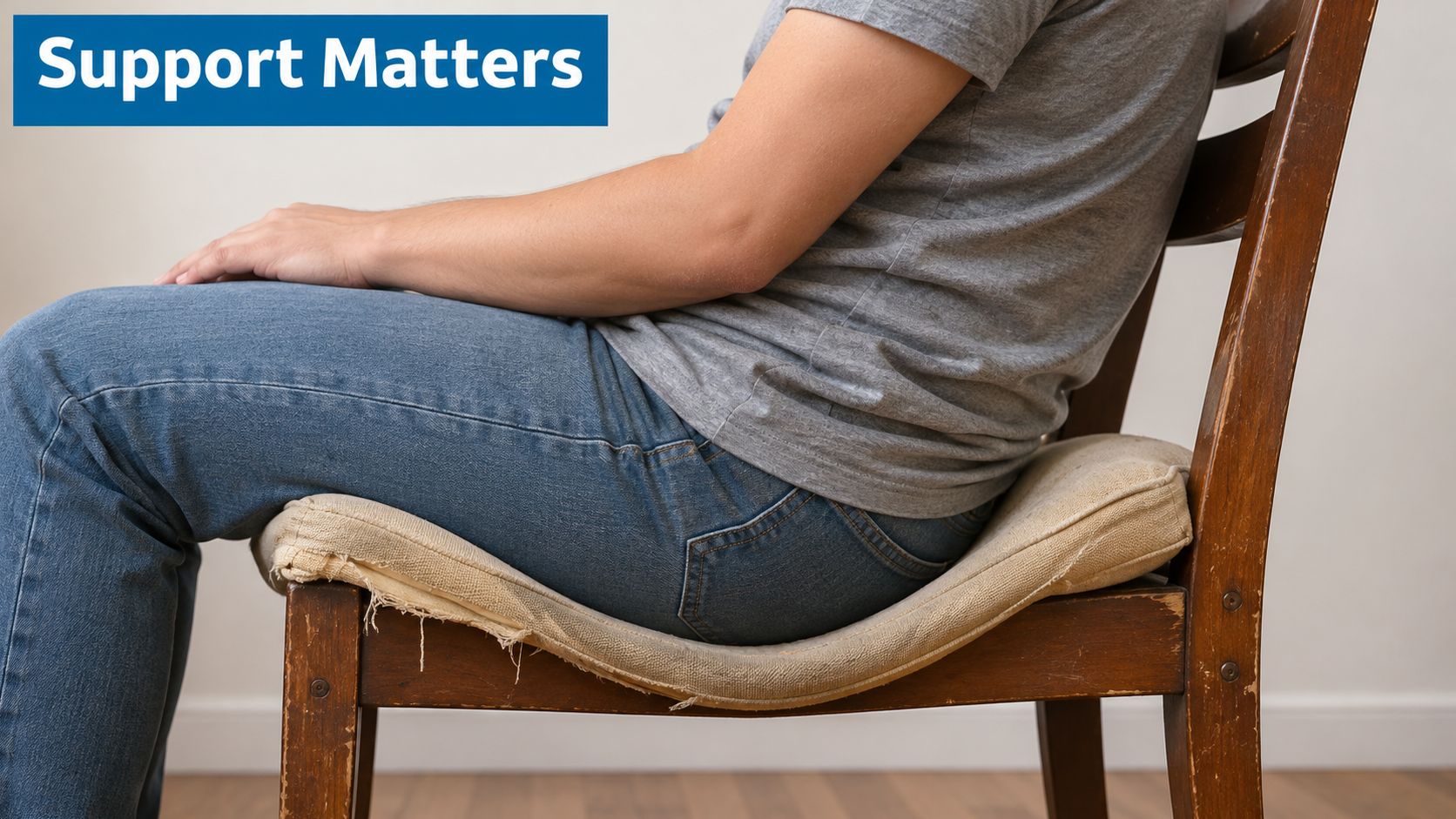
A sagging chair seat behaves like a hammock. Under your weight, the middle drops, the cushion follows, and your pelvis settles into a bowl-shaped depression. Adding padding might disguise that depression when nobody's sitting there.
A structural cushion support is a firm layer that usually goes beneath a removable cushion to provide a more even platform. A cushion placed on top of the seat serves a different purpose: it changes the contact surface, contour, or height. Some products combine those functions, but the listing should explain which problem they address.
Support isn't the same as hardness
Firm surfaces produced higher peak and average interface pressures than several alternatives in a controlled cushion study published through PubMed Central. A useful setup therefore balances structural firmness with enough cushioning for the buttocks and thighs to share the load.
Say a dining chair's upholstered seat dips about two inches in the middle, although a loose cushion looks level on top. The cushion's appearance tells you little about what happens under body weight. You need to inspect the seat beneath it.
Make these checks with someone sitting normally:
- Seat alignment: Does the occupied surface remain reasonably level, or collapse toward the middle?
- Hip position: Do the hips drop noticeably below the knees?
- Contact pressure: Does weight spread across the buttocks and thighs, or collect at a hard spot?
For the relationship between seat position and back support, Gates Home Furnishings office chair advice provides useful additional context. Assess the whole sitting position, not the seat alone.
A support can improve the foundation beneath a cushion. It can't repair a broken frame or turn worn furniture into a medical seating device.
Why TV Demos Favor Visible Softness
The familiar demonstration is a before-and-after comparison: someone presses the cushion, sits briefly, or photographs a seat that now looks flatter. Extra loft and immediate softness are easy to show. Long-term shape retention and sustained comfort aren't.
Consider a hypothetical dining cushion that feels plush during a showroom press but compresses enough during a month of daily use to let the pelvis tilt backward. The first impression wasn't necessarily false. It didn't answer the durability or fit question.
A video of a cushion lifting a sagging seat proves that the seat rose. It doesn't establish that the occupied seat will stay level during daily use.
Claims need evidence beyond a demonstration
Discount these claims until the seller supplies evidence appropriate to the promise:
- Orthopedic: Ask what function was assessed and whether the advertised product was tested.
- Pain-relieving: Look for human-subject evidence relevant to the condition being discussed, not an animated spine.
- All-day comfort: Request information about sitting duration, participants, and pressure mapping where pressure distribution is part of the claim.
Pressure mapping can help assess contact loading, but it doesn't establish pain relief by itself. Likewise, a testimonial doesn't tell you whether the product will suit your chair.
Ask the advertiser: What was measured, on which chair, and for how long? If the listing answers only with adjectives, treat the claimed benefit as unproven rather than assuming the demonstration fills the gap.
Measure Your Chair Before Buying Any Support
Chair dimensions to check before buying a support
| Measurement | Recommended range | How to check at home |
|---|---|---|
| Seat height, adjustable | 15 to 22 inches | Measure floor to top of the compressed seat with the cushion in place |
| Seat-pan length | 15 to 17 inches | Measure from the front edge of the seat to the backrest on the compressed seat |
| Seat-pan width | About 18 inches minimum | Measure across the seat at its widest point |
| Seat-pan tilt | About 5 degrees forward and backward | Confirm the tilt control still works with the cushion in place |
| Front clearance | About 2 inches between seat edge and lower legs | Sit with feet flat and check for clearance and no pressure behind the knees |
The OSHA workstation purchasing guide specifies adjustable seat height of 15 to 22 inches, seat-pan length of 15 to 17 inches, minimum width of about 18 inches, and tilt adjustment of approximately 5 degrees forward and backward. These are office-chair purchasing references, not universal pass-or-fail dimensions for every household chair.
The GSA ergonomic seat adjustment guide places the highest point of the horizontal seat just below the kneecap and recommends approximately 2 inches between the front edge and lower legs. It also calls for support beneath most of the thigh without pressure behind the knee.
Measure the occupied seat
Use a tape measure, a straightedge, and a helper. Put the chair on a level floor, wear your usual indoor footwear, and sit in your normal position while your helper measures.
Measure height where your weight compresses the cushion, not at an unloaded decorative edge. Record the front and middle separately if the seat slopes or collapses. A product's uncompressed thickness won't tell you the final sitting height.
Check usable depth with your back against the backrest. A thick back cushion can reduce that space, while a badly positioned seat pad can encourage you to perch forward. Measure width at the widest point as listed, but also check the narrower space between arms where the support must fit.
Interpret the measurements
- Too much height: Your feet may lose firm contact, leaving pressure beneath the thighs.
- Too much depth: The front edge may press behind the knees before your back reaches the backrest.
- Too little usable depth: You may slide forward to find enough thigh support.
- Poor width or shape: An insert can ride onto an edge instead of resting securely within the seat.
Our large chair cushion sizing guide helps distinguish overall cushion size from the space available on the chair.
Repeat the occupied measurements after installation. Write down the original dimensions before shopping so you can compare a listing's measurements with your actual furniture, then verify the result rather than assuming added thickness equals improvement.
Stabilize the Chair Base Before the Cushion
A home-environment pilot study of pressure cushions found that products performing best on a standard control surface weren't necessarily best on a non-ideal armchair; the researchers also set transfer height using the floor-to-biceps-femoris insertion measurement plus 50 millimetres. That anatomical reference near the back of the knee helps explain why transfer height should suit the individual, although it isn't a universal home fitting formula.
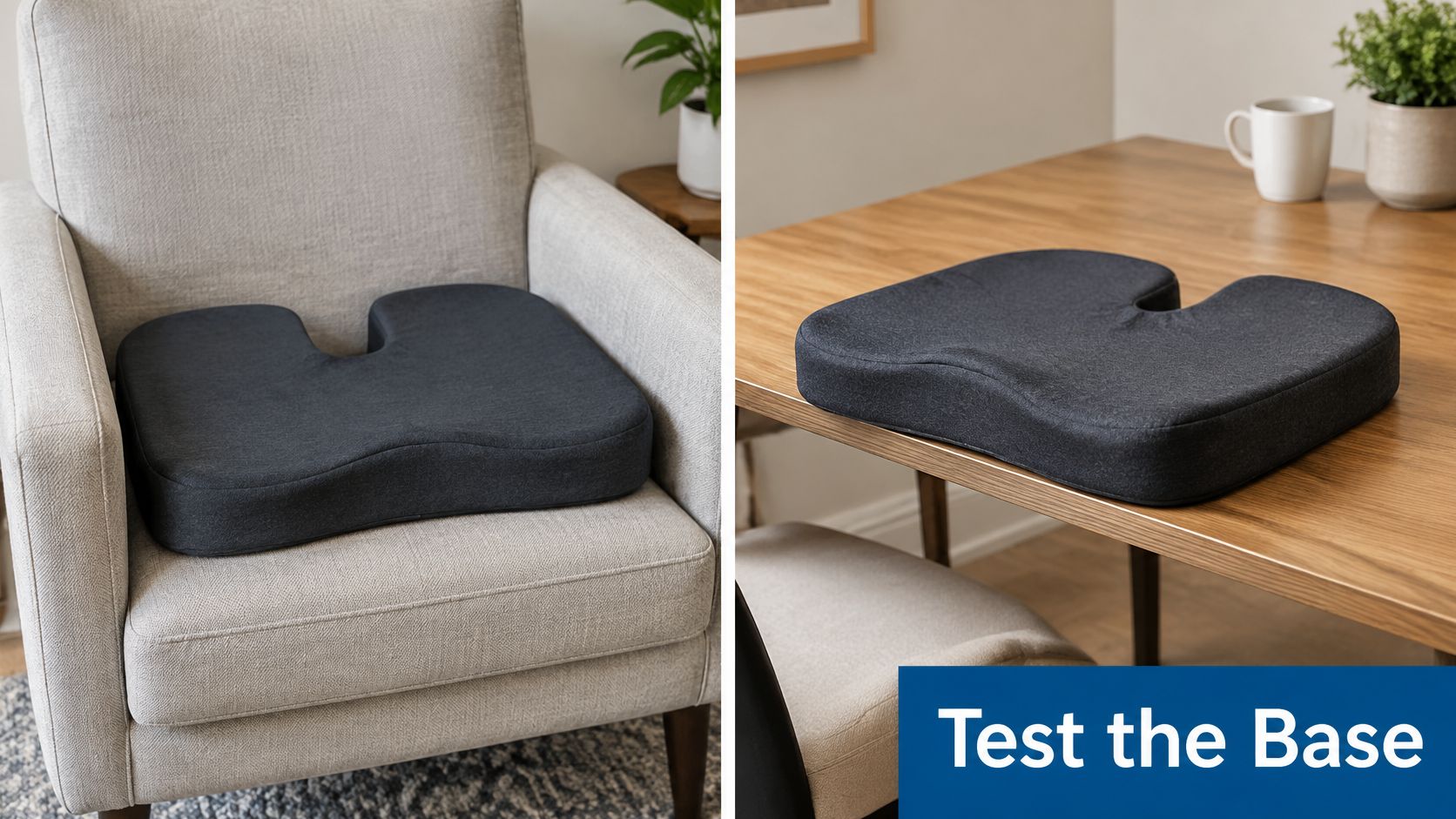
An uneven deck changes where the cushion carries weight. It can also alter sitting height and the way the sitter moves toward standing, so a successful flat-surface demonstration doesn't settle compatibility with a worn chair.
Inspect before adding anything
- Remove the cushion and press the deck. Compare the center, edges, and corners to locate soft or unusually low areas.
- Inspect underneath. Look for stretched webbing, detached spring clips, loose supports, cracked rails, or failed joints. A board must not substitute for repairing damaged structural parts.
- Record the seat height. Compare the occupied position with the fitting references and the sitter's leg position.
- Trial a suitable firm support beneath the cushion. It should rest on sound supporting areas, remain within the seat, and have smooth, protected edges. Don't bridge a broken frame or place a loose board across moving hardware.
- Test sitting and standing. Check comfort, leg clearance, and a controlled rise using the chair's normal armrests where available.
For inspection, use a flashlight rather than reaching blindly beneath upholstery. Disconnect a powered recliner before examining accessible components, and keep clear of springs and mechanisms under tension.
Read the result correctly
If the supported base feels even but the cushion still collapses into a permanent hollow, the cushion filling may need replacement. If the chair rocks or twists, investigate its joints and legs instead of adding more layers.
Pass-or-fail check: Keep the support only if the occupied base feels level and the sitter can rise without the insert shifting or the chair becoming unstable.
Judging Firmness and Resilience Claims
A firmness number on a TV listing means little until you know what was measured and how. Sellers can quote a figure for a foam sample that never went into the advertised cushion, and a hand squeeze at the store tests the corner, not the part your weight sits on. Two specifications do real work: resilience and compression hardness.
Two specifications worth asking for
| Property | What it measures | Why it matters | What to ask the seller |
|---|---|---|---|
| Resilience | How well the foam returns energy after being compressed | Predicts whether the cushion rebounds during a rise instead of staying flattened under you | The stated resilience percentage and the test method used |
| Compression hardness | Resistance to compression under a defined load | Determines whether the cushion still has travel left once occupied | The hardness value in newtons and the compression level tested |
Both figures depend on the test setup, so a number without a stated method is marketing rather than measurement.
Separate rebound from resistance
Hardness describes resistance to compression under specified conditions. Resilience concerns how the foam returns energy after deformation. Neither is interchangeable with thickness, and neither can be established by squeezing a corner between your fingers.
A cushion that bottoms out under body weight can feel pleasant during a hand press yet offer little remaining support once occupied. During standing, the sitter needs a predictable response rather than continued collapse beneath the pelvis. Foam that recovers quickly assists that motion, while foam that stays compressed turns every rise into a climb out of a dip.
The same distinction applies to bedding comfort layers. HearSmart's resource to compare mattress topper options covers a different application, but the buying discipline carries over: separate a surface-comfort change from a foundation repair.
Use specifications without turning them into promises
User mass, cushion geometry, base stiffness, and seat height all shape the result. A cushion that matches a respectable test range still cannot guarantee pain relief, easier standing, or a correct fit in your chair. A missing foam specification does not disqualify a rigid under-cushion board either, since a board does a different job: it restores a level base rather than adding comfort.
Ask a cushion seller for:
- The test definition: resilience percentage and compression hardness, including the compression level and method.
- Product relevance: confirmation that the figures describe the advertised cushion, not an unrelated foam sample.
- Fit documentation: dimensions, intended placement, and compatible seat construction.
Our ergonomic chair cushion guide covers fitting in more detail. Use specifications to screen candidates, then check that the cushion stays put and its added thickness doesn't compromise foot placement or standing.
Safety, Compatibility and Who Needs Extra Care
Can a support cushion make a chair less safe? Yes. It can reduce effective back support, interfere with a recliner hinge, raise the sitter beyond stable foot contact, or slide during a transfer.
Less obvious problems include slipping on leather and trapping heat against the body. Children may move or climb on loose layers, while smoking materials and nearby heaters introduce ignition hazards. A support accessory shouldn't create a new risk while correcting a comfort problem.
Check the furniture in its actual setting
Compatibility checks by chair type
| Chair type | Main risk | Check before use |
|---|---|---|
| Dining chairs | Raised seat cuts thigh clearance and pushes the body forward | Confirm seat height and front clearance against the reference table |
| Office chairs | Cushion blocks height or tilt controls | Confirm the height and tilt adjustments still work with the cushion in place |
| Recliners | Cushion blocks the hinge or shifts the back support | Recline fully with the cushion in place and check for pinching and sliding |
| Wheelchairs | Added height changes foot placement and transfer safety | Check foot position and a controlled transfer before regular use |
| Sleeper furniture | Support layer shifts when the seat is folded out | Check that the layer stays in place in both sitting and sleeping positions |
Apply those checks room by room:
- Dining area: Check clearance beneath the table apron as well as the seat itself.
- Home office: Make sure the new position still allows relaxed access to the desk and armrests.
- Living room recliner: Cycle the mechanism slowly, keeping hands away from hinges. Stop if anything catches.
- Wheelchair seating: Have the existing seating prescription and transfer method reviewed before changing the setup.
- Guest room sleeper: Follow the accessory's intended removal or folding procedure. Don't assume every seating support can remain inside a closed bed mechanism.
Labels address a different question
The CPSC upholstered furniture guidance sets out the U.S. requirement for upholstered furniture manufactured, imported, or reupholstered from June 25, 2021 to meet TB 117-2013, with certification-label requirements for products made from June 25, 2022; U.K. upholstered furniture rules cover cushions through relevant filling, cover, ignition, and permanent-label provisions and were amended in 2025.
Ask for documentation applicable to the specific product and market. Don't assume a loose accessory has the same regulatory classification as the chair beneath it. Fire-safety compliance doesn't prove comfort, durability, or clinical support, and it doesn't make upholstery fireproof.
Pressure risk requires more than everyday comfort
International guidance discussed in the context of seating for older adults reports a possible reduction in pressure injuries with pressure-redistributing seating, but the result wasn't statistically conclusive: relative risk 0.86, 95% confidence interval 0.74 to 1.01. That uncertainty doesn't support treating an ordinary support cushion as a medical pressure-relief device.
For older adults, suitable seat depth, accessible armrests, and a secure sitting position can matter as much as surface feel. Our furniture guidance for older adults helps homeowners assess those practical details. Someone with reduced sensation, an existing pressure injury, or difficulty repositioning needs individualized seating advice.
Stop using a cushion that shifts, compresses unevenly, or causes numbness. Don't keep adjusting around those warning signs to justify the purchase.
Decide Whether a Cushion Support Is Worth Buying
The wrong way to judge a cushion support is by how soft or firm it feels on the first sit. It earns its price by fixing the component that failed, and padding over a collapsed base only hides the failure.
Use these decision rules before choosing a product:
- Buy for a defined support problem. The chair's measurements should suit the sitter, the supported base should stay even under load, and the finished setup should pass the safety checks. For a foam cushion, request the seller's mechanical specifications and weigh them against the study benchmarks without treating them as universal requirements.
- Repair or replace damaged furniture. A broken frame, a sharp front-edge dip that remains after a suitable support trial, or an unstable transfer is a reason to stop experimenting with padding.
- Leave clinical needs to clinical seating. A sitter who needs pressure management requires assessed seating, and a firmer advertised cushion does not change that.
At Meliusly, our recliner chair supports face the same dimension, base, and safety checks before purchase. Our Heavy Duty Sofa Cushion Support Board is a couch support for sagging cushions, on sale for $29.99. It is a poor match for a dining or office chair unless the measurements and intended-use guidance confirm compatibility.
A support is worth buying when it addresses the failed component without creating another problem. Check the seller's numbers, installation directions, and safety documentation before trusting any advertised claim.
Meliusly sells sofa supports, recliner chair supports, sleeper sofa support boards, bunkie boards, and bed slats. Visit Meliusly to compare support solutions for your furniture's actual dimensions and construction, whether you're addressing a sagging seat or an inadequate mattress foundation.
Share this post
- Tags: as seen on TV cushion, chair cushion support, chair seat support, furniture support boards, sagging chair cushion