

Ergonomics Chair Cushion: Comfort and Support Guide
Posted by Meliusly
You sit down in a dining chair you've owned for years, settle into your favorite reading seat, or spend an evening at the kitchen table. The furniture still looks perfectly usable, but your lower back, hips, or tailbone tells a different story. A seat cushion that has compressed or sagged can leave your body sitting lower, unevenly, and without the stable support it once had.
An ergonomics chair cushion can be a practical first fix. It adds targeted support without forcing you to replace a sturdy chair, recliner, or sofa that still fits your home. The right choice depends on more than softness. Shape, firmness, thickness, and the condition of the furniture beneath the cushion all affect comfort and long-term support.
Why Your Favorite Chair Hurts Your Back
A familiar chair often becomes uncomfortable gradually. The foam compresses, the springs lose tension, or the seat base flexes under repeated use. You may respond by leaning to one side, sliding forward, or rounding your lower back. Those adjustments feel harmless at first, but they can make a comfortable evening increasingly difficult.
The problem isn't always a damaged frame. A chair can remain attractive and structurally sound while its seat no longer distributes your weight properly. If your pelvis drops into a hollow or your thighs press against a hard front edge, your back has to compensate for the missing support.

Find the actual failure point
Start by checking whether the discomfort follows you or stays with the chair. If you feel fine in other seats but develop pain in one dining chair or recliner, inspect the seat before blaming your posture. Press across the cushion and compare the center, front edge, and sides. A soft spot, visible dip, or tilted sitting surface points to a support problem.
A removable cushion can restore the sitting height and make the surface more stable. For a chair with deeper structural sagging, an under-cushion support may be more appropriate than a soft topper alone. You can also review seat depth ergonomics before buying, because adding a thick cushion changes how far your knees sit from the front edge.
A 2024 randomized controlled trial involving 133 office workers found that a dynamic seat cushion used for six months reduced the risk of developing neck pain by 81% and low back pain by 84% in a high-risk group, as reported in the published seat-cushion trial. The intervention group included 67 people and the control group included 66, giving the result a concrete foundation rather than relying only on comfort testimonials.
That doesn't mean every cushion will prevent pain, or that a cushion replaces medical advice. It does show why cushion design deserves attention. If your needs extend beyond a dining or reading chair, comparing Top Mobility ergonomic seating options can help you evaluate more seating features.
The Ergonomics Behind Proper Seat Support
Sitting concentrates load rather than distributing it evenly across the whole seat. The bony points beneath the pelvis, especially the ischial tuberosities, carry much of the pressure. An independent review identifies this region as the typical area of greatest concentrated pressure, with loading also extending into the upper rear thighs, which is why contouring and pressure redistribution matter in cushion design. See the research on seated interface pressure for the underlying analysis.
A flat, hard surface gives those pressure points little relief. A cushion should spread the load without allowing the pelvis to sink so far that the spine loses a stable base. This is the central distinction between supportive softness and simple padding.
Geometry changes the sitting experience
A useful cushion usually has a shaped surface, a stable underside, or a layered construction that combines both. Contouring can reduce the feeling that your weight is concentrated in one small area. A firmer base prevents the cushion from collapsing under the pelvis, while a more forgiving top layer improves initial comfort.
Firmness also affects movement. If the entire cushion is extremely soft, you may sink into it and struggle to reposition yourself. If it's rigid and flat, pressure can build at the seat bones and front edge. The practical target is a surface that supports your weight while allowing small posture changes.
Practical rule: Choose a cushion that keeps your pelvis stable, not one that simply feels soft for the first few minutes.
Thickness must match the chair. A cushion that's too tall may raise your knees, reduce clearance under a dining table, or bring your face too close to a desk. One that's too thin may fail to compensate for a compressed seat. Before choosing, measure the available seat area and consider how your feet, knees, backrest, and armrests will align after the cushion is added.
For a broader overview of how body position and furniture interact, the guide to what ergonomics means in everyday seating provides useful context. If relaxation is the priority, you might also compare ergonomic recliners with heat and massage while keeping the same principles in mind. Added features don't compensate for an unstable seat base.
Comparing Materials for Lasting Comfort
Material choice determines how a cushion responds when you sit, shift, and remain seated for a long period. No single material wins for every room. A cushion for a lightly used accent chair has different demands from one used daily at a dining table or desk.
Memory foam conforms closely to the body. That can reduce the sensation of a hard pressure point and suit people who prefer a more enveloping seat. Its drawbacks are equally practical. Some memory foams retain heat, and a low-quality or insufficiently supportive layer can compress enough that you feel the chair beneath it.
High-density foam offers a more stable feel. It's often a better match for dining chairs, task chairs, and other seats where you need to maintain a consistent height. Foam quality varies, so don't judge a cushion by the label alone. Look for a construction that resists bottoming out and keeps its shape across the usable seating area.
Match the material to the job
Air compartments behave differently from solid foam. They can respond dynamically as you move and allow firmness to be adjusted on some designs. They also require attention to inflation, fit, and potential leaks. A highly adjustable air cushion may be useful for pressure management, but it can feel less familiar than a stable foam seat.
Clinical reviews found that air-compartment seat cushions provided the best pressure distribution overall, while foam cushions performed best at approximately 8 cm thickness, according to the clinical review of pressure-redistributing seat cushions. That evidence helps explain why a thin decorative pad may feel pleasant initially but fail during extended sitting.
| Material | Main strength | Main trade-off | Suitable use |
|---|---|---|---|
| Memory foam | Close contouring and pressure comfort | Can retain heat or compress too deeply | Reading chairs and personal seating |
| High-density foam | Stable support and shape retention | Less adjustable than air | Dining chairs and frequent-use seats |
| Air compartments | Dynamic pressure redistribution | Needs setup and maintenance | Users prioritizing adjustable support |
A layered design can offer a useful compromise. A softer upper surface cushions contact points, while a firmer lower layer limits excessive sinking. Whatever material you choose, check how it changes the chair's height and whether it stays in place when you stand, turn, or pull the chair toward a table.
Choosing the Right Cushion for Every Room
The right cushion depends on what the chair does. A dining chair supports meals, conversation, and movement around a table. A reading chair encourages longer, quieter sitting. A recliner changes angle as you rest. Treating all three seats the same often creates new problems.
Start with the chair, not the product label
Use this sequence before you shop:
- Measure the usable seat. Record the width, depth, and the space available between armrests. A cushion that overhangs the front or sides can interfere with movement and look untidy.
- Check the sitting height. Sit with your feet on the floor and note whether your knees and hips already feel balanced. An added cushion raises the body, so account for table clearance, foot placement, and armrest height.
- Identify the activity. Dining calls for a relatively stable, low-profile cushion. Reading may justify more contouring and softness. A recliner needs a cushion that won't slide as the back angle changes.
- Inspect the support underneath. If the seat is sagging, a cushion placed on top may follow the same dip. Restore the base first or use an under-cushion support designed for that type of furniture.
Apply different standards by room
For a kitchen or dining chair, prioritize firmness, modest thickness, and secure placement. You should be able to sit close enough to the table without rounding forward. A wedge can change the angle of your pelvis, but it shouldn't force your feet off the floor or create pressure at the back of your thighs.
A reading chair can accommodate a more substantial cushion, especially if its seat has flattened with use. Pair it with a supportive back position rather than adding softness until you sink into a hollow. Recliner cushions need particular care because a loose pad can migrate as the mechanism opens and closes.
Pressure mapping reinforces the importance of shape. One study found peak pressures in the 1.31 to 2.69 kPa range when contoured cushioning was paired with an optimized shell, while pressure rose above 3 kPa when the contoured shell was removed and all-foam layers were used, as described in the pressure-mapping study of cushion geometry. The lesson is straightforward. Foam alone doesn't guarantee good support. The underlying contour and seat structure matter just as much.
Wheelchair and pressure-injury needs require more specialized assessment than a general home cushion guide can provide. If reduced sensation, skin vulnerability, or mobility limitations are involved, work with an appropriate clinician or seating specialist rather than choosing only by softness.
Extending Furniture Life Through Better Support
Comfort and furniture maintenance are connected. A sagging seat changes how you sit, while repeated uneven loading can continue to stress the cushion and internal support. Adding a stable layer can help you address the immediate sitting problem while you decide whether the chair needs upholstery work, a frame inspection, or a replacement component.
The key is to distinguish surface comfort from structural repair. A cushion can improve the interface between your body and the chair, but it won't repair a broken frame or restore damaged springs. If the seat drops dramatically, creaks under load, or shifts from side to side, investigate the furniture beneath the cushion.
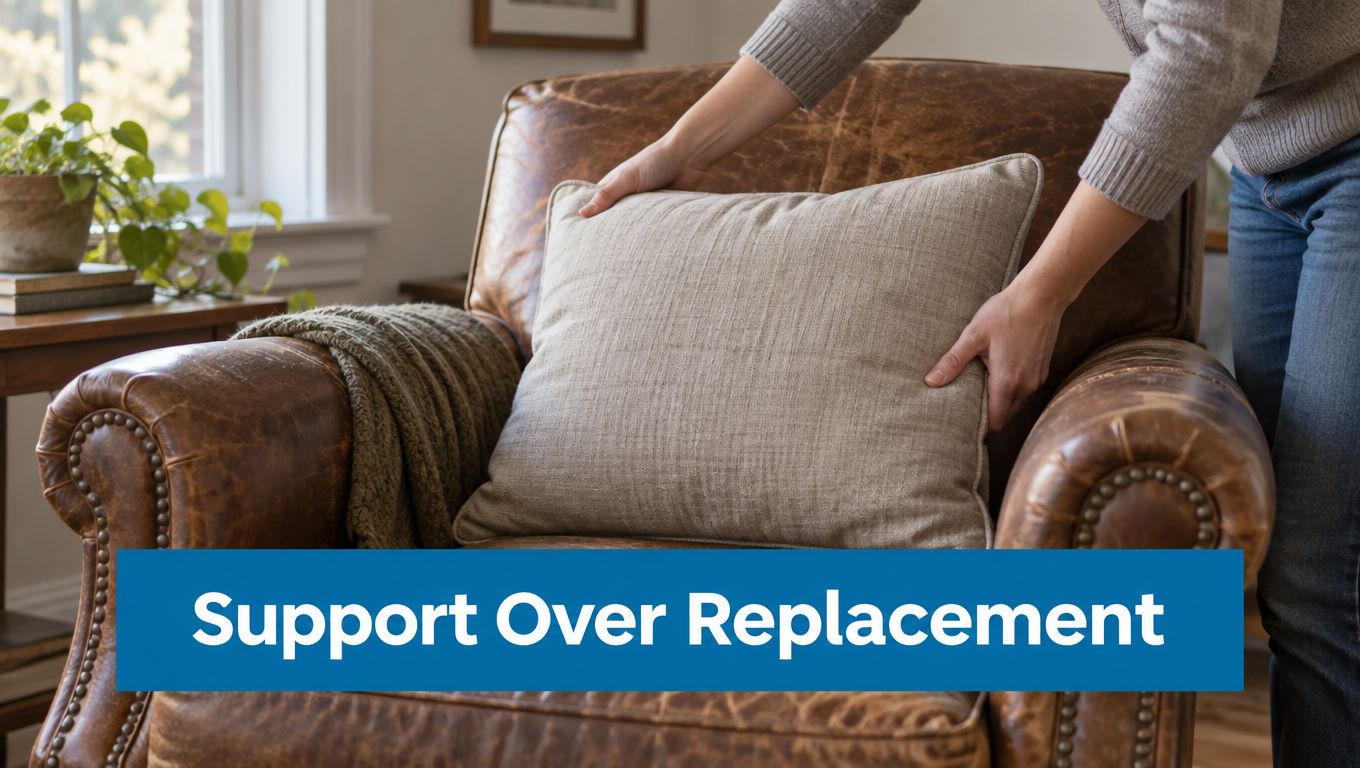
Use layered support with care
Classic seating-ergonomics guidance warns that excessive softness can make you sink into a chair, restrict circulation, and increase compression beneath the thighs. The same guidance describes a more effective construction, a soft top layer over a firm bottom layer, as outlined in this seating ergonomics guidance.
That approach works well for worn home furniture because it addresses two different needs. The upper layer improves contact comfort, while the lower layer resists collapse and helps preserve a more consistent sitting position. Don't keep adding pads if the chair continues to sag. More material can raise the seat without solving the unstable foundation.
An under-cushion support board, such as a recliner or armchair seat support designed to firm up a sagging cushion, may be more suitable when the furniture has lost base support. Use it as part of an inspection, not as proof that every structural problem is solved. The right solution should fit the chair, remain stable, and avoid creating sharp edges or new pressure points.
This matters especially in homes where a chair needs to be easy to use repeatedly. People planning a comfortable home for seniors should look beyond padding and consider seat height, transfer effort, stable armrests, and clear floor space. A comfortable seat is only useful if the person can sit down and stand up safely.
Making the Smart Choice for Your Home
A good ergonomics chair cushion doesn't need to look like specialized office equipment. It needs to solve the problem you can identify: concentrated pressure, a flattened surface, an unstable seat base, excessive heat, or a sitting height that no longer works with the room.
Use your symptoms and your furniture as the starting point. If the chair feels hard, consider pressure distribution and a suitable upper layer. If you sink, look for a firmer base or address the sagging beneath the cushion. If you slide forward, check the contour and angle rather than just buying a softer pad.
Make the decision fit the furniture
Before purchasing, ask:
- Does the cushion fit the seat? It shouldn't overhang, bunch up, or interfere with the chair's moving parts.
- Will it preserve useful alignment? Your feet should remain supported, and the added height shouldn't make the table or desk awkward.
- Does it address the cause? A topper can improve comfort, but a sagging foundation may need an under-cushion support or furniture repair.
- Can you maintain it? Covers, fasteners, and air systems should suit the way you use and clean the chair.
- Will you move during the day? No cushion makes prolonged stillness harmless. Houston Methodist recommends getting up for about 5 minutes after every 30 minutes of sitting, with light movement such as walking, stretching, or taking the stairs, as described in its guidance on breaking up sitting time.
Pain also deserves a careful response. Reviews of ergonomic chair designs report inconsistent findings on pain reduction, and coccyx cushions may relieve tailbone discomfort for some people while increasing pressure near the sciatic nerve for others. A clinical review of ergonomic chair designs and pain outcomes captures why comfort should be assessed over time, not judged during a brief test sit.
For homeowners, the most sensible purchase is usually the one that improves the existing chair without compromising its function. Measure first, select support rather than excessive softness, and correct sagging beneath the cushion when necessary. For more options and practical guidance, explore this chair cushion buying guide.
Meliusly offers practical furniture support solutions for sagging sofas, chairs, recliners, sleeper sofas, and beds, helping homeowners improve comfort without replacing usable furniture. Visit Meliusly to choose a support option that matches your furniture and restore a more stable foundation at home.