

Cushion Arch Support: How It Works and How to Choose
Posted by Meliusly
Does a cushion arch support help because it's soft, or because it's shaped? Many buyers pick the soft one, then wonder why their arch still collapses by mid-afternoon. Cushioning and support do two separate jobs. Cushioning absorbs impact. Shape moves load from one part of the foot to another.
Get those two jobs confused and every purchase decision goes wrong. A squishy gel pad feels wonderful for twenty minutes and does almost nothing for an arch that's flattening under body weight. A firm, well-shaped insert can feel unforgiving on the first day and hold the foot in a better position for a whole shift.
The balance is never "maximum softness" or "maximum firmness." It's enough firmness to stop the arch collapsing, enough cushioning to keep the surface comfortable, and enough height to match your own foot. Get those three in proportion and the insert disappears into your day. Overshoot any one of them and you'll feel it, either as a pressure spot or as an arch that sags anyway.
How Cushion Arch Support Changes the Load on Your Foot
A nurse finishing a twelve-hour shift on vinyl flooring knows the pattern: the arch has dropped, the heel aches, and the ball of the foot feels bruised. Nothing about the foot changed in those hours except where the load went. Standing pushes body weight through a small contact patch, and when the arch flattens under that weight, the heel pad and the metatarsal heads carry work the arch normally shares.
An insert changes that by holding the arch up and putting something soft between the foot and the floor.
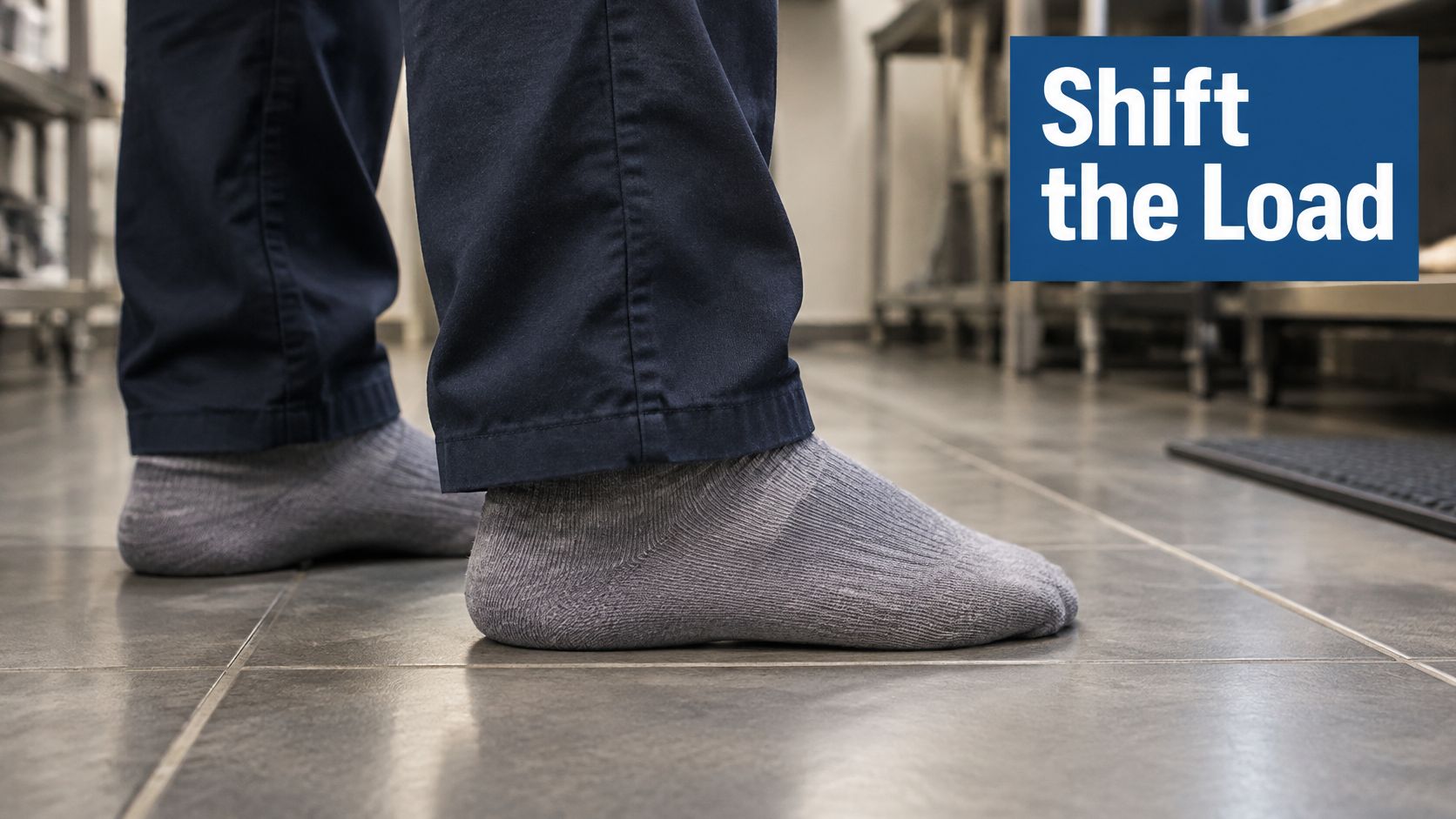
Biomechanical evidence collected in a review of medial arch support shows the shift directly: a medial arch support moves plantar loading away from the heel and the lesser metatarsals and toward the medial midfoot. The load doesn't vanish. It spreads.
That's the trade-off most product pages leave out. Raising the midfoot lowers stress at the heel, and it raises contact pressure under the arch itself. If the contour is too high or too narrow for your foot, the new pressure point sits exactly where the old ache used to be, just relocated.
Support redistributes load. It doesn't delete it. An insert that promises the second thing is selling a feeling, not a mechanism.
What's inside a typical insert
- The arch contour: the shaped core that determines how high the foot is lifted and how wide the contact band across the arch becomes. This is the part that does the structural work.
- The cushioned top layer: foam, gel or a combination, usually a few millimeters thick. It softens impact and takes the edge off hard ground, and it can't hold an arch up on its own.
- The base: a flatter, wider platform under the heel and forefoot that keeps the whole insert from sliding forward inside the shoe. A base that shifts turns a good contour into a bad one within an hour.
Cushioning without shape is a mat. Shape without cushioning is a ridge. The useful product is the pair of them together, with the contour broad enough that no single spot on the arch takes the whole load.
Two checks tell you whether it's working, and neither requires equipment. First, stand in the shoes and ask whether the arch feels held from below without a sharp point pressing into it. Second, wear them for an hour of standing and notice whether the heel feels less loaded than it did before. If the arch feels lifted but the heel hasn't changed, the contour is probably too narrow. If nothing changed at all, the insert is likely too soft to matter. For the longer-term version of that ache, treating the cause of foot pain rather than only the surface under it is the more useful route.
Types of Cushion Arch Support Compared Side by Side
Four constructions cover most of what sits on a shelf, and they fail in different ways. The table describes how each one is built, not which brand makes it.
| Type | Construction | Main strength | Main trade-off |
|---|---|---|---|
| Soft cushion insert | Foam or gel top layer with no rigid shell | Softer feel and impact cushioning | Limited stability and limited support |
| Semi-rigid cushioned support | Contoured firm shell with a cushioned top layer | Holds arch shape while adding comfort | Can cause discomfort if too high or too firm |
| Rigid shell with cushioned cover | Hard arch shell wrapped in soft fabric | Consistent arch height and stability | Localized pressure risk and less forgiving fit |
| Custom-molded cushioned insert | Shaped to a measured arch | Closest fit to an individual foot | Higher cost and fitting time than off-the-shelf options |
Reading the trade-offs
The pattern runs top to bottom. Softness buys comfort in the first hour and costs stability for the rest of the day, because a material that compresses easily stops holding a shape once body weight settles into it. Firmness buys shape and costs forgiveness. A rigid shell with the wrong height doesn't adapt to your foot; it presses on it.
Which trade-off you want depends on what the insert has to survive. Eight hours of standing on concrete calls for the semi-rigid or rigid construction, because the arch needs to stay up long after the novelty wears off. Twenty minutes of walking to the shops and back tolerates a softer build, and the extra padding may be the reason you keep wearing it. Matching the product to the duration is more useful than matching it to the price.
The custom option sits apart. An insert shaped to a measured arch trades money and fitting time for a closer match than any stock size, and it makes sense when off-the-shelf contours keep missing. For many, a semi-rigid cushioned support in the right height gets close enough.
The same logic applies when the problem is under your seat rather than under your foot, and the ergonomics of a chair cushion covers that side of it. Before you buy anything, answer one question: do you need more comfort, more stability, or a balance of both? Everything else follows from it.
Who May Benefit From Cushion Arch Support and Who Should Be Cautious
Arch pain is common enough that many shoppers assume a product will solve it. A 2024 foot-pain survey published by footwear brand KURU Footwear reported that 39% of Americans experienced arch pain, while 35% reported pain under the heel. It's a brand's survey of its own market rather than a clinical population study, so read it as a signal about how many people are shopping for relief, not as a medical estimate.
Within that group, three kinds of people tend to notice a real difference. Anyone on their feet for long stretches, such as nurses, warehouse staff, retail workers and teachers, gains from load being shared across the midfoot instead of concentrated at the heel and ball. People whose arch feels flatter by evening than it did in the morning are describing a structure that gives way under sustained load, which is exactly what a contoured insert addresses. And people wearing a shoe whose original insole has gone flat often get their improvement from restoring the surface under the foot rather than from adding anything dramatic.
The caution list matters just as much, and it's shorter than expected.
- Diabetes or reduced sensation in the feet. A pressure spot you can't feel is worse than one you can, because you won't notice it forming.
- Circulation problems or a diagnosed foot condition. Support changes load, and it doesn't treat a named diagnosis. Ask before adding one.
- Balance concerns. Stability has a cushioning cost. A 2025 study comparing insole designs found that an arch height of 1.75 cm produced the strongest postural-stability results, reducing mediolateral sway by an average of 29% among non-fallers and 35% among fallers, while the same body of work notes that thick, soft midsoles can work against stability (insole designs and fall prevention). Thicker isn't safer.
Here's the boundary that keeps this honest. Arch support improves comfort and redistributes load. It does not diagnose, treat or cure a foot condition. If pain persists, worsens, or starts limiting how far you can walk, that's a clinician's question, not a shopping question. Sorting out which of those two you're facing first saves months. Long sitting can produce its own foot and leg complaints, and the ergonomics of a workspace explains why the chair matters as much as the shoe.
How to Choose Firmness, Height and Thickness
Firmness and height solve different problems, and mixing them up is where most purchases go wrong. A finite-element study reported that increasing insole stiffness reduced modeled plantar peak stress by 47.5%, foot displacement by 48.0%, calcaneal peak stress by 30.8% and metatarsal peak stress by 20.8% (the insole stiffness analysis). It's a model, not a prescription for your foot. The same body of work found arch height explained 45.7% of the variance in peak plantar pressure, while material stiffness explained 37% of proximal plantar-fascia strain.
The practical reading is a construction rule rather than a shopping slogan: use enough firmness to limit collapse, then pair it with a broad cushioned surface so the load has somewhere to go. A very stiff insert with a narrow contour concentrates pressure. A very soft insert with a beautiful contour loses the contour the moment you stand on it.
Five things to check, in the order they cause trouble:
- Arch height. The arch should feel held from underneath, not lifted into a point. If you can identify one specific spot pressing upward, the height is wrong for your foot, no matter what the size chart says.
- Firmness. Press the insert with your thumb. It should give a little and spring back, not fold flat. A ridge you can feel through your thumb will be a ridge you feel through a sock.
- Thickness. Take the shoe's original insole out before fitting a thicker insert. If your toes touch the top of the toe box or your heel lifts out of the back, the shoe doesn't have room for that insert.
- Footwear. A good insert in a cramped shoe is a worse experience than a mediocre insert in a roomy one. Lace-up shoes with a removable insole are the easiest place to start.
- Standing time. A short walk and a full shift place different demands on a support. Match the firmness to the hours, not to the label.
Then test it properly. Wear the insert indoors for about 20 minutes, on a hard floor, and check for hotspots under the arch, heel and ball of the foot before you commit to a long day. Indoors matters because you can take the shoe off the moment something feels wrong. If you're choosing a seat rather than a shoe, picking a chair cushion online runs through the same firmness logic for a different body part.
Practical rule: firm enough to stop the arch collapsing, spread over enough surface that no single spot carries the whole load.
How to Break In a New Cushion Arch Support Safely
New support rarely hurts because it's the wrong product. It hurts because the wearer changed three things at once: full-day wear, a long walk and a different shoe, then blamed the insert. A 2025 review of footwear for prolonged-standing workers found that soft soles reduce impact and fatigue but provide limited support, while hard soles improve stability but can create localized pressure, and it also reported that semirigid arch supports may cause discomfort (footwear for prolonged standing). The same review found the evidence too varied for a single definitive conclusion, which is why your own response is the data that matters most.
Start with moderate support, wear it for short periods, inspect for concentrated pressure, and stop if numbness or persistent pain appears. That sequence is the whole protocol, and the steps below are how it looks in practice.
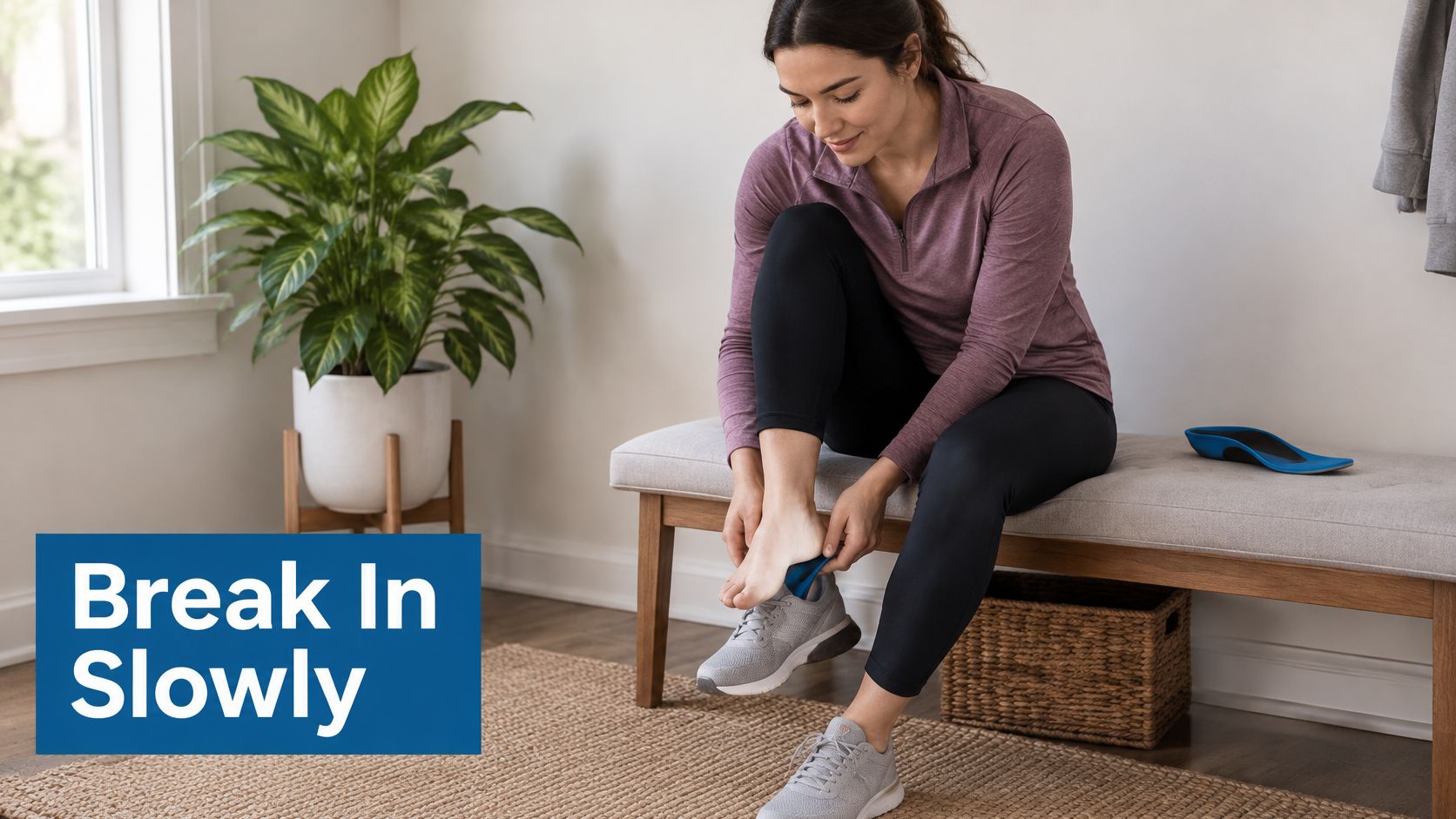
- Remove the original insole and dry the shoe out. A damp, gritty interior creates friction, and friction blisters get blamed on the insert. Ten seconds with a dry cloth prevents that confusion.
- Seat the heel edge against the back of the shoe. Push the insert all the way back before you put your foot in. An insert that has slid forward lifts the toes and leaves the heel unsupported.
- Wear it indoors for about 30 minutes on day one. Short sessions reveal hotspots while you're near a chair and a pair of slippers. A full shift reveals them at the far end of a car park.
- Go to one to two hours on day two, if day one was comfortable. The arch and the soft tissue under it adapt to a new contour gradually. Doubling the time every couple of days is plenty.
- Check after every session. Run a thumb under the midfoot, the heel and the ball of the foot and look for a red mark that lasts more than a few minutes. A mark that fades quickly is normal pressure. A mark that stays is a hotspot forming.
- Extend wear time only while the arch feels held. Progress isn't measured in hours, it's measured in whether the support still feels like support at the end of the session. Stop extending when it stops feeling that way.
- Stop immediately for numbness, tingling or sharp pain. These aren't adaptation symptoms, and pushing through them is how a minor irritation becomes a reason to stop wearing the insert altogether.
A snug shoe sometimes needs a thinner insert rather than a different one. Success after a week looks unremarkable: the arch feels supported, the feet are less fatigued by evening, and no new pressure point has shown up. That's the whole result you're after.
Warning Signs With Cushion Arch Support and What to Change
Numbness, tingling or persistent pain means take the insert out and speak to a clinician. Comfort adjustments are not treatment, and no amount of repositioning fixes a nerve problem. Everything below that line is a fitting question with a fitting answer.
| Symptom | Likely cause | What to do |
|---|---|---|
| Numbness or tingling | Excess pressure or nerve irritation | Stop use and consult a clinician |
| Persistent arch or heel pain | Support too high, too firm or worn too long | Stop, reduce wear time and consult a clinician if it persists |
| Pressure spot under the midfoot | Contour too high or too rigid | Switch to a lower or softer profile |
| Feeling unstable when standing | Overly thick or soft cushion | Try a firmer, thinner insert and check footwear fit |
| Insert feels flat or dead | Foam compressed and no longer recovers | Replace the insert rather than reshaping it |
Change one thing at a time
Adjust a single variable per week, whether that's height, firmness, thickness or wear time. Change two and you learn nothing: if the ache improves, you don't know which change did it, and you can't repeat the result on the next pair of shoes.
The flattened-insert case deserves its own note, because people try to fix it by adding a pad underneath. Foam doesn't come back. The Polyurethane Foam Association's explanation of foam fatigue testing describes how repeated compression cycles are used to measure the percentage of indentation-force-deflection loss, which is the technical way of saying a foam sample gets softer and shorter with use. A support placed under a compressed layer can reduce how much deflection reaches it, and it can't restore foam that has already taken a permanent set.
So track how long an insert keeps its shape, not just how it felt on day one. When the arch no longer feels held, replace it. Waiting for the pain to return is a slower and less pleasant signal.
"It felt great for three weeks and then stopped" usually means the foam gave out, not that your foot changed.
Keep a short log for a week: wear time, activity, and anything you noticed. Symptom patterns show up in a written record that memory smooths over, and a clinician can do far more with that page than with a vague description.
Choose the Right Support for Your Need
Two different problems get called the same thing, and separating them decides what you buy. One is foot comfort inside a shoe. The other is furniture that has lost its shape. They share a vocabulary of support and cushioning, and they need completely different products.
For the foot, work through the construction comparison and the fit checklist, then run the break-in steps before committing to long shifts. Nothing new there.
For the furniture, the problem isn't the foot at all. Before buying anything, check the cushion and the platform beneath it: the frame, the springs, the webbing on a chair, the slats under a bed. A shaped support under a tired seat changes the numbers measurably. A case study of foam properties and support surfaces found that a pre-shaped support cut average peak seat pressure from 12.6 kPa to 9.4 kPa, a drop of about 25.4%, while increasing average contact area from 1,190 cm² to 1,318 cm² (pressure mapping of shaped seat support). That's the same principle as an arch contour: spread the load and the peak falls.
Meliusly makes the furniture side of that fix. The Heavy Duty Sofa Cushion Support Board is a couch support for sagging cushions, and the range also covers sleeper sofas and beds. If the deck under the cushion has failed, though, a new support board alone won't hold. Fix the platform first, then support what sits on it.
Three questions sort any case. What is sagging? Where does the discomfort sit? What should change first? Change one variable at a time, and check the cheapest thing before the most expensive one.
Meliusly builds simple support products for furniture that has started to give way, from sofa cushion support boards to sleeper sofa boards and bunkie boards, all aimed at restoring comfort without a replacement purchase. If your seat sinks or your sofa bed has a ridge down the middle, the fix usually starts underneath the cushion rather than in a showroom. Visit Meliusly to see which support matches what you found when you inspected the frame.
Share this post
- Tags: arch support cushion, arch support insole, choosing arch support, cushion arch support, foot arch support