

Sleeper Sofa or Futon: Which Should You Actually Buy
Posted by Meliusly
You're standing in a small living room, trying to decide whether the couch should also be the guest bed, and the room is giving you exactly one inch of grace. That's where the sleeper sofa or futon decision gets real. The wrong pick doesn't just look off, it turns into daily annoyance, awkward sleep, and a piece of furniture you start avoiding.
| Feature | Sleeper Sofa | Futon |
|---|---|---|
| Main strength | Looks and sits more like a normal sofa | Saves space and flips fast |
| Main weakness | Mechanically complex, heavier, needs clearance | Usually less refined for all-day lounging |
| Best for | Formal living rooms, guest hosting, frequent sitting | Tight rooms, studios, flexible multipurpose spaces |
| Sleep surface | Concealed mattress and frame | Same mattress used for sitting and sleeping |
| Repair logic | Often worth fixing the support system first | Often worth repairing the mattress or frame first |
The right answer usually isn't about trends, it's about use. If the piece sits in a main living room, a sleeper sofa usually makes more sense. If the room has to switch roles fast, a futon often wins on simplicity. Before you buy, ask yourself three blunt questions. How often will someone sleep on it. How much floor depth can you spare. Do you care more about daytime appearance or night-time function.
Meliusly's angle is simple. Furniture should last, and the smartest choice is the one you can live with comfortably for years, not the one that only looks good in the showroom. If you want a broader buying checklist, tips from Lott's Furniture are useful for thinking through room fit and sofa priorities before you commit.
The Decision Behind Sleeper Sofa or Futon
A couple moves into a city apartment with one real living room and one extra corner that has to work hard. By day, it needs to handle sitting, work, and guests. By night, it has to become a bed without making the room feel like a storage unit. The choice comes down to how much flexibility the room needs without making the furniture feel temporary.
Buy for the life you live
A sleeper sofa usually fits better when the room should still read as a living room first. It closes up like a normal sofa, which matters if you care about a polished look, guests, or a more finished feel. A futon makes more sense when the room is multi-use and you want the furniture to fade into the function of the space.
A lot of buyers make the same mistake. They judge comfort in the showroom and ignore how the piece will be used over time. That is backward. A sleeper sofa that hosts a few nights a month and a futon that gets used every day are solving different problems.
Practical rule: choose the piece that matches your most common use, not the rare one.
If you host occasionally and want the room to still feel finished, choose a sleeper sofa. If you need one piece to work hard in a studio, office, or small guest room, choose a futon. Treat the decision as a daily-use question, not a style quiz.
What to decide before you scroll listings
Use this short filter before you compare models:
- Hosting frequency: occasional guests point toward a sleeper sofa, daily sleep use needs better support either way.
- Room purpose: a formal living space usually fits the sleeper sofa look, multipurpose rooms accept the futon profile more easily.
- Tolerance for conversion effort: if you will open and close it often, simple operation matters more than marketing language.
- Long-term ownership: if you want to keep the furniture for years, think repairable system, not disposable purchase.
That last point is where many buyers save money or waste it. A convertible piece is not one object, it is a system of frame, support, cushion, and sleep surface. Choose the one you can maintain, not the one that only feels impressive on delivery day.
Furniture should last, and the smarter choice is the one you can live with comfortably for years. If you want a broader buying checklist, tips from Lott's Furniture are useful for thinking through room fit and sofa priorities before you commit.
How Sleeper Sofas and Futons Actually Work
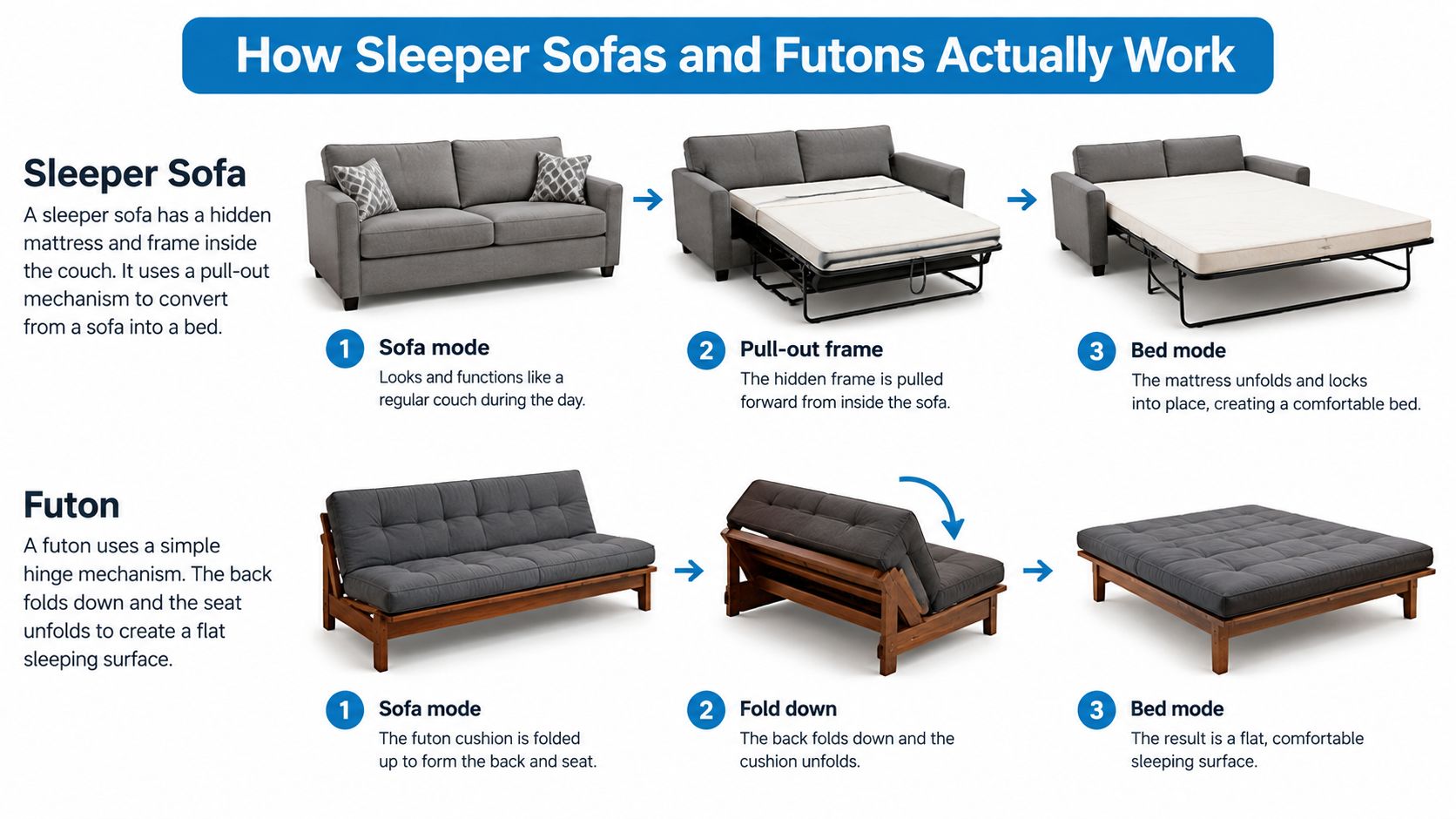
A sleeper sofa is a mechanism hidden inside a sofa shell. The seat cushions stay on the outside, but inside there's usually a folding metal frame, a concealed mattress, hinges, and a support deck. The modern version didn't come from one clean invention, it evolved through repeated furniture patents over decades, including early work like Sarah E. Goode's folding bed desk in 1885, Leonard C. Bailey's folding bed patent in 1899, and Rudolf Coopersmith's sofa-bed patents in the early 1900s, which helped move the design toward the modern pull-out idea. That history explains why sleeper sofas are mechanically more complicated than ordinary sofas.
Why futons feel simpler
A futon is mechanically straightforward by comparison. One hinged frame changes the angle, and the same mattress or cushion does double duty as seating and sleeping surface. That simplicity is why futons often feel easier to operate and easier to understand at a glance. There's less hidden hardware, fewer moving parts, and usually less to break.
That doesn't make a futon automatically better. It just means the comfort burden falls more heavily on the mattress itself. A sleeper sofa can hide more engineering inside the frame, while a futon asks the cushion to do nearly everything.
For a closer look at the different categories of convertible seating, the breakdown in types of sleeper sofas is useful because it shows how much the mechanism changes the whole experience.
The part most people miss
The hidden frame matters as much as the visible upholstery because it decides whether the piece sits well, sleeps well, and folds cleanly.
That's the core difference. A sleeper sofa combines seating upholstery with a convertible sleep platform, which means support lives under the fabric, not just in the cushions. A futon is more transparent, but it also gives you fewer ways to compensate for weak support.
Once you understand that, the rest of the choice gets easier. You're not comparing two styles of couch. You're comparing two different structures built to solve the same problem in different ways.
Mattress and Mechanism Differences
The mattress is where sleeper sofa comfort either works or fails. The key issue isn't just thickness, it's whether the mattress fits the mechanism and still folds properly. Practical buying guidance puts many sleeper sofa mattresses in the 4.5 to 5.5 inch range, and some newer mechanisms can accept about 6 inches, but the manufacturer's limit always wins. If the mattress is too thick, the deck may not close correctly and the mechanism can bind.
| Feature | Sleeper Sofa | Futon |
|---|---|---|
| Sleep surface | Separate mattress hidden in a folding frame | Same cushion used in both modes |
| Typical fit concern | Thickness must match the fold volume | Cushion has to work for both sitting and sleeping |
| Support logic | Frame, deck, and mattress all matter | Mattress quality carries most of the load |
| Common comfort issue | Frame or bar pressure through a thin mattress | Uneven firmness or loss of shape over time |
| Best material direction | High-density foam, latex, or hybrid layers | Denser, more resilient mattress construction |
Fit matters before comfort
A sleeper sofa mattress should be measured in the actual frame, not guessed from the product photo. The internal clearance can vary at the head, center, and foot, so the safe move is to check the deepest and tightest points before you buy a replacement. A 5-inch class mattress can help buffer frame pressure better than older 3- to 4-inch designs, but only if the mechanism can still close smoothly.
Futons are different. They usually rely on a thicker mattress or cushion because the same piece has to feel acceptable in both sofa and bed mode. That means you're making a compromise either way. A futon can be efficient, but if the mattress is too soft it collapses, and if it's too firm it can feel punishing for lounging.
Material choice changes the whole feel
High-density foam, latex, or hybrid layers generally spread weight better than a thin low-density pad at the same thickness. That matters because the load path runs through the frame, deck, support surface, mattress, and sleeper weight together. A support upgrade under a bad mattress is not a cure-all. It has to work with the geometry of the mechanism.
Practical rule: buy for dimensional compatibility first, then choose thickness and material second.
That's the mistake to avoid. Mattress thickness on its own doesn't tell you whether the piece will work. The key question is whether the mattress, frame, and folding path fit together without strain.
Comfort in Both Sitting and Sleeping Modes
Comfort isn't one thing here, it's two separate experiences. A piece can be decent for sitting and bad for sleeping, or the other way around. That's why showroom testing often misleads people. You need to judge the daytime and nighttime versions separately.
Sitting comfort favors the sleeper sofa look
A sleeper sofa usually feels more like a traditional living room sofa when closed. It tends to have a more familiar silhouette, more defined arms, and a stronger “real sofa” presence. That's a real advantage if the furniture sits in your main room and has to blend with the rest of the space.
Futons often sit flatter and firmer. Some people like that because it feels clean and direct. Others hate it because long lounging sessions can feel less relaxed, especially if the back support is too upright or the cushion edges are noticeable.
Sleeping comfort depends on pressure points
Sleeper sofas get criticized for bar pressure when the mattress is thin or the support surface isn't doing enough. That's the classic complaint, and it's real. A sleeper sofa can look refined in the room and still feel unforgiving once someone lies down.
A sleeper sofa can look like a normal couch and still punish your back if the bar sits too close to the sleeping surface.
Futons avoid the internal bar problem because the sleeping surface is more continuous. That helps some sleepers, especially guests who are sensitive to hard edges. But futons bring their own trade-off. If the mattress is too soft, too thin, or worn down, the surface stops feeling supportive and starts feeling saggy.
For a more detailed breakdown of how sleeper sofas feel in real rooms, the notes in sleeper sofa comfort are worth reading if you're deciding whether the issue is the frame or the mattress.
Long-term comfort is where cheap choices fail
The showroom test lies because fresh foam always feels better than tired foam. After years of use, a sleeper sofa usually shows its weak points at the support interface, while a futon tends to lose shape in the mattress itself. So don't just ask what feels nice on day one. Ask which design still makes sense after regular use.
Space Requirements and Style Considerations
A sleeper sofa eats floor depth when it opens, and that's the first thing people underestimate. You need room in front for the bed to pull out, and that can turn a tidy living room into a cramped obstacle course if you didn't measure properly. A futon usually asks for less clearance because it rocks or folds into position with less effort.
For clearance planning, measuring clearance for a sleeper sofa is a smart place to start before you buy anything. If you want a room-by-room sizing reference for common setups, the guide on sleeper sofa dimensions is useful for checking whether your floor plan has the depth the mechanism needs.
Match the furniture to the room
- Small apartments: a futon usually wins when every inch matters and the room has to change quickly.
- Formal living rooms: a sleeper sofa usually fits better because it looks more like standard seating when closed.
- Home offices: either can work, but futons are easier if the room has to switch from work zone to guest zone fast.
- Guest rooms: choose based on how often people stay over, not on which piece looks nicer in the catalog.
Style matters more than people admit. Sleeper sofas usually blend into conventional interiors better because they look like normal sofas until you use them. Futons have a more obvious convertible look, and that can read as casual, minimalist, or temporary depending on the room.
Use the visual cue that fits your home
If you care about a polished, coordinated living room, the sleeper sofa is usually the better visual choice. If you want a low-profile, straightforward piece that signals flexibility, the futon makes more sense. Neither is wrong. The room decides.
The smartest buyers stop thinking about furniture categories and start thinking about open floor depth, traffic paths, and what the room looks like when the bed is fully deployed. That's the version that has to work in real life.
Durability, Maintenance, and Cost Over Time
Durability should be judged by testing, not by wishful thinking or lazy weight claims. EN 12520:2024 covers domestic sofas and sofa beds, while EN 16139:2013 applies to non-domestic seating. Testing programs use loads, forces, and velocities that simulate normal use and foreseeable misuse, but that still doesn't guarantee what happens after years of daily sitting, folding, and sleeping. Initial performance is not the same thing as long-term survival.
What the benchmarks actually tell you
Some manufacturers and test programs use cyclic benchmarks like 6,000 unloaded plus 6,000 loaded cycles for high-performance domestic indoor seating, including sofa beds, and upholstery references may also look at 30,000 rubs with no yarn breakage and a minimum color-change grade of 3.5. Those numbers are useful because they show a product was built to handle repeated use. They do not mean you can ignore the mechanism afterward.
That matters more for sleeper sofas than for futons because sleeper sofas have more moving parts. Hinges, fasteners, the deck, and the support interfaces all need inspection. Futons are simpler, but they still need flipping and occasional batting adjustment if you want them to stay usable.
Passing a test doesn't cancel maintenance. It only tells you the furniture survived the test.
Cost over time is really about upkeep
Sleeper sofas usually cost more to build, ship, and repair because the mechanism is more complex. Futons are generally simpler and cheaper upfront, but the mattress can wear faster if it's used heavily. That's why the true cost question is not just purchase price. It's how soon you'll need repairs, support upgrades, or a replacement cushion.
If you own either type for years, basic maintenance matters. Check for loose fasteners, uneven support, and frame alignment. On a sleeper sofa, also watch for folding resistance and bar pressure. On a futon, look for sagging in the mattress and wear in the hinge positions. Small problems become big annoyances when they change how the furniture opens or supports weight.
When Repair Beats Replacement
A sagging sleeper sofa does not automatically need to go to the curb. That's the lazy answer, and it's usually wrong when the frame is still sound. A 2025 CE Delft analysis found that repairing household sofas and chairs can have a much lower climate impact than replacement, with cleaning stains producing 24 to 33 times less impact and reupholstering holes or burn marks producing 3 to 4 times less impact than buying new. The biggest savings come from avoiding new production and waste processing.
Diagnose the actual failure
Start with the part that's failing, not the whole sofa. Is it the mattress, the deck, the frame, the hinge, the cushion foam, or the upholstery. If the structure is intact, repair usually deserves a serious look. If the structure is cracked or unstable, stop there and replace it.
For sleeper sofas with bar pressure or sagging, a sleeper sofa support board or bunkie board placed between the mattress and the metal frame can make a real difference. It helps spread load across the sleep surface and can reduce the feel of the bar underneath. That's often the smartest fix when the frame works but the comfort doesn't.
Repair when it buys you time and comfort
Use this decision filter:
- Reversible problems: loose comfort, worn fabric, sleep-surface pressure, and minor support loss usually deserve repair first.
- Structural failures: cracked members, unstable mechanisms, and severe frame damage are replacement territory.
- Health hazards: mold, pests, or contamination should push you toward disposal, not patching.
The key idea is simple. A visibly uncomfortable sleeper sofa isn't automatically obsolete. If the mattress geometry is wrong or the support path is weak, a targeted fix can make the piece usable again without the cost and disruption of a full replacement.
For homeowners trying to extend the life of what they already own, Meliusly makes support solutions for sagging couches and sleeper sofas, including boards designed to improve support under the sleep surface. If your current furniture just needs smarter support, visit Meliusly and look at the options before you start shopping for a whole new piece.
Best Fit by User Type and Use Case
If you host overnight guests in a formal living room, buy a sleeper sofa. If you sleep on the piece every night in a studio, lean toward a futon or a sleeper sofa with a serious support upgrade. If you rent, choose reversible fixes that don't permanently alter the frame. If you manage a rental or hospitality space, prioritize durable construction, accessible replacement mattresses, and clear testing documentation.
Older adults and caregivers should look harder at fit than at labels. A higher loaded seat, firm armrests for push-off, and an open bed that doesn't create trip hazards matter more than whether the piece is called a sleeper or a futon. If sitting down or standing up feels awkward in the showroom, it'll feel worse at home.
My blunt recommendation is this. Choose the sleeper sofa when you want the room to look finished and the piece needs to act like a real sofa most of the time. Choose the futon when the room needs fast flexibility and space efficiency matters more than style polish. If the piece you already own is close to working, fix the support before you replace it.
If your current couch sags, feels harsh in bed mode, or just needs a smarter support setup, Meliusly builds furniture support solutions that help existing pieces last longer. Explore Meliusly for sleeper sofa support boards, sofa supports, and other practical fixes that can make the furniture you already own feel usable again.
Share this post
- Tags: convertible furniture, futon buying tips, futon vs sleeper sofa, sleeper sofa guide, sleeper sofa or futon