

Sleeper Sofa Comfort How to Make It Sleep Worthy
Posted by Meliusly
A guest arrives for the night, you open the sleeper sofa, add clean sheets, and feel the metal bar through the mattress before you've even finished making the bed. The sofa may look perfectly presentable during the day, yet the first night exposes every weak point, from a thin mattress and sagging support to a front rail that makes sitting uncomfortable.
Sleeper sofa comfort isn't only a mattress issue. The surface, folding frame, support structure, cushions, mechanism, pillows, and bedding all affect how the furniture feels. Meliusly has helped more than 400,000 customers address sagging furniture, and the same practical lesson comes up repeatedly: diagnose the failure point before buying an upgrade. A topper can soften a firm but sound sleeper. It won't reliably fix a support bar pressing into your hips or a frame that sags in the middle.
If you're still comparing designs, it helps to compare sofa bed options by both their seating construction and sleeping mechanism, not just their fabric and appearance.
Why Sleeper Sofas Feel Uncomfortable and What to Check First
A sleeper sofa has a difficult engineering constraint. It must provide supportive daytime seating, then fold into a bed without taking up the space of a conventional mattress. A standard residential mattress averages 8 to 14 inches in thickness, while sleeper sofa mattresses are commonly limited to about 4 to 6 inches, as explained in the history and construction overview of sleeper sofas. That difference leaves less material between your body and the folding frame.

Older spring-and-bar designs often make the problem obvious. A thin mattress compresses under the shoulders and hips, allowing the body to contact a metal rail or uneven section of the mechanism. If the frame also dips through the center, the sleeper experiences both bar pressure and midsection sag. A replacement mattress may help with the first problem, but it can't correct a support surface that no longer stays level.
Daytime comfort deserves equal attention. Sit in the sofa as you normally would, then check whether the front edge collapses, whether a hidden rail presses into your lower back, and whether the cushions sink unevenly. A sleeper can be acceptable for sleeping and unpleasant as a daily sofa, particularly when the cushion thickness and mechanism placement force your pelvis too far forward.
Separate the three common failure points
Start with a visual inspection. Remove the cushions, open the bed, and look for bent components, uneven folding sections, loose hardware, or a mattress that has developed a permanent hollow. Run your hand across the sleeping surface without bedding. You're looking for exposed bars, abrupt height changes, and a center section that sits lower than the ends.
Then perform a real lie-down test. Spend several minutes on your back, side, and stomach if those are your usual positions. A short showroom sit can hide pressure points because your body hasn't settled into the mattress. If your shoulders, hips, and low back can't remain reasonably level, note exactly where the discomfort begins.
Practical rule: Softness can disguise a structural problem for a few minutes. Pressure that returns in the same location after you change positions usually points to the mattress or frame, not the sheets.
A thin mattress feels like a pad over the mechanism, especially when it measures below roughly 4 inches, a range commonly described as suitable mainly for children or occasional use in sleeper sofa buying guidance. If the mattress feels uniformly hard but the frame is level, thickness and firmness are the likely starting points. If you feel a distinct bar, a support shield or board deserves attention before you spend on softer foam.
How to Assess Your Sleeper Sofa Mechanism and Mattress
You can identify most sleeper sofa comfort problems without tools. The useful test isn't whether the sofa feels soft in a showroom. It's whether the opened bed supports your actual sleeping positions and whether the mechanism works smoothly enough for regular use.
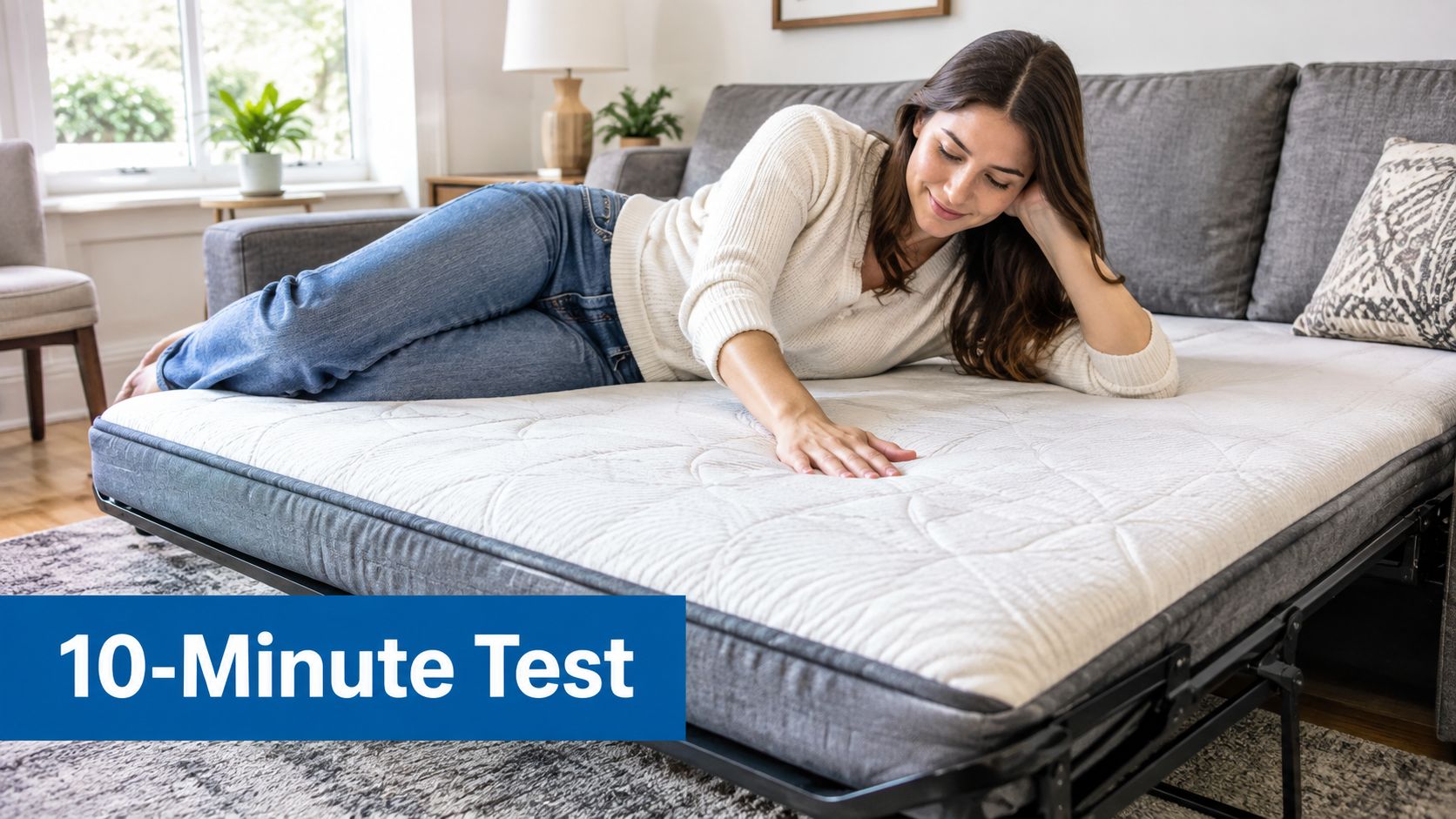
Run the sleep test before shopping
Open the sleeper completely and remove thick bedding. Lie down for several minutes in the position you use most often. Repeat the test on your back and side, even if one position isn't your usual choice, because the change in load can expose a sagging center or a pressure rail.
Check three contact areas:
- Shoulders and hips: These areas need enough cushioning to avoid concentrated pressure, especially for side sleeping.
- Low back: Your lumbar area shouldn't drop into a hollow while the hips remain propped up.
- Edges and transitions: Roll toward the sides and feel for edge collapse, a raised front rail, or a hinge that interrupts the sleeping surface.
A reliable evaluation method is to check whether the shoulders, hips, and low back stay aligned while the mechanism remains stable. The mattress support guidance from Meliusly is useful when the surface feels uneven and you need to decide whether the problem sits above or below the mattress.
Listen and watch the mechanism
Fold the sofa out and close it again slowly. The movement should feel controlled rather than rough or forced. Listen for creaks, clanks, and scraping. A noisy mechanism may need adjustment or hardware attention, while a section that catches or twists can create uneven support even when the mattress itself looks sound.
Inspect the closed sofa after the test. Make sure the mattress and bedding aren't bunching against the frame. Measure the available space inside the folded structure before ordering a replacement. Many sleeper sofa frames limit mattresses to about 4 to 5 inches, and some models cap out at roughly 4.5 inches, as outlined in this sofa-bed mattress sizing guide.
Measure clearance, then choose the repair
Don't judge a replacement by thickness alone. Confirm that the sofa closes without excessive compression and that the mechanism can move through its full path. Guidance for replacement mattresses commonly recommends allowing about 1/2 inch of clearance, while noting that an 8-inch sofa base with 3-inch seat cushions can produce a maximum mattress thickness of approximately 4.5 inches in one example calculation. The sleeper sofa clearance guide explains why the closed-frame measurement matters.
A topper makes sense when the mattress is level but too firm. A thicker replacement suits a uniformly thin surface that still fits the mechanism. A support board or bar shield is the better direction when you can identify a hard rail, center sag, or uneven folding frame. For brand-specific shopping context, you can also review this Ashley Furniture sleeper sofa 2026 guide, then apply the same hands-on tests to the model you're considering.
Choosing the Right Mattress Thickness and Firmness for Better Sleep
Mattress thickness changes sleeper sofa comfort in steps rather than in a smooth progression. Below roughly 4 inches, the mattress often behaves like a thin pad over the folding mechanism. At approximately 4.5 to 6 inches, pressure relief and separation from the support bars generally improve enough for regular adult guests, according to current sleeper sofa quality guidance.
The upper limit is mechanical. Mattresses above 6 inches may provide more cushioning, but they can make the sofa harder to fold and may interfere with smooth operation. Some guidance extends the upper end to 7 inches for heavier adults or more frequent use, but only when the frame has enough room to close properly.
| Thickness Range | Best For | Comfort Outcome | Foldability |
|---|---|---|---|
| Under 4 inches | Children or very occasional use | Greater risk of bar feel and pressure points | Usually easiest to fold |
| About 4.5 to 5 inches | Adult guests and constrained frames | Noticeable improvement over a thin stock mattress | Often compatible, subject to clearance |
| 5 to 6 inches | Most adult guests and regular hosting | Strong balance of cushioning and support | Common sweet spot, verify the frame |
| Above 6 inches | Heavier adults or frequent use where approved | More pressure relief when the frame supports it | Can become difficult to close and manage |
Firmness must match the sleeper
A medium to medium-firm surface is a dependable starting point because it balances contouring with spinal support across common sleep positions. Side sleepers generally need some give at the shoulders and hips. Back sleepers need a flatter load distribution so the lumbar area doesn't sag. Stomach sleepers usually need a firmer surface to keep the pelvis from dropping too far.
A firmness label isn't a universal measurement. Identical ratings can feel different because foam density, top-layer composition, and the underlying support structure change the result. The mattress firmness guidance from Sleep Foundation recommends evaluating firmness through sleep position and alignment rather than relying only on a brand's number.
A firm sleeper sofa isn't automatically a poor sleeper. If the frame stays level and the spine remains aligned, a topper can add surface softness without removing the support underneath.
For a mattress that's structurally sound but too hard, a topper can be a more practical purchase than replacing the entire bed. This queen sleeper sofa mattress topper guide can help you think through topper placement, storage, and the relationship between added cushioning and the sofa's closing clearance. Test the finished setup over several nights, then recheck pillow height because a softer or thicker sleep surface changes how high your head sits.
Proven Ways to Add Support and Stop Bar Pressure
A topper changes the feel above the frame. It doesn't remove a steel bar, rebuild a sagging section, or level a distorted folding mechanism. When the sleeper feels a hard line under the hips or dips through the center, restore the support surface first.
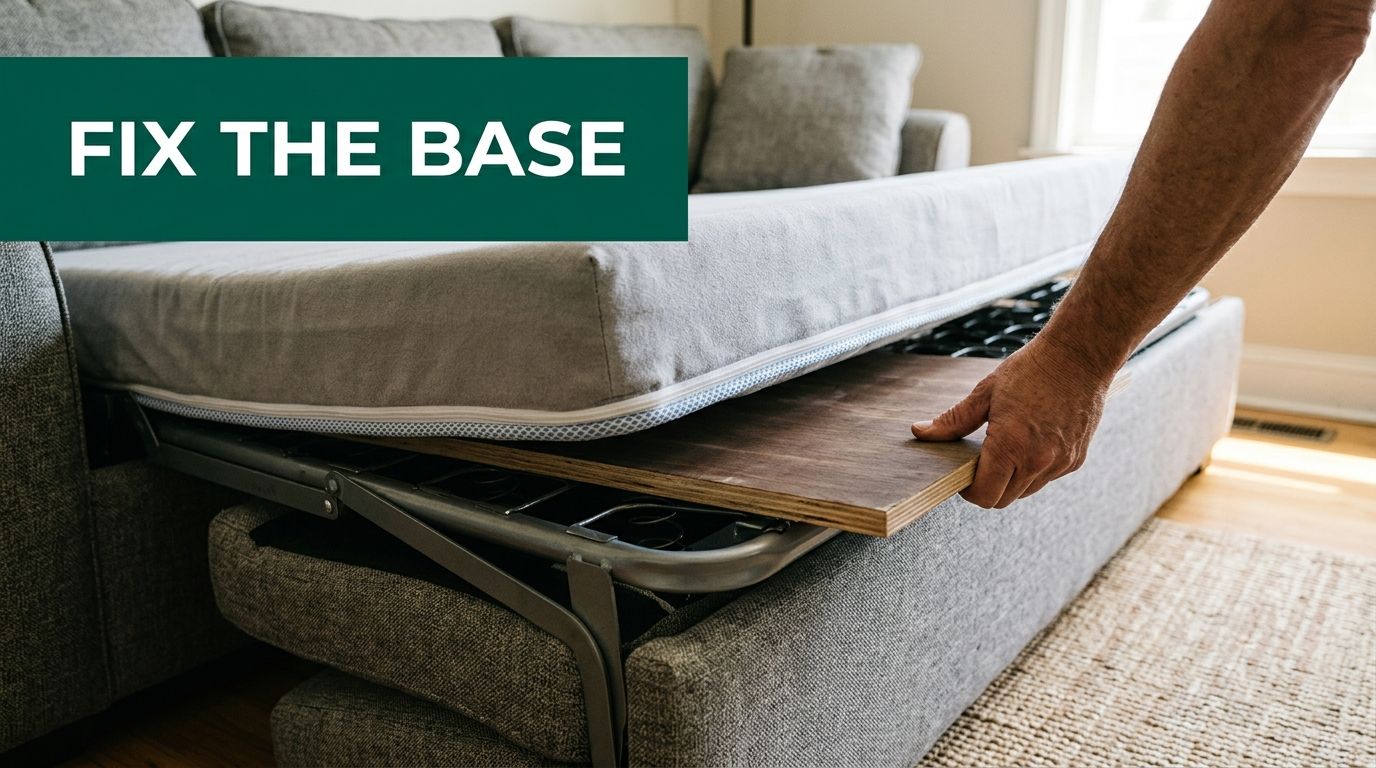
Confirm the space before adding anything
Open the sleeper and measure the length and width of the section that needs support. Identify the metal bars, hinge points, and folds. A board must cover the pressure area without blocking the mechanism, catching on the frame, or preventing the sofa from closing.
Check the closed-frame clearance before selecting mattress or board thickness. Allow about 1/2 inch of clearance, and use the example of an 8-inch sofa base with 3-inch seat cushions, which can leave approximately 4.5 inches for the mattress in that configuration, as described in this sleeper sofa measurement guide. Your sofa may differ, so measure rather than assuming.
Choose the intervention that matches the failure
A rigid support board creates a flatter barrier between the mattress and the bars. Meliusly's SleeperSaver Lite is one example of a sleeper sofa support board intended to cover steel bars and add a more even layer between the frame and mattress. For a permanent installation, a board designed to stay with the frame can make sense in a guest room or hospitality setting. Renters may prefer a foldable support board that can be removed and stored when the sofa returns to seating mode.
Reinforced slats or a bunkie board can also distribute weight across a wider area, provided the design fits the folding frame. Don't install a permanent, rigid piece where the sofa must hinge unless the product is specifically designed for that mechanism. A board that improves the sleeping surface but prevents closure isn't a successful repair.
Decide whether a topper still has a role
Once the support is level, reassess the mattress. If the bar pressure has disappeared but the surface remains too firm, add a quality topper within the remaining clearance. If the mattress still has a deep permanent hollow, replacing it may be more sensible than layering material over worn foam.
Support-first diagnosis: If you can feel a narrow hard line, address the line. If the entire surface feels uniformly firm, evaluate firmness and cushioning.
Use the sleeper sofa bar shield guide when deciding how to address recurring bar pressure. The broader principle applies to homeowners, renters, and hosts alike: restore the frame-to-mattress interface before trying to mask it with extra softness.
Avoid loose household plywood, folded blankets, or thick improvised padding that shifts during use. These materials can create new ridges, interfere with folding, or conceal damage that needs a proper repair. Measure, test the mechanism through a complete opening and closing cycle, then lie down again in the positions that exposed the original problem.
Bedding Ergonomics and Hosting Tips for Guests and Small Spaces
A sound sleeper sofa can still feel disappointing if the bedding setup ignores its firmer surface and compact proportions. Comfort comes from the complete arrangement, not only from the mattress. A topper can soften a modern sleeper, but the pillow, protector, sheets, and daytime cushions all need to work with the new height.

Build a guest-ready sleep surface
Use bedding that adds comfort without trapping the sleeper in an overly soft, unstable stack. A mattress protector helps keep the mattress clean and can reduce some friction and noise between the sleeper and sheets. Fit sheets carefully, because sleeper mattresses can have nonstandard dimensions and loose fabric can bunch under the body.
A firmer sleeper often benefits from a topper placed directly over the mattress, followed by the protector and fitted sheet. Keep the topper thin enough for the mechanism's clearance, and store it flat or loosely rolled rather than compressed into a permanent crease. After changing the surface height or firmness, reassess the pillow. A pillow that worked on the original mattress may now angle the neck too high or too low.
Fix the daytime experience too
Fold the bed away and sit in the sofa as a normal chair. Check the front rail, seat edge, and cushion transitions. If the front edge presses behind the thighs or the cushions sink so far that standing becomes difficult, adjust the cushion support rather than focusing only on overnight bedding.
A firmer seat isn't necessarily defective. It can provide more stable support during conversation, reading, or getting up, especially for older adults and caregivers who don't want to sink into a deep cushion. A lumbar pillow can correct a deep seat, while a smaller back cushion can help someone maintain an upright posture without forcing the shoulders forward.
Keep small spaces easy to reset
Apartment dwellers usually need a solution that disappears when the sofa becomes seating again. Choose removable bedding, a foldable support component where appropriate, and a storage location close to the sofa. Avoid a setup that requires moving heavy pieces through a narrow room every time a guest arrives.
Hosts and hospitality operators can use a short turnover routine:
- Inspect the surface: Check for a shifted topper, bunched sheet, or exposed support point.
- Test the conversion: Open and close the mechanism periodically, listening for new resistance or noise.
- Reset the sitting cushions: Return cushions to their intended positions so the sofa doesn't feel uneven during the day.
- Store bedding nearby: Keep clean linens and the topper accessible without placing them on a damp floor or compressing them unnecessarily.
For rooms where a full sleeper sofa won't fit, reviewing Rome Georgia sleeper chair options can broaden the comparison, but the same questions still apply: how does it sit, how does it sleep, and how does its mechanism affect both uses?
Keeping Your Sleeper Sofa Comfortable for Years
Comfort declines when small problems go unchecked. A mattress develops a preferred sleeping hollow, support components loosen, and repeated folding can change how the frame carries weight. A simple inspection routine protects both overnight comfort and the sofa's daily seating position.
Rotate the mattress when its design allows it, following the manufacturer's instructions for orientation. Check the support board, slats, and folding joints for movement or wear. Tighten accessible mechanism hardware carefully, but don't force a fastener that appears bent or misaligned. Resistance during opening and closing is a reason to inspect the mechanism, not to pull harder.
Refresh support before replacing furniture
Recheck the sleeping surface after heavy use or repeated hosting. If the mattress remains level but feels firmer than guests prefer, a properly fitted topper may be enough. If bars have become noticeable or the center has begun to sag, restore the support underneath first. If the mattress has lost its shape after the frame is corrected, replace the mattress rather than adding more layers.
Store removable toppers clean and dry, with enough room to retain their shape. Keep the sofa's folded interior free of objects that can press into the mattress or obstruct the mechanism. During daytime use, rotate seat cushions when their construction permits it and redistribute sitting positions instead of loading the same edge every day.
Meliusly focuses on practical furniture support solutions, including sleeper sofa support boards, sofa supports, bunkie boards, and bed slats, so homeowners can address sagging and bar pressure without automatically replacing usable furniture. The most economical repair is the one that matches the failure: support for a weak foundation, a mattress for worn cushioning, and bedding adjustments for the final layer of comfort.
Visit Meliusly to find furniture support solutions for sleeper sofas, sagging couches, and bed foundations. Choose the component that matches your sofa's measured problem, then restore the support before your next guest night.
Share this post
- Tags: fix sagging sofa, furniture support, sleeper sofa comfort, sleeper sofa support, sofa bed mattress