

Best Pull Out Couch for Real Comfort That Lasts
Posted by Meliusly
The most popular advice about the best pull out couch is also the least reliable: sit on it for a few minutes, lie down once, and buy the one that feels softest. That showroom test tells you almost nothing about how the sleeper will perform after repeated folding, nightly sitting, guest turnover, and months of pressure on the same support points.
A pull-out couch is a mechanical piece of furniture. Its comfort depends on the relationship between the frame, conversion system, mattress clearance, and support deck. If one of those parts is poorly matched, a plush first impression can turn into a sagging seat, a noisy mechanism, or a mattress that presses against metal bars.
The category is established for good reason. One industry estimate valued the global sleeper sofa market at USD 5.79 billion in 2024, with a projection of USD 8.98 billion by 2033, while another estimated the U.S. market at USD 2,844.22 million in 2024 and reported pull-out sofa beds as the largest U.S. product segment, with 40.22% share in 2024. See the sleeper sofa market analysis for those estimates. People keep buying these sofas because one piece must do two jobs, especially in apartments, guest rooms, home offices, and short-term rentals.
| Buying priority | What matters most | My recommendation |
|---|---|---|
| Occasional guests | Simple mechanism and reasonable mattress support | Traditional bi-fold with a support upgrade |
| Weekly hosting | Easy conversion and durable deck | Sturdy bi-fold, three-fold, or platform design |
| Nightly sleeping | Stable support and mattress compatibility | Reinforced three-fold or platform sleeper |
| Small apartment | Compact footprint and low conversion effort | Click-clack or compact three-fold |
| Existing sagging sleeper | Mattress-to-frame support | Add a properly fitted support board before replacing the sofa |
Why Most Pull Out Couch Reviews Miss the Real Question
A showroom review usually measures initial comfort. It doesn't measure what happens after the frame has been opened and closed repeatedly, after guests shift position during the night, or after the mattress spends months pressing against the same rails and bars. The softest sofa in the store can still be the wrong purchase if its mechanism has poor clearance or its deck concentrates weight in narrow areas.
The better question is simple: what will this couch feel like after six months of real use? Recent review formats have started to recognize that long-term testing matters, with one 2025 roundup evaluating sleeper sofas again at six-month and one-year markers. That approach is still unusual, which leaves buyers with too much showroom information and too little durability information. The long-term pull-out couch discussion makes the same important point, durability must be judged beyond the first review period.
The three hidden variables
Mechanism wear appears first in the conversion process. Rails can bind, hinges can develop play, and folding legs can stop deploying cleanly. A mechanism that feels effortless on the sales floor may become awkward when debris collects beneath the deck or when fasteners loosen under repeated movement.
Mattress clearance is the second variable. The internal cavity determines what mattress can fold without stressing the frame. A thicker mattress isn't automatically a better mattress if the mechanism can't close around it.
Frame sag is the failure buyers feel most clearly. Weak areas in the deck allow the mattress to dip between bars, while the sofa seat can lose its shape where people sit most often. A support board can address a weak deck, but it can't compensate for a damaged frame or a mechanism that no longer tracks correctly.
Practical rule: Judge the sofa in three positions, seated, fully opened, and halfway through conversion. The halfway position exposes binding and awkward leg deployment that a finished showroom setup hides.
A pull-out couch has been solving the same space problem for generations. Sarah E. Goode's 1885 convertible furniture patent is commonly cited as an early antecedent of today's sleeper sofa, and the category became more useful as urban households adopted smaller living spaces. Its staying power reflects a durable need, but it doesn't excuse poor engineering. The best choice is the one that remains serviceable when the novelty has disappeared.
The Four Pull Out Mechanisms and How They Age
Mechanism type predicts more about long-term ownership than upholstery color. Before comparing fabrics or arm shapes, identify how the bed opens, where the weight lands, and how much folded space the mattress occupies. The four formats below behave differently under repeated use.
Traditional bi-fold pull-out
A bi-fold stores a separate mattress inside the sofa and unfolds in two main sections. It can accept a relatively substantial mattress compared with more compact systems, but the front rail and folding joints carry significant stress when the sleeper opens and closes. Inspect the rails for smooth travel, confirm that the legs deploy without catching, and look for a rigid frame rather than thin components that flex under load.
Three-fold systems
Three-fold mechanisms divide the sleeping surface into more sections. They often feel easier to operate because each movement handles less of the total extension, but that compact folding pattern usually limits mattress thickness. More hinges mean more potential wear points, so check hinge alignment, pin movement, and whether the folded mattress sits without being crushed.
Click-clack designs
A click-clack folds the backrest down through a ratcheting hinge. It's compact and fast, but the seat and back become the sleeping surface, so the cushion structure must do both jobs. Listen for rough ratchet engagement and inspect whether the back locks evenly on both sides. These models work best when floor space is tight and overnight use is occasional.
Ottoman-style and slide-out systems
Ottoman-style sleepers use a platform or cushioned section that extends from beneath the seating area. They avoid some of the narrow-bar problems found in traditional pull-outs, but the extension hardware and platform alignment become the main inspection points. Look for a platform that rolls or slides evenly and stays level when fully deployed.
The sofa construction details, including frame joints and support choices, deserve the same attention as the mechanism itself. Use this sofa construction guide before buying, especially if the product page gives only general language about “durable construction.”
| Mechanism | Fold effort | Max mattress thickness | Avg lifespan (yrs) | Common failure point |
|---|---|---|---|---|
| Traditional bi-fold | Moderate | Often the most forgiving of the four, subject to frame clearance | Not stated reliably across models | Bent rails, stressed front rail, loose folding joints |
| Three-fold | Low to moderate | Usually more restricted than bi-fold systems | Not stated reliably across models | Hinge wear, compressed folded mattress, uneven leg deployment |
| Click-clack | Low | Usually limited by seat and back cushion depth | Not stated reliably across models | Noisy or uneven ratchets, hinge looseness |
| Ottoman-style or slide-out | Low to moderate | Depends on platform cavity | Not stated reliably across models | Misaligned platform, worn runners, weakened support deck |
I haven't assigned invented service-life figures to these mechanisms because manufacturers use different materials, loads, and warranties. A buyer should treat “expected lifespan” as a product-specific question, not a universal number. Ask for the mechanism warranty, replacement-part policy, and internal clearance before trusting a sales label.
Mattress Types and the Clearance Trap
Showroom softness tells you little about how a pull-out couch will feel after six months. Folded height is the primary constraint because a mattress that feels luxurious in the store may prevent the cavity from closing or strain the mechanism at home. For adult use, buying guides commonly place the practical thickness benchmark around 5 to 6 inches, while mattresses under 4 inches can leave sleepers feeling the underlying grid or bar. The sleeper sofa comfort checklist explains this thickness trade-off.
Many sleeper systems accommodate roughly 4 to 5 inches of mattress thickness. Exceeding about 5 to 6 inches can interfere with closing and stress the folding mechanism. Check the sofa-bed mattress sizing and clearance guidance before ordering a replacement, then measure your own cavity rather than relying on the mattress label.
How the main mattress constructions behave
Innerspring mattresses provide familiar responsiveness and airflow, but their weight and coil structure need a frame that resists excessive flex. Pairing a heavy innerspring insert with a light click-clack is a poor match.
Memory foam conforms to the body and reduces the sensation of individual bars. It still has to fold inside the cavity. A thick foam mattress or topper can buckle against the frame instead of improving comfort.
Polyurethane foam is lighter and easier to fold, which suits many compact sleepers. It can compress over time when the deck has unsupported spans or the foam lacks sufficient resilience.
Hybrid pocket-coil mattresses combine foam and coils for a more conventional bed feel. Their construction can require greater folded clearance and adds weight, so match them with a frame designed for both demands.
Air-over-coil designs offer an adjustable feel, but the air chamber, coil structure, and pump or valve arrangement must fit the storage space without rubbing against moving parts.
| Mattress type | Typical thickness | Best-suited mechanism | Folded clearance needed | Comfort vs support notes |
|---|---|---|---|---|
| Innerspring | Confirm the exact product specification | Sturdy bi-fold or reinforced platform | Must match the internal cavity precisely | Responsive, but heavier and less forgiving of a weak frame |
| Memory foam | Commonly selected within the practical 5 to 6-inch benchmark | Bi-fold or three-fold with verified clearance | Measure compressed folded height | Good pressure relief, but can expose deck sag |
| Polyurethane foam | Often used in thinner sleeper formats | Three-fold or click-clack | Usually modest, but product-specific | Light and flexible, with compression risk under poor support |
| Hybrid pocket coil | Varies by construction | Strong bi-fold or platform | Requires careful cavity measurement | More bed-like support, with greater weight and clearance demands |
| Air-over-coil | Product-specific | Platform or sturdy pull-out frame | Check valves, chambers, and folded hardware | Adjustable feel, but more components require protection |
A topper improves surface comfort, but it cannot correct a bent rail or unsupported span. If the deck needs reinforcement, review this pull-out mattress pad guide before choosing an aftermarket solution. Measure the mattress, folded cavity, and closed mechanism together, then confirm that the frame leaves enough clearance for the mattress to close without compression.
Dimensions, Weight Limits, and Room Fit
A sleeper sofa can fit against a wall and still fail the room test once opened. Measure the sofa, the extended bed, the path around it, and the delivery route. The open footprint controls whether people can walk through the room, reach a door, or use nearby furniture while guests are sleeping.
Match the sleeper footprint to the room
Chair sleepers suit solo overnight use and tight rooms. Loveseat sleepers offer more sleeping width without the full visual and floor demand of a sofa, while full sofa sleepers provide the broadest practical sleeping surface among these three categories. Exact dimensions vary by manufacturer, so use the published bed dimensions rather than the sofa label alone.
A pull-out design also needs clear space behind and around the backrest. Plan for at least 85 cm of clearance behind the backrest when the design requires added rear space for conversion or movement. Tape the open footprint on the floor before ordering. This test catches conflicts with coffee tables, media consoles, radiators, and doors faster than a product photo can.
| Sleeper size | Extended bed, W × L | Typical weight capacity | Min. room clearance |
|---|---|---|---|
| Chair | Product-specific compact sleeping surface | Depends on frame class | Open footprint plus walking route |
| Loveseat | Product-specific intermediate sleeping surface | Depends on frame class | Open footprint plus access on the usable side |
| Sofa | Product-specific broad sleeping surface | Depends on frame class | Open footprint, walking clearance, and conversion space |
Treat capacity as a frame question
Light tubular-steel frames are commonly described around 180 kg total load, while kiln-dried hardwood frames may be rated around 250 to 350 kg, depending on construction and manufacturer specification. Those figures should be treated as total supported load, not a promise that any particular sleeper is suitable for every couple or sleeping position. Check the actual rating, warranty terms, and whether the rating covers the bed mode as well as ordinary sofa seating.
Delivery creates another hard constraint. Queen sleepers often create problems at doorways, stair turns, and elevator entrances, even when the room itself has plenty of space. Measure the packaged width and height, not just the assembled sofa, and ask the retailer for the delivery dimensions before placing the order.
The mechanism sets the mattress ceiling. A bi-fold may accept a thicker mattress than a three-fold, while a click-clack is limited by its cushion depth. If the product page doesn't state the folded clearance, don't assume the advertised mattress thickness will work.
Where Pull Out Couches Actually Fail Over Time
Static showroom tests miss the forces that damage sleeper sofas. People don't lie still on a bed platform. They sit on the edge, roll, stand up, fold the mechanism with uneven weight, and repeat the process under time pressure. The combination of dynamic body movement and repeated conversion exposes weak rails, stretched fabric, loose fasteners, and compressed foam.
Five real-use patterns
A guest-room sleeper used only occasionally may stay comfortable for a long time, then reveal a depressed center when visitors finally use it for several nights. The problem usually starts at the mattress and deck interface, where unsupported spaces allow foam to settle into the gaps.
A city apartment hosting friends every week sees a different pattern. The sofa serves as primary seating, then converts regularly, placing repeated stress on the front rail, folding legs, and seat suspension. The first warning may be a rail that catches or a frame that sits slightly unevenly when opened.
Short-term rentals expose the mechanism to constant turnover. Different guests pull from different angles, leave debris in the tracks, and apply body weight before the platform is fully locked. This environment can produce noisy ratchets, bent bars, cracked support straps, or a mattress that loses shape faster than an occasional-use sleeper.
A family den with daily napping concentrates wear in the same seat and sleeping zones. The upholstery may still look acceptable while the foam underneath compresses and the deck begins to transmit pressure points. Children also create abrupt loads that a static capacity test doesn't represent.
A sleeper used by someone with mobility limitations faces another challenge. Sitting down on the edge and rising from it loads the front rail more aggressively than lying in the middle. A low, flexible, or uneven platform can become uncomfortable and difficult to use long before the sofa appears visibly damaged.
The first failure usually isn't dramatic. It starts as a small dip, a faint click, or one awkward fold that users learn to work around.
What the symptoms mean
A central dip points toward unsupported spans, compressed foam, or a mattress that needs a more even base. A support board can spread pressure across the frame, but inspect the underlying metal before adding anything.
A bent bar or uneven deck indicates structural stress. Don't force the mechanism closed, because added resistance can damage hinges and rails.
Cracked lattice straps or stretched seat fabric show that the suspension is carrying loads it wasn't designed to distribute indefinitely. A board-on-deck solution may help in bed mode, but it won't repair damaged upholstery suspension.
A noisy ratchet deserves attention before it stops locking. Clean accessible debris, inspect fasteners, and avoid lubricating surfaces where a spray could reach fabric or the mattress.
The right response depends on the failure. Surface discomfort calls for mattress or deck support. Binding, bent rails, and broken locking parts call for mechanical repair or replacement.
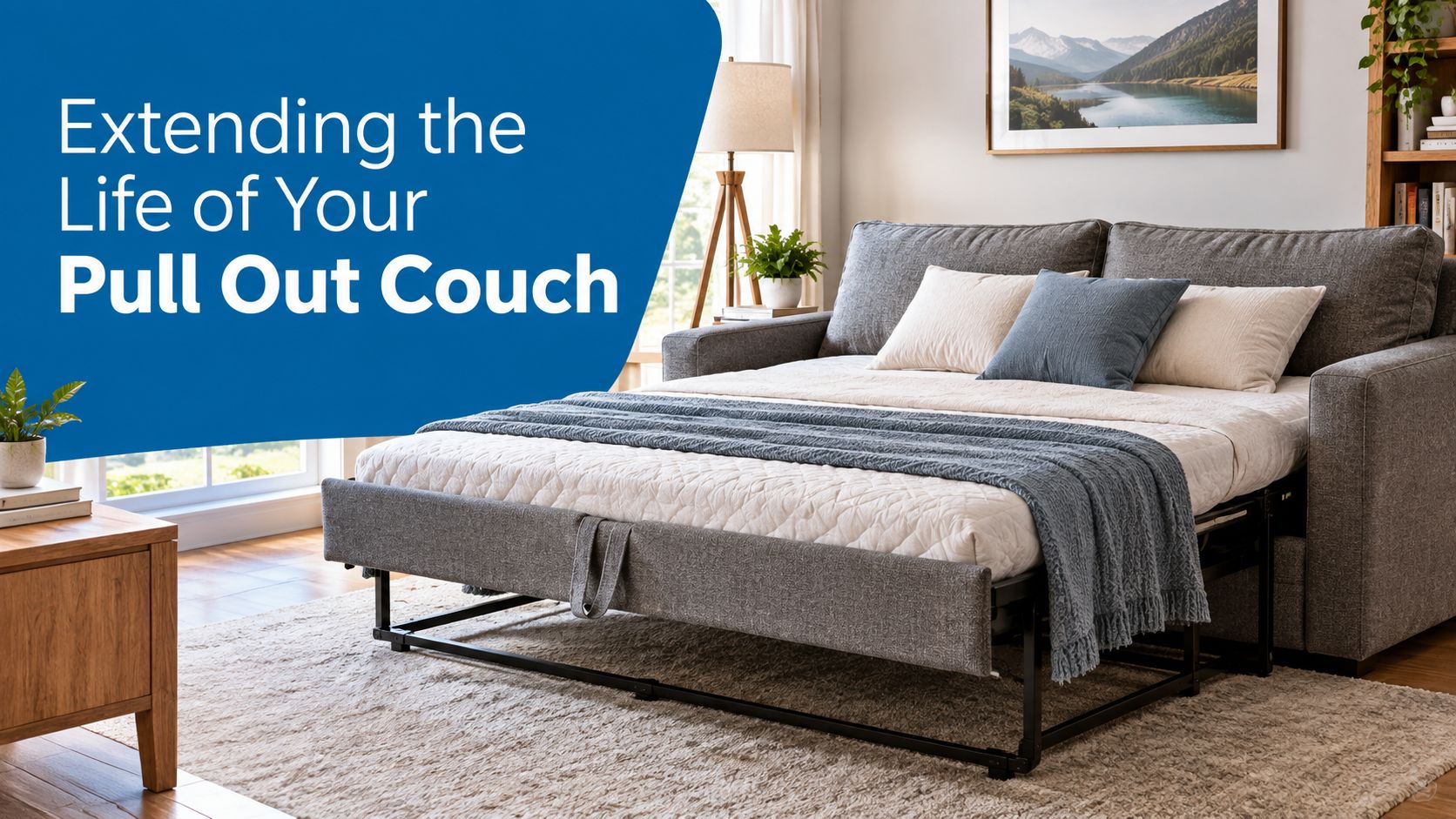
Extending the Life of Your Pull Out Couch
Start with maintenance, then add structure. A sleeper sofa lasts longer when its moving parts stay clean, its mattress avoids permanent impressions, and its deck distributes weight instead of concentrating it over narrow bars.
Use a simple maintenance routine
Rotate the mattress every 60 days. Turn it in the directions the construction allows, and inspect the edges for compression. Rotation won't fix a weak foundation, but it can prevent one sleeping position from creating a permanent impression.
Vacuum the mechanism. Dust, crumbs, and fabric fibers can collect around rails, hinges, and folding legs. Remove the mattress when possible and clean the accessible frame before conversion becomes rough.
Lubricate pivot points annually. Use a silicone spray sparingly on appropriate metal pivot points. Keep the product away from upholstery, foam, and sleeping surfaces.
Tighten carriage bolts after the first month. New furniture can settle during the initial break-in period. Check accessible fasteners without overtightening or stripping the hardware.
A mattress cover helps control moisture and surface wear. Pair it with rotation rather than using a topper as a substitute for a stable deck. The pull-out mattress support guide covers the relationship between the sleeping surface and the support underneath.
Reinforce the deck before replacing the sofa
A plywood overlay can bridge gaps between bars and reduce the sensation of the frame beneath the mattress. A cross-slatted replacement goes further by creating a more structured platform, but it requires accurate measurement and more installation effort. Neither approach should interfere with folding clearance or prevent the sofa from closing.
A sleeper sofa support board sits between the mattress and pull-out frame. Its purpose is straightforward, it bridges weak points, spreads pressure over a broader area, and reduces sagging between bars. One commonly cited construction example uses hardwood veneer or reinforced plywood around 1/3 inch, roughly 8.5 mm, thick. See this sleeper sofa support board explanation for the underlying support principle.
Meliusly offers foldable and permanent sleeper sofa support boards for compatible pull-out frames. The foldable format can be placed on the opened frame and stored away, while a permanent installation is intended to remain with the sleeper. Measure the bed surface, check the closed clearance, and choose the approach that fits your conversion routine.
A support board doesn't replace a failed mechanism. If the frame has bent rails, broken welds, or locking hardware that won't engage, repair that problem first. Structural reinforcement works best when the original frame remains aligned and functional.
Matching the Best Pull Out Couch to Your Situation
The best pull-out couch isn't a universal model. It's the sleeper whose mechanism, mattress, frame, and maintenance needs match the way your household uses it. A guest-room buyer can sensibly prioritize appearance and occasional comfort, while a nightly sleeper needs a stable deck and a frame built for continuous loading.
| Buyer situation | Recommended mechanism | Recommended mattress | Frame priority |
|---|---|---|---|
| Occasional guest-room host | Traditional bi-fold | Mid-density foam within verified clearance | Rigid frame and accessible replacement parts |
| Small-space urban dweller | Click-clack or compact three-fold | Flexible foam construction | Compact, evenly locking mechanism |
| Short-term rental operator | Platform, sturdy bi-fold, or durable three-fold | Resilient foam or compatible hybrid | Easy maintenance and strong deck |
| Nightly sleeper | Reinforced three-fold or platform | Supportive innerspring, foam, or compatible hybrid | Kiln-dried hardwood or robust engineered frame |
| Family with children | Click-clack for compact use, or reinforced pull-out | Durable, easy-to-protect foam | Stable hinges, rounded hardware, cleanable upholstery |
Five buying decisions
Occasional guest room: Choose a traditional bi-fold with a mid-density foam mattress and a rigid wood frame. Guests may tolerate a less refined mechanism when the sofa spends most of its time closed, but they won't appreciate a mattress that exposes every bar.
Small apartment: Prioritize conversion effort and open-floor clearance. A click-clack can work well when the bed must stay in the same footprint, while a compact three-fold makes sense if you need a more separate sleeping surface.
Short-term rental: Treat the sleeper as equipment, not decoration. Choose a mechanism that guests can operate without instructions, use a mattress protector, and make deck support easy to inspect between stays.
Nightly sleeper: Avoid selecting by upholstery alone. Look for a sturdy frame, a mattress that matches the folded cavity, and a support system you can maintain. A platform sleeper may be preferable when the room allows it, because it removes some folding-frame stress.
Family with kids: Choose stability over delicate styling. A simple mechanism with protected edges and a mattress cover is easier to live with than a complicated sleeper that children can misalign during conversion.
Sectionals deserve consideration when chaise seating solves the room layout, while futon hybrids make sense for buyers who accept that the same cushions must serve as both sofa and bed. The trade-off is clear, lower initial complexity can mean more compromise in sleep comfort, while a more engineered system may demand careful maintenance.
A Buyer's Checklist Before and After the Purchase
A good purchase has two phases. First, verify that the sofa's frame and mechanism deserve your confidence. Then improve the mattress-to-deck relationship after delivery instead of assuming the factory setup is perfect for every sleeper.
Before you buy
- Cycle the mechanism repeatedly. Open and close it several times in the showroom. Watch for binding, uneven legs, scraping, or a frame that needs body weight to lock.
- Measure the unfolded deck. Confirm the actual sleeping surface, not just the advertised sofa size.
- Check mattress clearance with a tape. Ask for the internal folded height and compare it with the mattress thickness.
- Inspect frame reinforcement. Look at corner blocking, rail stiffness, hinge alignment, and accessible fasteners.
- Read the mechanism warranty. Upholstery coverage doesn't necessarily include folding hardware, rails, springs, or locking components.
- Measure delivery access. Check doorways, stair turns, elevators, and the packaged dimensions before ordering a large sleeper.
After delivery
Add support early. If the opened frame has noticeable gaps or pressure points, install a correctly sized sleeper sofa support board within the first month, provided it doesn't interfere with closing.
Rotate the mattress quarterly. Use the permitted rotation pattern for the mattress construction and keep a cover on it when the bed is used frequently.
Lubricate metal joints annually. Apply silicone spray only to suitable pivot points, and protect all fabric and foam from overspray.
Vacuum under the deck every six months. Removing debris helps the mechanism move cleanly and makes it easier to spot loose hardware, bent rails, or damaged straps.
Treat toppers and protective covers as useful additions, not substitutes for a sound frame. A topper can improve the sleeping surface, but it won't correct a deck that sags or a mechanism that no longer locks securely.

Buy the frame and mechanism you trust, then upgrade the mattress and support to fit your actual use.
Meliusly provides practical support solutions for sagging sofas, sleeper sofa decks, bunkie boards, and bed slats, helping homeowners improve comfort without replacing usable furniture. Visit Meliusly to find a sleeper sofa support option that fits your frame and conversion routine.