

How to Remove Pee Stains Out of a Mattress That Works
Posted by Meliusly
It's 6 a.m. and the mattress has a wet patch where your toddler was sleeping. Or your dog has jumped down from the bed, leaving a fresh accident behind. Maybe the problem is older, a yellow mark that looks clean until the room gets humid and the smell returns. The right response depends on which situation you're facing.
Fresh urine needs fast extraction. Older urine needs a treatment that reaches the residue below the fabric. The mistake is using the same amount of liquid and the same cleaner for every stain. Use the lightest method that fits the problem, then escalate when the mattress tells you the first pass hasn't worked.
When the Accident Is Fresh and Why Speed Matters
A fresh accident is the easiest version of this problem, but only if you treat it as an extraction job rather than a scrubbing job. Strip off the sheets, move any washable protector or underpad straight to the laundry, and expose the mattress so air can reach it. A wet surface gives you a chance to remove liquid before it travels farther into quilting and foam.
Urine can penetrate beyond the visible ring, particularly in pillow-top or foam mattresses. That's why a small-looking patch may produce a much larger odor later. The CDC's environmental infection-control guidance treats persistent wetness or staining as a sanitation concern in healthcare settings, and says mattresses should be discarded if they become and remain wet or stained. Household mattresses don't automatically meet that replacement threshold, but the principle is useful: a mattress that stays wet or stained needs more than cosmetic attention.
Practical rule: Treat the accident during the first response window, before the liquid has dried into the fabric and foam.
Whether the source was a child, pet, adult, or elderly relative, don't waste time identifying the exact chemistry before removing what you can. Put on disposable gloves, keep the mattress flat, and gather clean white towels. Wash the bedding with detergent and hot water, then dry it thoroughly so odor isn't transferred back to the mattress after cleaning.
A fresh stain may respond well to a controlled vinegar treatment. A set-in stain that keeps smelling after drying usually needs an enzyme cleaner instead. Speed improves your options, while delay reduces them.
Blot First and Skip the Soaking
The first move is simple: press, lift, rotate, and press again. Take a stack of clean white towels, fold one into a thick pad, place it over the wet area, and apply firm downward pressure. Hold for about 30 seconds, then move to a dry section of the towel or replace it entirely.
Most of the extractable liquid comes out during the first few press cycles. Keep working until a fresh towel shows only slight dampness. Don't scrub from side to side. Friction spreads the urine across the ticking and pushes it into the foam, where later cleaning becomes slower and less predictable.
For a visual walkthrough of the immediate response, this guide to getting urine stains off a mattress follows the same basic principle, remove liquid before adding anything else.
Avoid colored cloths because their dye can transfer to a damp mattress cover. Skip cleaning products during this extraction stage, and don't reach for a steam cleaner or wet vacuum. Both can introduce more moisture than you can remove, especially from memory foam and thick quilted layers.
Blotting doesn't make the mattress spotless. It gives every later treatment a better chance to work without diluting it or enlarging the wet zone.
Keep the mattress uncovered while you prepare the next step. If the accident happened on a medical or powered mattress, check its care label before applying liquid, and keep cleaners away from pumps, hoses, controls, and exposed seams.
Choosing the Right Cleaning Method for Your Stain
Three methods cover most household situations, but they don't do the same job. Vinegar is a practical first treatment for fresh or moderately aged marks. Baking soda is mainly an absorbent and deodorizing finish. Enzyme cleaners are the better choice when odor returns because they're designed to digest biological residue rather than just mask it.
| Method | Best For | Dwell Time | Main Limitation |
|---|---|---|---|
| Vinegar and water, followed by baking soda | Fresh to moderately aged stains | 5 to 10 minutes for a fresh pass, followed by an overnight baking soda rest | May not remove deep, recurring uric acid residue |
| Baking soda alone | Light surface odor and final moisture absorption | 8 to 10 hours or overnight | It isn't a complete stain treatment |
| Enzyme cleaner | Old, set-in, repeat, or persistent-smell stains | Follow the product label, with older residue often needing extended contact | Costs more and can leave the mattress too wet if overapplied |
A 50:50 white-vinegar-and-water mist is the accessible DIY workhorse. It can help neutralize alkaline urine salts, but it doesn't reliably dismantle every crystallized residue in an old stain. That's why an area can look better while the smell resurfaces later.
Baking soda works best after liquid extraction and chemical treatment. Sprinkling it directly onto a substantial wet patch may absorb some moisture, but it won't replace cleaning. Use it as a finishing layer, not as the main answer.
Enzyme cleaners cost more per treatment and require patience, but they're the sensible escalation for repeated accidents, old discoloration, pet urine, or a smell that returns whenever humidity rises. Always check the mattress cover's care instructions and test a hidden area first. If you're treating other washable fabrics at the same time, a laundry stain stick alternative can help separate bedding treatment from mattress treatment, which is safer than using one product indiscriminately on every material.
The Vinegar and Baking Soda Deep Clean
Use cool water, not hot water. Heat can set protein-based residue and make discoloration harder to remove, while cool water gives you more control over the treatment.
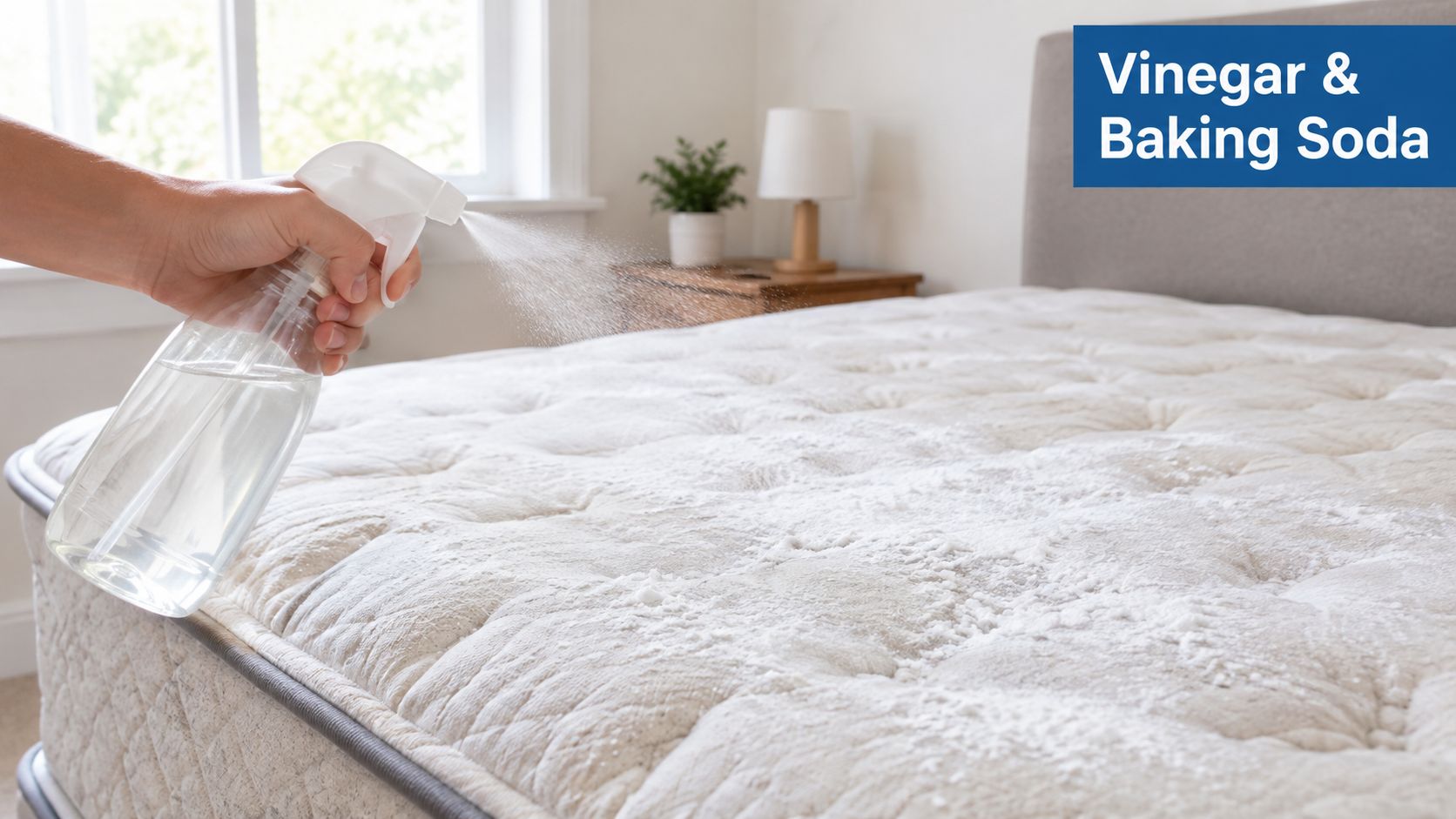
Mix equal parts white vinegar and cool water in a labeled spray bottle. After blotting, mist the affected section evenly. You want the fabric damp, not saturated. Cover the whole visible area and a small margin around it, because liquid often travels farther than the first dark patch suggests.
Match the dwell time to the stain
Let a fresh spot sit for 10 minutes. For a mark that's about a day old, allow 20 to 30 minutes. Older stains generally need a repeat cycle rather than one aggressive soaking, because adding more liquid all at once can drive residue deeper.
After the dwell period, press with clean towels to remove loosened moisture. If odor remains but the mattress isn't excessively wet, apply a second light vinegar pass to the affected zone and blot again. Don't layer vinegar with an enzyme cleaner, bleach, peroxide, or another chemical. Product stacking can create residue and may interfere with the intended action of the next cleaner.
Finish with a dry absorbent layer
Spread baking soda over the damp area in a thick, even layer. Leave it for at least eight hours, preferably overnight, so it can absorb remaining surface moisture and help pull odor from the fabric.
The vinegar helps neutralize alkaline urine salts, while baking soda absorbs moisture and supports odor reduction. Neither step guarantees complete removal when urine has penetrated far into the foam or dried into it, so judge the result only after the mattress is fully dry.
Vacuum slowly with an upholstery attachment, making several passes in different directions. Then inspect the area in daylight for yellowing, a tacky feel, or a returning smell. If the stain remains visible or the odor comes back after drying, stop repeating the same DIY cycle and move to an enzyme treatment.
When Enzyme Cleaners Are the Only Real Fix
Old urine leaves residue that can sit below the mattress cover and release odor again when moisture in the air rises. Vinegar may reduce the smell, and baking soda may absorb what's near the surface, but persistent odor indicates that the source hasn't been fully broken down.
Enzyme cleaners work through biological action. Uricase is the enzyme category most directly associated with uric-acid residue. Protease targets proteins, while amylase targets starches and lipase targets fats. Those supporting enzymes may be useful in broader biological cleaners, but a product aimed at urine should clearly identify its urine-residue or uric-acid target rather than relying only on fragrance and surfactants.
How to choose and apply one
Look for a product with clear directions, a pet-safe label where relevant, and transparent information about its active enzyme system or concentration. Third-party testing can add confidence, but don't assume a higher concentration automatically makes a product safer or more effective on a mattress. Surfactant-heavy formulas may clean the surface while leaving a film that attracts soil.
Test the product on an inconspicuous seam first. Then apply enough cleaner to reach the contaminated fiber level, without flooding the entire mattress. For deep, old contamination, controlled coverage matters more than a light mist, because the cleaner needs contact with the residue rather than just the visible cover.
Some difficult stains need extended contact. One recent guide to removing urine odor with enzymes notes that dried urine may require 20 to 30 minutes or more for hardened uric-acid crystals to soften. Follow your product label rather than forcing a universal schedule.
| Product | Key Enzymes | Concentration | Best For | Dwell Time |
|---|---|---|---|---|
| Urine-specific enzyme cleaner | Uricase or another urine-targeting enzyme system | Use the labeled concentration | Old, set-in, repeat, or pet stains | Follow the label, with extended contact for dried residue |
| Multi-enzyme biological cleaner | May combine protease, amylase, lipase, and urine-targeting enzymes | Varies by product | Mixed organic contamination | Follow the label |
| Commercial service treatment | Product system selected by the technician | Varies by service | Deep penetration or widespread contamination | Set by the service protocol |
Covering a treated area with plastic wrap can help keep humidity stable during a long treatment, but only if the product label permits it and the mattress can be monitored. After the dwell period, blot as directed and use strong airflow to dry the mattress completely. For severe contamination, a commercial cleaning with enzymes may be more sensible than repeatedly wetting a mattress at home.
Drying and Sanitizing Without Damaging the Mattress
Cleaning isn't finished when the stain looks lighter. Drying is a separate phase, and it determines whether the odor stays gone. Residual moisture can keep the mattress smelling stale and can create a more serious hygiene problem when trapped under sheets.
Set up standing fans so air moves across the treated area. Add a dehumidifier if the room feels damp, and open windows when outdoor conditions allow cross-ventilation. Press a clean dry towel into the area during the early part of drying, then leave the mattress uncovered until the core feels dry rather than merely the surface.
The CDC's urine clean-up guidance says an affected area should be made very wet with bleach solution or an EPA-registered disinfectant and left for 5 minutes before wiping. It also recommends gloves, handwashing after cleanup, hot-water laundering for contaminated bedding, and thorough drying. On a household mattress, don't improvise by pouring bleach into foam. Use a product approved for the surface, follow its label, and spot-test any sanitizer on a hidden seam.
Use sunlight as a finishing aid
Indirect sunlight can speed drying, and some cleaning guidance describes sunlight's UV exposure as a natural disinfecting aid. A few hours of indirect sun after cleaning may help, but don't treat it as a substitute for extraction, dwell time, or ventilation. Strong heat can damage memory foam, and dragging a heavy mattress outdoors can strain seams or handles.
Avoid steam cleaners and excessive heat on foam unless the manufacturer specifically permits them. Heat and trapped water can deform foam, weaken covers, and leave dampness below the surface.
Before remaking the bed, perform a final sniff and hand-press check. If the area feels cool, clammy, or smells stronger when pressed, keep drying. Give the mattress a 24-hour patience window before declaring the job complete, especially after an enzyme treatment or any deeper application. For broader furniture-care principles, the Meliusly furniture care guide also reinforces the value of controlling moisture and avoiding unnecessary material stress.
Preventing Future Stains and Protecting Your Investment
Cleaning is reactive. A full waterproof mattress protector is the long-term fix because it keeps urine away from the foam in the first place. Encasement-style protectors wrap the mattress, including its sides, seams, and zipper area, rather than protecting only the sleeping surface. That design limits liquid migration through vulnerable edges.
Wash the protector regularly in hot water according to its care label, and replace it when the waterproof barrier cracks, peels, or stops fitting securely. For a deeper look at choosing protection for incontinence care, use this complete AU mattress protector guide.
Foundation support is the overlooked half of mattress care. A mattress that sags develops low areas where liquid can pool, and uneven support can accelerate body impressions and shorten useful life. A stable foundation, appropriate bed slats, or a suitable bunkie board helps the mattress keep its shape and makes future accidents easier to manage. If you're protecting a sleeper sofa as well, this guide to a sofa bed mattress protector addresses the same containment problem in a different sleeping setup.
Keep the routine simple: rotate the mattress every three months, vacuum it monthly, and inspect seams and edges quarterly. Prevention costs less effort than pulling recurring odor from foam.
Meliusly offers practical support solutions for bed slats, bunkie boards, sofas, and sleeper sofas that help extend furniture life without immediate replacement. Visit Meliusly to find a firmer, more stable foundation for the furniture and sleep surfaces you're working to protect.
Share this post
- Tags: enzyme cleaner mattress, mattress care tips, mattress stain removal, pee stains out of a mattress, urine odor removal