

Spring Down Cushion Guide and How to Make It Last
Posted by Meliusly
You sit down after a long day, expecting the familiar soft landing from your sofa, but the seat drops farther than it used to. The cushion looks full enough, yet your hips settle into a hollow and the front edge feels less supportive. Before you order a replacement, identify which layer has failed.
A spring down cushion isn't just a bag of feathers over a spring. It combines a coil core, foam, and a down, feather, or fiber wrap. That construction creates a plush first impression with more underlying resistance than a down-only cushion. It also creates several separate failure points. Foam can fatigue, coils can break or lose their rebound, and the suspension beneath the cushion can sag while the cushion itself remains serviceable.
Why Your Spring Down Cushion Feels Different Than It Used To
A spring down seat can change gradually, which makes diagnosis difficult. The down envelope mats down first, the foam loses some recovery, or the support deck underneath stretches. From above, all three problems can feel like “the sofa is sagging,” but the repair is different in each case.
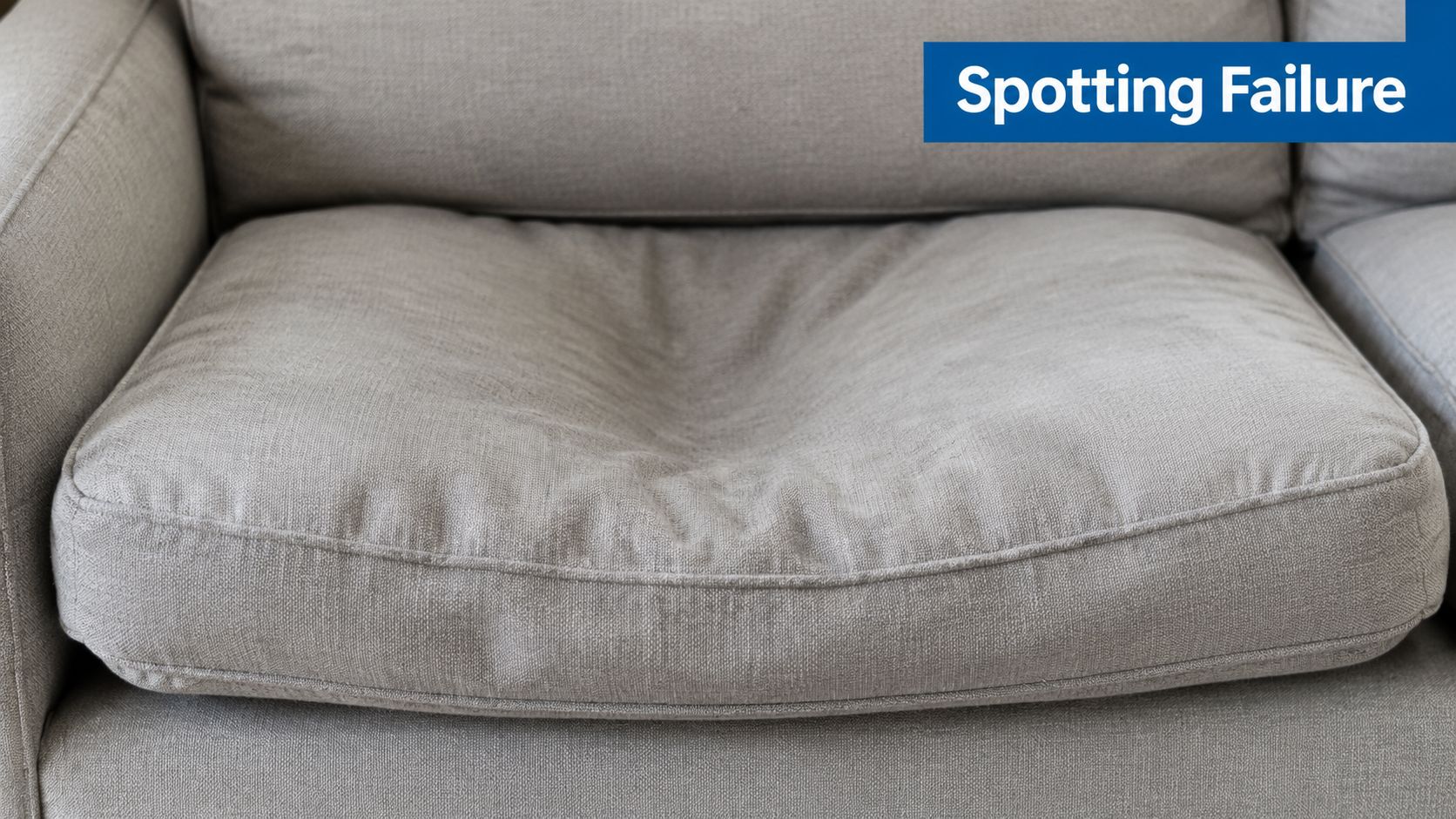
A useful example is a seat that forms a soft hollow in the middle. If the cushion rebounds after you stand, the outer fill may need redistribution. If the dip remains and the cushion feels flat, the foam wrap may be tired. If the same hollow remains even after you move the cushion to another seat, the deck or internal support may be responsible.
Practical rule: Don't replace a premium cushion until you've tested the cushion and the seat deck separately.
The construction itself explains why the symptoms overlap. The inner spring unit supplies the deeper pushback, the foam contains and supports that unit, and the down or feather blend creates loft at the surface. A failure in one layer changes how the other layers feel.
Three failures that look alike
Foam fatigue usually feels broad and soft. The cushion may look compressed, and pressing the center produces little resistance before your hand reaches the core.
A broken or set coil tends to create a more localized dip. One side may feel lower, or a single area may collapse while nearby areas remain relatively firm.
Collapsed suspension produces a hammock-like seat across a wider area. Remove the cushion and press the deck. If the platform itself sinks, the cushion isn't the first repair target.
This diagnosis-first approach often saves a usable cushion. Fluffing, rotating, reinforcing the deck, or replacing only the foam wrap can cost and disrupt less than rebuilding the entire seat.
What a Spring Down Cushion Is Actually Made Of
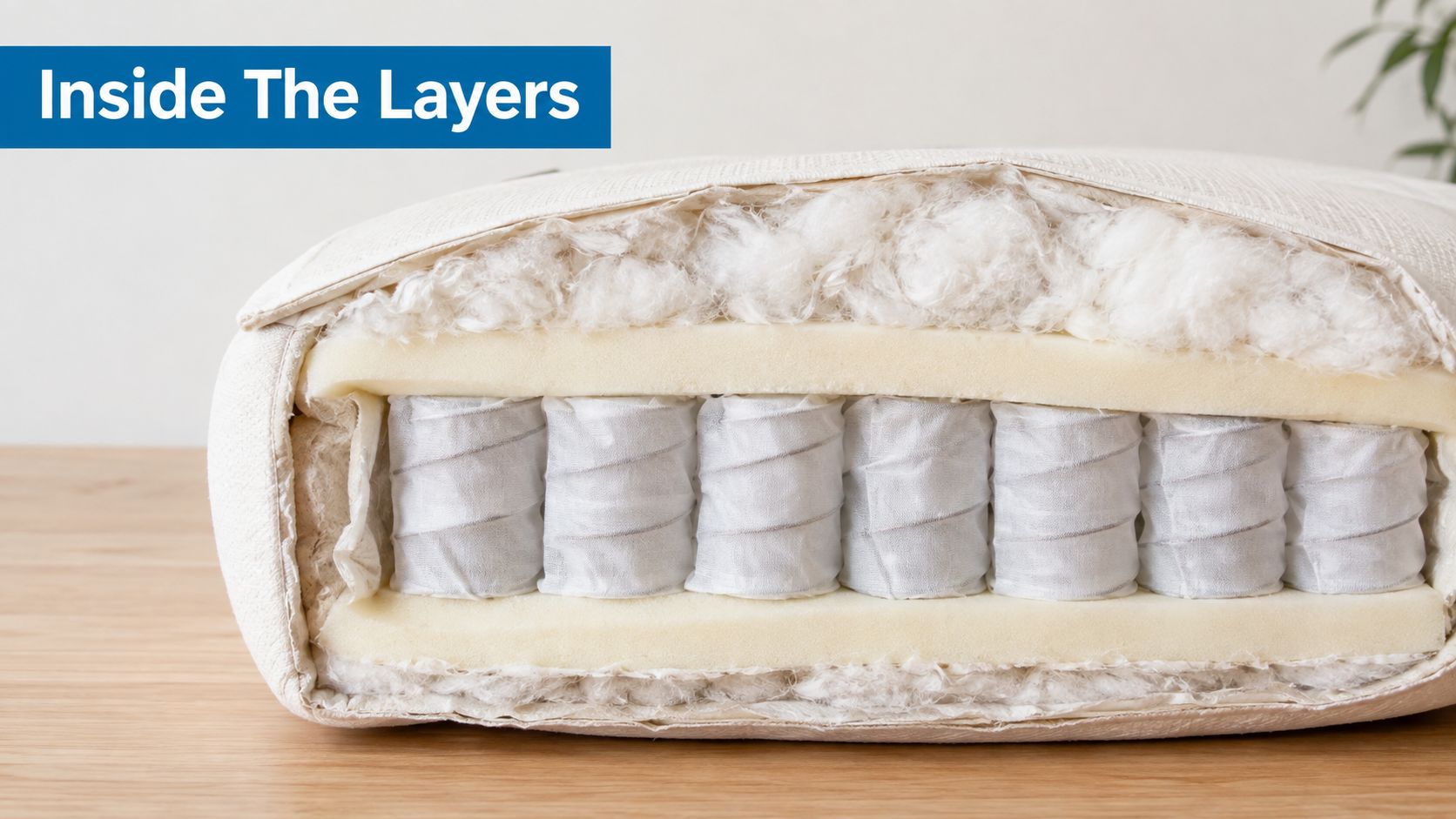
Think of the cushion as a layered sandwich. Each layer has a separate job, and each can wear at a different rate.
The bottom layer is the spring core
At the center, many spring down designs use a Marshall-style pocketed coil unit. Individual lighter-gauge springs sit in muslin pockets, then work together as a compact support pack. One documented construction uses individually wrapped 6×6 coils, approximately 3.5 inches high, combined with a foam enclosure and a down-proof ticking bag filled with a 50/50 blend of polyester fiber and down or feathers. These specifications are documented in Paladin Furniture's cushion construction guide.
Another upholstery specification describes 14-gauge tempered steel springs, a 30 oz. foam cap, and a channeled down-proof envelope containing 50% feather and down plus 50% synthetic fiber. The exact package varies by manufacturer, but the principle stays consistent. The coils provide deep support and shape retention, while the softer layers control the contact feel.
The middle layer controls the transition
A foam box, foam rails, or foam caps surround the spring unit. This layer prevents the fill from migrating into the coils and gives the cushion its initial firmness. Technical upholstery guidance identifies 1.8 lb/ft³ as a minimum density for acceptable durability in wrapped cushion cores, as described by CM Furniture's frame construction guidance.
Foam can fail without a broken spring. It may soften, crumble, or develop permanent compression, leaving the coil pack intact but poorly contained. A cushion with a healthy coil core and failed foam often deserves rewrapping or refoaming rather than full replacement.
The top layer supplies loft
The outer envelope uses down, feathers, polyester fiber, or a blend. Down creates softness, feathers add structure, and synthetic fiber helps maintain volume. A down-proof ticking or cambric-style inner cover keeps the fill from escaping into the upholstery and helps maintain the channels around the core.
Finally, the outer upholstery cover holds the package in its finished shape. If the ticking tears, fill migrates and creates lumps. If the ticking remains intact but the fill mats down, careful redistribution and restuffing may restore comfort.
The important point is that a spring down cushion isn't one material. Its repair path depends on whether the coil unit, foam enclosure, fill envelope, or exterior cover has lost function.
How Spring Down Compares to Other Cushion Types
Cushion choice involves a trade-off between immediate softness, structural support, maintenance, weight, and repair complexity. Spring down usually occupies the premium comfort end of that spectrum, but it isn't automatically the right choice for every room or household.
| Cushion Type | Feel | Typical Lifespan | Cost Tier | Weight |
|---|---|---|---|---|
| Foam-only | Consistent, firmer, less lofty | Often longer than softer fill constructions when properly specified | Lower to mid | Lighter |
| Down-only | Very soft and relaxed, requires frequent reshaping | Compresses faster and needs regular fluffing | High | Light to moderate |
| High-resilience foam with fiber wrap | Supportive with a softer surface | Generally durable with stable shape | Mid | Moderate |
| Spring down | Plush on contact with deeper pushback | Commonly described as a premium, long-service construction when maintained | Highest | Heaviest because of the coil core |
Foam-only cushions are easier to manufacture and usually easier to replace. They provide predictable resistance, which suits people who want a neat seat that doesn't require much daily attention. Their weakness is the lack of the soft, yielding surface that makes spring down attractive.
Down-only cushions feel luxurious, but the fill compresses and shifts readily. You'll need to fluff and redistribute them more often, and they don't provide the same mechanical support as a coil core.
High-resilience foam with a Dacron or fiber wrap sits between those choices. It can offer a supportive seat with a softer surface and fewer moving parts than spring down. The compromise is that it won't deliver the same layered, buoyant feel.
Spring down is heavier, more labor-intensive, and more complicated to service. When it works properly, the seat feels soft at first contact and resilient underneath. When it sags, you must determine whether the problem is fill, foam, coils, or suspension instead of treating every change as ordinary foam flattening.
How Long a Spring Down Cushion Should Realistically Last
A spring down cushion can remain comfortable for years, but its service life depends on which internal layer carries the wear. The 7 to 12 year range is a practical reference for a well-built cushion, not a promise. Use the cushion's symptoms to judge whether the likely problem is tired foam, a failed coil, or a weakened support system.
Construction sets the starting point
Fill weight affects loft. A fuller down and fiber envelope has more material to redistribute after compression than a lightly filled one. The blend, channel layout, and ticking also affect how quickly the surface loses its even feel.
Foam density matters around the coils. Upholstery guidance identifies 1.8 lb/ft³ as a minimum density for acceptable durability in wrapped cushion cores, according to CM Furniture. Low-quality foam may soften and stop recovering while the metal spring unit still works. In that case, replacing the foam can restore support without replacing the entire cushion.
Coil design affects rebound. Individually wrapped coils, spring gauge, coil count, and the enclosure method determine how load moves through the cushion. A broken coil creates a localized weak spot. Foam fatigue creates a broader, softer depression, so the repair decision differs.

Use determines how quickly those materials age
Daily use in one favorite spot concentrates compression. Rotating cushions and changing sitting positions spread the load, while body weight, sitting duration, pets, children, and repeated edge loading create different wear patterns.
Rotation can slow uneven wear, but it cannot restore a failed coil or collapsed foam. Treat it as maintenance, not a repair.
A cushion early in its service life may look rumpled yet recover after fluffing. A worn cushion develops hollows that return quickly, brittle or permanently soft foam, damaged ticking, or coils with little pushback. If the core still responds, a low-cost insert, foam, or cover repair may be sensible. If several layers have failed together, replacement is usually the more realistic choice.
Common Spring Down Cushion Problems and What They Mean
A sagging spring down cushion doesn't automatically belong in the trash. In repair work, the visible hollow is only a symptom. The useful question is which component stopped doing its job.
Read the shape of the failure
Center pooling usually means the middle of the foam and coil package no longer pushes the outer fill upward. Fluff the envelope first. If the hollow returns quickly and the foam feels permanently soft, refoaming or a new cushion insert may be necessary.
A hammock-like sink across the seat points below the cushion. Stretched webbing, detached support, or a sagging platform lets the entire seating area drop. A cushion replacement won't correct a deck that has lost its level.
Edge collapse can result from broken coil ties, a damaged foam rail, or fill that has migrated away from the perimeter. If only the edge has failed, a repairer may be able to rebuild that zone without replacing the entire unit.
Lumpy fill is often mistaken for structural damage. A torn or poorly channeled ticking can let feathers collect in one area while leaving another thin. This is a cover and fill problem unless the core also feels weak.
A persistent one-sided dip suggests a localized failure, such as a damaged coil, a torn foam sleeve, or a compromised attachment point. Move the cushion to another seat. If the dip follows the cushion, work on the cushion. If it stays in the frame, inspect the deck.
The symptom-to-cause approach is also central to Meliusly's guide to fixing sagging sofa cushions. A low-cost fix works only when it supports the failed layer.
A cushion can look worn while the expensive part inside it is still sound.
Don't confuse a soft surface with a dead spring core. Conversely, don't keep restuffing a cushion whose coils have lost rebound. Diagnosis prevents both kinds of waste.
Diagnosing the Cause of the Sag
A spring down cushion can feel soft for several reasons, and the correct repair depends on which layer has failed. Test the cushion first, then inspect the deck before buying foam, fill, or hardware.
Use your hands before using tools
Remove the cushion and place it on a clean, flat surface. Press the center with a flat palm, then compare that response with the front edge and each corner.
- Press the center slowly. A healthy spring down package gives layered resistance. If your hand passes through loose fill and soft foam before reaching firm spring response, the outer layers may be fatigued.
- Compare the rebound. A cushion that rises after pressure still has active support. If it stays compressed, the foam, coils, or both may have failed.
- Check the perimeter. A firm center with a collapsed edge points to the foam rail, coil tie, or edge fill. That pattern does not automatically mean the entire core is worn out.
- Move the cushion. Place it on another seat if the dimensions permit. If the sag moves with the cushion, inspect the cushion. If it remains in the same frame location, inspect the deck.
A broad dip between support points often traces back to the seat's construction, as explained in Meliusly's sofa construction guide.
Inspect the support beneath it
Remove the cushion and press the seating platform. Check for sagging webbing, broken sinuous springs, loose clips, or a frame that shifts under pressure. A rigid board can spread weight over the existing supports, as described in Meliusly's couch cushion support guidance.

If the deck sags before the cushion does, the cushion is not the source of the dip. A crumbly foam sleeve needs replacement. Coils that move freely without rebound indicate a failed spring core.
For board-style support, measure the inside width from arm to arm and the seat depth from the front edge toward the backrest. Size the board to the weak zone, not the sofa's exterior. Meliusly's support-board measuring instructions explain why the board must rest over the actual support points.
Use this decision flow:
- Cushion rebounds and fill is matted: Fluff and rotate.
- Deck dips without the cushion: Add a support board or repair the suspension.
- Core holds its shape but feels bottomed out: Rewrap or refoam.
- Coils are broken or the ticking is torn: Replace the damaged unit or have an upholsterer rebuild it.
Repair Options That Actually Work
The highest-impact repair is often under the cushion, not inside it. If the deck has sagged, a rigid or semi-rigid support board spreads weight across the existing support points and removes the hammock effect. It won't repair a broken coil inside the cushion, but it can restore usable seating without opening the upholstery.
Match the repair to the failed layer
If the down envelope is compressed but the foam and coils rebound, a professional can open the ticking, redistribute the fill, add compatible material, and resew the cover. Restuffing works when the cover and core remain sound. It won't cure dead foam.
Foam fatigue calls for a new high-density foam section cut to the original profile and enclosed in the existing ticking. The replacement must fit the coil pack and preserve the cushion's intended height. A loose slab stuffed into a spring down cover usually creates hard ridges and premature shifting.
Coil-level work is more invasive. A repairer may access the core, retie loose spring connections, or replace an individually failed pocket coil. Spring tension and confined upholstery make this a poor first project for most homeowners. A staple gun and pliers are useful for fabric access and minor reattachment, but they don't substitute for correct upholstery twine, matching components, or safe handling of tensioned metal.
For softer seats that need a little more resistance, Meliusly's guidance on making sofa cushions firmer provides a useful starting point before committing to a full rebuild.
| Failure Mode | Recommended Repair | Skill Level | Typical Cost |
|---|---|---|---|
| Matted down or feather blend | Fluff, redistribute, or restuff the envelope | Low for maintenance, professional for restuffing | Qualitatively low to moderate |
| Sagging seat deck | Fit a rigid support board over the weak area | Low | Qualitatively low |
| Loose webbing or detached support | Retension, replace, or reattach the suspension | Moderate to high | Qualitatively moderate |
| Failed foam wrap | Replace foam to the original profile and reclose the ticking | High | Qualitatively moderate to high |
| Broken coil or damaged spring unit | Repair or replace the affected core through upholstery access | High | Qualitatively high |
| Torn ticking with widespread fill loss | Rebuild or replace the cushion package | Professional | Qualitatively high |
A homeowner can safely begin with rotation, cleaning, fill redistribution, and a properly fitted support board. Leave structural spring work, foam fabrication, and sewing repairs to an upholsterer when the cover is difficult to remove or the core has visible damage.
Your Spring Down Cushion Decision Checklist
Use the cushion's response, not its age or appearance, to choose the next step.
Four practical decisions
Fluff and rotate when the cushion still rebounds and the only problem is flattened or uneven fill. Work the corners and channels by hand, then rotate the cushion so the favorite sitting zone isn't always carrying the load.
Add a support board when the seat deck sags before the cushion does. A board placed over the slats, springs, or other support points spreads weight and creates a firmer base. Measure inside the arms and along the seating depth so the board fits the weak zone instead of extending into upholstery or blocking the backrest.
Rewrap or refoam when the spring core still holds its shape but the cushion bottoms out inside the ticking. This is the right path when the foam enclosure has softened or the fill has lost its loft, but the metal support still rebounds.
Replace the unit when coils are visibly broken, the ticking has torn at its seams, or the cushion has several failures that would require a complete rebuild. A replacement makes more sense when the repair would leave you with a new foam section surrounding an unreliable core.
Try this test today. Press the center, front edge, and each corner with the same flat-palm pressure, then compare how quickly each area rises. A single weak zone suggests localized repair. A uniformly flat cushion suggests broader foam or fill fatigue. A seat that remains low after you remove the cushion directs attention to the suspension or frame.
Keep the maintenance simple
Quarterly, flip and rotate compatible cushions, vacuum the deck, inspect the ticking and seams, and let the cushion air out before returning it. Don't force rotation if the upholstery pattern or cushion shape allows only one orientation.
A professional reupholster is the smarter financial choice when the frame is sound, the fabric still suits the room, and the failure is limited to the cushion package. Replacement is more sensible when the frame moves, multiple support systems have failed, or the upholstery would need extensive work at the same time.
Meliusly offers sofa support boards, sleeper sofa support boards, bunkie boards, and bed slat solutions for furniture that needs a firmer, more even base without immediate replacement. If your spring down cushion is still serviceable but the deck underneath has sagged, visit Meliusly to compare practical support options for extending the life of your furniture.