

Stop Sagging Couch: Practical Fixes That Actually Work
Posted by Meliusly
Americans spent $23.5 billion repairing and replacing damaged furniture, with sofas making up 34% of damaged furniture items and the average repair costing $287, according to Woodworking Network's summary of furniture damage research. That makes a sagging couch more than an irritation. It's often a repair decision with real financial consequences.
The mistake I see most often is treating every dip as a cushion problem. A flat cushion, a single deep hollow, a hammock-like seat, and a wobbling frame point to different failures. If you diagnose the symptom first, you can stop sagging couch problems with the smallest effective repair, rather than buying foam when the webbing has failed or installing a board over a cracked frame.
Why Couches Sag and Why Repairs Are Worth Considering
A sofa usually doesn't become unusable in one dramatic moment. Foam compresses, webbing loses tension, springs shift, and joints loosen gradually. The typical sofa lifespan is commonly placed at 7 to 15 years, while lower-end couches may begin sagging within 3 to 7 years, according to Houlte's 2026 sofa lifespan guide. Sagging is therefore often a lifecycle problem, not proof that the entire sofa has failed.
The cost case for repair is straightforward. A new sofa can require a substantial household purchase, while a localized support problem may need only a cushion insert, a removable support board, new webbing, or a frame repair. The right comparison isn't the price of a random repair against the price of the cheapest couch in a showroom. Compare the repair with a comparable replacement, including delivery, moving, and the risk of buying another poorly built frame.
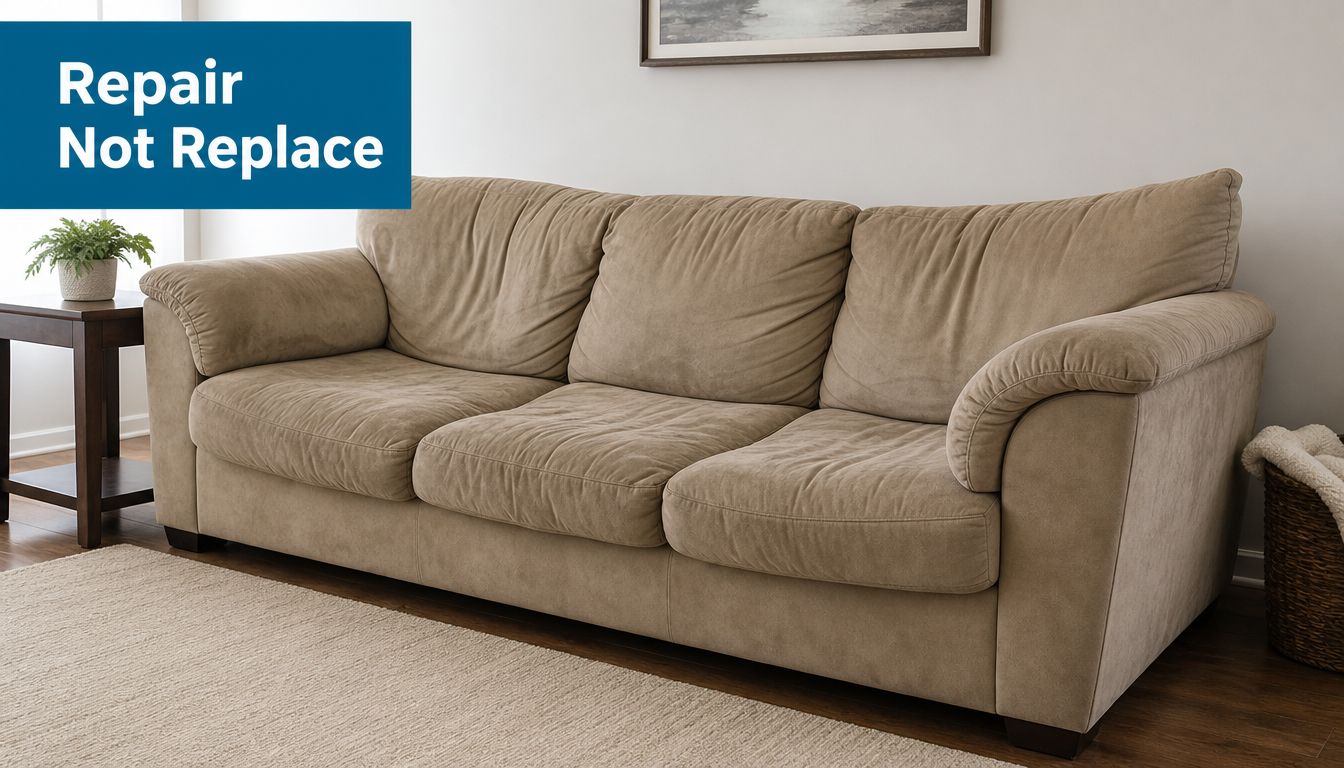
The four failures behind most sagging
- Foam fatigue: The cushion has become thin, soft, or concave, while the empty seat deck remains reasonably flat.
- Spring failure: A coil has broken, detached, or lost tension, creating a single deep dip that may bounce or squeak.
- Webbing failure: Jute or elastic support strips have stretched, torn, or pulled away from their staples, producing a broad hammock feel.
- Frame damage: A cracked rail, loose corner block, or separated joint allows the whole seating structure to rack or bow.
A repair is worthwhile when the frame remains sound and the defect is isolated. A support product can restore a usable load path under cushions, while foam or upholstery work addresses comfort above that structure. The important point is that support solutions only work when they match the failed component.
Practical rule: Don't buy a cushion fix until you know whether the empty deck is flat, bowed, or unstable.
That diagnosis-first approach prevents the most expensive kind of waste, paying for the wrong repair and then still needing the correct one.
Diagnosing Your Sagging Couch Before You Fix It
Start with the cushions off and the sofa empty. You won't need tools for the first inspection, although a flashlight helps when you look underneath.
A no-tools inspection
- Remove every seat cushion. Press the exposed deck with your hand, then sit carefully on it. If the empty deck feels solid but the cushion collapses, the foam is the likely failure. If the deck bows beneath you, the problem is below the cushion.
- Compare the center with the corners. Press each area with similar force. A uniform softness across the cushion suggests foam fatigue. One concentrated hollow points more strongly toward a broken spring, detached clip, or damaged section of webbing.
- Flip the cushion. If the dip changes dramatically or disappears when the cushion is turned over, inspect the cover, insert, and seams. A cover that has shifted or a cushion insert that has compressed unevenly may be creating the appearance of a deeper structural problem.
- Use a flashlight under the sofa. Look for stretched or frayed webbing, popped staples, loose spring ties, detached clips, and cracks around rails or corner blocks. Don't pull hard on anything yet. You're identifying the failure before disturbing the evidence.
- Rock the frame gently. Hold the sofa body, not the arm cushion, and apply light pressure from side to side. Creaking, racking, or visible movement at a joint indicates a frame issue. A soft seat alone doesn't usually make the entire frame wobble.

The practical repair sequence described by Engineer Fix's sagging couch guide begins with this same separation of cushion and deck. That distinction matters because replacing foam won't straighten a bowed deck, and a support board won't restore foam that has lost its shape.
Use the symptom as your decision filter
- Flat and uniformly soft usually means compressed foam.
- One deep dip with bounce or a squeak usually means a spring or clip problem.
- A hammock feel across the full seat usually means stretched webbing.
- Creaking, racking, or visible cracking means frame damage.
If you find two failures, repair the structure first. New foam placed over loose joints will conform to the movement below it, and a board installed over a broken rail can conceal a safety problem instead of solving it.
Choosing the Right Fix for the Right Problem
There are five sensible paths, and they aren't interchangeable. The least expensive option isn't automatically the best value if it only masks the defect.
Compare the available repairs
| Fix Option | Typical Cost | Time Required | Skill Level | Best For |
|---|---|---|---|---|
| Replace foam only | $40 to $120 per cushion | About an hour | Moderate | Worn foam on a stable frame |
| Add plywood or OSB support board | $25 to $60 | About two hours | Beginner to moderate | Stretched support on a fixed sofa or sleeper |
| Retension webbing and retie springs | $30 to $100 in materials | 3 to 5 hours | Advanced DIY | Coil-spring sofas with serviceable frames |
| Professional reupholstery | $600 to $1,500 | 2 to 4 weeks | Professional | Valuable furniture with a strong frame |
| Full replacement | Varies by comparable sofa | Varies | None | Extensive structural or suspension failure |
Foam replacement is the cleanest answer when the empty deck is firm and the cushion has lost resilience. Choose a replacement insert that fits the cover closely, but don't use a thicker or firmer core to compensate for a damaged deck. The cover may strain, the seat height may change, and the original failure will remain underneath.
A removable board is more appropriate when the cushion still has life but the base flexes. It can be especially useful for renters, guest rooms, and sleeper sofas where you want a reversible intervention rather than a permanent alteration. The trade-off is feel. A board can make a sofa more supportive, but an oversized or poorly cut panel can create a hard edge, noise, or pressure line.
Webbing and spring work offers the most direct repair for suspension failure, but it demands patience. Even tension matters more than brute strength. One loose strip or poorly tied spring becomes the softest path under load and attracts more deflection.
Professional reupholstery only makes economic sense when the frame and design justify the labor. A high-quality sofa with a sound hardwood frame may deserve it. A low-value frame with several failures generally doesn't.
Replacement becomes reasonable when repair requires rebuilding multiple systems. Don't compare a major repair with a bargain sofa. Compare the total work with a similar replacement that offers the same size, construction, and comfort.
Adding a Support Board the Practical DIY Way
A support board is useful when the cushions need a flatter base and the frame itself isn't cracked. I've seen people start with a random scrap of plywood, force it into the seat, and then blame the concept when the sofa squeaks. Fit matters more than thickness.
Remove the cushions and measure the exposed deck at three points across the width and three points along the depth. Use the tightest measurement, not the largest one. The board should drop into place without binding against the arms, back rail, or upholstery folds.
For a standard fixed sofa, 1/4-inch hardboard is a practical starting point. A sleeper mechanism needs 3/8-inch plywood for additional stiffness, while a deck that sags more than two inches may need 1/2-inch plywood. Those choices are only appropriate when the moving parts and frame can accept the added height.
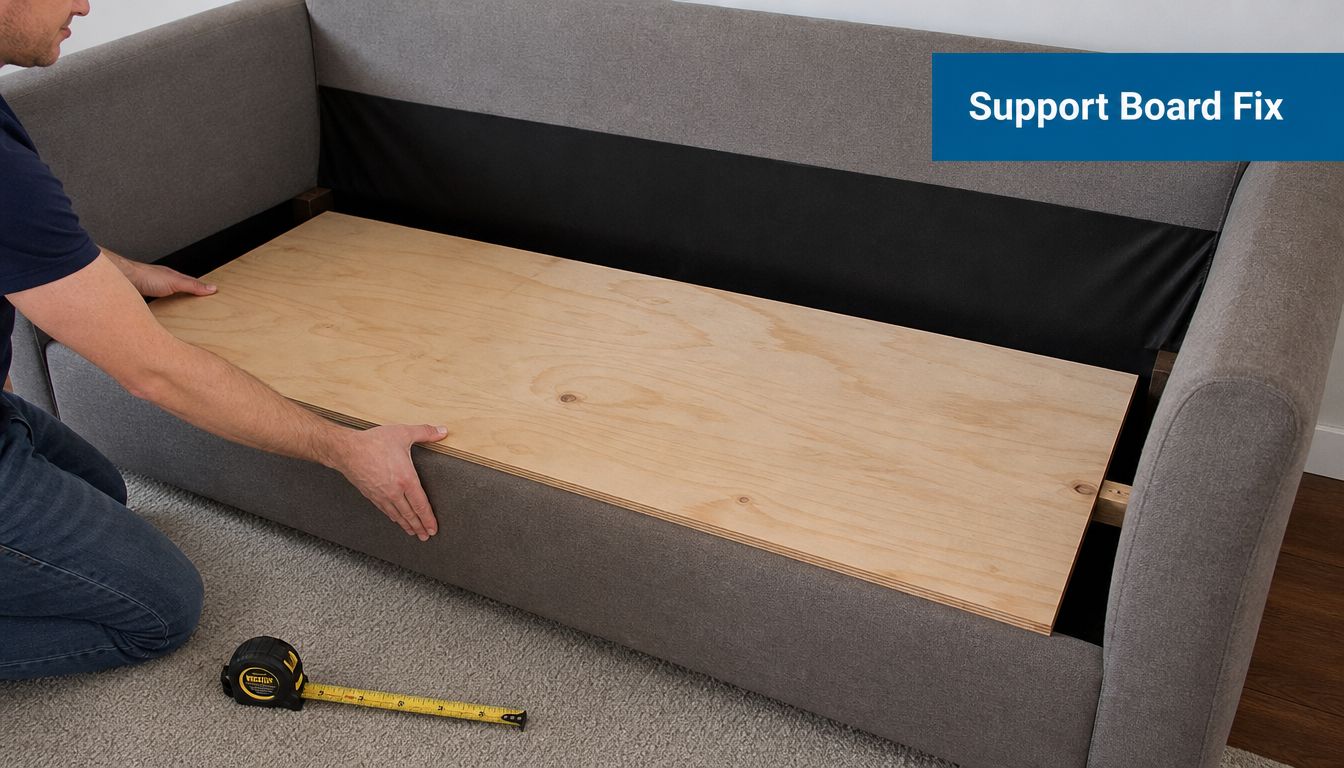
Cut for clearance, not appearance
Use a circular saw or jigsaw with a suitable blade, then sand every edge and corner. Drill a finger hole near one edge so you can remove the board for cleaning or moving the furniture. Don't fasten the panel to the sofa. A removable support is easier to inspect and safer around upholstery mechanisms.
A sleeper sofa needs special care. The board must stop short of the hinge and every part of the fold-out path. If the deck needs reinforcement, a centered 2x2 cleat can support the panel without blocking the mechanism, but confirm the sofa can still open and close freely before using it.
For a more detailed cut-and-fit approach, use Meliusly's plywood sofa support guide. A purpose-made sofa support board is another option when you want a removable insert without building and finishing a panel yourself.
Replace the cushions and perform the guest-tight check. Sit in the usual position, lean forward as if reaching for a coffee table, then shift toward the front edge. The board shouldn't lift, slide, scrape, or squeak. If it does, remove it and correct the fit before regular use.
Reinforcing Springs, Webbing, and Frames for a Lasting Repair
A lasting repair starts underneath, but diagnosis still comes first. A flat cushion can mean tired foam, while a single low spot may point to one spring or a damaged frame. Remove the cushions and dust cover carefully, photograph every connection, and keep the original support layout visible until you know which part has failed.
- Inspect the webbing for sagging, frayed edges, torn sections, and popped staples. Replace stretched jute or elastic strips with matching material across the frame. Pre-tension each strip by hand before stapling it securely. Add cross-strips where needed so weight spreads across the seat instead of loading one direction.
- Examine the springs for broken coils, detached clips, shifted crowns, and uneven height. A loose coil needs more than another staple. Secure it with spring twine in eight directions, upward, downward, toward the front, toward the back, and along the four diagonals, following Meliusly's guide to repairing sagging couch springs. This keeps the spring crown at a consistent compressed height and stops one coil from becoming the low point.
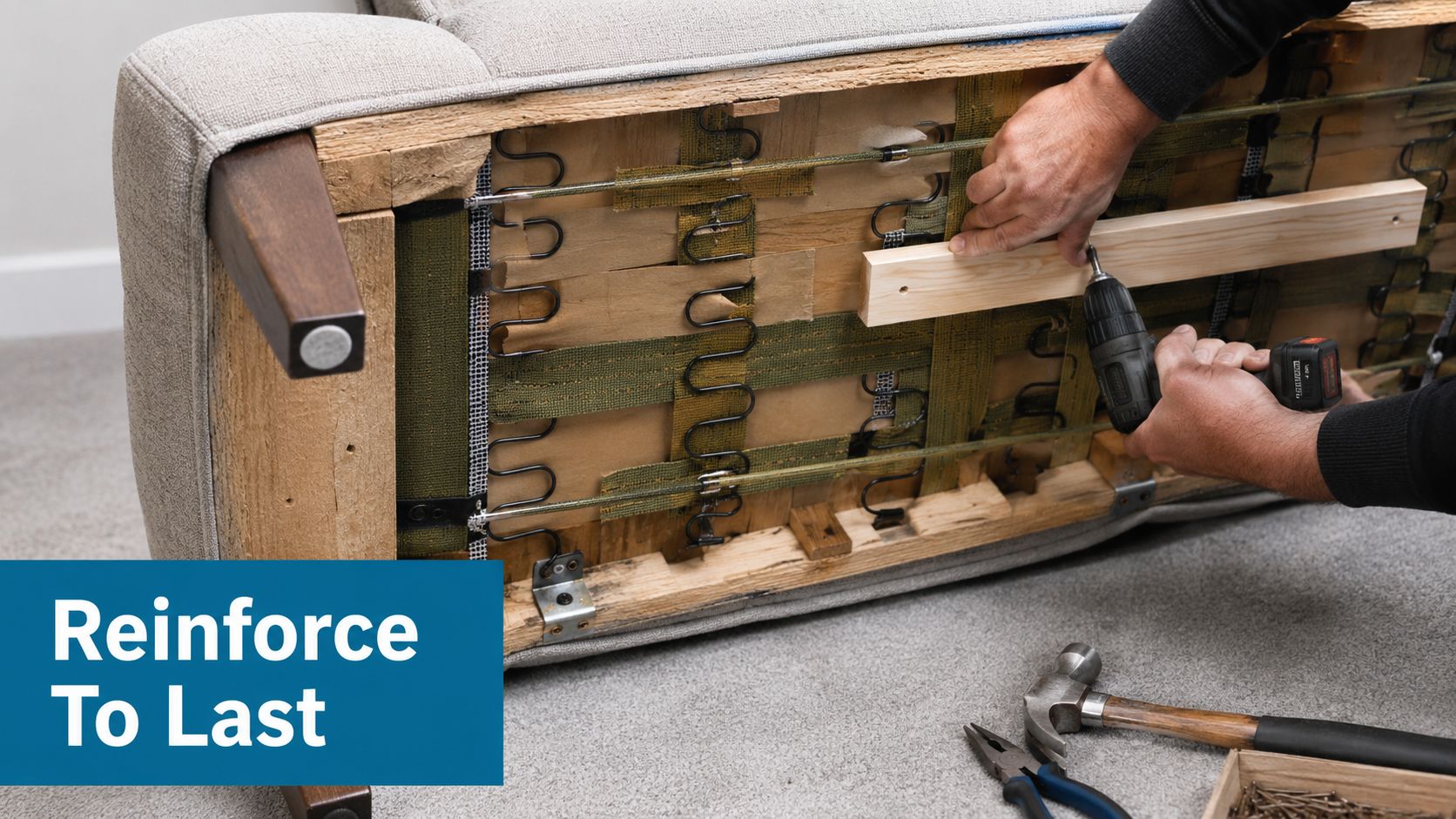
Treat the frame as a separate repair
- Probe the rails, dowels, corner blocks, and joints. Look for split wood, stripped fasteners, or movement where the frame should stay rigid. Apply wood glue to a loose joint, realign the pieces, and clamp them with deep-throat or ratchet clamps for 24 to 48 hours, as recommended in CS Osborne's upholstery repair guidance.
- Reattach the dust cover only after the support system stays firm. Reinstall the cushions and test-load the seat with adult weight for five minutes. Inspect the repaired area again. Load can expose slack webbing, a wandering spring, or a joint that still shifts.
If the webbing pattern is unfamiliar or the springs are badly distorted, stop before dismantling the entire seat. Once the original tension geometry is lost, upholstery repairs become harder to reproduce accurately. A professional rebuild makes sense only when the frame and upholstery justify the labor.
Quick Fixes Worth Skipping and When to Replace Instead
Extra stuffing is rarely a structural repair. Adding batting or loose foam can restore loft temporarily, but compression returns when the underlying support has failed. It can also raise the seat enough to change how the cushion meets the frame, leaving the sofa unbalanced.
Flipping cushions has a narrower use. It can redistribute wear briefly, but turning a cushion onto a side that wasn't designed for regular loading may accelerate breakdown or distort the cover. A folded blanket under the cushion is useful as a diagnostic test. If the seat improves when you create a firm temporary layer, you've learned that the base needs support. The blanket itself isn't a durable repair.
Know when the furniture has crossed the line
| Condition Found | Repair | Replace |
|---|---|---|
| Isolated foam fatigue | Replace the insert | Not necessary |
| One loose spring or clip | Retie or reclip it | Not necessary |
| Stretched but intact webbing | Replace and retension it | Not necessary |
| Cracked frame at multiple load points | Usually poor value | Yes |
| More than 30% of springs broken | Often extensive rebuilding | Usually |
| Webbing missing entirely | Rebuild only if the frame is valuable | Often |
| Repair exceeds 50% of a comparable new sofa | Recheck the economics | Usually |
Frames made from particleboard or cardboard honeycomb rarely reward deep structural repair. Hardwood frames with one isolated failure usually do, provided the upholstery and suspension are otherwise serviceable.
The honest answer is replacement when several systems have failed at once. No cushion insert can compensate for a frame that twists, and no support board should be used to hide a dangerous joint.
Preventing Future Sag and Keeping Your Sofa Supportive
Prevention works best when each habit targets a known failure. Rotate seat and back cushions weekly so one favorite position doesn't receive every landing, lean, and shift. This spreads compression across the cushion chambers instead of allowing one zone to flatten first.
Distribute weight across the deck, particularly on a three-cushion sofa where the center seating area may have less direct support beneath it. Don't use one corner as a permanent workstation, dining chair, and lounging spot. That concentrated loading accelerates whichever component is already weakest.
Sleeper sofas need an extra check after each conversion. Keep the mattress and mechanism from forcing against unsupported gaps, because gaps wider than 3 inches can let a mattress sink between slats and lose support, as explained in Bolonhome's bed-base slat guidance. A low-profile bunkie board is commonly used to create a more continuous platform over an existing frame, with many guides describing these boards as about 1 to 2 inches thick, according to Mattress Nut's slat-spacing guide.
Small maintenance prevents large repairs
- Vacuum the deck monthly: Grit can work into webbing, spring ties, and fabric contact points.
- Blot spills: Saturating foam can encourage distortion and prolonged drying.
- Limit heat exposure: Keep the sofa away from direct sun and at least two feet from heating vents so upholstery components aren't repeatedly dried and heated.
- Watch new dips early: A new localized hollow deserves the same symptom check as the original failure.
For broader upholstery and furniture maintenance habits, use the Meliusly furniture care guide. Prevention can't rescue a mismatched repair, but it can help a correctly repaired sofa remain level and comfortable.
Meliusly offers removable sofa supports, sleeper sofa support boards, bunkie boards, and bed slat solutions for furniture that needs a firmer, more continuous base. If your diagnosis points to under-cushion support rather than a cracked frame, visit Meliusly to choose a practical, non-destructive way to extend your furniture's useful life.