

Sofa Bed vs Air Mattress: Which Fits Your Guests?
Posted by Meliusly
By the time Bernard Castro died in 1991, his company was believed to have sold approximately 5 million sofa beds, and a 2005 Chicago Tribune report put sleeper sofas at about 20% of all sofas sold, with the sleeper mechanism typically adding several hundred dollars, according to the Bensons for Beds history of sofa beds. That is the backdrop for sofa bed vs air mattress. One option is furniture you sit on every day. The other is a bed you build from air when someone stays.
The failure that matters shows up at 2 a.m. An air bed can go soft or flat, and a patch kit or a working pump usually sorts it by morning. A sleeper fails differently: the deck bows, the thin mattress sinks, and the guest feels the folding bars through the night.
The sofa failure looks expensive. Often it is not. I would not replace a sagging sleeper until the deck has been checked, because a support board that sits between the frame and the mattress, like the SleeperSaver boards Meliusly sells for sleeper sofas, restores a flat sleep surface for a fraction of the cost of new furniture.
Sofa Bed vs Air Mattress at a Glance
A 2022 market analysis found that one in four U.S. households owned an air mattress, up from one in seven two years earlier. 36% of purchasers cited comfort as the main reason and 28% cited cost, according to GlobeNewswire's air mattress market release. The same note said 33% of owners used one at least once a month, and more than half had hosted guests on one. An inflatable bed is a common spare. It isn't automatically the better fit.
A sofa bed is permanent seating that converts into a bed. An air mattress is a separate sleep surface you store between visits. The sleeper costs more up front because the mechanism is built into the furniture. The air bed costs less to buy and nothing in floor space until you inflate it.
| Criterion | Sofa bed | Air mattress |
|---|---|---|
| Best use | Regular guests, daily seating, hosting on a schedule | Occasional guests, camping, emergencies, temporary extra capacity |
| Daytime function | Works as seating every day | Not furniture; must be deflated or stored away |
| Upfront cost pattern | Higher; the sleeper mechanism adds several hundred dollars | Lower initial purchase |
| Main driver of lifespan | Frame, deck, mattress and folding mechanism | Valve, seams and puncture resistance |
| Typical repair path | Support upgrade, deck repair or replacement | Patch kit, new pump, or replacement mattress |
Practical rule: Pick the option whose failure you can fix before the guest's morning, not the one with the softer showroom feel.
The table can't tell you how a surface feels under two people, or whether your room has depth for a pull-out. An air mattress wins on storage and cost for occasional guests. A sofa bed wins when sleeping is a regular part of daily use. Measure the open footprint and count the nights per year before you spend.
How Comfort and Support Compare Night to Night
The complaint I hear most isn't "too firm" or "too soft." It's a metal bar or a center fold under the hips. On a sleeper, comfort follows the whole load path, not mattress thickness alone. The Bel Furniture sleeper sofa buying guide makes that plain. The mattress has to work with the folding mechanism, the deck, the support frame, and how even the surface is. Too much thickness can fight the mechanism. Weak support under the mattress creates pressure zones or a fold you feel all night.
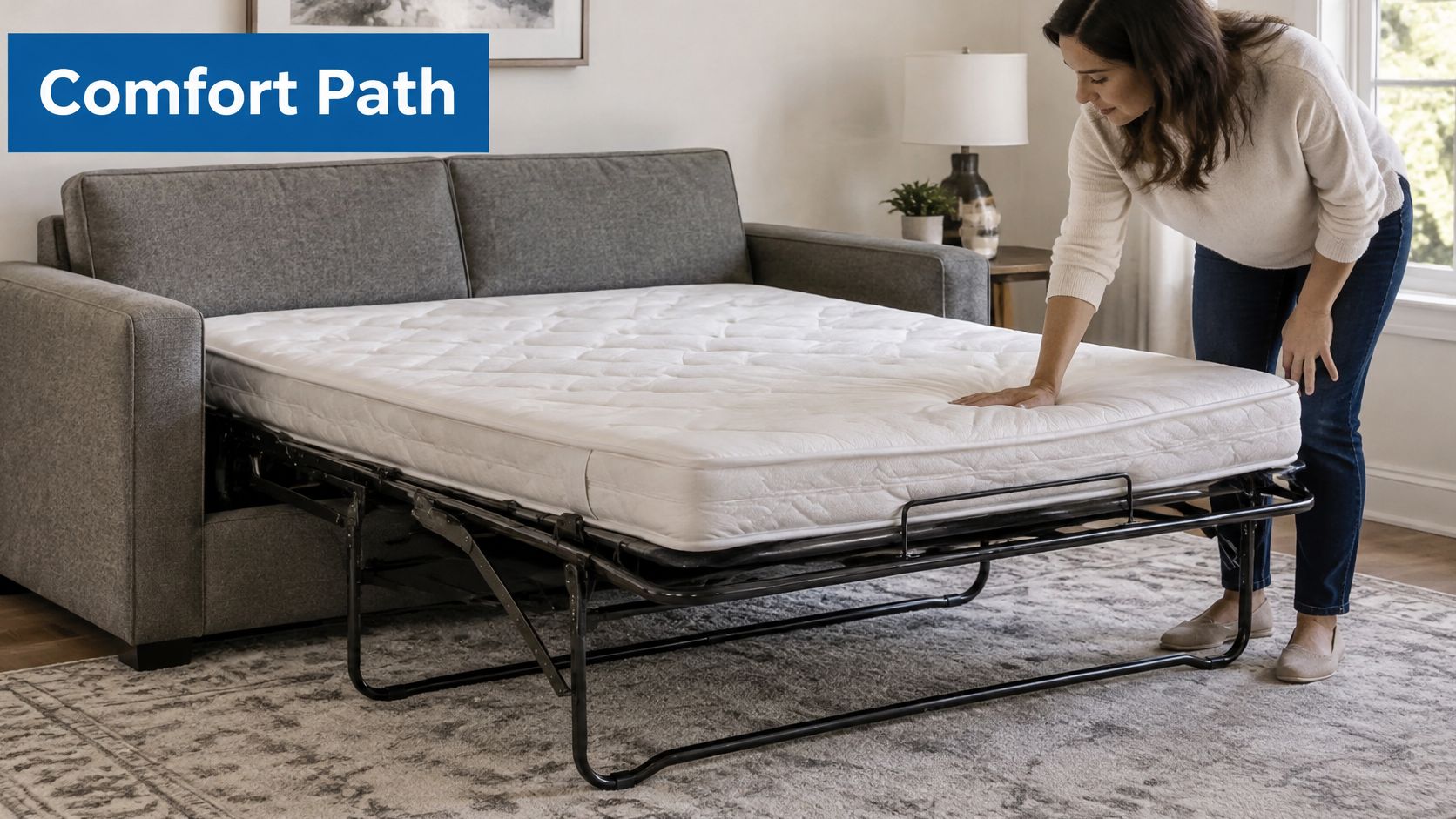
A sofa bed skips inflation time, pump noise, puncture risk, and overnight pressure drift. That steadiness is why it suits frequent hosting. You give up portability, and you can't dial firmness the way you can with air. If the sleeper you own sleeps badly, start with the deck, not a new sofa. Our notes on sleeper sofa mattress support walk through that load path in more detail. Any board or pad you add still has to leave the maker's folding clearance and load-bearing geometry alone.
What to check before you blame the mattress
Open the bed in daylight and work through four checks:
- Level deck: Sight along the platform. A twist or a belly in the middle shows up as a hammock once someone lies down.
- Firm edges: Sit on the side. If the edge collapses, guests will struggle to get in and out.
- Hinge alignment: Bars should meet without a ridge. Misaligned hinges chew the mattress and the mechanism.
- Fold behavior: The mattress should fold without severe compression. If you feel metal through the foam, the support under it is the problem.
Why an air bed feels softer by morning
Air beds change with temperature even when they have no hole. As the air inside cools and the volume stays about the same, pressure falls. Mattress Nut's note on air beds losing air cites an estimate that a 10°F overnight drop can cut absolute pressure by roughly 3–4%, enough to feel softer by morning. Pumping in more air every time isn't always the fix. Inflate at room temperature, then inspect the valve and seams only if the loss is large. A sofa bed's firmness comes from the mattress, frame, bars, and deck, not from the room cooling down.
Sleep climate is the other half of the night. An air-mattress study archived by the National Diet Library found that air-based surfaces produced different temperature and humidity conditions from a conventional futon, and some setups felt cooler. That can matter for older adults who overheat. It doesn't make a consumer air bed a clinical pressure-relief surface, and it doesn't compare that study mattress with your sofa. Floor insulation, sheets, room temperature, a cover, and sofa upholstery all change the result.
Lie on the actual setup for a full night. A ten-minute sit test misses both the center fold and the morning pressure drop.
Setup, Storage and Floor Space Trade-Offs
Buyers compare a closed sofa with a rolled air bed and then discover the room doesn't work. Compare the sleeping surface, the setup, and where the bed lives when nobody is using it.
| Option | Sleeping surface | Setup | Storage or footprint |
|---|---|---|---|
| Queen sleeper sofa | About 60 x 72 inches, about 5 inches thick | Unfold; no inflation | Permanent; needs clear floor in front when open |
| Standard queen bed (reference) | 60 x 80 inches | Fixed; no inflation | Fixed footprint in the room |
| 16-inch air mattress model | Raised profile, about 16 inches high | About 1 minute to inflate | Packs away between uses |
| Taller queen air mattress | Queen size, taller than the 16-inch class | About 4.5 minutes to inflate | Packs away between uses |
Those sleeper numbers come from common U.S. queen sleeper mattresses, about 60 inches wide by 72 inches long and roughly 5 inches thick, against a standard queen at 60 by 80 inches. GadgetsFeed's sleeper mattress guide flags the roughly 8-inch shorter length, which matters for taller guests. The thin profile is what lets the mattress fold into the frame. A conventional thick mattress can stop the frame from closing or overload the mechanism. Two Seventy Nine's sleeper sofa primer is clear on the other constraint. You need clear floor in front, because the mattress and frame extend outward.
Good Housekeeping's air mattress testing is where the times come from. Some 16-inch models inflated in about one minute. A taller queen took about 4.5 minutes. Lab protocols also load the bed (one used 170 pounds of sand for 24 hours) and score puncture resistance, so a fast pump isn't the whole spec. Look for reinforced seams and a pump you can hear finish.
Measure in the order you'll use the room
- Closed footprint. Mark the sofa where it sits every day, including the path to the door.
- Open depth. Pull the bed fully out, or tape the published open depth on the floor. Our sleeper sofa dimensions page is the checklist if you don't want to guess from a product photo.
- Walking clearance. Leave a route to the bathroom and a light switch. A bed that fits the floor but blocks the door fails the visit.
- Guest height. If someone's feet will hang off a 72-inch surface, say so before they arrive, or plan the air bed on a longer patch of floor.
The SleeperSaver Classic arrives pre-folded and unfolds in seconds, with no tools and no permanent changes to the furniture. That only helps after the open bed already fits. If the room can't hold the open sofa with clearance, a raised air mattress with a fast pump and a closet to hide in is the better fit.
What Breaks First and How to Recover
For hosts and caregivers, the useful question isn't which bed feels nicer at 9 p.m. It's what fails at 2 a.m., and how fast you can get a sleepable surface back. Ideal Home's air bed vs sofa bed comparison is one of the few write-ups that treats failure as the decision, not a footnote. Air beds lose firmness, and a dead pump or a puncture can end the night. Sofa beds skip inflation failure and pick up uneven support, a rough transition at the fold, and wear in the mechanism.
Recovery is often quicker on air. A patch kit, a spare pump, or a replacement mattress can put you back in business within hours. A sagging sofa sounds like a furniture project, and sometimes it is. Often the root is the deck under a thin mattress, and a support layer fixes that without a new sofa. Hosts who already send arrival notes can add a bed check to guest messaging checks for Airbnb hosts so a soft deck isn't the guest's first discovery.
| Symptom | Air mattress cause | Sofa bed cause | First fix |
|---|---|---|---|
| Softer by morning | Air pressure drops as the room cools; possible slow leak | Mattress compressing on a weak deck | Re-inflate at room temperature; check the deck for sag |
| Felt metal bars | Not applicable | Crossbars through a thin mattress | Add a support board between the bars and the mattress |
| Slow loss of firmness through the night | Valve or seam leak, or a puncture | Hinge or mechanism wear | Patch the seam or valve; check the hinges |
| Dip along the center fold | Uneven pressure across the surface | Inadequate center support on the deck | Reinforce the support layer under the fold |
| Cannot fully close the sofa | Not applicable | Mattress too thick for the mechanism | Swap for a mattress within the maximum thickness |
Air mattress, in this order
Inflate at room temperature and wait. If it only softens a little as the house cools, that can be pressure, not a hole. If it keeps falling:
- Valve first: Listen and feel at the valve with the pump off. A bad cap is the cheapest miss.
- Seams next: Run a damp hand along seams. Mark any cool or hissing spot with tape.
- Then the floor: Grit and pet claws puncture the bottom. Patch only after the surface is dry, and keep a second pump in the closet if this bed is your only spare.
Sofa bed, deck before mattress
Don't buy a thicker mattress because the current one feels the bars. Extra thickness can stop the frame from closing and stress the hinges. Open the bed, look for a sagging or twisted deck, protruding crossbars, and hinges that don't sit flush. If the deck flexes under you, reinforce that layer. If the mechanism grinds or won't lock, stop and deal with the hardware before anyone sleeps on it.
A spare pump is a five-minute recovery. A bent sleeper deck is not, unless you already own a board that covers the bars.
Which Option Fits Your Guests and Routine
Frequency decides more than brand. Match the bed to how you host.
| Situation | Better fit | Why it matters |
|---|---|---|
| Two to four guest nights a few times a year | Air mattress | Low upfront cost and easy storage between visits |
| Weekly hosting or short-term rentals | Sofa bed | Consistent setup and no inflation or pump failure at turnover |
| Regular two-person sleeping | Sofa bed with a sound support deck | Steadier support than an air surface that shifts overnight |
| Small apartment with no spare storage | Air mattress | Packs away; the sofa bed takes permanent floor space |
| Older adult or caregiver with overheating concerns | Test both before choosing | Air surfaces can feel cooler in some setups, but the sofa bed gives steadier support |
A few nights a year. If you host two to four nights a handful of times, buy the air mattress. You aren't paying for a mechanism you barely open, and the bed leaves the room when the visit ends. Inflate it the afternoon before, not at midnight.
Weekly hosting or turnover. A sofa bed is steadier. You open it, add bedding, and you're done. There's no pump to fail between guests. The SleeperSaver Pro is designed for Airbnb hosts, vacation rentals, and anyone who uses a sofa bed regularly, because that deck takes a beating. If you rent a room in the house, prepare your room for paying guests before you commit to a permanent sleeper. Privacy and a clear path matter as much as the mattress.
Two people, most weeks. Movement on an air surface changes pressure for both sleepers, and preferences don't settle the same way for everyone. A sofa bed with a sound deck stays put. That only holds if the center isn't folding into a trench.
No closet and a small apartment. The air mattress wins if you have even a shelf for it. A sleeper occupies floor every day. Don't buy one to solve a storage problem you don't have.
Heat and older guests. Test both for a full night. Some air setups sleep cooler. The sofa bed usually supports the body more consistently, and neither is a medical surface. Choose on frequency, number of sleepers, storage, thermal sensitivity, and how badly a failure would disrupt the household.
How to Firm Up a Sagging Sleeper Sofa
A sleeper that drops in the middle at 2 a.m. is usually a deck problem, not a dead mattress. Thin foam lets the crossbars print through, and a flexible platform lets the center fold into a trench. The recoverable version of that failure is cheap. A support board between the frame and the mattress covers the bars and gives the foam a continuous surface, and that beats shopping for a new sofa while a guest is still asleep on it.
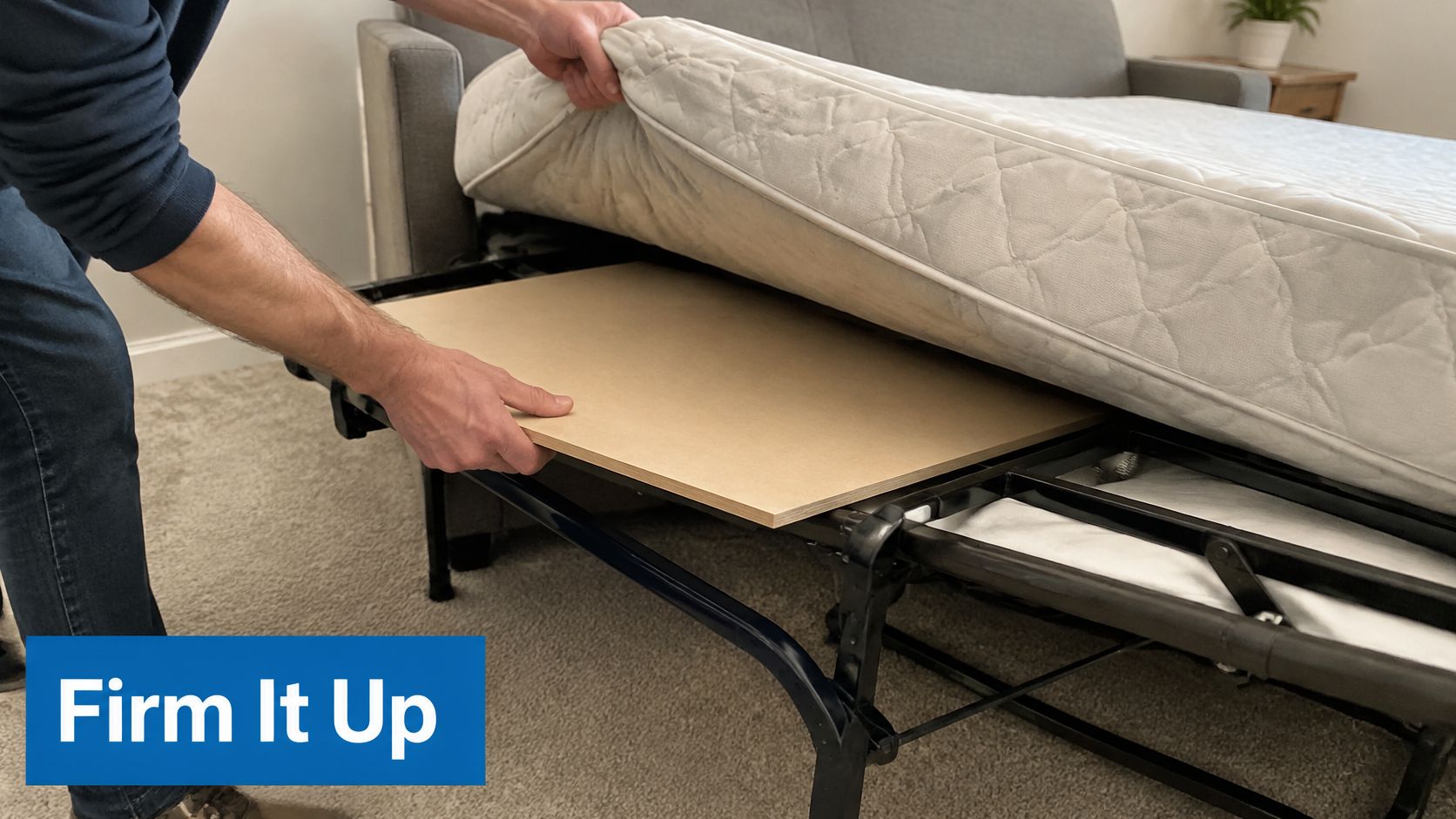
A dip under the lower back isn't only "a bit soft." When mattress sagging affects spinal alignment, guests wake sore and blame the bed. On a sleeper, look under the foam before you blame the foam. I would start with the board.
Meliusly makes three sleeper supports, and they install differently.
The SleeperSaver Pro is permanently installed. It sits between the sofa frame and the mattress and collapses together with the bed, so there is no loose panel to store. It comes in Twin, Full, and Queen, sized to standard sleeper frames, and it suits people who open the bed often.
The SleeperSaver Lite unfolds onto the frame with no tools and no permanent modification. An air-gap design resists moisture buildup under the mattress, which matters if the sofa sits in a cool room and the bed stays folded for weeks. It is listed at $83.99.
The SleeperSaver Classic is the heavy-duty board you place on the frame before the mattress goes on. Listed prices are $95.99 in Twin (36 x 48 inches), $107.99 in Full (48 x 48 inches), and $113.99 in Queen (60 x 48 inches).
| Board | Size | Installation | Listed price |
|---|---|---|---|
| SleeperSaver Lite | Lightweight board; measure the open frame | Unfolds onto the frame; no tools | $83.99 |
| SleeperSaver Classic Twin | 36 x 48 inches | Placed on the frame before the mattress | $95.99 |
| SleeperSaver Classic Full | 48 x 48 inches | Placed on the frame before the mattress | $107.99 |
| SleeperSaver Classic Queen | 60 x 48 inches | Placed on the frame before the mattress | $113.99 |
| SleeperSaver Pro | Twin, Full, or Queen, sized to standard sleeper frames | Permanently installed; collapses with the bed | Not listed |
Posted prices exclude taxes, shipping, and handling. Full product details are at meliusly.com. For the wider repair sequence, from tightening the mechanism to checking the bar covers, see how to fix a sagging sofa bed.
Fit checks before you order
Sleep Sage's sofa bed mattress guide lists queen sleeper mattresses at 5 inches thick and twin versions at about 4.5 inches, because that is the clearance the fold needs. A support layer can't push you past that.
- Measure the frame width and length with the bed open, inside the rails, not the upholstery outside. The board has to match that opening.
- Check the fold path. Close the sofa with the board in place before you add bedding. If it binds, the board is too thick or too long for that mechanism.
- Stay inside the mattress limit. The queen's roughly 5-inch mattress and the twin's roughly 4.5-inch mattress already fill the fold. Don't stack a thick topper on top of a board and then force the sofa shut.
If the deck is sound and the mattress is still shot, replace the mattress inside the thickness limit. If the deck sags and the mattress is fine, the board is the spend that changes the night.
Choose Your Sleep Option and Next Step
Write down three numbers today. The open footprint of the sofa or the guest floor, the sleeper length, and how many nights a year you'll use it.
If you host only a few nights a year, buy an air mattress that fits your storage and check firmness at room temperature before every visit. If the sleeper is in weekly use, don't replace it yet. Measure the frame, feel for metal bars and a center fold, and test the deck before you buy another mattress.
If it still sags after that, fit a support board sized to the frame and inside the mattress thickness limit. Order of operations is simple. Measure the sleeping surface and the frame first. Decide whether the problem is the mattress or the support. Then choose the board or the air mattress. Budget the final total, because posted prices exclude tax and shipping.
- Footprint: Tape the open depth, including a walking path.
- Length: Note 72 inches on a typical queen sleeper versus what your tallest guest needs.
- Nights: A handful of nights points to air. Weekly use points to the sofa and a sound deck.
- Failure plan: Spare pump and patches for air. A fitted board for a bar-filled sleeper.
That list is the whole decision. The catalog photo isn't.
We build support boards for sagging sofas, sleeper sofas, and beds so you can keep the furniture you already own comfortable. If your pull-out shows metal bars or a center fold, a fitted sleeper board is the fix to try before a new sofa. Visit Meliusly to match a SleeperSaver to your frame.
Share this post
- Tags: air mattress comfort, sagging sleeper sofa, sleeper sofa mattress, sleeper sofa support, sofa bed vs air mattress