

Firm Sofa Guide: What Firm Means and How to Fix It
Posted by Meliusly
A deep seat is the most wanted feature in a new sofa. In 2024, 51% of 400 surveyed furniture shoppers named deep seating as their favorite sofa feature, according to Living Spaces' Consumer Insights survey. It's also the geometry that works against everything the word firm is supposed to promise, because a deep seat lets your hips slide forward of the backrest and puts more of your weight behind your knees than your feet can help with.
Firmness itself is not one property. It's at least two engineering numbers sold under one adjective, plus a third property, fire compliance, that has nothing to do with how a seat feels, plus a fourth, sag, that no cushion rating predicts. A sofa can be firm on the day it arrives and hollow in the middle by year four.
Treat a firm sofa the way an upholsterer does: as a measurable spec, a diagnosable fault, and sometimes a question about whether you can get out of it without using momentum.
Firm Sofa Ranges and What the Numbers Mean
Firm is a measurement before it's a feeling. Two sofas can carry the same firm label and behave nothing alike, because the word covers two separate engineering properties that the trade tests in different ways.
Density is foam mass per volume, tested under ISO 845. Higher density generally means more polymer in a given volume and better resistance to long-term breakdown. Firmness is indentation force under ISO 2439, reported as ILD or IFD, and it describes how strongly the foam resists compression. The technical upholstery guidance from MakeBespoke is blunt about the split: density alone can't predict how hard a sofa feels, and firmness alone can't predict how long it lasts.
That's why a spec sheet with only one number on it is close to useless. Low-density firm foam feels crisp for a season and then crumbles under the same load that a high-density soft foam absorbs for years. The two measurements answer different questions, and you need both answers before you spend money.
| Firmness band | Indentation force (ISO 2439, ILD or IFD) | Typical use |
|---|---|---|
| Soft | 80 to 120 N | Relaxed lounging and lighter-use seats |
| Medium | 130 to 180 N | Everyday household seating |
| Firm (contract grade) | About 200 N or more | High-use and hospitality seating |
Anything sold as contract grade should land in that top band. If a seller calls a cushion extra firm but can't say whether that means 150 N or 220 N, you're reading an adjective, not a specification.
Fatigue is the missing test. Pressing a cushion in a showroom tells you how foam behaves for two seconds. Repeated-loading fatigue testing under ISO 3385 measures loss of thickness and hardness over thousands of compression cycles, which is the number that predicts how a seat feels in year three. Ask for it on replacement foam. Most sellers won't have it, and the ones who do tend to be the ones worth buying from.
The three-point spec check
Before you buy replacement foam, a topper, or a whole new sofa, confirm three things. Both values are listed: density and indentation force. The test method is named: ISO 845 and ISO 2439, not a marketing phrase. The seller can place the cushion in a band: soft, medium, or firm and above, with the number behind it. If any of the three is missing, ask before you buy, and treat a vague answer as the answer.
Use the same list as a shopping checklist for a new purchase. A seller who can state density, the indentation force band and the test method is giving you comparable numbers; one who can't is asking you to trust a word. When you're comparing replacements, our guide to the best sofa cushions keeps firmness, density and seat fit as three separate decisions instead of one blended comfort claim.
How Firmness Shapes Pressure and Comfort
A seat that feels supportive and a seat that feels hard are managing pressure differently, not firmness differently. The difference shows up in newtons per square centimetre.
A 2017 Springer study that paired body-pressure measurement with subjective comfort ratings compared sofa seats and backrests built from different sponge-layer configurations. The condition participants rated most comfortable used a seat cushion at 4.0 ± 1.35 and a backrest cushion at 3.25 ± 1.07 on the study's hardness scale. The winning seat was not the hardest one in the trial.
The pressure numbers are the more useful half of the result. Pressure at the ischial tuberosities, the sitting bones, should stay below 2 N/cm², with roughly 0.6 to 1.2 N/cm² optimal. Average pressure across the seat should sit below 0.6 N/cm², and the preferred range was 0.4 to 0.5 N/cm².
A pressure map makes the mechanism visible. The hot spots show where load concentrates, and the goal is a surface that spreads it.

Sag interferes here. When the center of a cushion sinks, your pelvis settles into the dip and bears a disproportionate share of your weight. A cushion that reads firm on a spec sheet can still transfer pressure beyond those points if the base beneath it has collapsed. A firmness rating describes the foam. Pressure describes the foam plus the deck plus your body, and only one of those three is printed on the label.
A ten-minute test that needs no equipment
Sit upright in the spot where you normally sit and set a timer for ten minutes. Watch for three things.
- Where the pressure sits. It should spread across the backs of your thighs and buttocks, not concentrate in two points under your sitting bones.
- Whether you keep shifting. Fidgeting every minute or two to find a better spot is your body reporting concentrated load.
- Where your knees end up. If your hips drop below your knees, the cushion has given up and you're sitting in a dip.
If any of the three goes wrong, inspect the base before you buy anything firmer. A level, supported deck under a documented cushion does more for pressure distribution than a hard cushion on a sagging base.
Diagnose the Sag Before You Firm It Up
Buy nothing until you know which part failed. A soft seat has four common culprits, and they take different fixes.
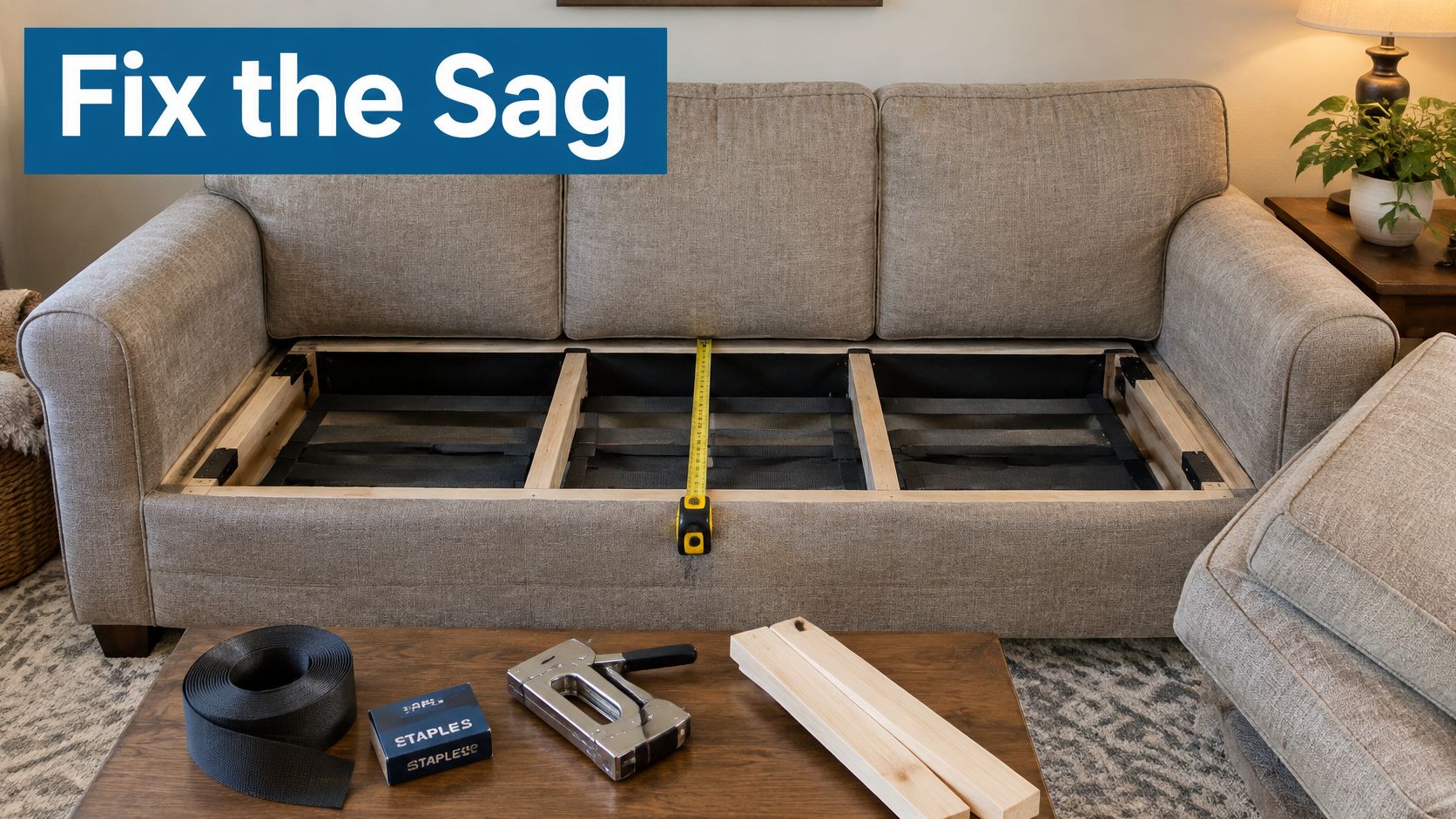
Take the cushions off first. Look at the deck, the panel or webbing under the cushions, and at the springs if the sofa has them. Sides and center should sit at the same height. Then press the front edge, the middle and the back with the heel of your hand and note which gives first. A front edge that sinks points to the base. A middle that dips while the edges stay firm points to the deck or the foam.
Next, measure every cushion at the four corners and the center. A cushion that's lost an inch in the middle has lost its ability to spread load, whatever its density. If the cover has a zip, open it and press the foam directly. Crumbly or discolored foam has failed chemically, and no support board brings it back.
| Symptom | Likely cause | Matching fix |
|---|---|---|
| Center dips when you sit | Cushion foam has lost height, or the deck has dropped in the middle | Support board under the cushions; replace foam if it has crumbled |
| Front edge sinks or feels tilted | Sagging deck or spring base | Level the seat with a board; check and repair the springs or deck |
| Top feels firm but seat bottoms out | Foam too thin for the load | Add a firmer topper within the seat height limit |
| Cushions flattened within a few years | Low-density foam under heavy use | Replace with higher-density foam; check the density on the spec |
| Bars felt through a sleeper mattress | Frame bars not covered | Board between the bars and the mattress |
Two fixes are quick and reversible: a support board under the cushions, and a firmer topper inside the existing cover. Replacing foam or repairing springs takes longer, costs more, and may need an upholsterer. Our sofa construction guide shows what sits under the deck, which is worth five minutes before you decide which layer failed. Sleepers follow their own pattern: if you feel bars through the mattress, the fix goes between the bars and the mattress, not under the seat cushions.
Stop here if the frame is cracked. A broken frame, a deck pushed through, or a snapped spring rail is structural damage. A board covers the symptom and leaves the cause in place.
If the base looks sound and the frame feels rigid but the whole seat still flexes, it helps to see how a wood frame sofa workshop project is assembled, because you can't judge a joint you can't picture.
How to Firm Up a Sagging Sofa Step by Step
With the diagnosis done, the repair itself takes about twenty minutes and one board. Work through it in this order.
- Clear the seat. Remove every cushion and anything wedged down the back. You need to see the surface you're supporting, because a board laid over a crumpled throw or a stray remote will rock.
- Measure the deck, not the sofa. Take the front-to-back depth and the side-to-side width of the flat panel under the cushions. Order a board slightly smaller than that area, about half an inch shy on each side, so it sits flat without binding on the frame. Ordering to the sofa's outside dimensions is the usual mistake, and it gets you a board that catches on the arms.
- Lay it flat face up. Flat side toward the cushions, edges square to the frame. On a sleeper, the board goes on the bed frame beneath the mattress rather than under the seat cushions.
- Press all four corners. Gaps or a see-saw under one corner mean the deck is uneven or the board is oversize. A rocking board recreates the uneven load the sag created, just higher up.
- Replace the cushions and sit for ten minutes. Test the front edge and the center separately. If the center still feels soft, the foam is the problem and the base was fine.
- Add a topper only if the height allows. A firmer foam layer under the existing cover helps a thin cushion, but only if the cushion still fits the seat without pushing you forward off the backrest.
The parts list is short: a board, a tape measure, and a deck you can see.
Where a support board stops and reupholstery starts
A board under removable cushions changes the seating base. It doesn't touch the cover, the filling or the decking, and that distinction matters well beyond warranty. The federal upholstered furniture rule incorporates California Technical Bulletin 117-2013 and evaluates four separate component categories: cover fabric, resilient filling material, barrier material and decking material, each against criteria for char length, smoldering and transition to open flaming, as the CPSC's upholstered furniture guidance explains. Swap the foam or the fabric and you've altered components that were originally tested.
Practical rule: if the board is removable, sits under the cushions, and you don't cut, sew or replace the cover or filling, you've done a reversible repair rather than a reupholstery job.
Firm Seating for Older Adults and Caregivers
An older parent sinks into a low, soft sofa, rocks forward twice, and pushes off the armrest to stand. The sofa is comfortable for the first ten minutes and a daily obstacle after that.
Research on this group is specific. A study of older adults and sofa design indexed in the Korea Citation Index found that users prioritized seating comfort above all, while their complaints centered on insufficient cushion firmness and uncomfortable seat depth. The same work names cushion durability, firmness and backrest height as important design considerations. Related age-friendly sofa research reports that low seat surfaces, soft cushions and low or absent armrests make standing harder for older users, who need higher initial seat heights to reduce effort and help mitigate fall risk.
So can making a sofa firmer make it safer and easier to get up from? Yes, when firmness arrives with suitable height, manageable depth, stable arm support and a back angle that doesn't leave the sitter slouched. No, if you bolt a hard board onto a seat that's still too low and too deep. Firmness changes the surface you push from. Height and depth decide whether your feet and knees can do the work.
A caregiver helping an adult stand from a firm, correctly sized seat sees the difference immediately.

The question isn't whether the sofa is firm. It's whether the person can stand up from it without using momentum.
Measure three numbers before buying anything
- Floor to seat height, taken at the front edge with someone sitting on it, since foam compresses under load.
- Seat depth, from the front edge to the back cushion where the back rests.
- Arm height, from the floor to the top of the arm, because that's the surface being pushed against.
Then have the person sit and stand three times. Watch how far they scoot forward and whether their feet stay flat. That tells you more than any label on the sofa.
Start with reversible changes: a removable board under the cushions, a firmer topper, a cushion that adds an inch of height. Caregivers should fix height and arm support first. Older adults should judge by standing effort rather than by how the seat feels in the first minute. Hospitality operators should aim for the same seat height in every unit, because a guest who meets one low sofa in one room and a firm one in the next has a worse stay than a guest who meets consistency. Our notes on furniture choices for elderly users go further into the geometry.
Decide to Firm Up Support or Replace
Once you know which part failed, the decision is mostly mechanical.
Firm up when the frame is solid, the deck and springs are intact, the foam still springs back, and the complaint is sag or bottoming out in the cushions. Replace when the frame is cracked, the deck is broken through, the foam has crumbled through its full depth, or the work you want involves new upholstery, filling or decking that moves the piece outside its tested configuration.
That second list deserves scrutiny, because replacement is often an emotional decision wearing practical clothes. In a 2024 survey reported by Home News Now, 39% of surveyed consumers expected their sofa to last five to nine years. A sofa sagging at year four with a sound frame isn't used up. It's under-supported, and a board costs a fraction of a new couch.
The compliance check that outlives the repair
In the United States, upholstered furniture manufactured, imported, or reupholstered on or after June 25, 2021 must meet the federal flammability requirements in the 16 CFR Part 1640 rule, which applies to indoor furniture with an upholstered seat, back or arm. Covered furniture must carry a permanent label stating that it complies with U.S. CPSC upholstered-furniture requirements. Check that label on any used sofa you're considering, and be clear about what a support board does: it changes the seating base, and it does not make an older, unlabeled piece compliant.
Scope matters here too. The CPSC's 2021 announcement of the standard sets out what falls outside the rule, including futons, cushions and pads used on outdoor furniture, and seating prescribed by a healthcare professional. A residential indoor sofa sits inside the rule; an outdoor cushion does not. For a garden-variety sagging couch, the compliance question and the support question are two separate checks.
The next step is a measurement, not a purchase
Press-test the seat, measure the deck front to back and side to side, and confirm the frame will take a removable board without binding. A board sized for a standard sofa deck and a board sized for a sleeper frame are different jobs. So is the fix for bars felt through a sofa bed mattress.
We build the Heavy Duty Sofa Cushion Support Board for sagging cushions, and the SleeperSaver Lite unfolds onto the sofa bed frame with no tools and no permanent modifications to the furniture, alongside support for beds and sleeper sofas across the range.
Set the board, replace the cushions, and give it ten minutes before you call the job done. Test the front edge, the center and how you get up. If two of the three improve, you've solved it for the price of a board. If the center is still soft, the foam was the failure all along. When you suspect a piece is beyond saving, this guide to replacing worn-out furniture lays out the structural signs worth weighing against repair cost.
A firm sofa is usually a supported sofa, not a harder one, and that's the problem Meliusly exists to solve. We build the Heavy Duty Sofa Cushion Support Board for sagging cushions, plus SleeperSaver boards for sofa beds where the bars come through the mattress, so the seat you already own can feel firm again without a trip to a furniture store. Measure your deck, match it to a board, and start with the Meliusly support range to finish the repair in an afternoon.