

Best Sofa Cushions to Fix a Sagging Couch
Posted by Meliusly
You sit down on your sofa and drop lower than expected. The front edge has lost its shape, the middle feels like a hammock, and standing up takes more effort than it should. You may be tempted to order the softest replacement cushion you can find, but softness alone rarely fixes a sagging couch.
The practical question is simpler: is the cushion failing, or is the seat foundation beneath it failing? The best sofa cushions can restore comfort when the frame and support system remain sound. They won't perform well if worn foam is being forced against collapsed webbing, broken springs, or an uneven seat pan.
Before buying, compare the material, pressure distribution, compressed seat depth, and support beneath the cushion. This quick reference shows what matters most.
| Cushion decision | What to check | What it tells you |
|---|---|---|
| Foam density | Mass per unit volume | How well the material may resist compression and retain its shape |
| Foam firmness | IFD rating | How readily the cushion compresses and how much sit-to-stand support it provides |
| Cushion contour | Pressure across the pelvis and thighs | Whether your body weight is spread out or concentrated in hotspots |
| Seat foundation | Webbing, springs, boards, and frame | Whether the cushion has a stable surface beneath it |
| Compressed depth | Actual sitting depth with the cushion loaded | Whether your feet, back, and hips remain properly supported |
| Repair decision | Frame condition, moisture, covers, and safety labeling | Whether to replace the insert, reinforce the seat, or replace the sofa |
Why Your Sofa Cushions Are Failing
A sagging cushion usually announces itself gradually. First, one seat develops a favorite dip. Then the filling shifts toward the edges, the cover wrinkles, and you start folding a blanket beneath the cushion to recover a little height. Eventually, you can feel the hard structure below when you sit in the same place.
That doesn't automatically mean the entire sofa is worn out. In repair work, the visible dip is only the symptom. The underlying fault may be degraded foam, a flattened fiber wrap, loose webbing, broken springs, or a combination of these problems.
Start with the cushion, then look below it
Remove the cushion and place it on a flat floor. Check whether it has permanently compressed, whether the edges still hold their shape, and whether the cover is pulling unevenly. A cushion that remains distorted away from the sofa has likely lost resilience. A cushion that looks reasonably intact may still be reacting to a failing foundation.
Next, inspect the seat deck. Press down with your hand across the front, middle, and rear of the empty seat. If one area drops much farther than another, the problem isn't just the insert. Look for loose fabric, broken slats, exposed springs, or webbing that has lost tension.
Practical rule: Never install a premium replacement cushion on a seat base that collapses under light hand pressure.
A softer or thicker cushion can temporarily hide a structural problem. It may also compress farther into the weak area, making the sofa feel lower and less stable. The result is an expensive replacement that develops the same dip because the original load path hasn't changed.
Comfort is more than initial softness
A 2020 peer-reviewed seating study tested 16 volunteers across three sitting postures and four seat configurations. The researchers found that cushion contour changed pressure parameters and their distribution, while posture mainly shifted where peak pressure occurred. Comfort ratings were significantly associated with average pressure and mean peak pressure, and the study concluded that cushion contour had a greater effect on seat-pan pressure parameters than posture in the tested conditions. The findings are available in the peer-reviewed cushion contour and posture study.
That distinction matters at home. A cushion can feel wonderfully plush for a few minutes but still concentrate force near the sitting bones and back of the thighs. A better repair spreads the load across a useful contact area while preserving the seat height and contour you need for everyday use.
Decoding Foam Density and Firmness Ratings
Foam density and firmness describe different properties. Treating them as interchangeable is one of the easiest ways to buy a cushion that feels good initially but loses its shape prematurely.
Density measures the mass of foam in a given volume. It indicates how much material is packed into the cushion and is commonly used as a practical durability indicator. Firmness, usually expressed through Indentation Force Deflection, or IFD, describes the force required to compress a standardized foam sample by 25% of its height. The Polyurethane Foam Association's performance guidance explains why both specifications belong on a useful product sheet.
Think of density as the amount of material in the cushion and IFD as the resistance you feel when you press into it. A dense foam can be engineered to feel soft. A low-density foam can be made to feel firm at first, but still lack the material structure needed to resist long-term compression.
How to read the specification
For everyday residential seat cushions, a practical density range is approximately 1.8 to 2.5 lb/ft³, or 29 to 40 kg/m³, according to the same foam performance guidance. Higher-traffic or hospitality seating generally benefits from approximately 2.0 to 2.5 lb/ft³ or more.
That range isn't a universal order form. It gives you a defensible starting point, then the IFD must match the user and the furniture.
- Lower IFD: The cushion feels softer and conforms more readily. This can help someone who prefers a yielding surface, provided the cushion still has enough structural support.
- Higher IFD: The cushion resists compression more strongly. It can make sitting down and standing up easier and reduce the chance of feeling the seat structure underneath.
- Higher density with lower IFD: This combination can provide a soft surface with better material durability than a soft, low-density insert.
- Lower density with higher IFD: This is the trap. The cushion may feel impressively firm in a showroom or during an initial test, yet the low material content can still lead to faster shape loss.
Match the rating to the person
Don't choose a firmness rating in isolation. Consider body size, sitting posture, seat height, and how easily the user can rise. A firm cushion isn't automatically ergonomic if it leaves the user perched too high or creates pressure at the thighs. A soft cushion isn't automatically comfortable if it lets the pelvis sink backward and removes lower-back support.
Ask the fabricator for both density and IFD. If a listing only says “high density,” request the actual specification. That label doesn't tell you whether the foam will feel soft, medium, or firm, and it doesn't let you compare two products consistently.
For a daily-use sofa, I look for a clearly stated density within the practical residential range, then select IFD based on the user's needs rather than on a generic soft, medium, or firm label. The goal isn't maximum firmness. It's controlled compression that preserves usable height and spreads pressure without bottoming out.
Comparing Cushion Fill Materials for Longevity
The fill determines how a cushion responds when someone sits, shifts position, leans into a corner, or uses the same place every evening. It also affects maintenance. A material that feels relaxed and luxurious may need regular reshaping, while a firmer engineered core may hold its geometry with less attention.
The practical service life of any insert depends on quality, construction, use, and the condition of the seat beneath it. A comparative upholstery guide estimates that standard polyurethane foam may last roughly two to five years, while high-resilience foam may last about seven to twelve years. The same cushion material and replacement guide gives a broader replacement window of five to ten years for many couch cushions, depending on quality and use.
Sofa Cushion Fill Materials Compared
| Fill Material | Expected Lifespan | Support & Pressure Profile | Best Use Case |
|---|---|---|---|
| Standard polyurethane foam | Roughly two to five years, depending on quality and use | Can provide predictable support when properly specified, but lower-quality material may lose resilience sooner | Budget-conscious seating with moderate use |
| High-resilience foam | Roughly seven to twelve years, depending on quality and use | Recovers its shape more effectively and can provide stable support with a comfortable surface | Daily-use sofas, active households, and restoration projects |
| Down or feather wrap over a core | Varies by core and maintenance | Soft, conforming surface that may require reshaping; the underlying core still controls most structural support | People who prioritize a relaxed, enveloping feel |
| Polyester fiberfill | Varies with construction and use | Light and initially soft, but can migrate or compress, changing the pressure profile | Back cushions, decorative seating, or projects where easy reshaping is acceptable |
Pressure distribution matters more than the showroom feel
A 2023 Ergonomics study had 33 participants test three cushions with identical shapes but different stiffness levels in four postures. The researchers found that pressure measures near the distal posterior thighs and areas close to the ischial tuberosities, the lower pelvic sitting bones, correlated more strongly with comfort scores than several other pressure-map divisions. The findings are reported in the Ergonomics cushion pressure study.
That gives homeowners a useful test. Don't judge a fill only by how soft it feels when you first sit down. Notice whether pressure builds beneath the sitting bones, whether the backs of your thighs feel pinched, and whether the cushion keeps its contour after you shift from upright to relaxed sitting.
A down or fiber wrap can improve surface comfort, but it isn't a replacement for a sound core. If the core has collapsed or the seat base is failing, adding a softer top layer may make the sofa feel pleasant briefly while leaving the main support problem untouched. For a practical overview of layered cushion construction and replacement considerations, see this guide to couch padding for cushions.
Choose for use, not marketing language
For children, pets, frequent guests, or a household that uses the same sofa every day, a resilient foam core usually makes maintenance easier than loose filling. Someone who prefers a deep, relaxed seat may accept more reshaping in exchange for a softer surface. Someone with limited lower-body strength may benefit more from stable height and controlled compression than from a cushion that allows deep sinking.
The best sofa cushions are therefore not one material category. They're the combination of a suitable core, a useful comfort layer, an accurately fitted cover, and a stable foundation.
Assessing Your Sofa Frame and Seat Foundation
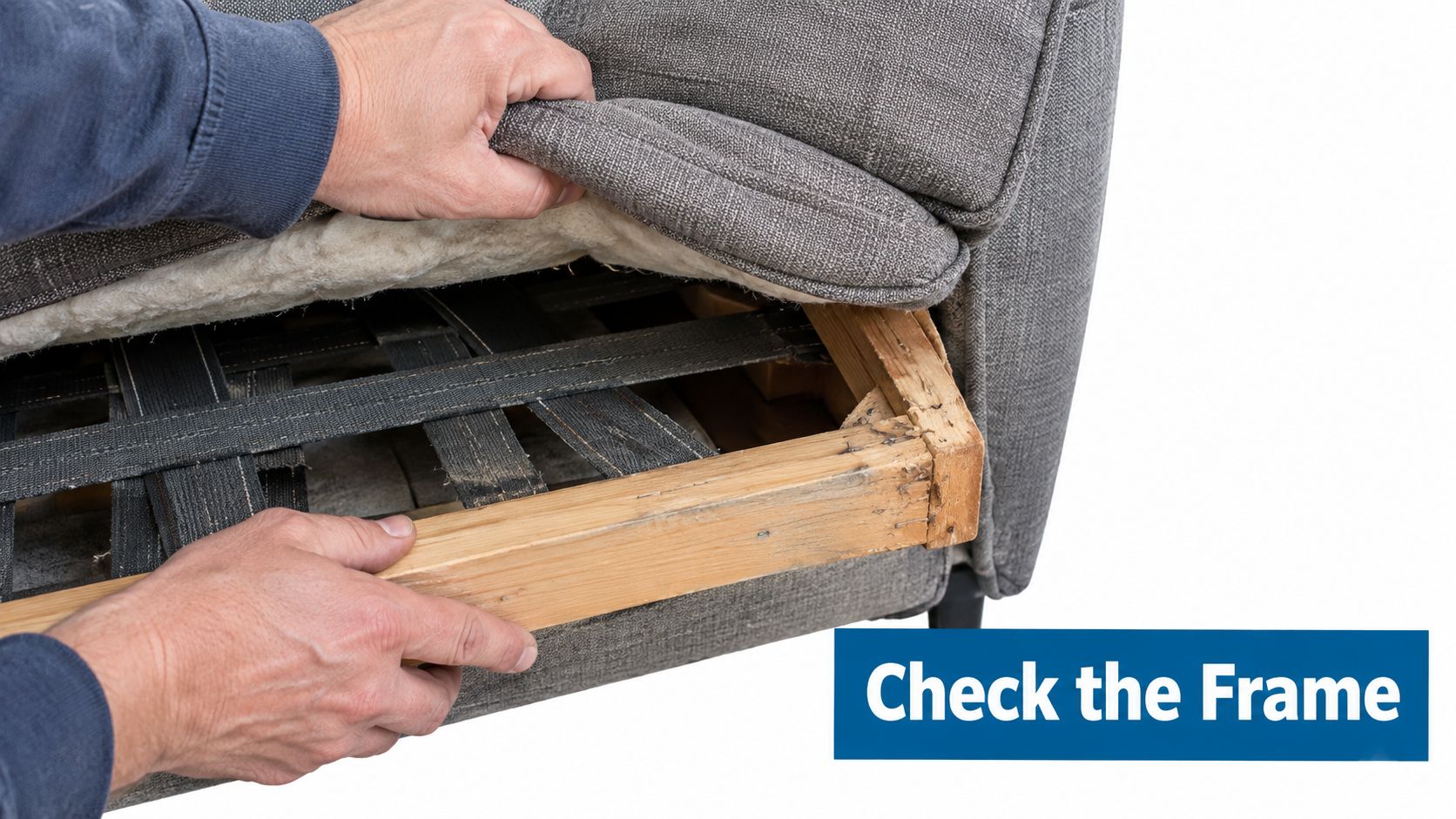
A new insert can only perform as well as the structure beneath it. Before ordering foam, inspect the sofa with the cushions removed and test the seat as if you were diagnosing a vehicle rather than decorating a room.
Follow a physical inspection sequence
- Check the frame. Push gently on the arms, front rail, and back. A frame that shifts, twists, or makes sharp cracking sounds needs attention before you invest in cushions. Look for split wood, loose joints, and visible distortion.
- Test the seat deck. Run your hand across the empty seating area. Identify soft zones, hard ridges, protruding springs, or a section that sits lower than the rest. Use a straightedge if the seat is difficult to judge by touch.
- Inspect the webbing or springs. Upholstery webbing is a load-bearing part of the sofa, not merely a fabric attachment. Instructional upholstery guidance describes a commonly used sprung domestic arrangement with four horizontal and four vertical webs, creating eight interlaced strands in a basket pattern. The upholstery webbing guide explains why tension and fastening affect the support beneath the cushion.
- Check the cover and seams. A torn cover can allow a replacement insert to shift or expose it to abrasion. A cover that has stretched substantially may need alteration even if the foam dimensions are correct.
For a clearer explanation of the main components you may encounter, use this sofa construction guide.
Measure the seat as a person uses it
Listed sofa dimensions don't tell you the usable sitting depth. Remove loose cushions, place a firm temporary board or straightedge across the seat if needed, and measure from the front edge toward the back cushion. Then assess the compressed depth, meaning the depth available when the cushion is loaded by the user.
Compare that measurement with the seated hip-to-knee length of the main user. Check whether the feet remain supported, whether the back can rest against the back cushion without slouching, and whether the user can rise without pulling on the arms. This fit protocol is particularly important for older adults, caregivers, shorter users, and anyone with limited lower-body strength.
A cushion that preserves the sofa's listed dimensions can still be wrong if it changes the user's actual sitting geometry.
A very soft insert may compress enough to make the sofa feel lower and deeper than expected. A very deep seat can leave the lumbar area unsupported, while excessive sink can make standing harder. Measure the sofa in its working condition, not just with an empty tape measure.
Pairing New Cushions with Support Boards

A replacement cushion can feel disappointing when the seat base still flexes beneath it. The insert may bottom out against sagging webbing, tired springs, or an uneven deck, concentrating pressure in the same weak area that caused the original dip. Diagnose the support beneath the cushion before choosing a thicker or softer replacement.
A sofa support board sits under the loose seat cushions and creates a firmer, more even surface. It can help when the frame remains serviceable but the webbing or springs flex too far, when cushions drop into a gap, or when usable foam still feels unstable. See our guide to sofa cushion support boards for sizing and installation details.
Check the load path
When someone sits down, weight moves through the cushion, seat foundation, and frame. A flexible foundation lets the cushion deflect farther, so pressure concentrates over a smaller area. A board limits that excess movement and gives the insert a more consistent surface to work against.
A pressure-distribution study examined sofa seating by adding different numbers of sponge-cushion layers, then measuring body pressure and reported comfort. Peak and average seat-surface pressure fell as layers were added, then stabilized at five layers, according to the study of sponge-cushion layers and seating pressure. The practical lesson is not to keep adding padding. Changes beneath the cushion can affect how the load spreads across the seat.
A new insert and a support board therefore address different parts of the problem. The insert provides the contour and surface comfort. The board steadies the foundation, reducing the chance that the cushion will collapse into a weak spot soon after installation.
Know the board's limits
A support board cannot correct a twisted frame, remove mold, restore rotten wood, or make unsafe springs safe. Major structural damage calls for an inspection from underneath or an upholsterer's assessment before you conceal the fault.
For a renter or apartment dweller, a removable board can improve a sagging seat without permanently altering the sofa. On a sectional, select a board that matches the shape and reaches the seating area where the dip occurs. Measure the opening beneath the cushions, allow for cushion seams and any center divider, and confirm that the board sits flat without catching on the frame.
Test the fit before ordering a new insert. The reliable combination is a correctly sized cushion, a stable support layer where needed, and an intact frame. Choosing the thickest cushion without checking the seat base leaves the underlying cause untouched.
Deciding Between Cushion Replacement and a New Sofa
A sagging sofa isn't automatically disposable. The better decision depends on what remains serviceable and what has failed.
Start with the frame. If the joints are stable, the upholstery is usable, and the sofa doesn't have serious moisture or mold damage, cushion renewal may be sensible. If the seat base is weak, reinforce or repair it before ordering the insert. If the covers are worn but structurally sound, they may be cleaned, altered, or replaced separately.
Use this repair decision tree
- The cushion is permanently compressed, but the seat base is stable: Replace or rebuild the cushion insert.
- The cushion and seat base are both weak: Repair the webbing, springs, or deck, then replace the insert.
- The frame is sound, but the seat feels too flexible: Test a correctly fitted support board beneath the cushions.
- The sofa has mold, serious moisture damage, unsafe deterioration, or a failing frame: Replacement or professional assessment may be more appropriate.
- The dimensions no longer suit the room or the user: A repair may restore comfort without solving the layout problem, so compare both options carefully.
The environmental case for repair is also practical. A 2025 sustainable-sofa pre-study states that extending product lifespan reduces material throughput and waste generation. When the frame, upholstery, and mechanism remain serviceable, targeted cushion renewal may carry a lower environmental burden than buying another sofa, as described in the sustainable sofa pre-study.
Consider the whole lifecycle
Don't compare only the purchase price. Consider how long the existing frame can remain useful, whether the insert can be replaced again, whether the cover can be repaired, and whether the foundation will overload a new cushion. A cheap insert that fails quickly isn't a bargain if the same underlying problem remains.
Protecting the sofa around the repair matters too. Keep sharp objects, abrasive debris, and pet claws away from exposed upholstery, and use practical guidance on how to prevent furniture surface damage when maintaining the surrounding wood and finish.
A new sofa makes sense when the frame is unstable, the damage is extensive, the size is wrong, or the repair would require rebuilding nearly every major component. Otherwise, replacing the failed part can preserve a better piece of furniture and avoid unnecessary disposal.
Your Action Plan for Restoring Sofa Comfort
Treat the project like a diagnosis, not a softness contest.
- Remove and inspect the cushions. Look for permanent compression, distorted edges, torn covers, and uneven filling.
- Test the empty seat. Identify weak zones, broken springs, loose webbing, or a seat deck that flexes excessively.
- Measure working dimensions. Record width, depth, and thickness, then check the compressed usable depth with the main user's body position in mind.
- Request real foam specifications. Compare density and IFD. For everyday residential seating, the practical density guidance is approximately 1.8 to 2.5 lb/ft³, while higher-traffic use generally benefits from approximately 2.0 to 2.5 lb/ft³ or more, as covered in the foam specification guidance above.
- Choose support before adding plushness. If the foundation flexes or the cushion drops into a gap, correct that load path with an appropriate support solution.
- Recheck the sitting position. Your feet should remain supported, your back shouldn't be forced away from the back cushion, and standing shouldn't require excessive push from the arms.
Once the structure is right, small comfort details become worthwhile. A properly sized throw pillow can refine lumbar or back support, and this That Blanket Co pillow guide offers ideas for choosing decorative support without using pillows to hide a structural fault.
The best sofa cushions are the ones that match the user, preserve the correct sitting geometry, distribute pressure, and work with a stable foundation. Diagnose first, buy second.
Meliusly offers sofa cushion support boards, sleeper sofa support boards, bunkie boards, and bed slat solutions designed to address sagging and improve the support beneath existing furniture. Visit Meliusly to find a practical support option for your sofa, sleeper, or mattress foundation before replacing furniture that can still serve you well.
Share this post
- Tags: best sofa cushions, foam density guide, furniture support boards, sagging couch fix, sofa cushion replacement