

Seat Cushion Lumbar Support for Better Posture and Comfort
Posted by Meliusly
Proper seat cushion lumbar support works by redistributing pressure away from the sitting bones toward the backrest, which is why it must be paired with a firm, stable seat foundation. A supported recline between 110° and 130° can also reduce lumbar-disc pressure, back-muscle activity, and discomfort when the seat and backrest work together (ergonomic review).
You know the feeling. You sit down on your favorite sofa, the cushion collapses beneath you, and your lower back never quite reaches the backrest. You add a thicker pillow, shift around, and perhaps feel better for a few minutes. Then your pelvis slides forward again and the gap returns.
After restoring thousands of sagging couches, I've found that homeowners often replace the wrong part first. They blame the lumbar cushion when the failure is underneath the seat. A soft support placed on a collapsing foundation can't hold your pelvis in position, preserve the lower-back curve, or maintain reliable contact with the backrest.
Meliusly has served over 400,000 customers with practical furniture support solutions, including sofa supports, sleeper sofa support boards, bunkie boards, and bed slats. The same principle applies across those repairs: improve the structure first, then fine-tune comfort.
Why Your Seat Cushion Isn't Supporting You
You sink into the sofa after work, push the lumbar pillow behind your back, and feel the lower edge of the cushion disappear beneath you. The pillow isn't necessarily defective. The seat foundation may be allowing the rear of the cushion to compress so far that your pelvis rotates backward and your lower back loses contact with the backrest.
That sequence creates a familiar chain reaction. Your hips slide forward, your spine rounds, and you lean against whatever part of the backrest still reaches you. Adding more soft material often makes the seat feel pleasant at first, but it can increase sinking and make the gap worse.

Find the foundation before changing the cushion
Remove the seat cushion and inspect what supports it. Look for a sagging platform, broken or weakened springs, a bowed support surface, compressed foam, or a rear section that gives way more than the front. Press down by hand across the seat. If the rear collapses while the front remains relatively firm, the cushion is being asked to correct a structural problem.
A lumbar element works best when the pelvis stays stable. The seat doesn't need to feel hard, but it must resist excessive rear compression and keep the sitting surface level enough for the lower back to meet the contour behind it.
Practical rule: If the cushion sinks away from the backrest, stabilize the seat before increasing lumbar padding.
A firmer rear section or supportive board can preserve the relationship between seat height, pelvic position, and lumbar support. Once the foundation is stable, choose a separate adjustable lumbar element that fills the lower-back gap without forcing an exaggerated arch. That combination is more dependable than a thick cushion that merely compresses under load.
How Lumbar Support Actually Works in Your Seat
Lumbar support isn't just a pad pressing into the small of your back. Its useful role is to change how your body shares the load between the seat and the backrest.
In a controlled biomechanical study using seat and backrest pressure mapping, an off-loading posture with reduced ischial support and enhanced lumbar support shifted force and peak seat pressure anteriorly toward the thighs, increased backrest contact, and significantly reduced lumbar-muscle activity compared with normally supported upright sitting (pressure-mapping study).
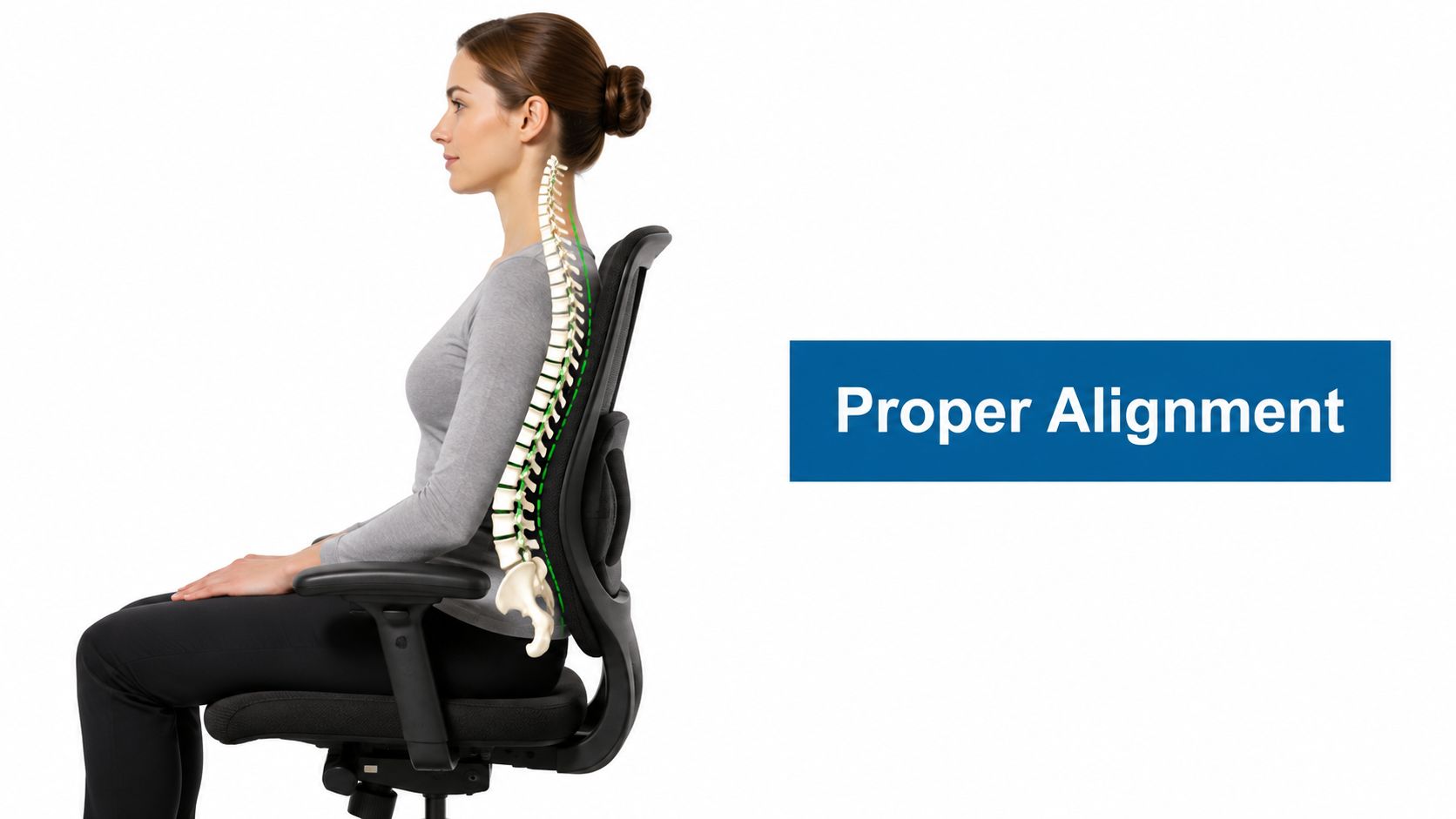
The ischial tuberosities, commonly called the sitting bones, carry substantial pressure when you sit upright. When the seat compresses excessively beneath them, the pelvis can rotate and the lower back can move away from the backrest. A properly positioned lumbar contour helps restore contact behind the lower back, while a stable seat keeps the pelvis from sliding into the unsupported position.
Why soft padding often fails
A cushion should stabilize the pelvis while allowing your lower back to contact the lumbar contour. Excessive rear-seat compression does the opposite. It concentrates pressure beneath the sitting bones, encourages pelvic rotation, and changes the position the lumbar support was designed to serve.
The pressure-mapping findings also show why a structural repair matters in a sagging sofa. A firmer rear section or supportive underlying board can preserve the intended geometry without requiring an unusually hard lumbar pad. The aim isn't to force your spine into a rigid posture. It's to distribute contact across the seat, thighs, and backrest more effectively.
For a broader perspective on arranging seating, desk equipment, and working habits, this resource on creating a safer productive workplace provides useful context. The furniture principle remains simple: support should be shared across a stable system, not concentrated in one small cushion.
Lumbar Support on Sofas, Office Chairs, and Car Seats
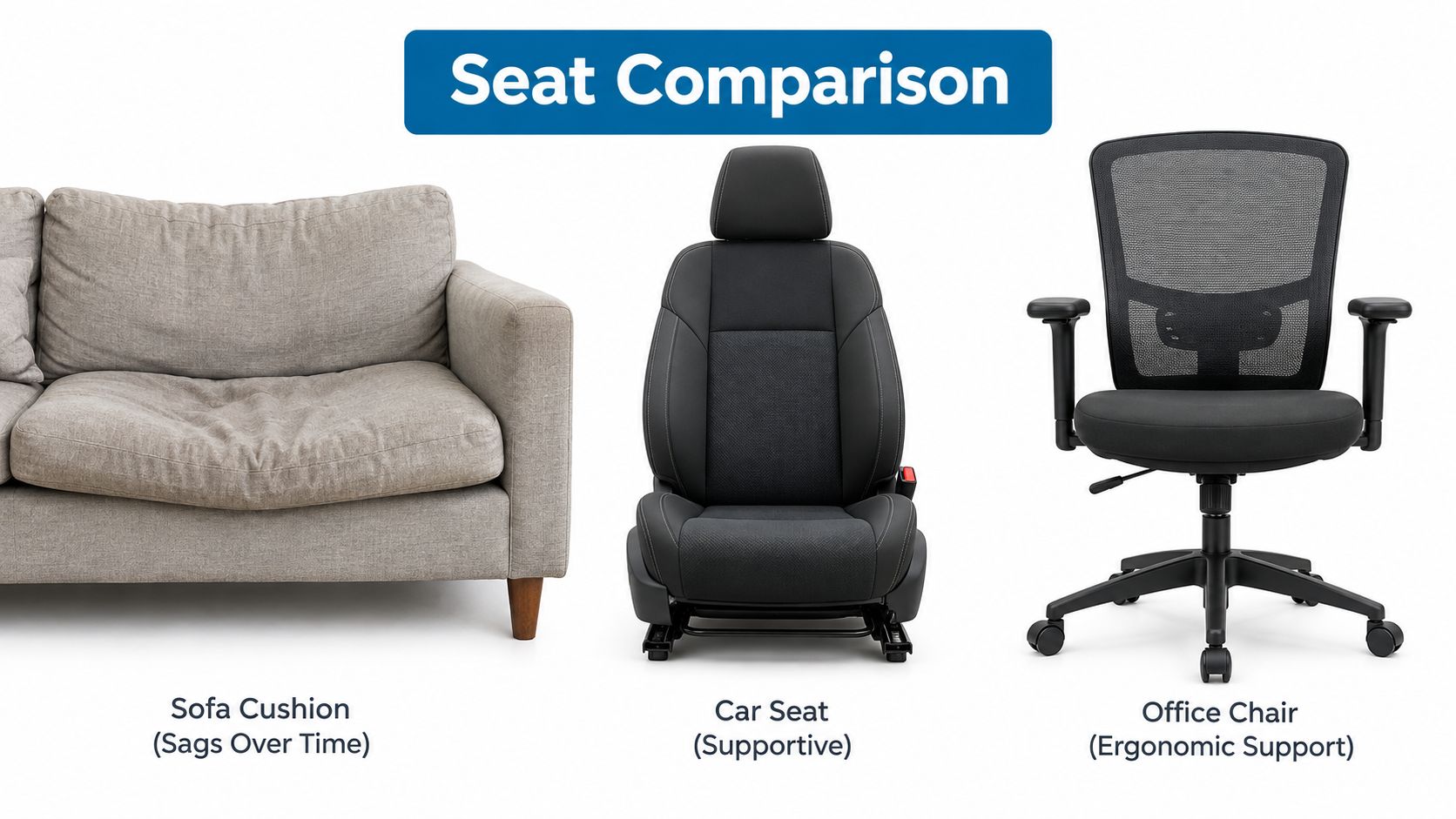
The same lumbar cushion can support one seat and fail on another. The difference often starts beneath the user: seat depth, foundation firmness, cushion compression, backrest angle, and movement determine whether the pelvis stays positioned for the lumbar contour.
On a sofa, inspect the seat before adding a pillow. Weak springs, a bowed platform, or crushed foam can let the rear of the cushion sink and the pelvis slide forward. A lumbar pillow may fill the resulting gap briefly, then shift as the foundation collapses. Repair or reinforce the seat base first, then choose a moderate support that follows the sofa's back angle. A stable foundation lets the cushion work without excessive hardness.
An office chair provides more adjustment, yet fixed lumbar geometry can still miss the user's natural curve. A Cornell ergonomics guide places adjustable lumbar support roughly 15 to 25 cm above the compressed seat height, so a pad that sits too high or low may support the wrong area. Set lumbar height and depth with the chair reclined as intended, rather than testing the support only in a locked upright position. For practical positioning and cushion considerations, this guide to office chair cushion lumbar support offers a useful reference.
Match the support to the seat
| Seating type | Common problem | What to adjust |
|---|---|---|
| Sofa | Sagging foundation lets the pelvis slide forward | Firm the seat base before adding lumbar support |
| Office chair | Lumbar height or depth does not match the user | Adjust support and recline together |
| Car seat | Narrow, fixed contours limit positioning | Use a slim, moderate support that does not interfere with controls |
Cars impose tighter limits. The seat is narrow, the backrest is often upright, and the built-in lumbar contour may not move. A bulky pad can push the driver forward, reduce shoulder contact, or interfere with controls. Use a slim, adjustable insert and check that it stays in place during normal entry, exit, and driving. Across all three settings, fix the seat geometry first, then match the cushion to the space available.
Choosing the Right Materials and Firmness Level
The right lumbar support holds its shape under load without creating a painful pressure band. Material affects comfort, but projection, contact area, and firmness determine whether the support stays useful during real sitting.
In practice, a pad with roughly 3 cm of projection can prevent lumbar flattening without creating the stronger lordosis that a larger pad may produce. More thickness is not automatically more comfortable. Start with moderate projection and increase it only if a clear gap remains between the lower back and the backrest.
Start with geometry, then choose the material
Memory foam conforms closely and softens abrupt pressure changes. A very soft grade, however, can bottom out against a sagging seat or lose its shape during long use. High-density polyester fiberfill feels more forgiving and suits a sofa where softer contact is preferred, though it can compress and require reshaping. Gel inserts distribute pressure and may feel cooler, but they still depend on a stable surface beneath them.
Use this decision sequence:
- Check the seat base. If the rear of the seat collapses, repair or reinforce it before selecting a firmer lumbar insert.
- Choose moderate projection. Begin with support that fills the lower-back gap without pushing the pelvis forward.
- Test the contact area. A broad, moderate contour usually spreads load better than a narrow, hard ridge.
- Account for shared use. Different users need different heights, depths, and levels of firmness, so adjustability matters on shared furniture.
- Reassess after sitting. Keep the support only if it reduces slouching, pressure, or fatigue without creating discomfort elsewhere.
Very firm support can produce localized soreness. An overly soft insert may compress until it no longer maintains the intended shape. The workable middle ground depends on body size, sitting duration, and furniture condition. A rental sofa, hotel chair, and personal office chair may therefore need different compression levels and adjustment options.
For a closer comparison of foam construction, see this guide to a lumbar support cushion made with memory foam. Select the material only after confirming that the seat and backrest can hold the position you need.
Seat Height, Cushion Thickness, and Safe Sit-to-Stand
A low sofa can leave someone leaning heavily on the cushion to stand. If the seat foundation has sagged, adding lumbar support may push the pelvis forward without solving the underlying problem. Check the base and the cushion's compressed height together.
One review of chair-rise research found that higher seats reduced knee moments by up to 60% and hip moments by up to 50%. The review also reported a minimum successful rising height of about 120% of lower-leg length for older people with chair-rise difficulties, with better 30-second chair-stand results at 100% to 120% of lower-leg length than with a standard 43 cm seat (sit-to-stand review).
Measure the compressed setup
Measure lower-leg length from the floor to the underside of the knee area, using the same method each time. Compare that measurement with the cushion's compressed height, not its advertised thickness. Then check whether both feet stay flat, the knees remain in a workable position, and the armrests leave room for the user to lean forward and rise.
A thicker cushion can reduce the effort required at the knees and hips. Too much height, however, can reduce foot contact and stability. Test the actual chair with the intended cushion, particularly in aging-in-place homes, rental furniture, and hospitality settings.
Seat depth also affects how far the user slides forward and whether the lumbar contour meets the lower back. Use this guide to seat depth ergonomics when the cushion changes the sitting position. A supported back is only useful if the user can still stand safely.
What the Research Says About Pain Relief and Posture
Lumbar support can improve sitting comfort and change posture, but it shouldn't be marketed as a guaranteed treatment for back pain. The strongest evidence is more cautious than many cushion descriptions suggest.
A Cochrane review covering seven prevention studies with 14,437 participants and eight treatment studies with 1,361 participants found little or no difference between lumbar supports and no treatment for preventing low-back pain or reducing sick leave, while treatment benefits remained uncertain (Cochrane review of lumbar supports).
That doesn't make a cushion useless. It means you should judge it as an ergonomic comfort aid, not a standalone medical intervention. During a specific task, ask whether the support reduces slouching, pressure, or fatigue. If it increases pain, creates numbness, or makes you brace against the cushion, remove it or reduce its projection.
A comfortable, adjustable posture with regular movement is more realistic than chasing one rigid version of perfect posture.
Short-term comfort and long-term clinical outcomes are different questions. Persistent pain, neurological symptoms, or pain following an injury deserves medical evaluation rather than repeated cushion experiments. A practical guide to managing low back pain can help explain when self-management is no longer the right approach.
Installing and Maintaining Your Lumbar Support Cushion
Start with the seat, not the backrest. Remove loose cushions, correct excessive sagging, and confirm that the rear of the seat provides enough resistance to hold the pelvis in place. A support board under a sofa or chair cushion can help create the firm, level foundation that a lumbar element needs.
Then position the lumbar support so it fills the lower-back gap without forcing an exaggerated arch. Sit fully back, adjust height and depth in small changes, and check that the support doesn't push your shoulders away from the backrest or move your hips forward.
Keep the support working
- Inspect the seat regularly: Look for new dips, shifting support, or foam that no longer rebounds.
- Rotate loose cushions: Change their orientation when the furniture design allows it, so one area doesn't carry every load.
- Clean by cover type: Follow the care label, use a removable cover when available, and avoid saturating an insert that isn't designed for washing.
- Replace the insert when needed: If it stays flattened, develops a permanent lump, or causes pressure despite correct placement, adjustment won't restore its original geometry.
- Recheck shared furniture: In a rental, guest room, or hospitality setting, verify the position for different users rather than relying on one fixed placement.
Meliusly's sofa and chair cushion support boards slide beneath seat cushions to create a firmer, more level foundation. They're one structural option when sagging is preventing the lumbar support from staying in the intended position.
Frequently Asked Questions About Seat Cushion Lumbar Support
How should I measure for the right cushion size?
Measure the usable width and depth of the seat, then check the compressed cushion height and the distance from the seat surface to the lower-back gap. The support should contact the lumbar area without covering the entire backrest or interfering with armrests, recline controls, or the back of your knees.
For a sofa, also inspect the space beneath the cushion. A correctly sized lumbar insert won't compensate for a platform that drops sharply toward the rear. Stabilize that surface before making fine adjustments to cushion dimensions.
Will lumbar support work with a sofa cushion, recliner, or car seat?
Usually, but compatibility depends on movement and geometry. A loose sofa cushion can accept a separate lumbar element if the foundation prevents excessive sliding. A recliner needs support that follows its changing angle without pushing the user out of the chair. A car seat generally requires a slimmer contour that preserves control access and shoulder contact.
Test the support through the seat's normal range of movement. If the cushion shifts, folds, or forces your pelvis forward, the shape or placement doesn't match that seat.
How often should I replace a lumbar cushion?
Replace it when it stays compressed, develops uneven areas, loses its ability to fill the lower-back gap, or causes discomfort even after the seat foundation and placement are correct. There's no useful universal replacement schedule because wear depends on the insert, the furniture, the user, and the sitting task.
Treat the cushion as part of a larger comfort system. Stable seat support, suitable height, moderate lumbar contact, and regular movement all matter more than thickness alone.
Meliusly offers practical sofa and chair support boards that reinforce sagging seat foundations beneath cushions, helping homeowners extend furniture life without replacing an entire sofa or chair. Visit Meliusly to find support options for sofas, recliners, sleeper sofas, beds, and other furniture where a stable foundation can improve comfort.