

Sofa Bed Mattress Pad: Pick, Fit, and Sleep Better
Posted by Meliusly
Friday night, a guest pulls out the sleeper sofa, unfolds the mattress, and lies down. Within minutes, they feel the metal bar, the center ridge, or the hard frame beneath their hips. You reach for a thicker blanket or spare comforter, but the problem isn't really the bedding. It's the relationship between the sofa bed mattress pad, the folding mechanism, and the support beneath the mattress.
A pad can soften a level, intact sleeping surface. It can't repair a bent frame, a sagging deck, or a mattress with a permanent depression. The right purchase starts with diagnosis, accurate measurements, and enough attention to folded clearance that the sofa still closes safely.
Why the Right Sofa Bed Mattress Pad Changes Everything
A sleeper sofa has to perform two jobs in one room. By day, it must function as seating. At night, it must unfold into a sleeping surface, then disappear back into its compartment. That history matters. Sofa beds developed through more than a century of space-saving furniture designs, including William McArthur's U.S. Patent No. 111,365 for a “Sofa Bed” in 1871, Leonard C. Bailey's folding-bed patent in 1899, and Rudolf Coopersmith's later sofa-bed mechanisms. The category never settled into one universal frame or mattress dimension. (Sofa bed history and patent development)
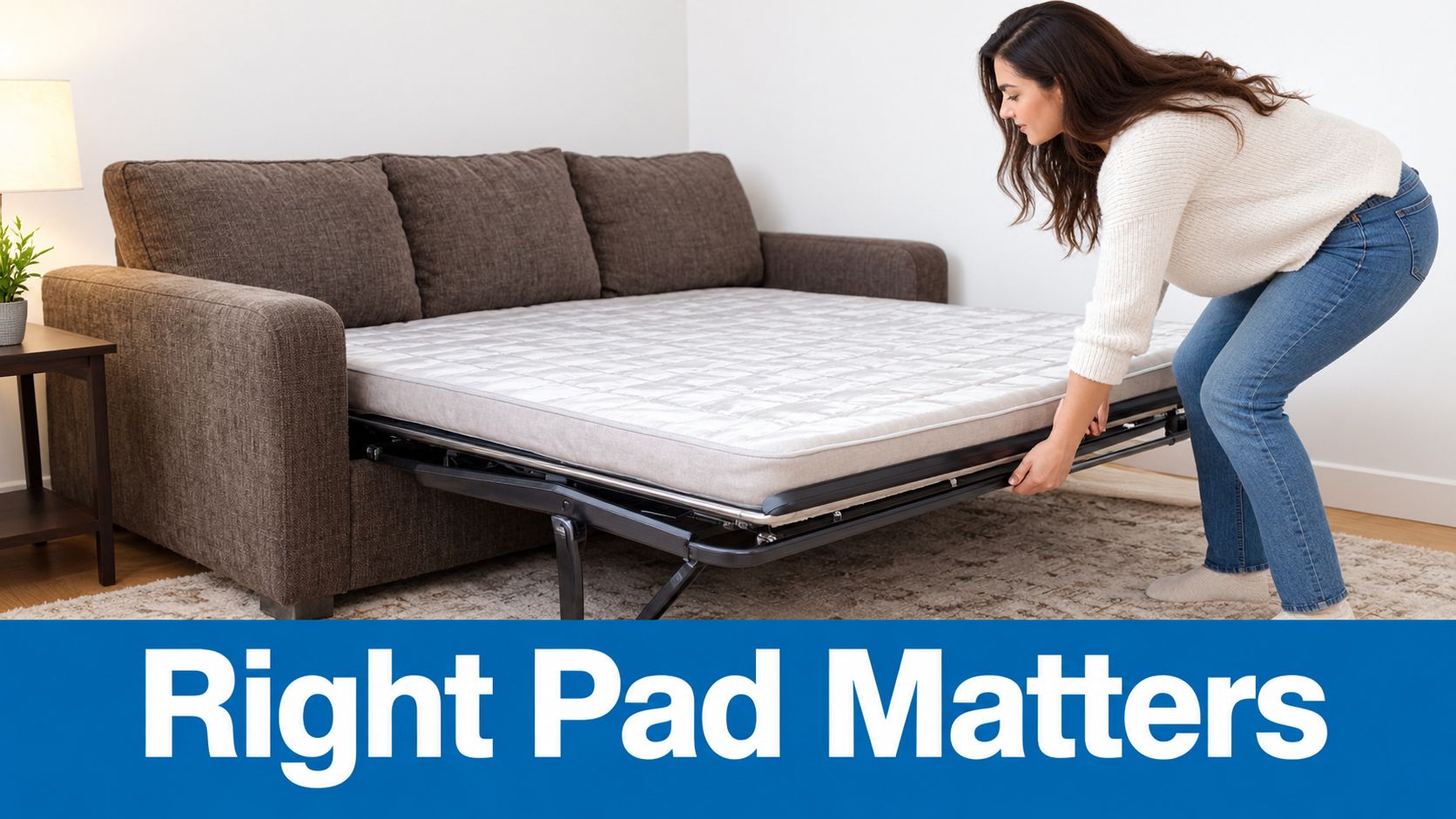
That creates two separate problems:
- Surface discomfort: The mattress feels firm, thin, uneven, or hot, but the frame remains level and sound.
- Structural discomfort: A bar, fold line, sagging deck, worn webbing, or misaligned mechanism creates the pressure point.
A pad is appropriate for the first problem. It's the wrong first move for the second.
The practical rule: Buy for the folded mechanism, not for the plushest feel when the bed is lying open.
A thick generic topper made for a stationary queen bed may feel luxurious for ten minutes and still bunch at the foot, compress against the hinge, or prevent closure. A thinner, well-fitted sleeper-sofa pad often performs better because it respects the actual storage compartment and fold pattern.
Also separate a sleeping pad from a mattress protector. The pad changes cushioning and pressure distribution. The protector addresses spills, sweat, and hygiene. If you're comparing those functions, this guide to compare mattress protector pads provides useful context without treating protection and comfort as the same purchase.
The useful sequence is straightforward. Measure the open and folded sofa, identify whether the frame or surface causes discomfort, choose a construction that matches how often the bed is used, install it without covering moving parts, and test repeated folding before a guest arrives.
Measuring Your Sofa Bed Before You Buy Anything
A sleeper sofa fails at the fold first. If you measure only the open bed, you can buy a pad that feels right for one night and jams the mechanism every time the frame closes.
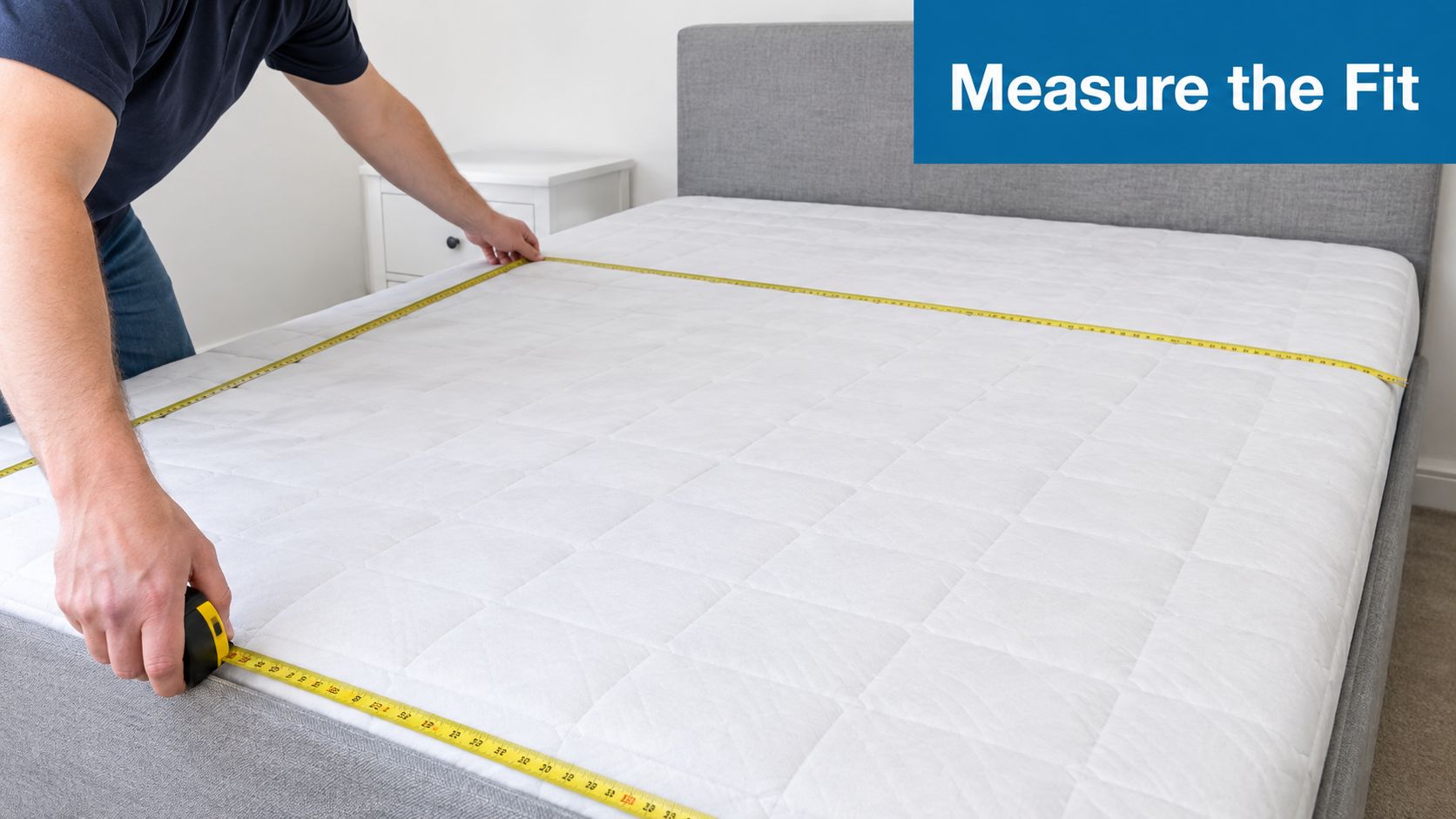
Open the sofa fully. Strip off sheets, blankets, and anything that changes loft. If the design allows it, remove the existing mattress so you can see what controls fit: the deck, the hinges, the fold points, and the storage space inside the closed sofa.
Record the dimensions that control fit
Use a tape measure and write down these five numbers and locations:
- Usable length: Measure head to foot in more than one spot. Sleeper surfaces often run short, and the corners are not always square.
- Usable width: Measure at the head, center, and foot. Frames can narrow near the mechanism, so a full or queen label tells you less than the tape measure does.
- Existing mattress thickness: Measure it without weight on it, then note how thick it is where the sections fold.
- Fold locations: Mark every crease, hinge area, and any place where a support bar sits under the mattress.
- Maximum folded-clearance depth: Close the bed and measure the compartment depth available to the folded stack. This is the dimension that decides whether a pad belongs on your sofa bed at all.
That last measurement matters most.
A pad is part of the folding system, not just a comfort layer. It may match the open sleeping surface and still be wrong because its compressed bulk steals space the mechanism needs. Extra material also tends to creep toward the foot, pile up at hinges, and create new pressure points instead of fixing old ones.
For a replacement-style sleeper mattress, practical guidance often puts the target around 4 inches (Sleeper-sofa measurement and mattress-fit guidance). Use that as a screening number only. Your compartment depth and fold pattern make the final call.
Connect each measurement to a decision
Each measurement should eliminate bad options fast. Length tells you whether the pad will buckle at the foot. Width affects edge overhang, corner lift, and whether straps stay where they belong. Compressed thickness decides whether the frame can close without strain. Fold locations tell you when a segmented design will behave better than a single rigid slab.
If you need a reality check on how retail labels differ from actual sleeper sizing, review these sleeper sofa dimensions.
Before you buy, cycle the empty mechanism once. Then place the pad loosely and close it again. Watch the head end, foot end, corners, straps, and hinge line. If the frame resists, the problem is fit, not softness. A category label never overrides the dimensions of your actual sofa bed.
Choosing Thickness and Material for Real Sleep
A sofa bed pad is part of the sleep system, not a fluffy add-on. The right choice has to cushion your body, clear the fold, and stop fighting the mechanism every time the bed opens and closes.
Start with thickness, but treat it as a fit limit before you treat it as a comfort upgrade. Occasional-use foam commonly falls around 4 to 5 inches, while daily-use constructions commonly fall around 5 to 6 inches. High-density foam screening often begins near 1.8 lb/ft³, with bases around 2.0 lb/ft³ or above generally aimed at heavier or repeated use. Those numbers are useful filters, not proof that a given pad will work on your frame. (Sleeper-sofa foam thickness and density guidance)
| Material | Typical Thickness | Fold Tolerance | Heat Behavior | Best For |
|---|---|---|---|---|
| Memory foam | Around 4 to 6 inches, depending on use | Moderate, check compressed clearance carefully | Can retain heat, and gel alone doesn't guarantee cooling | Pressure relief when the pad can be stored separately |
| Fiberfill | Varies by construction and loft | Usually forgiving, but can compress and shift | Generally more breathable than dense foam | Occasional guests and softer, lower-commitment cushioning |
| Latex | Varies by design and density | Resilient, but thickness and flexibility still matter | Often more breathable than dense memory foam | Responsive cushioning when storage and clearance allow |
| Ventilated foam | Varies by design | Depends on cell structure and compression recovery | Air channels may help, but testing still matters | Sleepers who want foam cushioning with better airflow potential |
Material choice should follow actual use. For occasional guests, fiberfill or a thinner foam pad can work if the mattress underneath is already level and the bars are not telegraphing through. For daily sleeping, recovery and support matter more, but thick comfort layers still fail if they create too much bulk at the hinge line or stay compressed after folding.
That is the point many buyers miss. If the sleeper feels hard because the frame bar is printing through, more plushness may only make the body sink farther into the problem. Lie across the center fold and over the bar zones before you commit. If you still bottom out under load, you are dealing with a structural support problem or an underbuilt mattress, not a pad-selection problem.
Heat matters too, especially with dense foams. A peer-reviewed 2024 study of 54 participants and more than 300 home sleep-test nights found that cooler temperature-controlled mattress-cover settings produced an average 14-minute increase in deep sleep, equal to a 22% mean improvement, during the first half of the night. Women sleeping at cooler temperatures also recorded an average 9-minute increase in REM sleep, a 25% mean change. The study also reported a 2% mean reduction in sleeping heart rate and a 7% mean increase in heart-rate variability when the system operated. (Peer-reviewed temperature-controlled mattress-cover study) This research is about temperature-controlled covers, not sofa-bed pads, but the design lesson is clear. Do not assume foam comfort and thermal comfort are the same thing.
For broader reading on mattress design developments, Jack Dellaccio on mattress breakthroughs offers additional context. Use one rule: choose the material that fits the fold and frame first, then improve softness and temperature from there.
Installing the Pad Without Breaking the Mechanism
You feel the mistake when the bed almost closes, then binds halfway and asks for one hard shove. That is not a comfort upgrade. It is a clearance problem, and clearance is what decides whether a sofa bed mattress pad belongs on the bed at all.
Start with the sleeper fully open and completely empty. Lay the pad flat, match the head and foot ends, and center it over the part of the mattress that supports the body. Do not stretch fitted corners over shapes they were not cut for. Extra tension pulls the pad toward the hinge line, and that drift gets worse every time the frame folds.
Secure the pad around moving parts
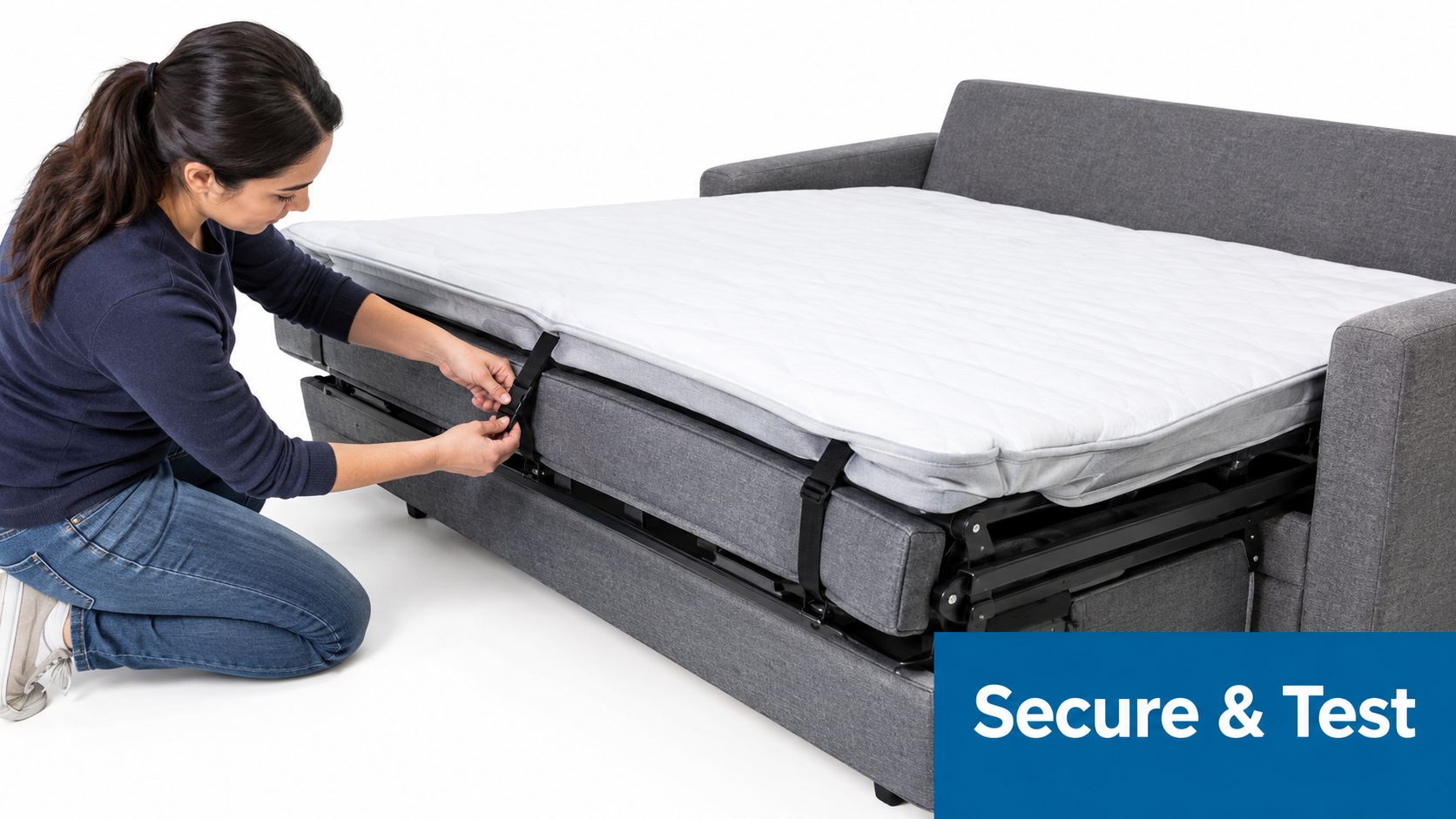
Treat straps and elastic like hardware, not decoration. If the pad has straps, route them only where they hold the surface in place without crossing a hinge, bar, pivot, or folding joint. The corners need to sit flat. The foot edge cannot bunch into a roll, and the head edge cannot cover any part of the mechanism that has to rotate or nest when the bed closes.
Check these points before you even try the first fold:
- Straps: They stay outside the path of hinges and moving frame members.
- Corners: They don't lift, twist, or pull the pad diagonally.
- Fold line: The pad bends where the sofa bends instead of forming a hard ridge beside the joint.
- Foot edge: No excess material gathers into a thick roll.
- Frame contact: Nothing catches, scrapes, or pinches as the bed moves.
Run the mechanism test
A quick lie-down test misses the true failure point. Pads often look fine on the first setup and then creep, crease, or stack up at the fold after repeated opening and closing. Run at least 10 full open-close cycles. Then reopen the bed and inspect the same spots each time.
Look for seam compression, fabric migration, fresh creases, and any place where the pad starts touching the frame. If the mechanism closes only when you press down on the deck, force the frame, or compress the sofa cushions to make space, stop. The pad is too thick, too long, too stiff at the fold, or wrong for that mechanism. Practical sofa-bed installation and clearance guidance
Before the first guest uses it: Open the bed, center the pad, secure it, close it, reopen it, and inspect every hinge and fold line. If the mechanism does not move freely, remove the pad and correct the fit.
That same test tells you whether the pad can stay inside the sofa during storage. Some pads need to be removed, folded or rolled to suit their construction, and stored dry. A pad that stays on the bed must prove it can fold with the frame without fighting the mechanism.
When a Pad Masks a Problem You Should Fix Instead
You feel the bar through the bed, add a thicker pad, and the first few minutes seem better. Then the same pressure point comes back because the problem was never the top layer. A pad is one part of the sleep system. If the frame, deck, or mechanism is failing underneath it, extra cushioning only hides the fault for a while.
Start with the pattern of discomfort. Pain that tracks one bar, one hinge line, or the center fold usually points to support trouble below the mattress. A surface that feels flat but too firm is different. That is a real pad problem. A mattress with a visible hollow, shifted fill, or one side sitting lower than the other needs inspection before you spend money on more foam.
Separate surface problems from support failures
Use this checklist before buying anything:
- The surface is level but too firm: Add a pad for pressure relief.
- One bar or ridge creates a clear pressure point: Inspect the frame, deck, and support under the mattress first.
- The mattress has a visible hollow: Measure the dip without load and check the base. A pad may soften the symptom, not fix the cause.
- The mechanism is misaligned or hard to close: Repair or adjust it before adding another layer.
- The sleeper runs hot: Choose breathable or ventilated construction and test it in normal use.
The same logic applies to expectations. User reports on common sleeper sofa problems and fixes often focus on comfort, but comfort gains do not automatically mean the bed is properly supported. Judge the setup by what happens through the night and the next morning. Fewer pressure points and less stiffness matter more than a softer first impression.
Sometimes the better fix sits under the mattress, not on top of it. Meliusly's SleeperSaver sofa bed support boards are made to sit between the sofa-bed frame and mattress, reducing bar feel and creating a flatter support plane. See the sleeper sofa support board guide for foldable and permanent options. Use a support board when the complaint is structural support. Use a pad when the complaint is surface comfort. Many sleeper sofas need both, and some need a frame repair before either one helps.
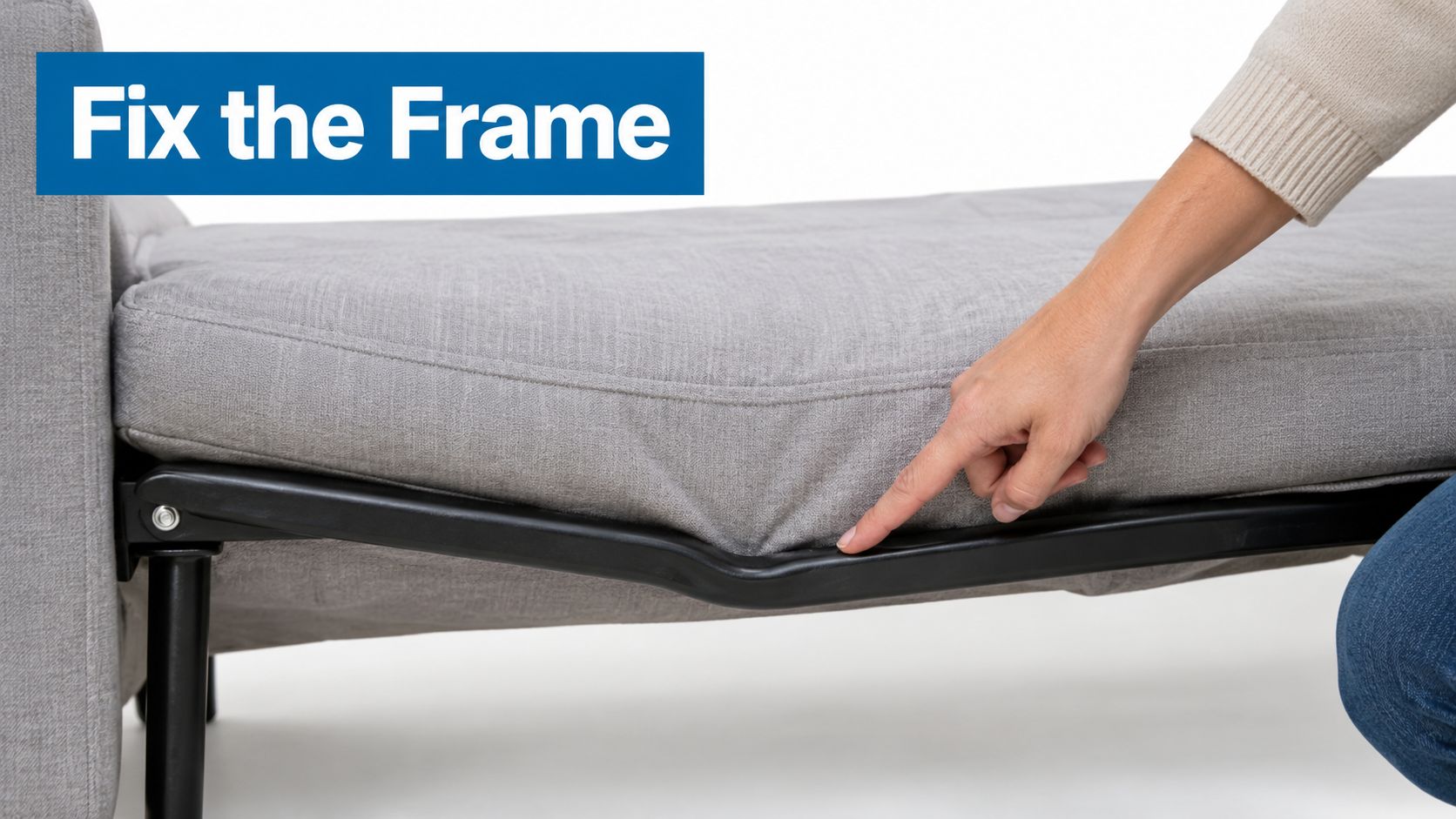
If the frame is bent, the deck sags, or the mechanism twists during opening, stop treating it like a topper decision. That is a repair decision.
That systems view matches EN 1725:2024, which covers adult bed frames, bases, mattresses, and mattress pads as a unit, with attention to safety, strength, and durability, not comfort alone. (EN 1725:2024 bed-safety standard)
Caring for the Pad So It Lasts
Care depends on construction. Memory foam and latex shouldn't be treated like a washable blanket. Spot-clean the surface, use the removable cover if provided, and let the core dry completely before folding or storing it. Moisture trapped inside a closed sofa compartment creates odor and encourages material breakdown.
Fiberfill pads are usually easier to wash, but follow the care label and dry them thoroughly. A damp pad folded into storage can deteriorate faster than one that receives less frequent but complete cleaning. Daily-use sleepers benefit from a removable cover because you can clean the contact layer without repeatedly stressing the core.
Build a repeatable care routine
- Air it out: After use, open the sleeper and let the pad breathe before storage. Hosts and rental operators should do this whenever turnover allows.
- Rotate the pad: If the construction permits rotation, alternate its orientation across the sleeping surface so one region doesn't receive every load.
- Clean the cover: Wash removable covers according to their label. For general bedding hygiene, this guide to washing bed sheets at the right temperature offers a useful reference for laundering practices.
- Inspect the core: Look for permanent compression, seam failure, shifted filling, or a crease that remains after the pad rests flat.
- Store it dry: Don't compress a damp pad into a closet or sofa compartment. Let it return to a dry, neutral state first.
Many mattress warranties use a permanent unweighted impression of 3.8 cm, or 1.5 inches, as a threshold, while some premium products use 2.5 cm, or 1 inch. (Mattress warranty sagging thresholds and support requirements) Those numbers aren't universal replacement rules for sofa-bed pads, but they give you a practical reference when visible compression becomes more than temporary settling.
For protection against spills and repeated guest use, see Meliusly's sofa bed mattress protector guidance. Review the pad at seasonal changes for an occasional sleeper, and more often when a rental or household sleeper sees frequent deployment. Replace it when compression remains visible, fit changes, or the pad begins to interfere with closing.
Putting It All Together for Better Sleep and a Longer-Lasting Sleeper
A good sofa bed mattress pad is a system component, not an isolated comfort accessory. Measure the open surface and folded compartment, identify the actual pressure source, match construction to use frequency, and verify that the pad folds without obstruction.
Use this final check before spending money:
- Measure first: Confirm length, width, mattress thickness, fold locations, and folded clearance.
- Diagnose accurately: A level but firm surface may need cushioning. A bar, ridge, sag, or bent frame may need structural support.
- Choose conservatively: Select the thickest construction that closes freely, not the thickest one available.
- Test repeatedly: Complete the 10-cycle open-close test and inspect migration, seams, and frame contact.
- Reassess the base: Check the frame, webbing, deck, center rail, and slats when discomfort follows a structural feature.
For a sagging or uneven sleeper, the next step may be a center rail repair, slat replacement, or a foldable sleeper-sofa support board beneath the mattress. Recheck comfort and closing clearance every six months for daily-use sleepers and every year for occasional ones. Stop adding cushioning when the evidence points below the mattress.
Meliusly offers sofa support solutions, including foldable and permanently installed sleeper sofa support boards, for homeowners and renters who want to improve underlying support without replacing the furniture. Visit Meliusly to match your sofa bed's support problem with a practical repair component.
Share this post
- Tags: furniture care, mattress topper guide, sleeper sofa comfort, sofa bed mattress pad, sofa bed support