

Queen Size Bed Metal: A Complete 2026 Buying Guide
Posted by Meliusly
A standard U.S. queen mattress measures 60 by 80 inches, or about 152 by 203 centimeters, but the true challenge isn't fitting the mattress. It's ensuring the metal frame supports the entire 4,800-square-inch sleeping surface without sagging. Source dimensions
You may know the situation already. A new queen metal bed looks clean, costs less than a heavy wood platform, and feels solid during assembly. Months later, the mattress dips in the middle, the slats press into its underside, and a squeak appears whenever you turn over. The frame didn't necessarily fail all at once. More often, the support system allowed repeated movement to concentrate in the weakest spans and joints.
The fix starts with measuring the right parts, then checking how the load travels from the mattress to the floor. A frame can fit the room and still provide poor mattress support. Conversely, a mattress can feel saggy even when the steel is sound because slats are too far apart, a center foot isn't touching the floor, or the mattress shifts inside an oversized opening.
Why Your Queen Metal Bed Sags Before Its Time
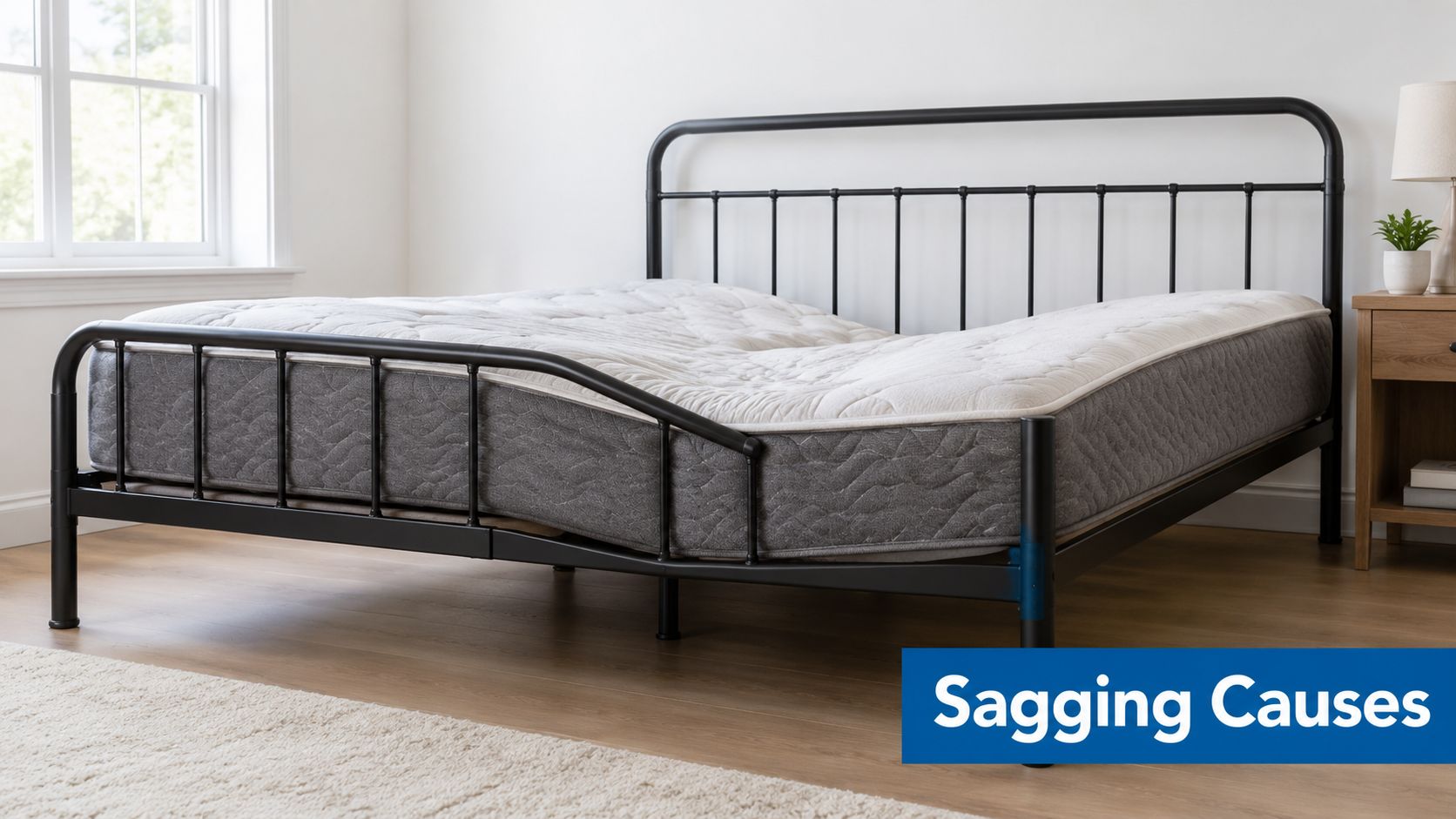
You set up a new black metal queen frame, tighten every bolt, drop in the mattress, and the bed feels fine. A few months later, the center feels softer, the edge starts creaking, and the mattress no longer sits flat. That failure pattern is common with metal queen beds because sagging usually starts in the support system, not at the outer corners.
Because the load is carried across the full deck, deflection at the center rail and slat gaps matters more than perimeter strength. A frame can look rigid during assembly and still let the middle work up and down every night. Once that happens, the mattress absorbs the movement first, then the joints start to loosen.
Where the failure starts
I usually find the same trouble spots. Slats sit too far apart, so the mattress bows between them. A center rail is present, but its support foot hangs slightly above the floor or lands unevenly, which leaves the rail carrying load without real transfer. Then the fasteners begin to move, and every small shift adds noise and wear at the joints.
The material history helps explain why this happens. Metal bedroom furniture developed around lighter, scalable construction rather than heavy solid sections. Tubular steel gained traction in the early 1920s because it offered strength with lower weight and a cleaner look, and Simmons introduced a steel bedroom suite in 1923. This history of metal bedroom furniture gives useful context for why many current frames still rely on formed or tubular members.
Practical rule: Do not judge a frame by the first night. Check slat spacing, center support contact, and joint tightness before you trust its long-term stability.
Understanding Queen Size Bed Metal Dimensions
“Queen” identifies the intended mattress category, not the frame's outside dimensions. The U.S. mattress standard is 60 by 80 inches, while a frame needs an interior opening that is slightly larger so the mattress can be inserted and manufactured tolerances can be accommodated. Queen mattress dimensions and frame planning explain why the mattress footprint and the frame footprint must be treated as separate measurements.
Slim metal designs may provide an interior or exterior span around 61 to 62 inches by 81 to 84 inches, while frames with larger perimeter rails may occupy approximately 62 to 65 inches by 82 to 85 inches. Standard bed-frame dimensions show the practical range shoppers need to plan around. Headboards, footboards, brackets, legs, and assembly clearances can make the outside footprint larger still.
Measure the opening, not the label
A tight opening can force the mattress against the rails and place unnecessary stress on the frame. An oversized opening permits lateral movement, which can wear the mattress edges and create the impression of poor support.
Before ordering, record these measurements:
- Mattress width and length: Measure the actual mattress, rather than assuming the label is exact.
- Frame interior width and length: Measure the usable opening between the rails.
- Outside footprint: Use the outermost rails, legs, and boards when planning room placement.
- Added projections: Account for headboards, footboards, and walking clearance separately.
International shoppers need extra care because “queen” isn't universal. A U.S. queen, a UK size, an EU 160 by 200 centimeter format, and an Australian equivalent can differ. This overview of regional bed-frame sizes recommends measuring the mattress and comparing it directly with the seller's stated inside dimensions.
Platform, Slatted, and Box-Spring-Compatible Metal Frames
The frame type determines where the mattress load goes. A platform frame supports the mattress directly on a solid deck or closely spaced slats. A slatted frame uses separate rails or bars, which can improve ventilation but creates a spacing risk. A box-spring-compatible frame supports a separate foundation, so the foundation becomes a major part of the load path.
| Frame type | What works | Main failure point |
|---|---|---|
| Platform | Direct support with no separate box spring | Gaps, flexing, or an unsupported center span |
| Slatted | Ventilation and a lighter construction | Openings that are too wide for the mattress |
| Box-spring-compatible | A foundation distributes load above the rails | A weak foundation or missing center support |
For foam and latex mattresses, open space between adjacent slats should generally be no more than about 2.5 to 3 inches. The relevant measurement is the clear gap, not the distance from one slat center to the next. Guidance on slat spacing for foam and latex makes clear why a strong metal frame can still provide inadequate mattress support.
Match the support to the mattress
A traditional foundation may suit a box-spring-compatible frame, but placing a flexible foam mattress over widely spaced bars creates a different result. The material can press downward between openings, concentrating stress and potentially creating warranty issues. Check the mattress maker's foundation requirements first, especially if they specify a tighter spacing limit.
A platform deck can work well when its surface remains level and its center support reaches the floor. Slatted construction can work just as well when the slats stay fixed and the gaps meet the mattress requirements. For a useful second opinion on construction details and expert bed frame advice, compare the frame's specifications with the mattress manufacturer's rules, not just the product photograph.
If you're considering a separate foundation, review whether a box spring works with a metal bed frame before buying. The key question isn't whether the parts can be placed together. It's whether the foundation transfers weight evenly and remains compatible with the mattress.
How to Measure and Fit Your Queen Metal Bed Frame
Start with the mattress on a flat surface. Measure its width, length, and thickness, then write those figures down before shopping. The mattress dimensions give you the reference point, while the frame's interior opening tells you whether the parts will work together.
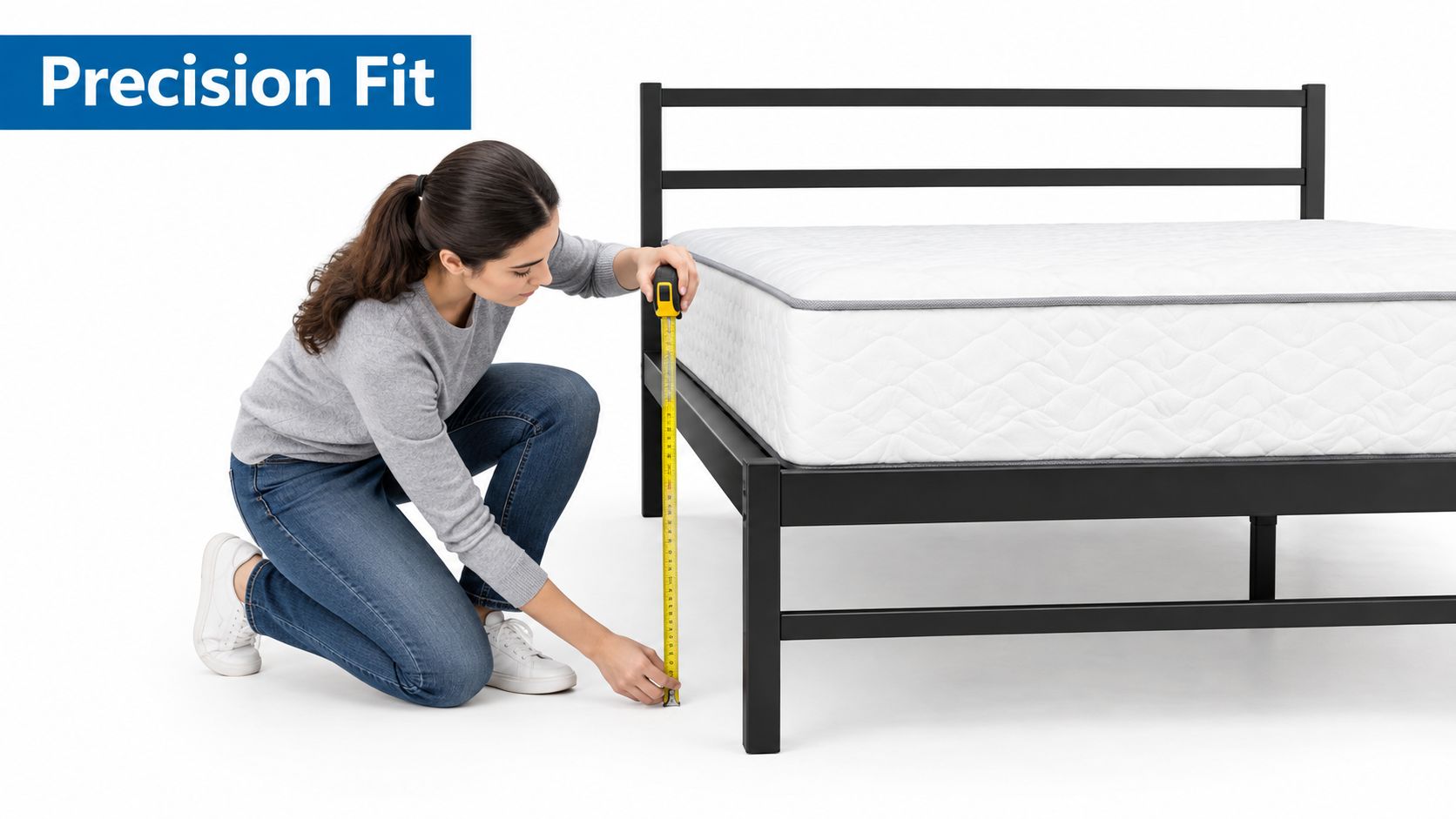
Use this inspection sequence
- Check the room: Measure the space for the frame's outside footprint, then account for headboard or footboard projections and walking paths. A frame that fits the mattress may still crowd the room.
- Check the opening: Compare the frame's stated interior width and length with your measured mattress. Look for a small, intentional clearance rather than a forced fit or a large gap.
- Check the deck: Measure clear slat gaps at several locations, including near the middle. Slats can shift, and the center area often receives substantial load.
- Check the center rail: Confirm that it runs straight, is securely fastened, and has feet making firm contact with the floor. A floating or loosely adjusted foot can't transfer weight properly.
- Check the mattress height: Compare the mattress thickness with the frame and foundation combination, especially where guardrails or other safety clearances apply.
For another reference on planning the outer footprint, consult this queen bed frame guide at Woodstock Furniture. If the existing support deck is sound but the slats don't suit your mattress, a queen bunkie board can create a more consistent layer between the mattress and the frame.
Load Capacity and Support Engineering for Metal Beds
A capacity number describes only part of the structure. One tested metal platform frame is listed at 900 pounds, and its test involved 1,350 pounds for 72 hours before inspection for deformation or loosened joints. The discussion of tested bed-frame capacity illustrates why the headline rating must be read as total static weight, not occupant weight alone.
The total includes the mattress, bedding, foundation components, and people. Movement also matters. Sitting down, turning, or transferring at the edge creates changing forces that a stationary, evenly distributed load doesn't reproduce.
Follow the complete load path
Inspect the parts in order:
- Mattress and foundation: Confirm that the combination is approved for direct support or for a foundation.
- Slats and deck: Look for bowed, displaced, or excessively flexible pieces.
- Side rails and center beam: Check for deflection across the broad span.
- Legs and feet: Make sure each support reaches the floor firmly.
- Fasteners and joints: Look for looseness, rocking, or elongated connection points.
A queen frame's center rail is especially important because the 80-inch mattress length creates a substantial supported surface. The rail section, joint rigidity, fastener condition, and leg placement all affect whether the load reaches the floor without excessive movement. This bed-frame support guidance offers a practical way to inspect slats and reinforcement rather than relying on a product-page rating.
Noise is diagnostic. Padding can reduce a squeak without correcting a loose joint or a flexing rail. Retighten accessible hardware after initial use, then recheck the frame if rocking, center deflection, or repeated noise returns.
Fixing Sagging Metal Bed Frames Without Replacement
You lie down, the middle dips, and the first instinct is to shop for a new mattress. In practice, I check the frame first. A queen metal bed often fails at the support layer long before the mattress is worn out, and replacing the mattress alone leaves the same weak span underneath it.
Start with the frame unloaded. Tighten every rail bolt and locking point, then adjust each center-support foot until it sits flat on the floor without wobble. After that, lay a straightedge across the slats or support bars and look for visible low spots, twisted pieces, or a center span that drops under hand pressure. This step matters because a frame can feel solid at the corners while still letting the middle sag.
If the joints are tight and the rails are straight, correct the deck before replacing parts. Reset any shifted slats, close inconsistent gaps, and check that the mattress is being supported evenly from side to side. When the frame itself is intact but the sleep surface still bridges too much open space, add a properly sized support board between the mattress and the existing frame.
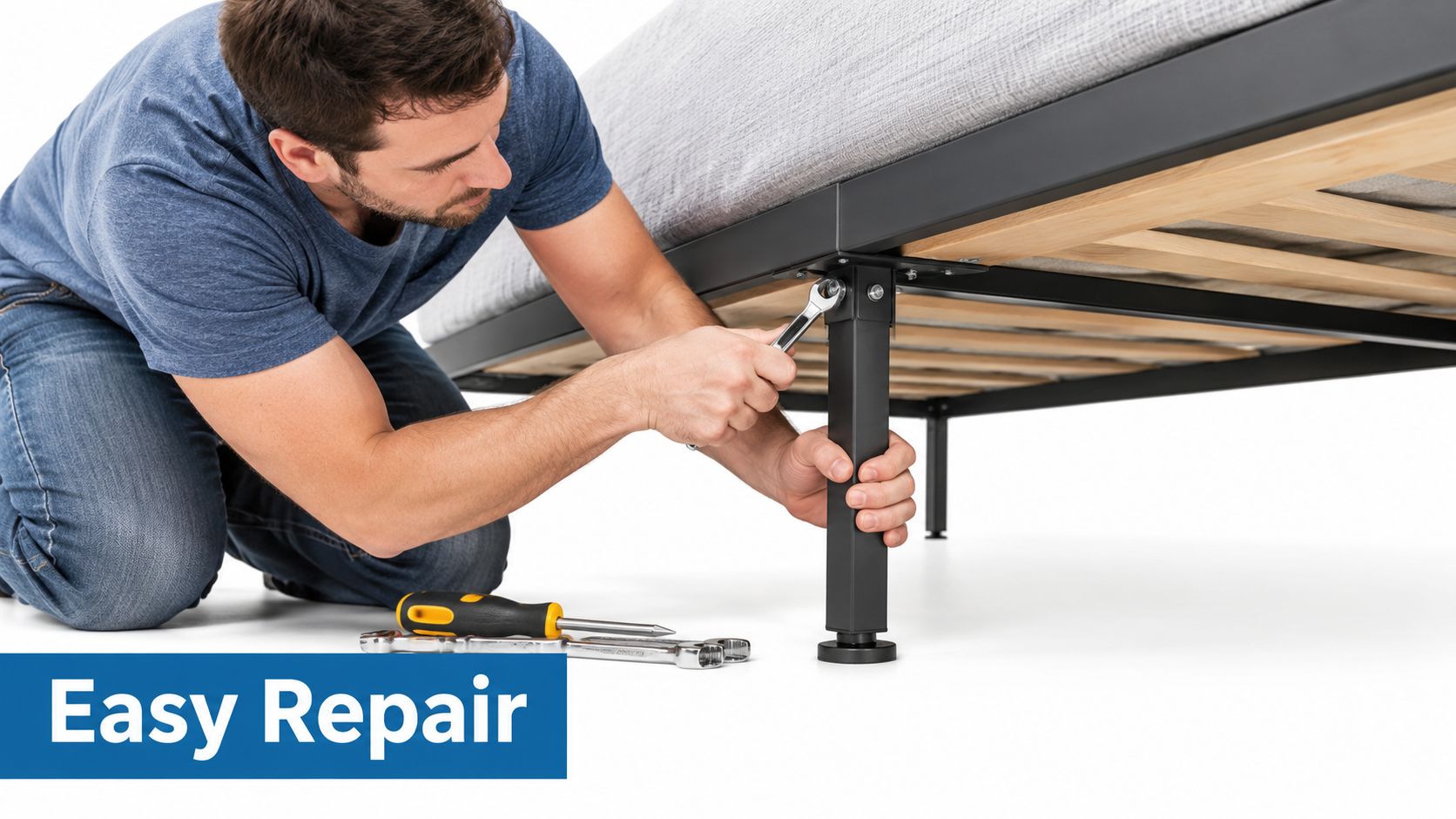
Reinforce the support layer
A support board spreads load across the deck and reduces how much individual slats telegraph their flex into the mattress. It does not fix a cracked weld, a rail that is permanently bent, or a center leg that still hangs above the floor. Those are frame repairs, not surface corrections.
Meliusly's BetterBunkie products are one option for adding that intermediate support layer on metal slats or similar frame layouts. Their bed-support products should be matched to the frame opening, the mattress type, and the manufacturer's compatibility rules.
A support board works when the weak point is the interface between the mattress and the frame. It will not correct damaged steel or a missing load path to the floor.
The repair order is simple and cost-effective. Stabilize the frame, confirm full floor contact at the center supports, check the deck with a straightedge, then reinforce only if flex remains. That sequence fixes the hidden support problem instead of masking it.
Choosing the Right Metal Queen Bed for Your Space
Choose the frame around the mattress and room, not around the word “queen” on the product page. Start with the mattress material, then determine whether it needs direct platform support, controlled slat spacing, or a separate foundation. Foam and latex need particular attention to clear gaps, while a box-spring-compatible frame depends on the condition and design of the foundation above it.
Room fit comes next. Plan with the frame's outside footprint, not the 60-by-80-inch mattress alone. Rails, legs, headboards, footboards, and assembly clearances all consume space, so a frame that technically fits the mattress can still restrict movement around the bed.
A practical buying checklist
- Verify the inside opening: Compare the frame's interior dimensions with the actual mattress measurements.
- Inspect the support deck: Measure clear slat gaps in the middle and along the sides.
- Confirm center support: Look for a straight center rail and feet that contact the floor.
- Define the load: Include mattress, bedding, foundation, and occupants when reading capacity information.
- Match the foundation: Follow the mattress maker's requirements instead of assuming every platform is interchangeable.
- Plan the room: Measure the outside rails and any headboard or footboard projection.
- Consider use intensity: A frequently used primary bed needs closer inspection than an occasional guest bed.
A lower price can be reasonable when the frame has a sound load path and measurable specifications. It isn't a bargain if vague dimensions, wide gaps, or a floating center rail force you to repair the foundation immediately.
Extending the Life of Your Queen Metal Bed Frame
You usually hear the problem at night first. A slight click at the corner, a bit of sway when you sit down, then a shallow dip that keeps getting worse. On a queen metal frame, that wear pattern usually starts at the joints and center support, not in the mattress itself.
Long service life comes from keeping the load path consistent. Tighten accessible bolts and screws after the first few weeks of use, then check them again on a regular schedule. Metal frames often loosen slightly as the finish beds in and the frame settles under weight. On hard floors, felt pads under center feet can help those feet stay in full contact instead of skittering and unloading part of the rail.
When the mattress starts shifting, correct the side-to-side clearance before it chews up the cover or stresses the edge. When the middle begins to dip, inspect the center rail, feet, and attachment points before blaming the mattress. If the support deck has gaps that are too wide for the mattress type, add a compatible support layer or replace the deck to match the manufacturer's requirements. In practice, the failure point is often the connection between steel, slats, and mattress.
Meliusly offers furniture support products across common problem areas, including sofa supports, sleeper sofa support boards, bunkie boards, and bed slats. The useful principle is simple. Find where the load escapes, reinforce that spot, and keep the rest of the frame in service.
After any move, retighten the frame and recheck for rocking or squeaks. Small corrections made early usually prevent larger sagging repairs later.