

Best Sofa Bed for Small Apartment Spaces
Posted by Meliusly
You measure the wall, check the sofa's closed dimensions, and feel confident that you've found a compact solution. Then bedtime arrives. The coffee table has nowhere to go, the bathroom door won't open fully, and the mattress puts a metal bar directly under your back. A sofa bed for a small apartment only works when you plan for both versions of the furniture, the comfortable sofa you use during the day and the full sleeping surface that takes over the room at night.
The most reliable approach combines three decisions: choose a mechanism that matches your available floor, evaluate the mattress within its mechanical limits, and solve support problems before sagging becomes permanent. A compact frame helps, but open footprint, circulation, and structural support determine whether the purchase remains useful after the novelty wears off.
The Reality of Sleeping in a Small Apartment
At 7 p.m., your studio may look like a living room. By 10 p.m., it needs to function as a bedroom without becoming an obstacle course. You move the coffee table toward the kitchen, shift a lamp away from the sofa, pull the bed forward, and discover that the only clear route to the bathroom has disappeared. The furniture hasn't become larger, but its job has changed, and the room must absorb that change every night.
That daily transformation creates two separate design tests. In sofa mode, the piece needs to support sitting, lounging, storage, and ordinary circulation. In bed mode, it needs enough room for the sleeping surface, safe access, and a mattress that doesn't punish the person using it. A showroom display usually shows only the first test.
Practical rule: Measure the room with the sofa fully opened, not just the wall where the closed sofa will sit.
This type of multifunctional furniture has a long history because limited living space has always demanded flexible solutions. Leonard C. Bailey received a patent for a folding bed in July 1899, Bernard Castro introduced a modern convertible couch in 1904, and Castro's 1931 business launch helped popularize the modern sofa bed. Historical accounts say he ultimately sold more than 5 million sofa beds. Those milestones are documented in this history of sofa beds, and they show that seating that converts for sleeping isn't a passing apartment trend. It's a long-running response to rooms that need to serve more than one purpose.
The practical lesson is simple. Don't shop by appearance alone. Mark the sofa's closed position, its deployed bed position, the route to essential doors, and the space needed to move around it. If the opened bed makes the room unsafe or unusable, a smaller sofa won't necessarily fix the problem. A different mechanism, sleeping orientation, or hybrid furniture type may be the better answer.
Choosing the Right Mechanism and Dimensions
A sofa bed can fit against the wall by day and still make the room unusable at night. The mechanism determines how much of the apartment becomes part of the bed, so choose it by the open footprint, not the closed silhouette.
A pull-out sofa slides a mattress forward from beneath the seat and commonly needs about 60 to 80 cm of clear floor in front. A click-clack folds its backrest down and usually needs about 20 to 30 cm, keeping the conversion closer to the original sofa position. These ranges are outlined in this studio sofa-bed sizing guide.
Pull-out versus click-clack
A traditional pull-out offers a more distinct mattress and familiar bed shape. The trade-off is nightly setup. A coffee table, ottoman, or floor lamp may need to move before the mattress can extend, and the same clearance must remain available for the room's circulation.
A click-clack suits a narrow room because its conversion zone is shorter. Its sleeping surface depends more directly on the sofa seat, backrest, hinges, and frame, so inspect the folded construction rather than judging comfort from the upholstery alone.
For studio-friendly models, allow roughly 95 cm to 1.05 m for the closed depth. Open sleeping lengths commonly fall around 1.9 to 2.0 m. Use the sleeper sofa dimensions guide to compare the sofa's closed and deployed measurements, then confirm every figure on the product specification sheet. The usable footprint includes the bed, access to it, and the route around it.
A two-seater preserves more wall space and leaves greater flexibility for storage or a work area. A three-seater gives a wider seating base but can overwhelm a short wall. These comparison ranges help establish the starting point:
| Configuration | Closed Width | Open Length |
|---|---|---|
| 2-seater sofa bed | Approximately 140 to 180 cm | Approximately 190 to 200 cm |
| 3-seater sofa bed | Approximately 180 to 200 cm | Approximately 190 to 200 cm |
The sofa bed size guide from Dreams lists comparable configuration ranges. A sofa bed dimensions guide describes chair or single sleepers as roughly 30 to 45 inches wide closed and 70 to 85 inches open, twin models as about 45 to 58 inches wide closed and 72 to 85 inches open, and full models as about 58 to 72 inches wide closed and 78 to 90 inches open.
Before ordering, measure the sofa wall, open length, doorways, hallway turns, and the diagonal delivery route. Also mark the open footprint on the floor with tape. That test reveals whether the furniture can change layout nightly without blocking doors, storage, or the only practical walking path.
Navigating Mattress Thickness and Foam Density
A sofa bed in a small apartment changes function every night. Its mattress must support sleep, then fold, pivot, or nest inside a restricted frame without blocking the mechanism. Comfort depends on that fit as much as on the foam itself.
Most sofa-bed mechanisms accept mattresses about 4 to 5 inches thick. Adding thickness can reduce folding clearance, stop the mechanism from closing, or place excessive pressure on moving parts. Check the manufacturer's allowable clearance before replacing the mattress. The sleeper sofa mattress replacement guidance explains why the original mattress dimensions matter.
Thickness is only half the decision
A thin mattress can still work, but it contains less material to spread pressure across the sleeper. As it compresses, the frame, support bars, seams, and foam construction become easier to feel. A topper can soften the surface, although many sofa beds require it to be removed before closing. In a small apartment, that creates a second problem: finding a dry, accessible storage spot. This queen sleeper sofa mattress topper guide explains the clearance and storage trade-offs before you commit to one.
Foam density offers a clearer durability clue than the label “memory foam.” Higher-quality sleeper mattress support cores typically use densities around 1.8 to 2.5 lb/ft³, while lower-density foam compresses faster with repeated guest use. Over time, that can produce pressure points, uneven support, and dips that become increasingly noticeable. The density ranges and related replacement considerations are covered in the guidance linked above.
Check these details before ordering:
- Actual thickness: Confirm the mattress fits the folding mechanism. Greater thickness does not automatically improve comfort.
- Support-core density: Request the density range rather than relying on broad terms such as “premium” or “memory foam.”
- Frame clearance: Verify that the mattress, protector, and any topper can fold without binding at hinges or joints.
Twin, full, and queen labels identify the sleeping-area category only. They do not confirm folding clearance, long-term support, or how strongly the frame will be felt beneath the foam. For a small apartment, choose the mattress that stays comfortable through repeated conversions and leaves the sofa bed ready to close without forcing the room into a permanent sleeping layout.
Fixing Sagging and Metal Bars with Support Boards
The familiar “bar in the back” problem usually isn't solved by adding a thick bedroom mattress. A sleeper sofa's thin mattress rests over a folding frame, and the metal bars can create concentrated pressure points when the mattress compresses. If the support beneath the mattress flexes or sags, the foam has to bridge those weak areas night after night.
A support board creates a more continuous layer between the mechanism and mattress. It spreads body weight across a broader surface, reduces the sharp sensation of individual bars, and helps limit the mattress from sinking into the gaps between frame members. It won't turn an unsuitable sofa bed into a permanent bed, but it can address the structural reason the mattress feels uneven.

A practical support-board installation
Start with the mattress removed and the mechanism fully opened. Inspect the frame for bent components, loose fasteners, broken welds, or anything that could damage a board or mattress. A support board is designed to improve weight distribution, not to repair a mechanically unsafe frame.
Next, place the board across the sleeping area so it bridges the underlying bars and sits flat. Check that it doesn't obstruct hinges, folding joints, locking points, or the frame's closing path. Close the mechanism slowly without the mattress first, then reopen it and inspect for contact. Never force the sofa bed shut.
For a foldable option that can be stored when the sofa returns to seating mode, compare the Meliusly SleeperSaver support board. Meliusly serves furniture owners looking to extend the useful life of existing sofas, and its sleeper-sofa support products are intended to place a firmer, more even layer over the metal support structure.
Pair support with mattress care
Once the board sits correctly, replace the mattress and test the surface across its full length. Lie in several positions, especially where you previously felt a bar or dip. If discomfort remains, inspect the mattress for permanent compression and confirm that the board hasn't shifted during conversion.
Support boards work best when they're treated as part of a system. The mattress still needs suitable thickness and foam construction, the frame must remain aligned, and the mechanism needs gentle operation. A board can reduce concentrated loading, but it can't compensate for a damaged hinge or a mattress that has already lost its shape.
Planning Clearances and Space-Saving Layouts
A sofa bed can fit against a wall and still make the apartment fail at night. The decisive measurement is the open footprint, which includes the deployed bed and the circulation space around it. A traditional pull-out queen can require about 85 to 90 inches of total depth clearance when opened, and Koala's small-space sofa-bed guidance recommends leaving 18 to 24 inches of walking space around the bed in its open state.
Map the room before you shop
Use painter's tape to mark the sofa's closed footprint first. Then extend the tape to show the fully opened bed, including the head and foot positions. Add the walking zone around the bed and mark doors that must remain usable, particularly the bathroom, entry, bedroom, and wardrobe doors.
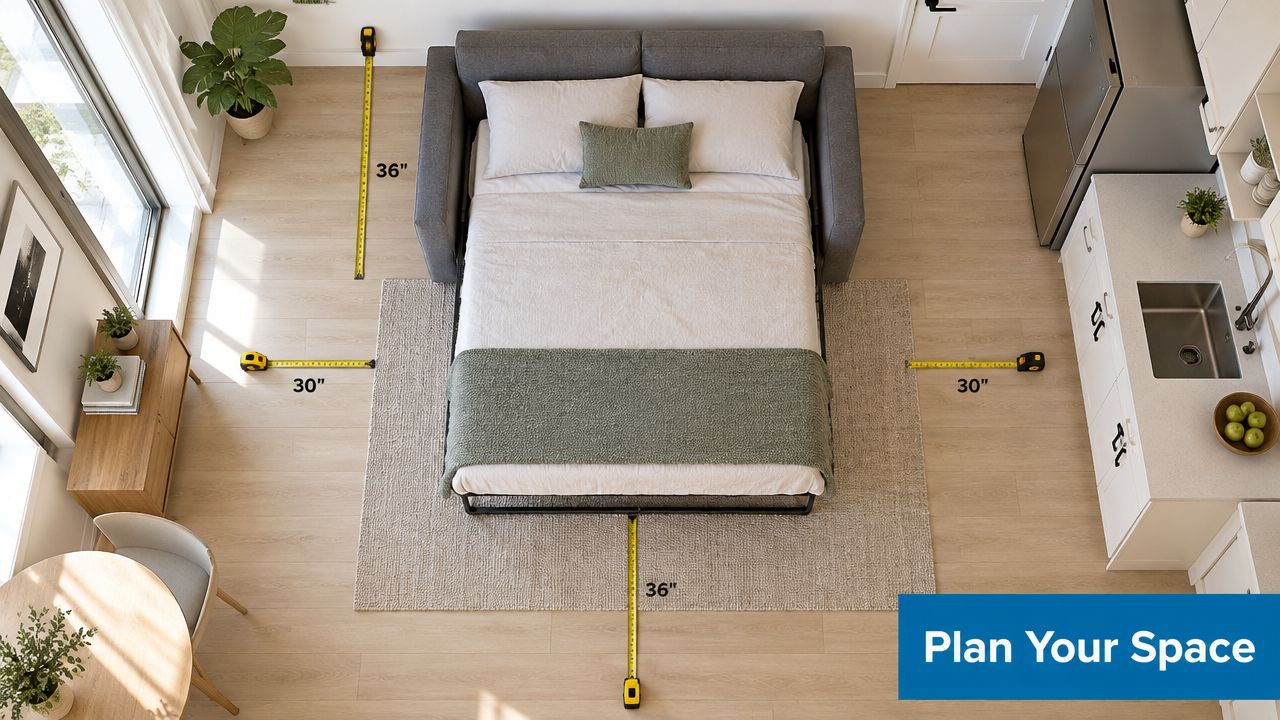
Stand inside the taped outline at different times of day. If the bed blocks the route to the kitchen, traps a table against the wall, or leaves you stepping over furniture in the dark, the layout isn't ready. You may need to rotate the sofa, choose a click-clack model, or use a narrower sleeping configuration.
Keep the conversion zone lightweight
A small apartment benefits from furniture that moves easily. Choose a light coffee table, nesting tables, stools, or an ottoman that can shift to a planned parking spot. Avoid anchoring heavy storage pieces directly in front of the sleeper unless you're prepared to clear them every night.
Think about the room as two layouts, not one. Daytime furniture should support normal living without making the nightly reset exhausting. Nighttime furniture should provide a clear route from the bed to the bathroom and entry without requiring you to move around sharp corners or unstable objects.
The delivery route deserves its own check. Measure the entry, hallway turns, stairwell, and elevator before ordering, then compare those measurements with the packaged sofa dimensions provided by the seller. A sofa that fits the floor plan but cannot reach the apartment isn't a practical purchase.
When to Consider Daybeds and Modular Alternatives
A traditional pull-out sofa bed makes sense when sleeping is occasional and seating is the room's primary function. It becomes less convincing when someone sleeps on it every night. Daily conversion creates a repetitive chore, and the hidden mechanism introduces more parts that must remain aligned and operational.
A daybed changes the priority. It presents a more permanent sleeping surface while still functioning as a sofa with cushions arranged along the back. In a studio, that can work well when the owner wants a dedicated bed but doesn't have room for a separate sofa and bed. The trade-off is visual and spatial. A daybed may read more like a bed during the day, and its fixed sleeping footprint can reduce flexibility.
Choose based on actual use
A modular sofa can suit households that need to change the room regularly. Sections may be rearranged for lounging, guests, or a different apartment layout, though the specific construction and support system must be checked before purchase. Modular demand is also part of the broader 2026 shift toward smaller-scale, low-profile, flexible seating, as described in current sofa and furniture trend coverage.
Ask yourself what the room must do most often:
- Occasional guests: A compact pull-out or click-clack can keep the sleeping function hidden.
- Frequent sleeping: A daybed or dedicated platform-style solution may be easier to live with.
- Changing layouts: A modular arrangement can adapt better than a one-piece mechanism-heavy sofa.
- Limited storage: A daybed avoids storing a separate bed frame, though bedding still needs a defined home.
Support strategy matters with every option. A daybed can use a more conventional foundation, while a sleeper sofa may need a board that bridges metal bars. A modular sofa may require inspection of the joining points and base support. The right choice isn't the one with the most functions. It's the one that creates the fewest daily compromises for how you use the apartment.
Maintaining Your Sofa Bed for Long-Term Comfort
Small furniture works harder because every piece performs several jobs. A sofa bed opens, closes, carries sitting loads, supports sleeping weight, and often serves as the room's main seating. A simple maintenance routine protects both comfort and the mechanism.
Inspect the moving structure
Open the bed fully and look over the hinges, legs, locking points, and fasteners. Tighten loose hardware according to the manufacturer's instructions, but don't overtighten parts that need to pivot. If a hinge squeaks, use only a lubricant suitable for the mechanism and keep it away from upholstery and the mattress.
Operate the frame slowly. Pull evenly, keep bedding clear of moving joints, and stop if the mechanism catches. A sofa bed that suddenly requires force may have a misaligned component or obstruction. Continuing to force it can turn a small adjustment into a larger repair.
Protect the sleeping surface
Rotate the mattress when its construction allows it, so the same area doesn't receive every load. Use a washable protector, allow moisture to dissipate after guests leave, and vacuum the sofa and mattress area as part of ordinary fabric care. Keep the mattress within the mechanism's approved thickness, especially if you add a topper.
Check the support board each time you notice a new dip or pressure point. It should remain flat, correctly positioned, and clear of hinges and closing parts. Remove it and inspect the frame if the board shifts, rubs, or develops damage. Owners who also maintain other upholstered furniture can use these tips to avoid coverage gaps when planning broader furniture protection and moving care.
A good routine also includes the room around the sofa. Keep the conversion path free of clutter, store the coffee table where it can be moved without lifting strain, and avoid piling heavy items on the folded mattress. Spatial discipline reduces the number of awkward conversions, while structural support reduces the stress placed on the mattress during each use.
With the right open-footprint plan, suitable mattress density, and correctly fitted support, a sofa bed can remain a useful part of a small apartment instead of becoming a replacement project.
Meliusly offers practical support solutions for sagging sofas and sleeper sofa mattresses, including boards that help bridge metal bars and distribute weight more evenly. Visit Meliusly to choose a support approach that fits your sofa bed and extend the comfort of the furniture you already own.