

Hotel Sleeper Sofa: The Complete Guide to Better Sleep
Posted by Meliusly
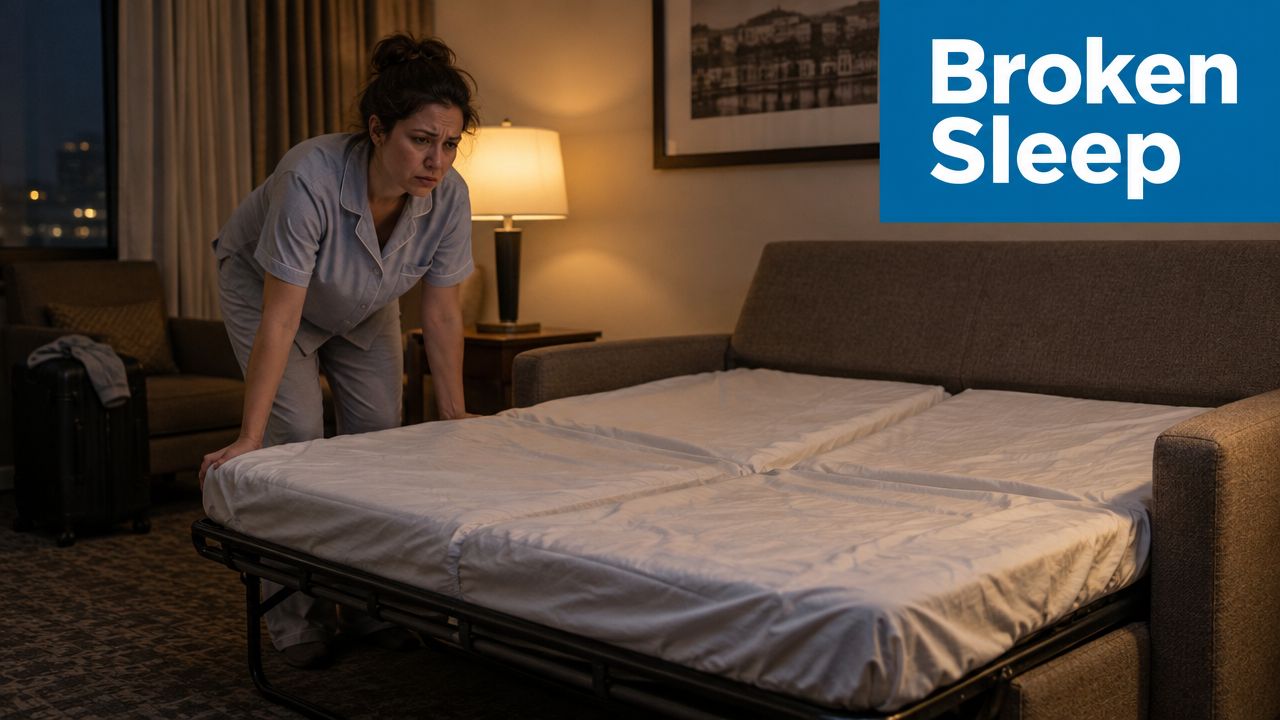
A guest checks into a suite expecting a second sleeping surface. At midnight, they pull out the hotel sleeper sofa, discover a hard support bar under a thin mattress, and spend the night shifting from one painful position to another. By morning, the room has a poor review, housekeeping has another complaint to document, and the property has a furniture problem that could have been identified during a routine inspection.
For hotel GMs, extended-stay operators, and Airbnb hosts, the sleeper sofa isn't decorative furniture. It's part of the room's occupancy promise. If the listing says the room sleeps additional guests, the sleeping surface must feel stable, clean, and credible. A practical way to improve the wider room experience is to review details such as how to create a hotel style bed at home, then apply the same attention to the pull-out bed hidden inside the sofa.
Why the Hotel Sleeper Sofa Matters More Than You Think
A hotel sleeper sofa sits in a strange operational category. Staff often treat it like upholstery, while guests treat it like a bed. That mismatch creates avoidable failures. The sofa may look acceptable when closed, but the guest judges it after deployment, when the mattress, frame, hinge points, and support deck carry the full burden of the room's promise.
The category itself has a long history of space-saving design. Convertible bed concepts date back to ancient Egypt, and the first U.S. patent for a double-duty bed appeared in 1885, commonly associated with Sarah E. Goode's folding bed that fit into a writing desk. Modern demand has moved far beyond compact homes. Independent industry reporting estimates the global sofa-bed market at $14.8 billion in 2025, with a projection of $25.6 billion by 2034, while hospitality procurement is estimated at about 4.8 million units annually in 2025 (DataIntelo's sofa-bed market report).
The hidden trust problem
The most expensive failure isn't always a broken mechanism. It can be a room description that promises a sleeper sofa but delivers a chair, a narrow surface, or a mattress with almost no usable cushioning. Guest reports describe sofa beds that feel like a hard board with roughly 1 inch of foam, as well as reservations confirmed with a sleeper sofa that turned out to have a chair instead (guest reports on Tripadvisor).
That gap between the listing and the physical experience damages trust quickly. Families, group travelers, and extended-stay guests often book the room specifically because the second sleeping surface matters. A hotel sleeper sofa that fails those guests can turn a capacity feature into a complaint generator.
Sagging is often a support-layer problem
Operators frequently assume the entire sofa needs replacement when guests report bar pressure or mid-bed sag. Sometimes the mechanism or frame is damaged. Often, the hardware remains intact and the problem sits between the mattress and the deck. Stretched webbing, gaps around crossbars, and thin foam allow body weight to concentrate in the wrong places.
Operator's rule: Inspect the support path before approving a full furniture replacement.
That approach protects the guest experience while giving the property a practical repair option. A support board can sometimes stabilize a serviceable sleeper sofa and defer capital spending, but it can't repair a failed mechanism or a collapsing frame.
What Actually Makes a Hotel Sleeper Sofa Different
A hotel-grade sleeper sofa isn't defined by appearance. It's defined by how each layer handles repeated deployment, cleaning, loading, and guest use. Evaluate the unit from the inside out.
Start with the frame
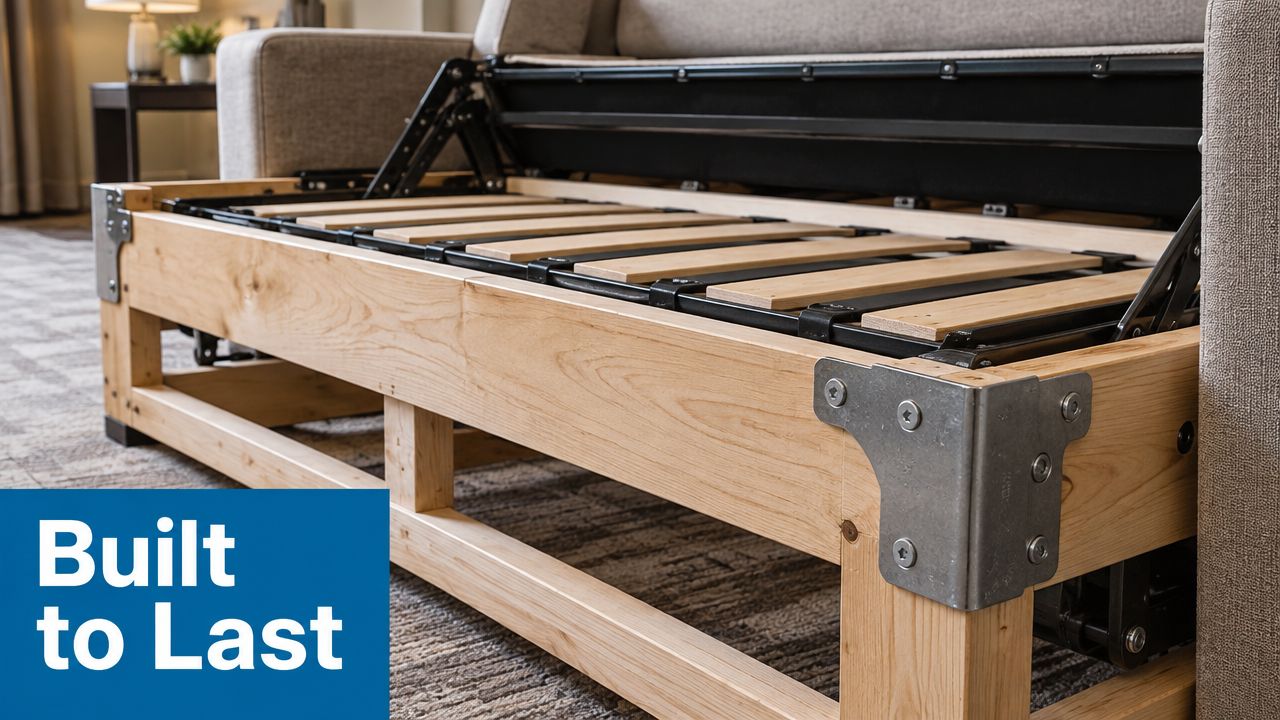
The frame carries the sofa when it's closed and the sleeper when it's open. Look for kiln-dried hardwood or reinforced steel, secure corner blocking, and doweled or otherwise substantial joinery. Particleboard and lightly stapled joints may work in low-use residential settings, but they're poor choices for rooms where guests repeatedly open the mechanism and sit on the front edge.
A rigid frame also helps the mattress maintain a predictable plane. If the frame twists, the folding linkage can misalign, the legs may land unevenly, and the mattress can develop pressure points that no topper will fully correct.
Then inspect the mechanism
The mechanism determines whether staff can open the bed smoothly and whether guests can close it without forcing the frame. Commercial pull-out and click-clack systems are built for materially heavier use than lightweight residential bi-fold mechanisms. Ask the supplier for a documented cycle rating rather than accepting “commercial grade” as a label.
The mechanism also sets the mattress limit. Guidance for sleeper-sofa replacement mattresses places the usual maximum around 4.5 to 5 inches, with premium frames sometimes accommodating 6 inches. A thicker mattress can stop the sofa from closing correctly or raise the cushions too far (sleeper-sofa mattress guidance).
Mattress and upholstery complete the system
The mattress must fold without binding while still distributing pressure. The upholstery needs to tolerate spills, cleaning, luggage contact, and repeated sitting. Commercial fabric specifications may include a high abrasion rating and stain-resistant treatment, but don't assume a particular fabric performance unless the vendor documents it.
A hotel sleeper sofa should also fit the room's broader service model. If the property already specifies compact equipment such as mini bar fridges for accommodation, use the same procurement discipline here. Confirm dimensions, service access, cleaning requirements, and replacement availability before installation.
The Specs That Decide Whether It Survives a Hotel
The difference between a residential sleeper sofa and a hotel sleeper sofa appears in the specifications, not in the showroom photograph. A buyer should ask for written ratings covering load, cycles, mattress compatibility, frame construction, suspension, and safety hardware.
One important constraint is mattress geometry. Sleeper mattress widths are typically 8 inches narrower than the mechanism's mounting width. Common listed mattress sizes include Twin at 36 by 72 inches, Full at 54 by 72 inches, Queen at 60 by 72 inches, and King at 64 by 72 inches (sleeper mechanism sizing guidance). Measure the mattress and mechanism separately. A width mismatch can interfere with deployment and increase wear at hinges and linkage points.
| Specification | Residential Grade | Hotel or Commercial Grade |
|---|---|---|
| Load rating | Often specified for lighter household use | Request a documented commercial rating |
| Mechanism cycles | Lower-use design | Request a substantially higher cycle rating |
| Mattress profile | Must fit the residential cavity | Commonly specified around 4.5 to 5 inches |
| Frame joinery | May rely on staples or lighter fasteners | Prefer reinforced joints and corner blocking |
| Suspension | Basic webbing or springs | Specify support designed for repeated occupancy |
| Safety | Standard consumer hardware | Locking legs and anti-tip protection should be evaluated |
The table deliberately avoids treating an unverified label as proof. Suppliers use “hotel grade” inconsistently, so procurement staff should request test documentation, warranty terms, replacement parts, and installation requirements.
Read the failure mode behind each number
A load rating predicts how the frame responds when guests sit on the edge or two people use the bed. A cycle rating predicts whether the mechanism will tolerate repeated opening and closing. Mattress thickness predicts whether the bed will close without binding. Joinery predicts whether the sofa stays square after ongoing movement.
Clearance matters just as much as the sofa's closed dimensions. A queen sleeper commonly needs about 80 to 90 inches of open depth, and another practical estimate uses the mattress length plus roughly 15 inches, before adding walking space (commercial hotel sofa-bed clearance guidance). Review sleeper sofa dimensions against the actual room layout, including wall offsets, tables, luggage benches, and the path guests need to reach the bathroom.
Choosing the Right Sleeper Mattress Type
The mattress that feels impressive in a showroom may be the wrong mattress for a hotel sleeper sofa. Hospitality buyers need to balance foldability, pressure distribution, edge stability, cleaning, and replacement logistics. The mechanism always wins the thickness argument. If the mattress won't fold cleanly into the cavity, comfort improvements become operational failures.
| Mattress Type | Typical Thickness | Durability | Comfort Score | Replacement Cycle | Price Tier |
|---|---|---|---|---|---|
| Traditional innerspring | Mechanism-dependent | Moderate when properly supported | Familiar, but can transfer bar pressure | Occupancy-dependent | Lower to mid |
| Memory foam | Mechanism-dependent | Variable under repeated compression | Initially comfortable, with good pressure relief | Inspect frequently in high-use rooms | Mid |
| Hybrid pocket-coil with foam | Mechanism-dependent | Stronger support potential | Balanced feel and edge support | Occupancy-dependent | Mid to high |
| Air-over-coil | Mechanism-dependent | More adjustable, with more components to service | Strong comfort potential when correctly set | Occupancy and component condition determine service | Higher |
Innerspring remains practical, but support is non-negotiable
Traditional innerspring designs fold predictably and can be easy to replace. Their weakness is pressure transfer. If a metal crossbar sits under the lumbar area, the guest will feel it through the mattress, especially when the support deck has gaps or the foam has compressed.
Memory foam can feel better initially because it masks small pressure points. It still must meet the mechanism's thickness limit, and the property should inspect it for permanent body impressions, edge collapse, and bottoming out. Do not select foam solely from a brief showroom test.
Hybrid and air-over-coil options trade cost for performance
Hybrid pocket-coil and foam designs can provide a more balanced surface, but their folded dimensions and weight must match the mechanism. Air-over-coil systems may offer a more adjustable sleep surface, yet they introduce additional components and service considerations. They make sense where guest comfort justifies the procurement and maintenance burden.
Selection rule: Match mattress construction and thickness to actual nightly occupancy patterns, not to the first impression created by a showroom bed.
A commercial replacement guide notes that 4.5-inch mattresses are often specified for hotel and commercial sleeper sofas because the thinner profile folds back into the frame without binding (commercial sofa-bed mattress options). Treat that profile as a compatibility starting point, then confirm the exact mechanism cavity before ordering.
How a Sleeper Sofa Support Board Fixes the Most Common Complaints
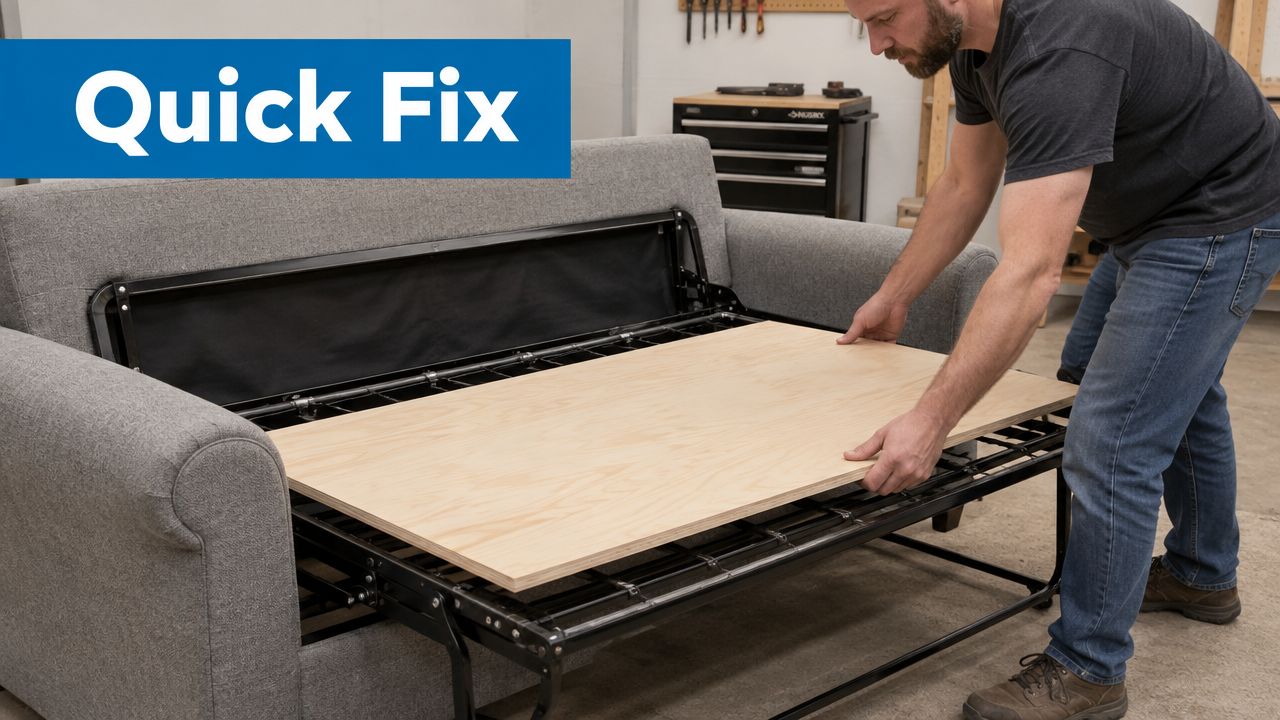
A sleeper sofa support board is a retrofit component, not a replacement mechanism. Its job is simple: create a more continuous load-bearing surface between the mattress and the folding deck. That can reduce the sensation of metal bars, limit mid-bed sag, and improve edge stability when the original hardware is still intact.
Install it as a measured retrofit
- Measure the deployed deck. Record the usable mattress footprint and identify every pivot, hinge, leg, and folding joint that must remain free.
- Choose a rigid board. Plywood or hardwood is typically selected to span the support gaps without adding excessive bulk. A common retrofit range is one-half to three-quarters of an inch, but the board must fit the specific mechanism.
- Cut mechanism clearance. Do not cover pivot points or create a contact surface that catches as the frame folds. Test the board through the full opening and closing path before placing the mattress on top.
- Place the board between deck and mattress. The board should distribute load across the available support area rather than forcing body weight directly onto one crossbar.
- Control movement. Use non-slip pads or another appropriate retention method so the board stays aligned during guest use and housekeeping turnover.
The improvement comes from load distribution. Without a continuous substrate, body weight can concentrate on a narrow bar or fall between webbing gaps. A properly fitted board spreads that load across a larger portion of the deck, reducing localized pressure and limiting the hammock effect created by stretched support materials.
Read the related sleeper sofa mattress support guidance before selecting a retrofit. Meliusly sells sleeper sofa support boards intended to cover steel bars and improve the support path, including options designed to remain in place during opening and closing.
Know when the board won't help
A board isn't a cure for a bent mechanism, broken locking leg, collapsed frame, or foam that has permanently bottomed out. Remove the unit from service when the hardware can't lock safely, the frame has separated, or the mattress has contamination or structural damage that cleaning can't resolve.
For an intact sleeper with premature sag, bar pressure, or an overly thin but still serviceable mattress, the retrofit is a rational first intervention. Document the condition before installation and check the opening path afterward.
Maintenance and Sanitation Practices for High-Turnover Rooms
A hotel sleeper sofa needs its own maintenance log. A housekeeping checklist can confirm that the room looks clean, but it won't tell engineering how many times the mechanism has opened, whether a pivot pin is rusting, or whether the support deck is beginning to deform.
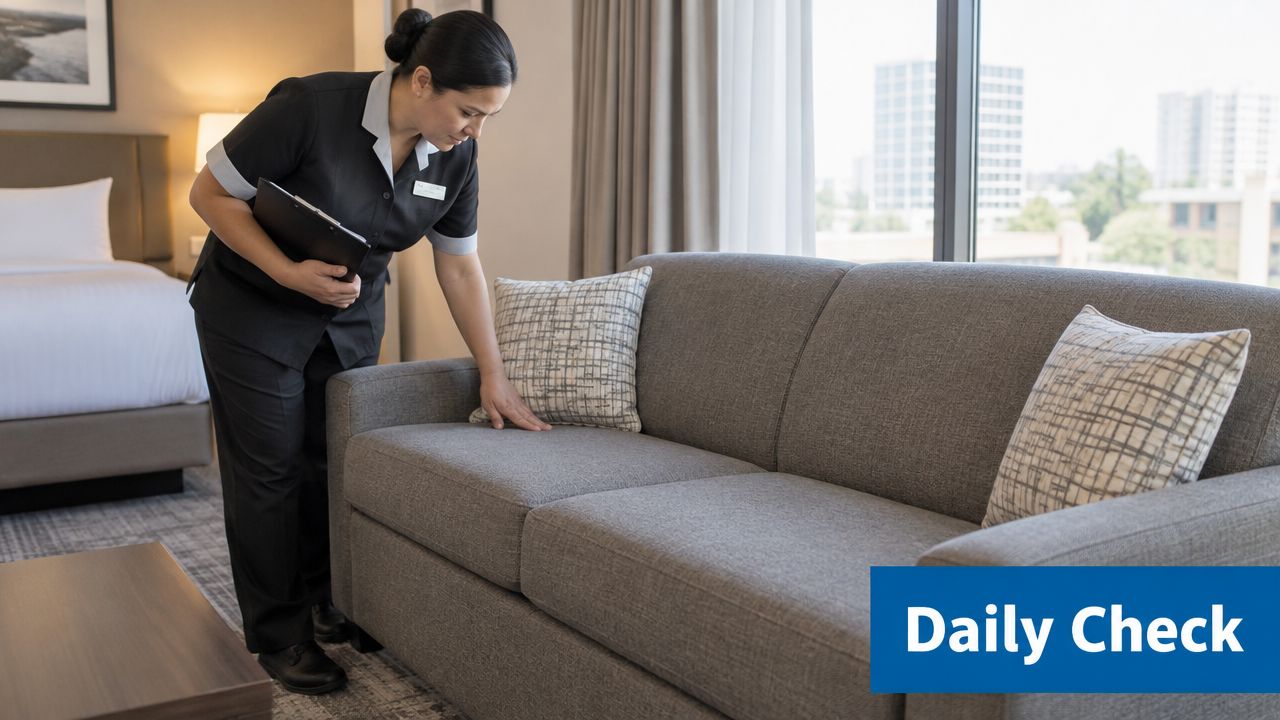
Start with a short visual check during every turnover. Staff should look for staining, pulled staples, exposed hardware, frayed webbing, displaced boards, damaged legs, and a mattress that no longer sits evenly. If the bed won't lock, a leg won't seat, or a sharp component is exposed, take the sleeper out of service immediately.
Clean according to the material
Vacuum the sofa, crevices, mattress surface, and mechanism-access areas routinely. Hospitality maintenance guidance recommends professional upholstery cleaning every 3 to 6 months, annual inspections, and flipping or rotating mattress components where the design allows (hotel furniture maintenance guidance).
Treat biological stains with an appropriate enzyme cleaner, then follow the mattress manufacturer's drying instructions. Low-moisture extraction is generally more suitable for innerspring construction than saturating the interior. Steam or UV-C treatment may be considered according to the property's sanitation protocol and equipment instructions, especially between longer stays.
Log cycles, not just dates
A room log should record:
- Deployment count: Estimate cycles from guest use or housekeeping tests.
- Hardware condition: Note pivot pins, locking legs, hinges, and crossbars.
- Mattress condition: Record staining, odor, body impressions, and bar transfer.
- Support changes: Document boards, pads, repairs, and replacement parts.
- Service decisions: Record when the unit was withdrawn, repaired, or returned.
A per-room sofa bed mattress protector can reduce direct contamination and simplify turnover, but it doesn't replace inspection. Operators who want to earn guest trust with cleaning should treat the hidden mattress and metal deck as part of the room's visible promise. Guests may not see the inspection log, but they'll feel its absence.
Procurement, ROI, and When to Replace Instead of Repair
A support retrofit is financially sensible only when the underlying sleeper remains structurally sound. The supplied market data shows why the decision deserves attention. Global hospitality furniture was estimated at $15.0 billion in 2025, with a projection of $23.3 billion by 2034, while North American hotel furniture, fixtures, and equipment was estimated at $21.65 billion in 2023, with projected growth at a 6.7% CAGR through 2030 (hospitality furniture market research). Furniture replacement is a recurring capital activity, not an occasional housekeeping expense.
The right calculation starts with room availability and guest trust, then moves to repair cost. Don't approve a board because it's cheaper in isolation. Approve it because it addresses the diagnosed failure while preserving a usable frame and mechanism.
| Cost Line Item | New Sleeper Sofa | Support Board Retrofit |
|---|---|---|
| Purchase decision | Full unit procurement | Targeted support intervention |
| Main benefit | Replaces worn components | Improves load distribution on serviceable units |
| Appropriate condition | Failed mechanism, frame, or upholstery | Bar pressure, premature sag, or deck gaps |
| Operational disruption | Delivery, removal, installation, room coordination | Shorter repair process, subject to fit and testing |
| Long-term limitation | New unit still needs inspection and cleaning | Doesn't correct damaged hardware or failed foam |
Replace when the system has failed
Order a replacement when the mechanism won't lock or deploy safely, the frame has structural separation, or upholstery damage exposes an unsanitary or unsafe surface. Replacement also makes sense when the mattress has permanently collapsed and the model can't accept a compatible replacement.
Repair or retrofit when the mechanism operates correctly, the frame remains square, and the complaint traces to support gaps or crossbar pressure. Before approving the work, compare the repair estimate with the cost of a complete unit, include removal and room downtime, and test the finished sleeper with the mattress installed.
The commercial decision is straightforward. A board can defer capital expenditure, but it shouldn't hide a safety issue or allow a property to continue advertising a sleeping surface that no longer meets guest expectations. Put every unit into one of three categories: retain and monitor, retrofit and verify, or replace and reset the room specification.
Putting It All Together for Your Property
Treat every hotel sleeper sofa as a small operational system. It has a frame, mechanism, mattress, support layer, sanitation requirement, guest-facing description, and capital plan. A housekeeping log alone can't manage all of those variables.
Use this priority checklist:
- Inspect every unit within 30 days. Deploy each sleeper and record the mattress condition, frame alignment, locking legs, crossbars, webbing, hinges, and upholstery.
- Test pressure points. Use a 5-pound test weight to identify areas where the mattress drops sharply onto a bar or deck gap. Record the location and photograph the support path.
- Install support boards selectively. Retrofit units with intact hardware and premature sag, then open and close each bed repeatedly during commissioning to confirm clearance.
- Track occupancy cycles. Document mattress wear and mechanism condition against actual guest use rather than relying only on calendar age.
- Set a 24-month review cadence. Reassess the room specification, guest complaints, repair history, and replacement availability.
- Pre-qualify two replacement vendors. Confirm dimensions, mattress compatibility, service parts, lead times, cleaning requirements, and installation support before an emergency failure.
A solid sleeper sofa is one of the least expensive ways to protect the credibility of a family suite or short-term rental listing. The cheapest five-star review a property can earn is often a guest discovering that the promised second bed feels solid.
Meliusly offers sofa supports and sleeper sofa support boards designed to improve load distribution and reduce discomfort from sagging or exposed support bars. Visit Meliusly to review practical furniture support options before replacing a sleeper sofa that may still have a serviceable frame and mechanism.
Share this post
- Tags: furniture support board, hospitality furniture, hotel sleeper sofa, sleeper sofa support, sofa bed maintenance