

Metal and Wood Bed Frames: Durability and Support Guide
Posted by Meliusly
Most buying advice treats a metal and wood bed as an automatic upgrade, combining steel strength with the warmth of timber. That sounds convincing in a showroom, but it misses the failures that appear after months of nightly use: squeaks at the rail connections, wobble at the headboard, loose fasteners, and a mattress that sags because the slats were never designed for its support requirements.
The visible materials matter less than the load path through the frame. A well-joined wooden bed can outperform a poorly connected hybrid, while a steel frame can remain straight yet become noisy when bolts loosen or a coating is damaged. The practical question isn't whether metal and wood are attractive together. It's whether the frame manages movement, distributes weight, supports the mattress continuously, and can be maintained without dismantling the entire bed.
The Reality of Mixed Material Bed Frames
A mixed-material bed frame creates more interfaces than an all-wood or all-metal design. A wooden side rail may attach to a metal headboard, steel brackets may carry a timber slat deck, and threaded fasteners may connect parts that expand, contract, or vibrate differently. Each interface can become a source of movement.
That's why a hybrid frame isn't automatically more durable. Joinery, center support, and maintenance determine long-term stability, not the marketing description on the product page. A frame can feel rigid during assembly and still develop noise once repeated loading works against an under-supported joint.
Where the trouble starts
Most complaints follow a familiar pattern:
- Squeaking: A bolt, bracket, slat, or rail shifts slightly under load and rubs against its neighboring surface.
- Wobbling: The side rails resist vertical weight but lack adequate lateral bracing, allowing the headboard or footboard to move.
- Mattress sagging: The frame remains intact, but widely spaced or unsupported slats let the mattress deflect between contact points.
- Progressive loosening: Repeated movement enlarges a fixing hole, reduces clamping force, or allows a connection to relax.
The frame's center support rail is particularly important on wider beds. Furniture design guidance recommends a center support rail for beds wider than 1400 mm, which includes king-size and larger formats, as summarized in this furniture design and repair guidance. Without that rail and suitable legs reaching the floor, the side rails carry loads they weren't designed to manage.
Practical rule: Judge a hybrid bed from underneath. Inspect the rail connections, center support, leg placement, and slat bearing surfaces before you judge the finish.
A reclaimed timber headboard or rail can add character, and buyers comparing finishes may benefit from reviewing these reclaimed wood options from Aureli Construction. The important point is to assess the actual condition and construction of the wood, not assume that a rustic appearance signals structural quality.
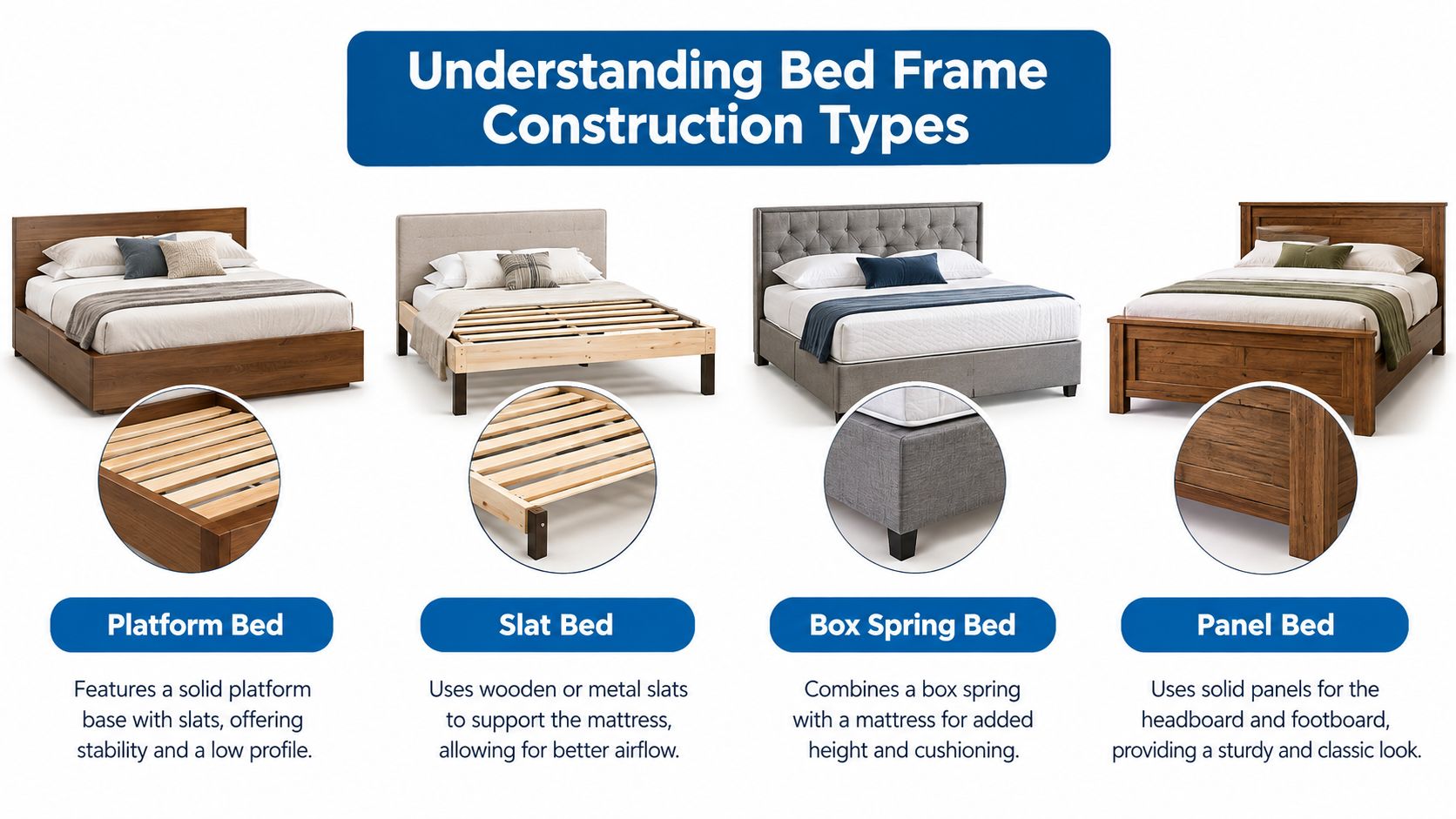
Understanding Bed Frame Construction Types
Before reinforcing a bed, identify how its components transfer weight. A mattress and sleepers apply downward force to the slats, slats transfer that force to side rails and center supports, and those supports deliver it through legs and joints to the floor. Lateral movement adds a different demand, especially at the headboard and footboard.
Solid wood frames
A solid wood frame usually relies on side rails, corner blocks, bolts, dowels, or traditional joinery. Its major advantage is repairability. A loose connection can often be re-clamped, reinforced, or rebuilt, provided the surrounding timber hasn't split or crushed.
Wood also remains a major residential choice. One industry estimate places wooden bed frames at 24.1% of the global bed-frame market, worth about $10.3 billion in 2025, while the wider market is estimated at $24.36 billion in 2025 and projected to reach $34.78 billion by 2033. The figures come from Dataintelo's bed-frame market analysis, which identifies strong residential demand in markets including North America, Northern Europe, and Japan.
The weak point isn't necessarily the timber itself. It's often the connection between the rail and the corner post, or a slat system that asks a long side rail to span too far without a center support. Wood selection still matters, so guidance on hardwood selection and longevity from Gates Home Furnishings is useful when comparing new or replacement components.
All-metal frames
An all-metal frame generally uses steel rails, welded sections, bolted connections, or a combination of those methods. Steel can remain dimensionally stable in humid conditions, which makes it useful in rooms where solid wood would experience repeated moisture movement.
Its failure points are different. A welded joint can develop fatigue, a bolt can loosen, and a scratched protective finish can expose metal to corrosion. A visually thick tube doesn't prove that the connection will remain stiff under repeated cyclic loading. Buyers should look for third-party load-test reporting that identifies the sample size, test method, applied weight, measured deflection, or pass/fail outcome, as explained in this metal and wood bed frame durability guidance.
Hybrid metal and wood frames
A hybrid frame can distribute tasks intelligently. Steel may provide a rigid headboard or center structure, while wood supplies side rails, slats, or visible panels. But the transition between materials becomes the critical zone.
A wooden side rail bolted to a metal headboard may resist downward force effectively while still allowing lateral movement if the bracket is shallow or the fasteners are poorly retained. A fully welded steel chassis can avoid that particular interface, although it still needs reliable slat supports and a center structure. For a practical comparison of timber construction, see this full wood platform bed guide.
Evaluating Durability and Noise Over Time
Wood and metal don't age in the same way. A repair that works on one can be useless on the other, so diagnosing the sound or movement correctly saves time and prevents damage to the frame.
How wood moves
Solid wood is hygroscopic. Its fibers absorb and release moisture as room humidity changes, and they don't expand evenly in every direction. That uneven movement creates internal stress, which can produce warp, twist, bowing, or loosened joints.
USDA Forest Products Laboratory guidance explains that dimensional change and warping are driven by moisture-content variation, not temperature alone. Practical woodshop guidance commonly targets roughly 6.5% moisture content for indoor use, as discussed in the USDA forest-products engineering document. A frame stored in a basement, delivered from a different climate, or assembled before it acclimates to the bedroom can change shape after installation.
That movement affects alignment. Slats may no longer sit evenly, corner joints can start rubbing, and a once-tight connection may squeak because the parts no longer clamp together with the same pressure.
How metal loosens
Metal usually fails through connections rather than dimensional distortion. Nightly loading creates repeated cycles at bolts, brackets, welds, and slat seats. If a connection loses clamping force, two metal surfaces can move against each other and produce a sharp creak or click.
Corrosion adds another problem. A scratch in a painted or coated frame may seem cosmetic, but damp or coastal air can reach exposed steel. Rust gradually reduces the condition of the joint and can increase movement, which then creates more noise.
A quiet frame isn't necessarily a strong frame. Noise is a diagnostic signal, but the absence of noise doesn't confirm that the mattress has adequate support.
What the sound tells you
A squeak near a corner often points to a loose bolt or bracket. A groan beneath the mattress may indicate slat movement or a rail flexing under load. A side-to-side wobble usually requires inspection of the headboard connection, corner joints, and center support rather than lubrication alone.
For a wooden frame, tightening may help if bolts are present, but a crushed hole or loose dowel can require reinforcement. For metal, check fastener retention, welds, coating damage, and contact points. Don't keep sleeping on a frame that shifts visibly, because repeated movement can worsen the joint and transfer uneven force into the mattress.
Mattress Support and Slat Spacing Rules
A bed frame can be structurally sound and still provide poor sleep if the slat deck doesn't match the mattress. The mattress responds to the gaps between slats, not to the attractive headboard or the material of the side rails.
For most mattresses, keep slat gaps at no more than 2.75 inches, with 2.5 inches described as the safer target in this slat-spacing guide. Wider gaps can allow sagging, damage foam, and create warranty problems. Memory foam and latex often need spacing under 2 inches because their softer layers can sink between supports.
Another commonly cited industry rule keeps slat spacing at 3 inches or less, with many recommendations narrowing the range to 2 to 3 inches for foam, latex, and hybrid mattresses. This mattress-on-slats guidance explains why these mattresses need more continuous support.
Measure before you reinforce
Remove the mattress and measure the clear distance between adjacent slats. Don't measure from the center of one slat to the center of the next, because the mattress sits over the open gap. Also check whether each slat rests securely on both side rails and whether any slat has bowed, cracked, or slipped out of position.
Then verify the mattress maker's requirements. Some brands specify both slat width and spacing. A retailer summary of Tempur-Pedic requirements describes slats at least 3 inches wide and gaps no more than 4 inches, while Purple's Queen, King, and Cal King mattress-direct slatted frames require gaps no more than 3.5 inches, plus a sturdy frame with center support and five or six legs, according to this manufacturer requirement overview.
Those requirements can differ from general rules, so the mattress warranty takes priority.
Choose the right support
A replacement slat system works when the existing rails are sound and the issue is broken, bowed, or insufficient slats. A bunkie board is more appropriate when the mattress needs a broad, flatter foundation over a widely spaced deck.
A center rail with floor-contact legs matters on larger beds because it shortens unsupported spans and gives the slats a stable load path. If the frame lacks that structure, adding surface slats alone may conceal the problem rather than solve it. Meliusly's bed-frame support slats guide is a useful reference when deciding whether to replace individual slats or reinforce the complete support system.
Assembly and Long-Term Maintenance Tips
Good assembly prevents many problems, but it doesn't eliminate movement. Fasteners settle, wood responds to room conditions, and coatings receive small impacts during cleaning, moving, and ordinary use.
Assemble for alignment
For wood components, let the frame acclimate to the bedroom before final assembly. The goal is to allow the timber to approach the room's equilibrium moisture content, especially when the bed has arrived from a warehouse or a substantially different climate. Assembly before acclimation can lock parts together while they're still changing shape.
Start every bolt by hand. Bring the frame together gradually instead of fully tightening one corner while the opposite corner remains loose. Confirm that the side rails are level, the center support contacts the floor, and the slats sit flat before applying final torque.
Don't force a misaligned connection with a power driver. That can strip a threaded insert, crush a timber hole, or pull a bracket out of square.
Inspect on a schedule
A practical care manual for a metal-and-wood bed instructs owners to check screws and bolts every 3–6 months, inspect slats for damage, and tighten connection points when squeaking or instability appears. Use that interval as a baseline, then inspect sooner if the bed is moved, the room is damp, or the frame has started making new sounds.
Use this short inspection sequence:
- Check the corners: Look for movement between the rail, post, bracket, and headboard.
- Test the center support: Confirm that the rail and its legs remain firmly in contact with the floor.
- Examine the slats: Replace cracked or bowed pieces instead of shimming them randomly.
- Inspect metal finishes: Touch up exposed areas before moisture reaches the steel.
- Listen under load: Have one person shift gently on the mattress while another locates the sound.
Thread-locking fluid may help on suitable metal fasteners, but follow the frame maker's guidance and don't apply it to joints that need regular disassembly. Felt or compatible protective material can reduce rubbing at contact points, but it won't compensate for a loose structural bolt.
Maintenance should correct movement, not disguise it. If tightening doesn't restore stability, inspect the hole, bracket, weld, or rail for permanent damage.
When a frame must be stored or transported, protect corners and keep wooden parts dry and flat. This furniture removal and storage guide from Get n Go Removals Melbourne offers useful handling context for protecting furniture during relocation.
Upgrading Your Existing Bed for Better Sleep
Replacement isn't always the sensible first step. If the rails are straight, the corner joints are intact, and the frame reaches the floor correctly, a targeted support upgrade can address the actual failure.
Start with the mattress and slat relationship. If the gaps exceed the mattress maker's limit, install a compatible replacement slat system or use a bunkie board that creates a flatter bearing surface. A solid wood bunkie board can be appropriate when the existing frame has adequate perimeter support but the mattress needs more continuous foundation contact.
A simple decision matrix
| Condition | First action |
|---|---|
| Loose bolts or brackets | Realign and tighten the connections |
| Broken or bowed slats | Replace the damaged slats and check spacing |
| Wide gaps beneath foam or latex | Add a suitable bunkie board or closer-spaced slat system |
| Bowing side rail | Add properly supported replacement slats and inspect the rail |
| Wobble on a larger bed | Verify the center rail and floor-contact legs |
| Split wood, bent steel, failed weld, or crushed fixing point | Retire the damaged frame |
Aftermarket slats can reinforce a usable frame, but they can't repair a side rail that has split through its load-bearing area. Likewise, a bunkie board can improve mattress support, but it won't stop a headboard from rocking if the connection is damaged.
Meliusly offers SlatSure™ Horizontal Bed Slats, described as a direct replacement for standard wooden slats, and BetterBunkie™ Endure, a low-profile wood-and-metal hybrid foundation designed to drop into a bed frame in place of a traditional box spring. Choose a support component based on the actual defect, the mattress requirements, and the condition of the underlying frame.
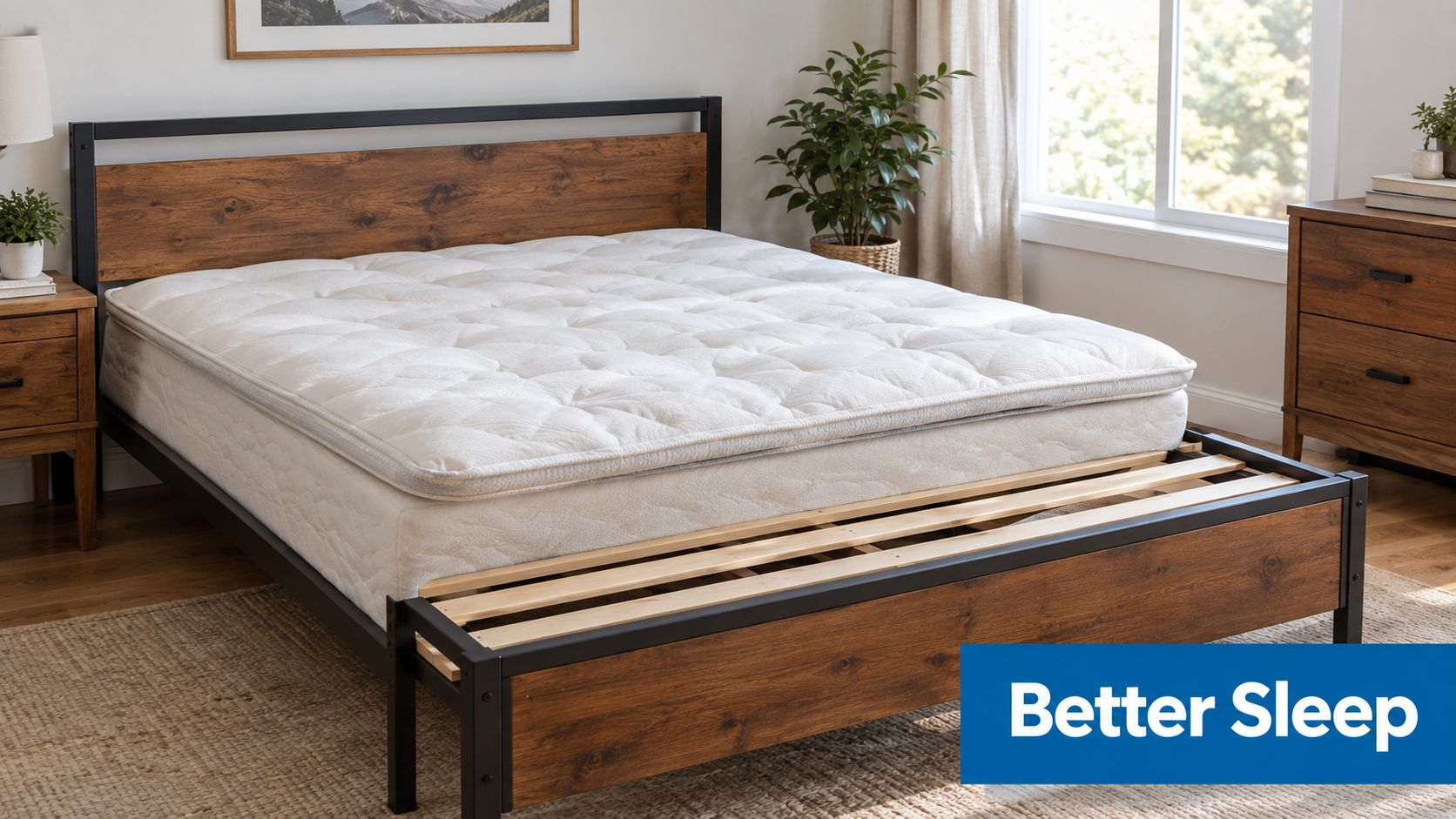
A durable metal and wood bed isn't defined by its material mix. It earns that description when its joints stay tight, its center support carries the load, and its slats protect the mattress from deflection. Tighten first when the structure is sound, reinforce the foundation when spacing is wrong, and replace the frame when its load-bearing parts are permanently compromised.
Meliusly provides practical furniture support solutions, including bed slats and foundation upgrades, for homeowners who want to improve comfort without replacing usable furniture. Review the available support options and visit Meliusly to choose the component that matches your bed frame and mattress needs.