

Recliner Replacement Parts Near Me: Find the Right Fit
Posted by Meliusly
You pull the recliner handle, but the footrest stays down. Or the chair still opens, while the seat sinks and the backrest refuses to hold its angle. Searching for recliner replacement parts near me makes sense, but buying the nearest look-alike part can leave you with the same problem.
Start by naming the failed component, then clear the safety checks before anyone uses the chair again. Match the replacement to the chair's measurements and, on powered models, its electrical system. The useful distinction is whether the chair needs a mechanical repair, an electrical diagnosis, or better support beneath a sagging cushion.
Match the Symptom to the Failed Part
A handle that moves without opening the chair doesn't automatically mean the complete mechanism has failed. The release cable may have detached, its sheath may have slipped out of its mounting bracket, or the cam may no longer respond. Check the connection before shopping for a large assembly.
A manual recliner works through a chain of components. As described in the ReclineWise recliner parts diagram, the release handle or cable moves a cam, which drives the scissor or pantograph linkage that raises the footrest. A spring-loaded pawl engages a toothed ratchet plate to hold the footrest, while rear recline plates control the backrest angle.
Pivot rivets provide hinge points. Tension springs assist opening and retraction, and tracking or spreader plates keep the sides synchronized. A fault anywhere along that chain can make the chair feel broken even when most of it remains usable.
Recliner symptoms, likely failed parts and first checks
Treat these as diagnostic starting points, not confirmation that a particular part needs replacing.
| Symptom | Likely failed part | First check before ordering |
|---|---|---|
| Handle moves but the chair does not recline | Release cable or cam | Confirm the cable is still attached at the handle and the cam |
| Footrest sags or sits crooked | Linkage or bracket | Inspect brackets, pivot rivets and linkage for bends or looseness |
| Backrest will not hold an angle | Recline plate teeth or pawl | Check the ratchet teeth and the pawl spring |
| Footrest will not stay locked or retracts suddenly | Tension spring or locking clip | Check spring hooks, spring length and clip seating |
| One side lags or the chair moves unevenly | Tracking plate or synchronized actuator | Confirm both sides move together through the full range |
| Powered chair: hand control works but chair does not move | Motor, transformer or control box | Unplug the chair and contact an authorized technician; do not open the control box |
| Frame cracked, bent or with a sheared weld | Frame or mechanism housing | Stop using the chair; the complete mechanism usually needs replacing |
Practical rule: An intact frame makes a component-level repair worth investigating. It doesn't prove that every spring, pivot or locking surface is sound.
Don't put fingers into the linkage to find the fault, and don't pull a tensioned spring free as a diagnostic test. Our furniture repair kit guide can help you organize tools and supplies, but the chair's service instructions should determine the repair procedure.
Powered chairs add motors, transformers, control boxes and synchronized actuators. A responsive handset doesn't establish which downstream component has failed, so electrical symptoms often need a technician rather than a guessed replacement.
Safety Checks Before You Use the Chair Again
Stop using the recliner if you find exposed electrical wiring, a burning smell, unusual heat from the motor or control box, a cracked frame, or linkage that releases without a command. A recall notice for the model is another reason to stop. Disconnect power when it's safe to do so, and keep the chair unavailable until the fault is assessed.
A chair that moves again isn't necessarily safe. During repairs, a missing guard, incorrectly routed cable or mismatched bracket can introduce a hazard that wasn't obvious when the chair was stationary.
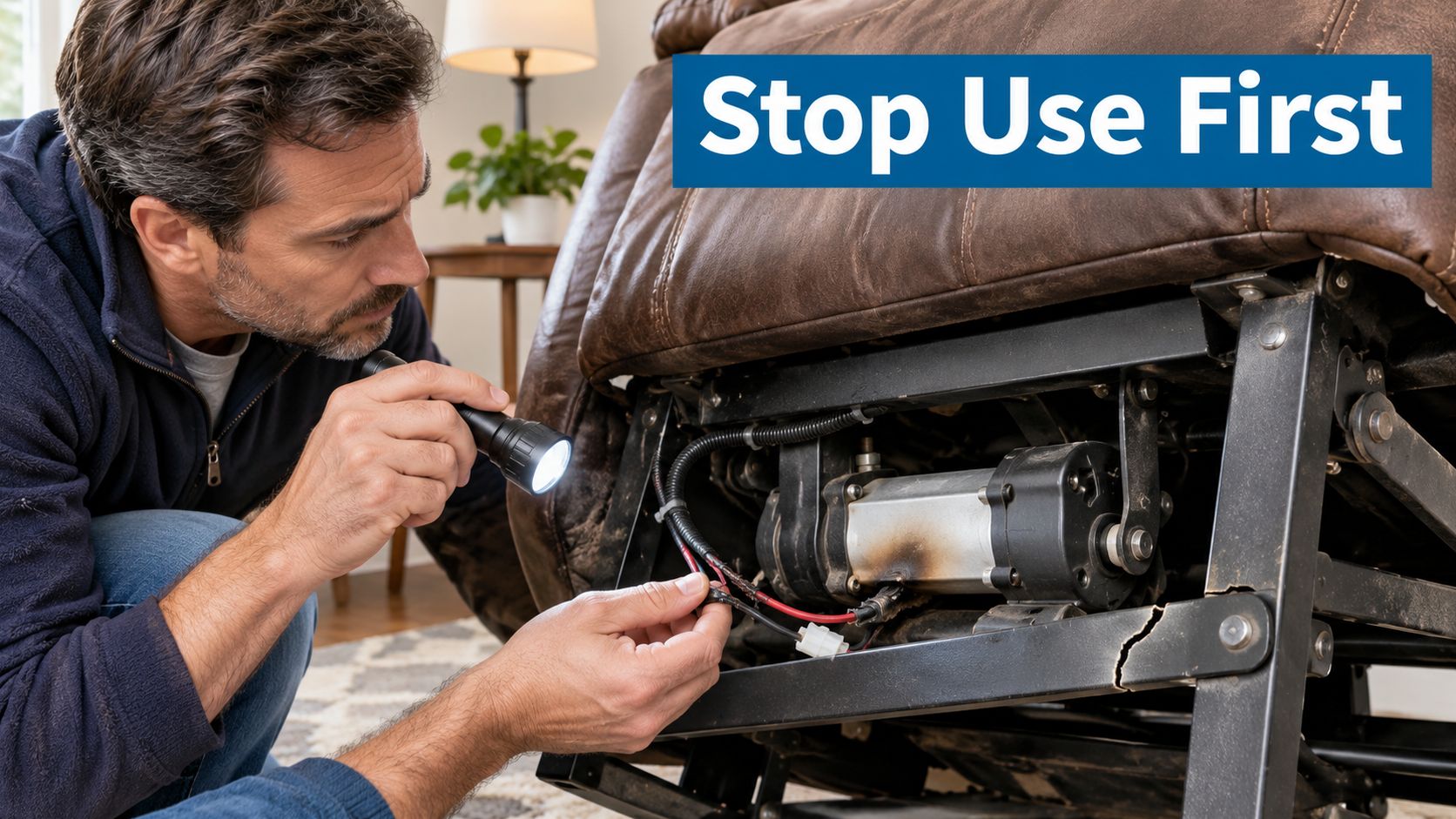
Check openings and moving edges
The New South Wales recliner-chair safety guidance says recliners shouldn't contain an unprotected gap of 95 mm or more or, with the footrest extended, a cavity 200 mm or deeper. These are useful inspection benchmarks, not a substitute for the manufacturer's model-specific requirements.
The guidance also warns against sharp-edged or scissor-action finger and toe traps at retracting footrests. Where a design requires a larger opening, protective upholstery or a crossbar should address it. Don't improvise a guard that could foul the mechanism.
- Inspect both positions: Examine the underside and footrest area with the chair closed and fully extended, without reaching into moving parts.
- Check protective pieces: Confirm that guards, covers and upholstery barriers are secured where they belong.
- Watch the travel path: Look for exposed linkage, newly created openings, trapped wiring and contact between adjacent parts.
- Keep the area clear: Move children, pets, loose fabric and tools away before any operational test.
Restoring movement without restoring safe clearances is an unfinished repair.
The Blue Rock recliner quality requirements also identify accidental collapse, sharp edges, rough operation and instability when fully reclined as unacceptable conditions. Check for those problems rather than judging the repair only by whether the footrest opens.
If the chair releases suddenly, shifts on its base or exposes an unguarded pinch point, stop testing. Contact the manufacturer or an authorized technician before anyone sits in it again.
Measure and Photograph the Part Before You Order
Two recliners can look identical from across the room and use different mechanisms underneath. Even within a brand, the upholstery style isn't enough to identify the correct cable, spring or motor. Match the part's mounting and operating requirements, not its silhouette.
The ReclinersArt repair guide emphasizes mounting-hole patterns, screw spacing, cable length, spring dimensions, connector type and mechanism orientation. The replacement also needs enough clearance to travel without hitting the frame or neighboring components.
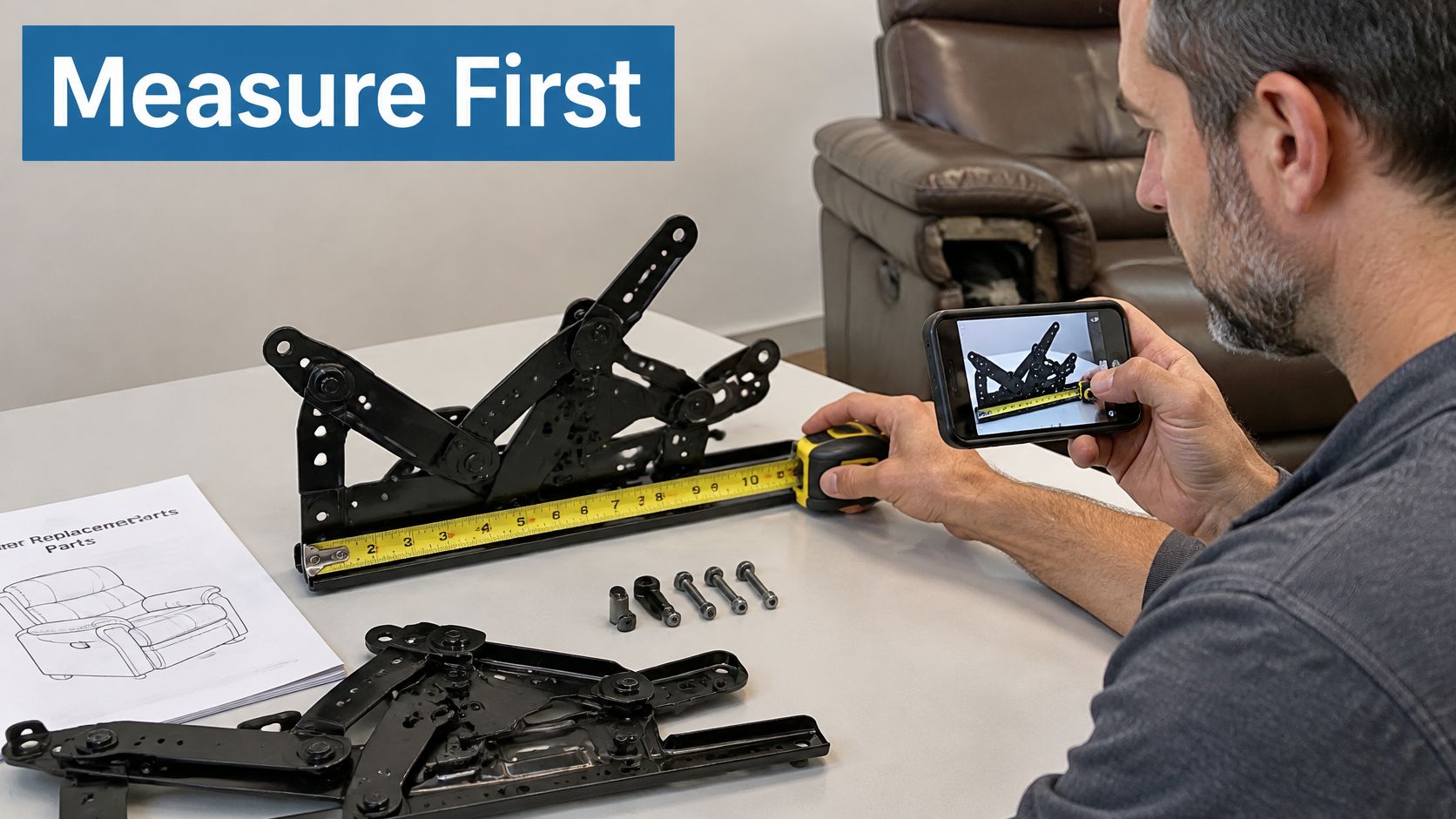
Build a usable fit record
Use a tape measure, flashlight and phone camera. Record measurements in the same units used by the seller so you're not relying on approximate conversions.
- Record the manufacturer, model and serial number from the chair's label to identify the correct assembly.
- Measure the mounting-hole pattern and screw spacing so the replacement aligns with the existing frame.
- Measure cable length from its anchor toward the handle or cam, recording the sheath and exposed cable separately when relevant.
- Note spring dimensions and hook style so a similar-looking spring isn't mistaken for a suitable replacement.
- Record powered connectors and count pins or plugs, while recognizing that appearance alone doesn't establish electrical compatibility.
- Record the bolt pattern and left/right orientation, stating whether you're describing the side from the seated position.
- Photograph the label, failed component, connectors, cable routing and mounting points to preserve the installation context.
A close-up of the broken end isn't enough. Include a wider photograph showing where the component sits, plus a ruler beside the mounting holes. Keep stamped part numbers readable and photograph connectors before disconnecting them.
Before removing a manual mechanism, place the chair upright with the footrest fully retracted. Disconnect power completely on powered models, and don't dismantle an assembly that remains under spring tension without the appropriate procedure.
After fitting, a competent repairer should run the mechanism through its full range while the chair is securely supported and tilted as appropriate to its service procedure. Never crawl beneath an unsupported chair or bypass an interlock. Check smooth movement, positive locking, unusual sounds and secure wiring before returning the chair upright for final assessment.
Find a Local Source That Can Verify Fit
Start with the manufacturer's parts service for model-specific mechanisms and powered components. A hardware counter can help with measured fasteners or brackets, but proximity doesn't make it qualified to choose a lift-chair control box.
The UltraComfort lift-recliner service documentation uses component identification, fault tracing, exploded views and wiring diagrams. That's the level of identification a powered repair needs: an apparently compatible connector doesn't guarantee electrical or positional compatibility.
Local sources for recliner parts and what to bring
| Local source | Best for | What to bring |
|---|---|---|
| Manufacturer parts service | Model-specific mechanisms and powered components | Model number, serial number, label photo |
| Authorized technician | Powered recliners, electrical faults, warranty repairs | Symptom notes, photos of connectors, power details |
| Upholstery or furniture repair shop | Cables, springs, brackets, cushion foundations | Failed part, measurements, mounting-point photos |
| Furniture-reuse group or repair cafe | Simple repairs and assessing donation or salvage options for unrepairable chairs | Photos and the model if known |
| Hardware store or parts counter | Generic fasteners, brackets, cable lengths | Mounting-hole spacing, cable length, old part |
An upholstery shop is a useful first call for a manual chair with a broken cable or failed seat foundation. It can also assess whether the surrounding frame and upholstery justify the repair. Our furniture repair shop guide explains how to evaluate that service.
A repair cafe may help with a straightforward mechanical problem, but don't assume volunteers handle electrical or lift-system faults. Likewise, a reuse organization may accept a chair for salvage rather than reuse, and some won't accept damaged furniture at all.
Filter the counter before you travel
- Ask whether they can look up your exact model and serial number. A brand name alone isn't enough.
- Ask whether the part is listed for that model or sold as generic hardware. Get a clear answer before paying.
- Ask whether they'll review the label photo and connector details. Bring mounting measurements as well.
If the seller can't identify the model or establish the part's listed application, treat it as a generic-hardware source only.
A counter that can't read the chair's label shouldn't be confirming its electrical compatibility.
For powered chairs, don't open control boxes, splice wiring or dismantle lifting assemblies to accommodate an available part. An authorized technician should determine whether the handset, power supply, motor or synchronization system needs attention.
Repair or Replace Across Common Cases
The cheapest online part isn't automatically the cheapest repair. Compare the part price, diagnostic fee, delivery time, labor and return conditions, especially when installation could make a mismatched electrical part nonreturnable.
Also consider what you're preserving. A chair that fits the room and suits an older adult may be worth repairing even when a basic replacement looks inexpensive. The European Commission-hosted circular economy overview for the furniture industry provides broader context for considering repairability, reuse and end-of-life handling alongside replacement.
Repair or replace decisions for common recliner cases
| Case | Repair path | Replace path and deciding factor |
|---|---|---|
| Broken release cable, intact frame | Replace the cable alone | Expand replacement to the cam or handle only if also damaged; weigh labor cost against part price |
| Cracked frame or sheared weld | Patching isn't recommended as a household repair | Replace the complete mechanism or chair; structural safety decides |
| Worn recline teeth, sound frame | Replace the ratchet plate or pawl where separately serviceable | Replace the whole mechanism if several parts are worn; part availability decides |
| Failed motor or transformer on a powered chair | Technician repair or manufacturer-supplied part | Replace the chair if repair approaches replacement cost; check warranty and recall status first |
A cable repair loses its advantage if the replacement doesn't seat in the anchor bracket and you pay for another visit. Ask for an installed repair estimate, not just a parts quote.
If replacement is sensible, Giorgi Bros. Furniture's recliner advice for Bay Area homes offers context for comparing powered and manual designs. Keep optional comfort upgrades separate from essential repairs; our recliner chair accessories guide can help with that distinction.
Disposal isn't a neutral fallback: 80.1% of U.S. furniture and furnishings waste was landfilled in 2018, according to the EPA's durable-goods figures. If replacement wins, ask reuse organizations about acceptance before transporting the chair. Donate only with full disclosure of its condition, and use municipal bulky-waste or appropriate recycling services when safe reuse isn't possible.
Confirm Fit and Order the Right Part
Buy only when you can connect the symptom, the identified component and the replacement's specifications. A seller's assurance that a part fits most recliners isn't enough for a locking mechanism or powered assembly.
Use this sequence before committing money:
- Confirm the failed component. Use the symptom table to narrow the fault, then verify it through inspection or professional diagnosis.
- Compare the listing with your fit record. Match mounting points, cable details, orientation and photographs rather than relying on the product name.
- Get compatibility confirmed. The supplier should verify the model application and, for powered parts, the required electrical connections.
- Check warranty and recall status. Contact the chair manufacturer before paying for work that might qualify for a different service route.
- Order or book the repair. After installation, complete the full-range operational test and clearance inspection before everyday use.
When the problem is seat sag instead
If the mechanism operates correctly but the cushion or supporting deck sags, consider a properly fitted support board rather than a mechanism replacement. Our Heavy Duty Sofa Cushion Support Board is a couch support for sagging cushions, currently on sale for $29.99. Confirm suitability and clearance for your furniture; don't assume a sofa board fits every recliner.
Our lifetime warranty covers defects in materials and workmanship, with a free replacement for manufacturing defects or structural failure under normal household use. A support board isn't a repair for a mechanism that slips, sticks or leaves an unsafe gap.
Motion without safe clearances isn't a finished repair. Leave powered faults with a qualified technician.
Meliusly offers sofa supports, sleeper sofa support boards, bunkie boards and bed slats for furniture support problems, not substitutes for broken recliner mechanisms. Visit Meliusly to compare support solutions for sagging furniture and choose an option suited to the piece you want to keep.
Share this post
- Tags: fix sagging recliner, recliner mechanism parts, recliner repair, recliner replacement parts, replacement recliner parts near me