

How Do I Fix Sagging Sofa Cushions: Quick DIY Fixes
Posted by Meliusly
You sit down on the sofa you've had for years and feel yourself drop into the same low spot. The cushions look tired, but that doesn't automatically mean the foam is to blame. Before you buy replacement filling or wedge a board under the seat, check which layer has failed.
A sofa seat works as a system: the frame holds its shape, the springs or webbing support the seat deck, and the cushion spreads your weight across the surface. The right fix depends on which part is sagging. Get the diagnosis right, and you can restore comfort without replacing a sofa that still has plenty of life.
Why Your Sofa Cushions Sag in the First Place
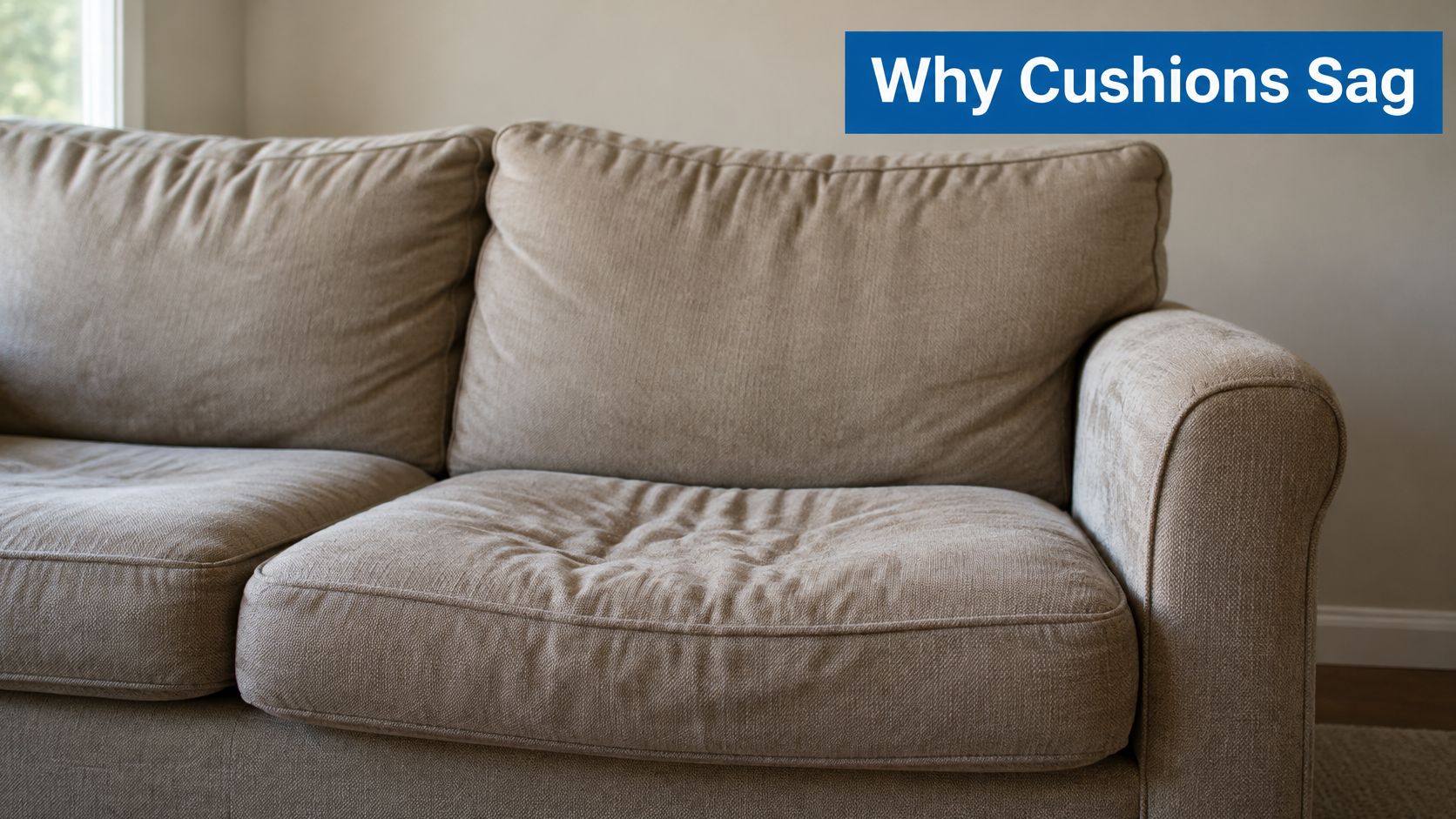
A sagging seat can start with the cushion, the suspension beneath it, or the frame. These parts don't wear out at the same rate, so a sofa can look fine from the outside while one hidden layer has already lost its support.
The first clue is often how the seat feels. If the cushion stays flat after you stand up, its foam may have lost resilience. If it feels reasonably supportive on the floor but sinks when it's back on the sofa, inspect the base. Springs can shift or lose tension, and webbing can stretch until it forms a hammock-like dip beneath the cushion. (Sofa suspension systems explained)
The frame is the rigid foundation. A cracked rail or loose joint can make the whole seat uneven, and no cushion refill will correct that. Sometimes more than one layer has worn: a soft cushion may be sitting on stretched webbing, so fixing only the visible dip gives you a temporary improvement rather than a lasting repair. (Field guide to sofa suspension systems)
Start with the layer you can test
Think of a homeowner who assumes the foam is finished because the seat has a hollow in the middle. They buy a new cushion core, fit it into the cover, and still feel the same dip. The new foam isn't the problem. The seat deck beneath it is giving way.
That's why the order matters: check the sofa base before spending money on filling. Then assess the cushion separately. A support board can help with a weak but sound seat base. Fresh foam can help with a flattened cushion. Neither is a substitute for repairing a damaged frame.
There's also a practical reason to try repair when the sofa is otherwise sound. The U.S. Environmental Protection Agency reports that furniture and furnishings entering the municipal solid-waste stream reached approximately 12.08 million tons in 2018, compared with 2.15 million tons in 1960. Furniture made up 4.1% of total municipal solid waste in 2018, and about 80.1% of discarded furniture and furnishings that year went to landfill. (EPA durable-goods data)
That's not a reason to keep an unsafe or broken sofa. It is a good reason to identify the failed part before throwing out furniture that could be repaired.
Diagnosing the Sag Like a Furniture Tech
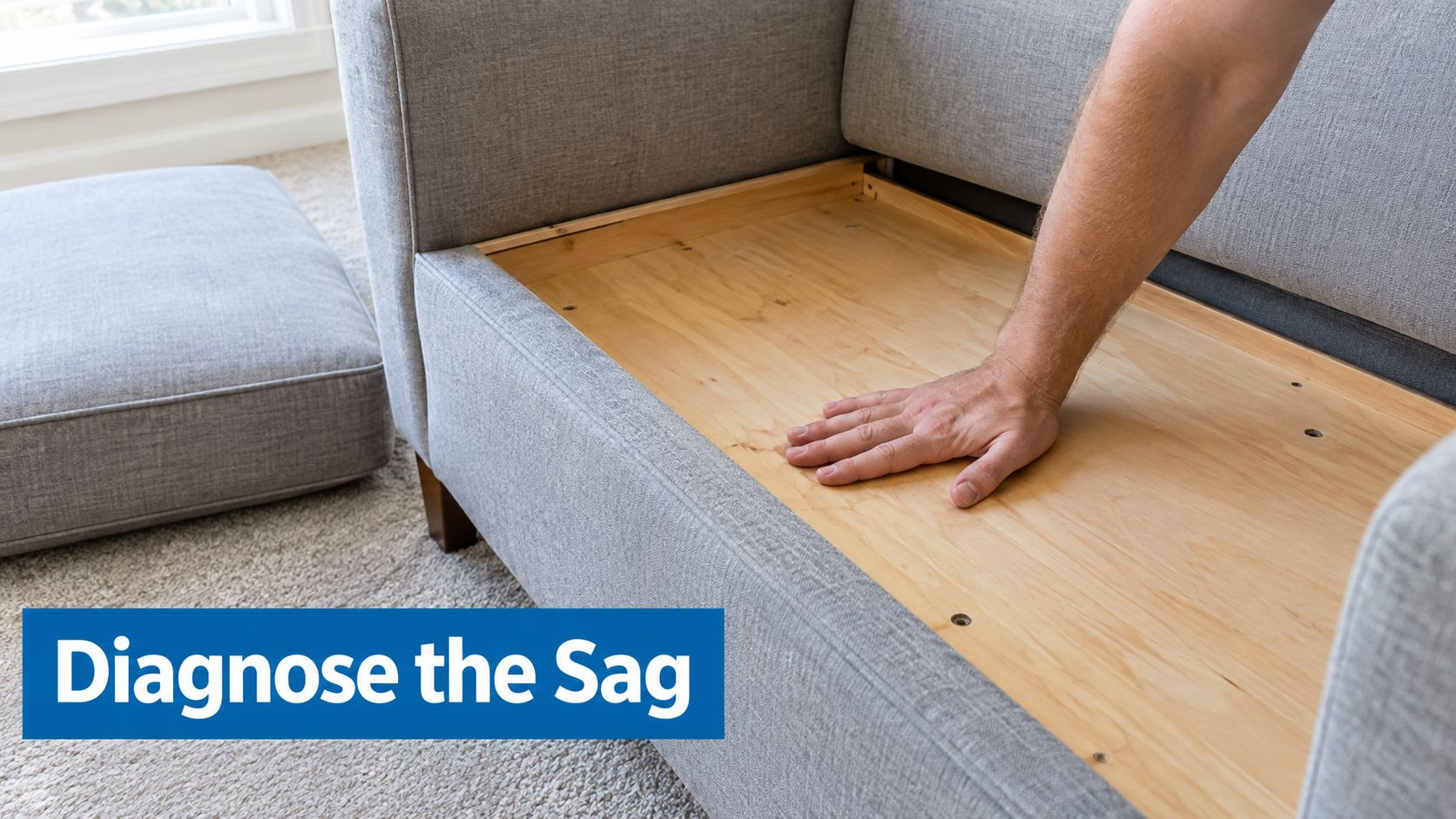
Take the cushions off before you order foam or a support insert. You're trying to find out whether the dip follows the cushion or stays with the sofa.
Run these checks in order
- Compare the cushion on and off the sofa. Put it on a firm, level floor and press the center and edges. If it still flattens easily or stays misshapen, the cushion is a likely source of the sag.
- Stand the cushion on its edge. A cushion with sound structure should hold a recognizable shape. If it folds over, collapses, or looks hollow, the foam may have lost its support. This test is a useful clue, not a substitute for checking the sofa itself.
- Press across the exposed deck. Use an open palm and check the center, front edge, and sides. A firm, even deck beneath a misshapen cushion points toward a cushion problem. A dip, loose movement, or sharp noise points to the suspension or frame.
- Listen and feel as you press. Squeaking, clicking, a hollow spot, or sideways movement can signal loose clips, displaced springs, stretched webbing, or a frame problem. Don't assume every noise means a broken spring, but don't hide it under new foam either.
Sofas commonly use sinuous springs, coil springs, or woven webbing. Their failures feel different under your hand, which helps narrow down what to inspect. (Common sofa suspension systems)
Suspension types and their telltale failure signs
| Suspension Type | How It Feels When Working | Common Failure Sign | Repair Difficulty |
|---|---|---|---|
| Sinuous springs | Even, springy support across the seat | A loose or displaced spring, failed clip, or uneven dip | Moderate; access and attachment points matter |
| Coil springs | Resilient support across the seat | A loose, damaged, or uneven-feeling area | Often difficult; repairs may need an upholsterer |
| Webbing | A taut, consistent seat platform | A hammock-like dip or visibly slack straps | Moderate; correct tension and attachment are important |
Don't buy a cushion fix until you've checked the deck. If the cushion is the culprit, work on the filling. If the deck dips, a new cushion alone won't fix the underlying support.
Restoring Cushion Filling Without Buying a New Foam Block
If the deck feels firm and level, focus on the cushion. You may be able to restore its shape without replacing the whole core, but choose materials by the job they need to do, not just by how soft they feel in the shop.
Foam density and firmness are different specifications. Density describes how much foam material is in a given volume; firmness describes how hard the foam feels under pressure. A furniture construction guide identifies approximately 1.8–2.5 pounds per cubic foot as a commonly recommended density range for sofa cushions used daily. Treat it as a starting point, then match firmness to the sofa and how you want it to feel. (Furniture anatomy and upholstery foundations)
Choose the repair that fits the cushion
- Redistribute loose fill if the cushion contains fiber or feather filling that has shifted but still has some loft. Work the filling back into the thin areas and corners. If it slides away again quickly, the material needs more than rearranging.
- Add a fiber wrap if the foam core still supports you but looks flat or has hard edges. Wrap it evenly, adding only enough to restore the shape. Too much wrap can make the cushion bulge and strain the cover.
- Add a new foam core when the existing foam collapses or stays compressed. Measure the cushion and cover carefully, and preserve the original height as closely as possible. A core that's too thick can make the cover pull tight; one that's too small can shift and leave empty corners.
- Replace the whole cushion core if the foam has lost its structure throughout. Ask for the density and firmness specifications rather than choosing only by feel. A quick sit in a showroom won't tell you what the foam's density is.
For more guidance on choosing and refreshing worn cushion filling, see this guide to old couch cushions. Don't stuff a flattened cushion with loose fiber just to make it look full. If the core has failed, loose fill usually changes the appearance more than the support.
Keep the original shape in mind
A replacement should support the cushion without changing the way it sits in the sofa. When you close the cover, the foam should fit without force, the corners should reach their intended positions, and the seat should feel even from the center to the edges.
A cushion that feels firmer isn't automatically a better cushion. The aim is to bring back stable support while preserving a comfortable contour.
Adding a Support Board the Right Way
A support board makes sense when the frame is sound but the seat platform sags under the cushions. It can't repair cracked wood, and it won't restore foam that has permanently collapsed. Get the fit wrong, and you can trade a dip for a hard ridge.
Start by removing the cushions and measuring the seating area where the board will sit. Measure the usable span between the seat rails, not the outside width of the sofa. The board should lie flat over the sagging area without resting awkwardly on the rails or pushing against the upholstery.

Fit matters more than brute firmness
A board that's too narrow can leave part of the sag unsupported. One that's too thick, or one that sits unevenly, may create a pressure ridge you feel through the cushion. The finished seat should feel more even, not like there's a plank edge beneath you.
Plywood is a familiar DIY option, but a rough cut or unfinished edge can catch the upholstery or shift under use. MDF is another rigid option, but neither material is automatically a good fit because it's flat. Check that the surface sits evenly, has no sharp edges, and doesn't interfere with the cushion or the sofa's moving parts.
For renters, or anyone who doesn't want to modify the sofa, a removable support insert keeps the repair reversible. A purpose-built option such as a Meliusly Heavy Duty Sofa Cushion Support Board unfolds beneath the cushions to create a more even base. For a sleeper sofa, use a support designed to suit that setup rather than assuming a standard seat board will work when the bed mechanism opens.
Practical rule: A board is a sensible fix for a weak seat platform over a usable frame. It's a stopgap, not a repair for broken springs, loose webbing, or cracked frame wood.
Put the board in place, check that it lies flat across the affected area, and replace the cushions. Sit near the center and front edge, then shift your weight from side to side. If you feel a sharp transition, a raised edge, or movement, take the board out and correct the fit before using the sofa regularly.
Repairing the Springs and Webbing Underneath
If the deck dips with the cushions removed, fix the suspension before adding cushion filling. Otherwise, the new foam will keep bearing weight over a weak foundation, and a board may only conceal a problem that still needs attention.
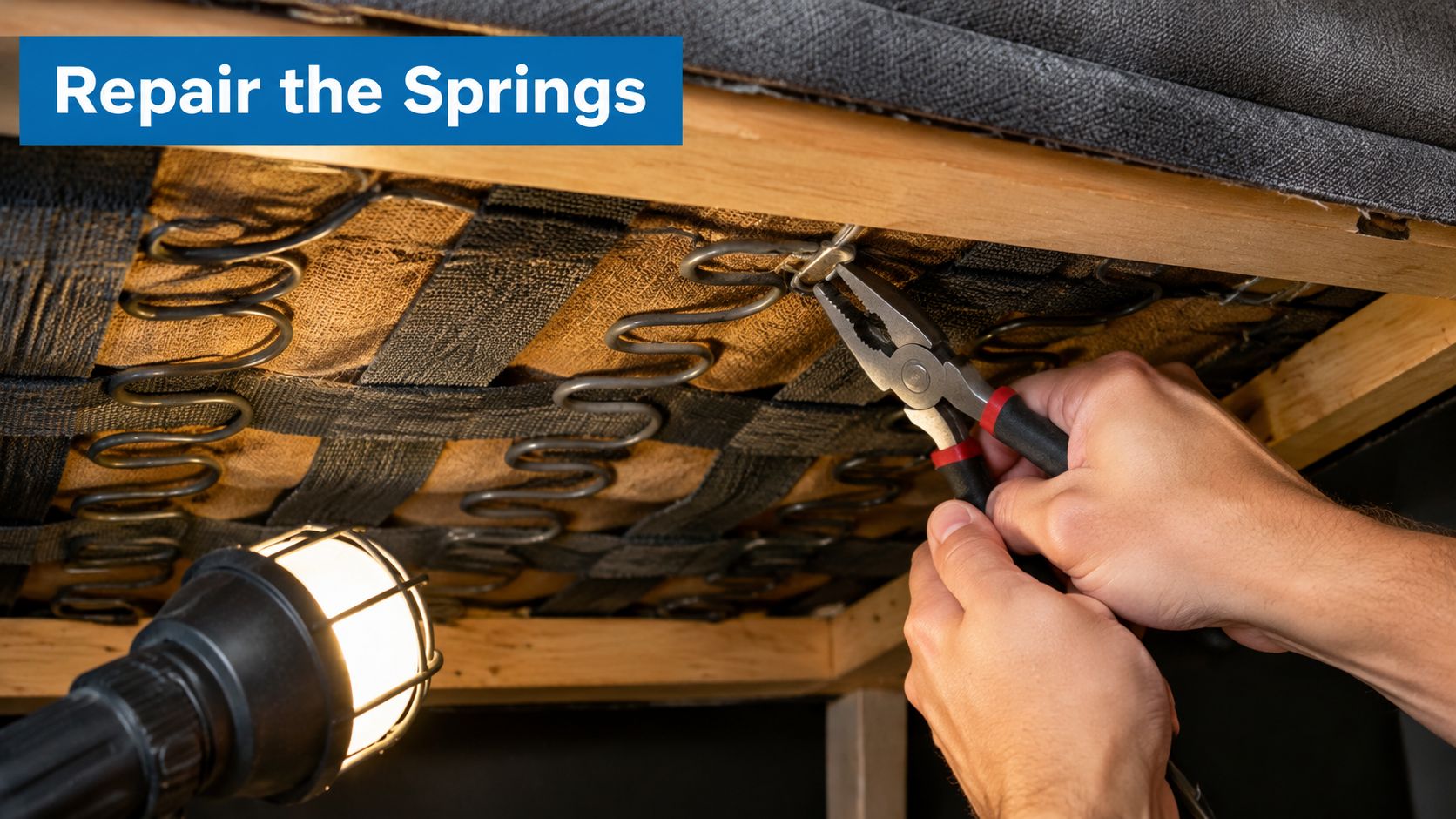
First, remove the dust-cover fabric carefully. Photograph the existing layout so you can see how the springs or webbing were positioned before you touch them. Identify the system, then check for stretched straps, loose clips, displaced spring ends, and damage to the wood where the suspension attaches.
Match the repair to the suspension
For woven webbing, replace straps that have lost tension, following the original front-to-back and side-to-side layout. Keep the attachment points and spacing consistent, and use a webbing stretcher instead of pulling by hand so the tension is more repeatable.
For sinuous springs, check whether the spring has slipped out of position or separated at a clip. Reseat a displaced end and replace a failed clip if the frame is sound. Don't spread springs farther apart to make them seem taut. That changes the load distribution and can add stress to the wire.
For coil springs, be honest about your experience. A coil system that's loose or damaged can involve more involved upholstery work than replacing a single clip. If you can't safely access and secure the springs, call a professional rather than improvising a fix.
A technical upholstery guide gives a 25–35-pound resistance range when a spring deck is pulled down 2 inches at its center, and recommends replacing springs below 20 pounds. (Upholstery repair screening reference) Treat that as a screening reference, not a universal specification for every sofa. Don't use a hand test as a reason to overload or distort a spring.
For more detail on the repair process, see this guide to repairing sagging couch springs. After the repair, test the seat gradually at the center and front edge. Stop if you hear new noise, feel sideways movement, or see the seat stay low after the load is removed.
Call an upholsterer if the frame is cracked, the suspension is inaccessible, or the sofa has powered or reclining mechanisms. Those aren't good places to guess.
Making the Repair Work for How You Actually Sit
A sofa can feel firmer after a repair and still be uncomfortable to use. Pay attention to seat height, firmness, and depth together, especially if you or someone in your household needs the sofa to make sitting down and standing up easier.
When the seat sits too low, standing up can take more effort. If you make the whole seat uniformly hard, though, you may trade the sag for uncomfortable pressure. A firm support layer under a softer cushion can work better than using the firmest foam you can find, because each layer has a different job.
Check posture, not just firmness
The shape and support of a cushion affect how your weight meets the seat. In a 2021 Comfort Congress study, 64% of participants preferred a shaped cushion, describing it as more comfortable and better suited to the shape of the buttocks. Pressure-mat measurements also found a larger contact area and lower mean pressure distribution with the shaped cushion. (Comfort Congress seating study)
That doesn't mean one repair works for every sofa. It does make a useful point: restore support without flattening or distorting the cushion's intended contour. A rigid insert that removes the dip but creates a hard edge can still make the seat uncomfortable.
An independent ergonomic guide recommends sitting with feet flat, knees level with or slightly below the hips, and the lower back reaching the back cushion. It also notes that excessive seat depth can encourage slumping. (Ergonomic seating guidance for older adults)
Use this after-repair checklist
- Feet: Can the person sit with their feet flat on the floor?
- Knees and hips: Are the knees level with or slightly below the hips?
- Lower back: Can the sitter reach the back cushion without sliding forward?
- Thighs: Does the seat avoid excessive pressure at the front of the thighs?
- Transfers: Can the person sit down and stand up without sinking into an unstable dip?
For older adults, caregivers, and anyone who uses the sofa for long stretches, these checks matter more than asking whether the seat feels "firm enough." The repair should make the sofa stable and comfortable to use.
When Repair Stops Making Sense
Don't keep fixing a sofa just because a repair seems cheaper than replacement. The right question is whether the frame is sound and whether the remaining work can restore a comfortable, dependable seat without turning into repeated patching.
Use this quick decision rubric:
- Frame condition: If the rails and joints feel solid, repair is more promising. If the frame is cracked or twisted, get a repair estimate before buying parts.
- Suspension condition: If the system is accessible and a failed strap or clip is the main issue, targeted repair may make sense. If the suspension is badly damaged or difficult to reach, ask an upholsterer what the full job involves.
- Cushion condition: If the deck is level and the cushion alone has lost its shape, replacing or rebuilding the cushion may be all the sofa needs.
- Total effort: Add up the materials, labor, and time you'll put in. Compare that with the cost and suitability of a replacement you'd actually want.
A reversible board can be a practical choice for renters or anyone who needs a temporary improvement on a sofa with a sound frame. It won't fix broken suspension or structural damage. A foam replacement is the right call when the cushion has failed, but it won't help if the deck itself dips.
The goal is a comfortable, reliable seat, not a heroic repair.
If you're unsure whether the sofa needs upholstery work or a simpler intervention, this guide to finding a furniture repair shop can help you think through the next step. Make the choice based on the layer that failed, not the fix you already have in mind.
Meliusly offers sofa support boards and solutions for sleeper sofas, along with support products for other furniture foundations. If your sofa has a sound frame but a sagging seat base, visit Meliusly to explore a support option that fits your furniture.
Share this post
- Tags: cushion repair, fix sagging couch, furniture support, sagging sofa cushions, sofa support board