

Fix Sofa Bed
Posted by Meliusly
At 10 p.m., with guests already on the way, you pull out the sofa bed and discover the mattress drops in the middle like a hammock. You add a folded blanket, rotate the mattress, and hope nobody notices the metal bar under their hips. By morning, the complaint is usually the same: the bed looks usable, but it doesn't feel supported.
That failure usually has a mechanical cause. A sofa bed combines a mattress, support deck, folding mechanism, and furniture frame in one compact system. Each part can fail differently, and a soft sleeping surface may be only the visible symptom. Before you buy plywood, a topper, or replacement hardware, identify which layer is giving way.
Why Your Sofa Bed Fails the Moment You Need It Most
A sleeper sofa may feel fine through weeks of sitting, then fail when guests arrive and the bed is opened. Sofa cushions spread weight differently from an extended mattress, so a weakened deck, loose joint, or misaligned frame can remain hidden. Once unfolded, the mattress crosses bars, hinges, gaps, and support rails. A connection that seemed harmless in sofa mode can become a hard ridge or sag at night.
That pattern has a mechanical cause. A sofa bed combines a mattress, support deck, folding mechanism, and furniture frame in one compact system. Folding joints and center bars interrupt the sleeping surface and create uneven load paths, which can leave the hips or shoulders over a stressed section, as engineering guidance on sleeper sofa support explains.
Practical rule: If the problem appears only after opening the bed, inspect the hidden support system before blaming the cushions.
Why the first fix often misses
Owners usually start with the component they can touch. A softer topper cannot correct a sagging deck. A replacement mattress will not straighten a bent mechanism, and a board will not solve a frame that no longer sits square. These changes may alter comfort for a while without repairing the failure underneath.
Repair costs make diagnosis useful. HomeAdvisor reports average furniture repair costs of $107 to $273, with an average of $185, while sofa-specific estimates range from $350 to $1,500. HomeAdvisor's furniture repair cost guide shows why a targeted support repair can make financial sense when replacement would remove both the seating and guest-bed functions.
The type of damage matters as well. Independent survey coverage cited by HomeAdvisor found that 40% of Americans said sofas, couches, and loveseats were the furniture most recently damaged, with an average repair or replacement spend of $299. Spills and stains made up 55% of those accidents, so service needs are not limited to broken frames.
If the design itself is the problem, compare alternatives before rebuilding the mechanism. A sofa air bed couch review can help you assess an inflatable sleep system, especially when eliminating metal bars matters more than preserving the existing fold-out hardware.
Treat the sofa bed as a system
Start with four layers: mattress, support deck, mechanism, and frame. The mattress affects comfort, the deck carries sleeping loads, the mechanism controls opening and closing, and the frame keeps the assembly aligned. Check those functions separately before buying parts.
The design follows a long tradition of space-saving furniture. Sarah E. Goode received a U.S. patent in 1885 for a folding bed that fit into a writing desk, and Leonard C. Bailey received a patent for a single folding bed in July 1899, milestones described in this history of the sleeper sofa. The same goal remains practical today, using limited living space for more than one purpose.
Find the failing layer first. That decision prevents an unnecessary topper, misplaced board, or replacement mechanism from becoming the next repair.
The Four Failure Layers of a Sofa Bed
A sofa bed isn't one support surface. It's a stack of components that must work together, and each layer leaves different clues when it starts to fail.
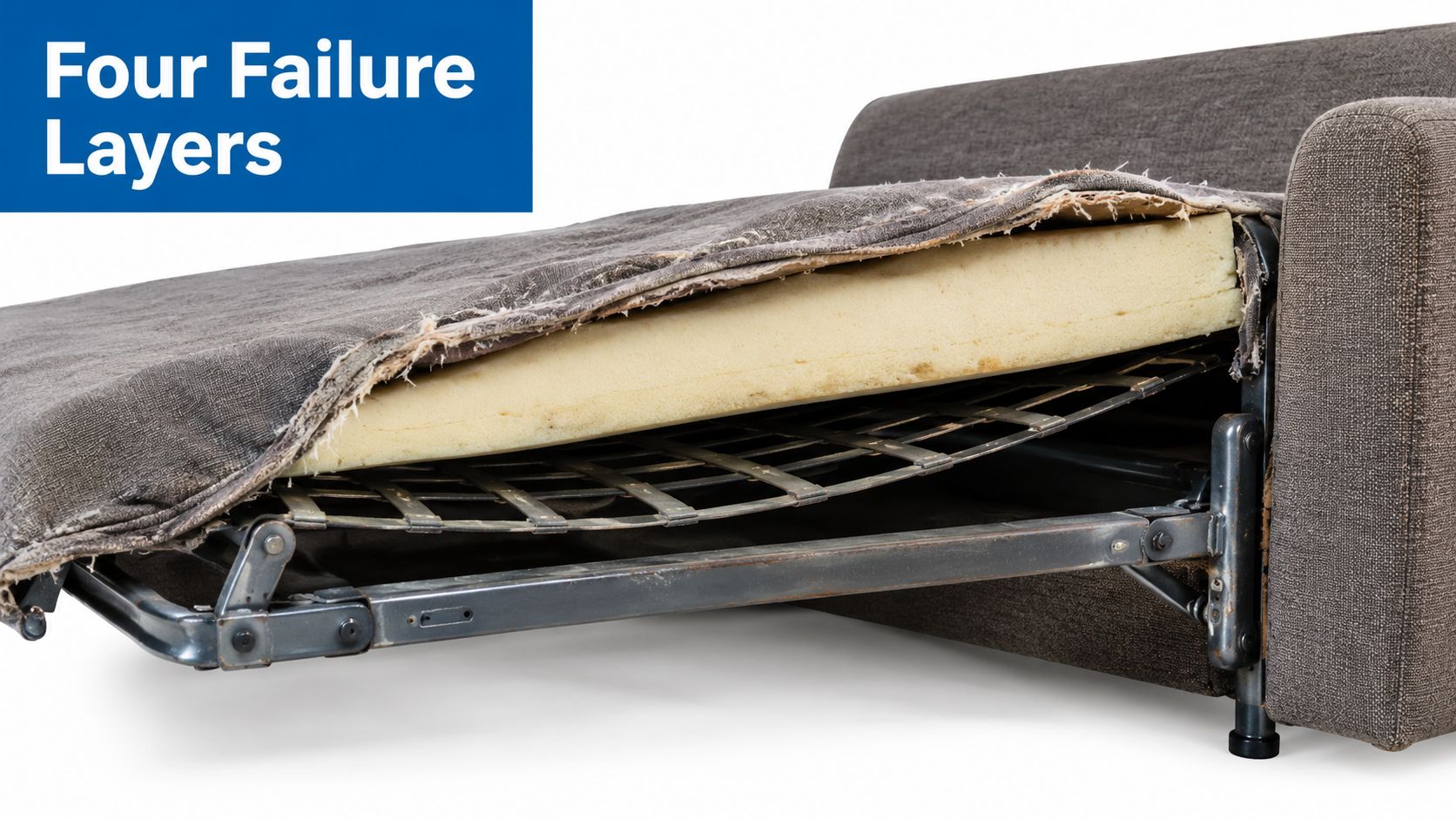
Layer one, the mattress
The mattress is the easiest part to blame because it's the part your body feels. Foam can compress, seams can create a ridge, and thin upholstery can allow a bar or support member to press through. If the mattress feels uniformly soft but the deck underneath is flat and firm, a topper or mattress replacement may address the comfort problem.
A mattress isn't the likely culprit when you feel one sharp line, a hard ridge, or a specific pressure point in the same place every time. That pattern usually means the mattress is conforming to a defect beneath it.
Layer two, the support deck
The deck includes webbing, spring rails, slats, wire grids, brackets, or a folded support panel. Stretched webbing loses tension. A bowed slat creates a low spot. A broken deck section can let the mattress dip even when the mattress itself still looks sound.
A useful distinction is whether the empty base sinks. Sofa repair guidance from Dr. Sofa recommends inspecting the frame, slats, support rails, corner blocks, and load joints rather than stopping at the upholstery. If the bare deck dips under hand pressure, cushion-only work won't solve it.
Layer three, the mechanism
The mechanism includes pivot pins, springs, locking linkages, rollers, brackets, and the pull bar. Binding, grinding, scraping, or a bed that stops halfway points here. A mechanism can still look intact while a loose fastener or worn bushing changes its alignment enough to create resistance.
Don't add a rigid board until the bed opens and closes normally. A support insert that improves the sleeping surface can still overload or obstruct a mechanism that is already bent.
Layer four, the frame
The frame keeps the sofa square. Loose corner blocks, cracked rails, stripped fasteners, or separated joints allow movement that transfers stress into the deck and mechanism. A frame problem often presents as wobble, creaking, or a corner that lifts when you sit down.
A comfortable mattress can't compensate for a frame that no longer holds the mechanism in alignment.
Match the symptom to the layer. Sag usually points to the mattress or deck. Grinding points to the mechanism. Wobble points to the frame. Reinforcing the wrong layer may make the sofa feel different, but it won't make the system reliable.
Diagnosing What Is Actually Broken
You can narrow down the problem without removing upholstery or buying parts. Set aside a few minutes, clear the sleeping area, and keep your hands away from pinch points while operating the mechanism.
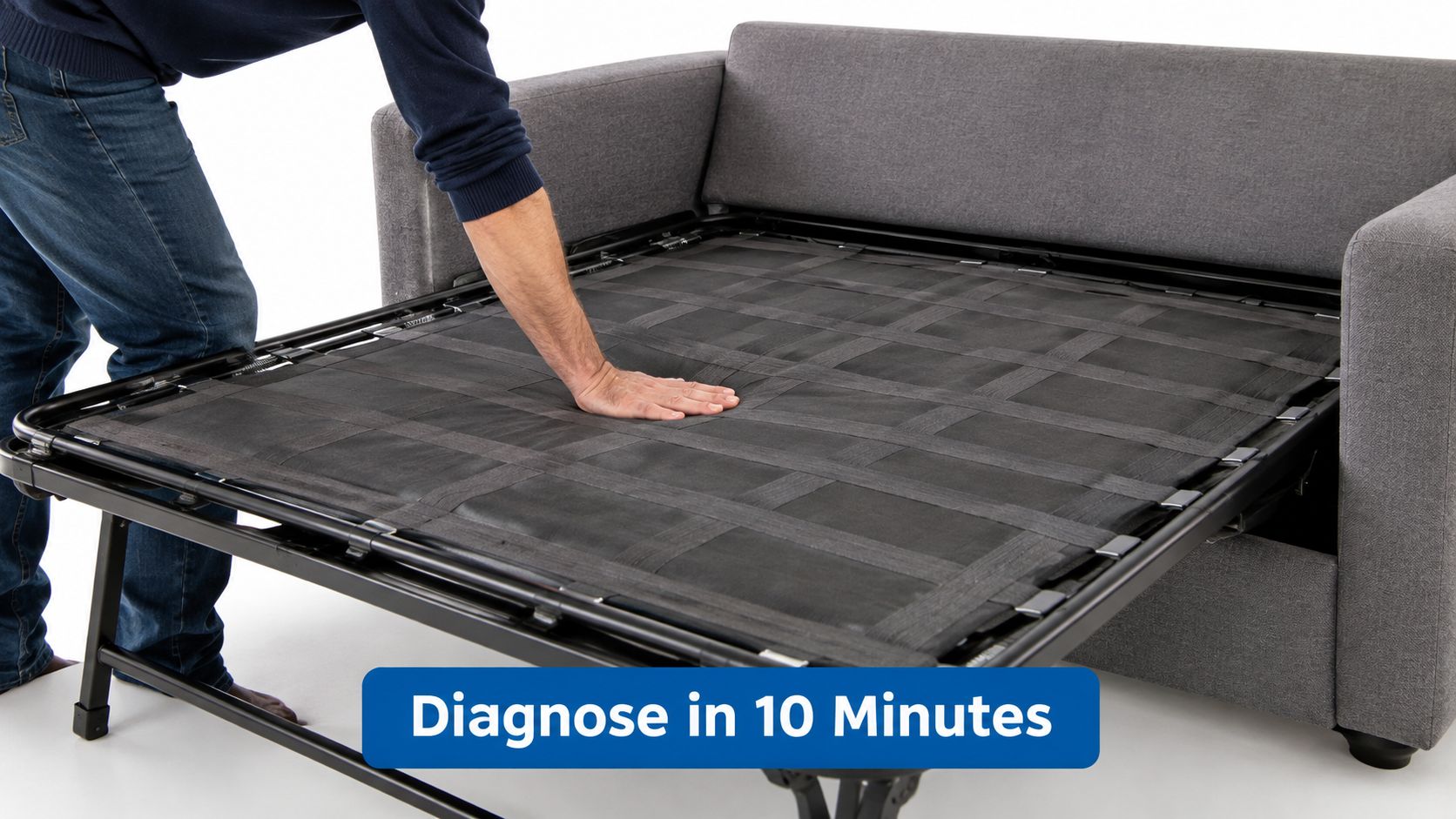
Start with the empty-base test
Remove the mattress and pull the bed fully open. Press the deck at the center, then at both sides and near each end. You're looking for a soft zone, a bowed rail, a loose slat, a gap, or a bar that rises noticeably above the surrounding surface.
If the center drops while the edges feel firm, the deck is carrying the problem. Stretched webbing, failed spring clips, loose staples, or a weak support panel can all create that pattern. If the base is firm but the mattress still sags, focus on the mattress rather than immediately adding structural reinforcement.
Look for separation, cracked wood, and missing fasteners while the deck is exposed. Repair specialists commonly replace sinuous springs, spring rails, seat supports, or defective flexplates, and may add bracing before reinstalling padding. The important point is to verify whether the support or foam is responsible.
Run the fold-cycle test slowly
Open and close the bed at a controlled pace. Don't force the pull bar through a tight spot. Notice whether the resistance occurs at the beginning, during the middle fold, or as the legs and back section approach their stored position.
A smooth movement with a noisy pivot suggests lubrication or loose hardware. A sudden stall, scraping sound, or section that rises off the floor points to the mechanism. Continued resistance while closing is a warning that a board or mattress isn't the only issue. Current sofa-bed repair guidance treats shifting support and closing resistance as reasons to reassess the underlying mechanism.
Finish with sound and wobble
Sit briefly on each corner, then rock the frame gently by holding the sofa arms or frame, not by pulling on loose upholstery. Listen for a creak, pop, metallic click, or wood movement. A corner that shifts independently suggests a loose joint, cracked rail, or failing corner block.
Use the results as a simple map:
- Soft empty deck: Inspect the support deck.
- Sharp pressure point with firm deck: Inspect the mattress and bar contact.
- Grinding or scraping during movement: Inspect pivots, rollers, springs, and latches.
- Wobble or wood creaks: Inspect the frame and fasteners.
Don't declare the sofa fixed until it passes all three checks. A sleeper can feel softer after a topper while still failing the empty-base or fold-cycle test.
Fixing a Stuck or Noisy Sofa Bed Mechanism
A mechanism that binds or grinds needs a different repair path from a sagging sleep surface. Start with simple obstructions, then move toward hardware and metal components. Keep the bed supported while you work, and never place fingers inside a moving hinge.
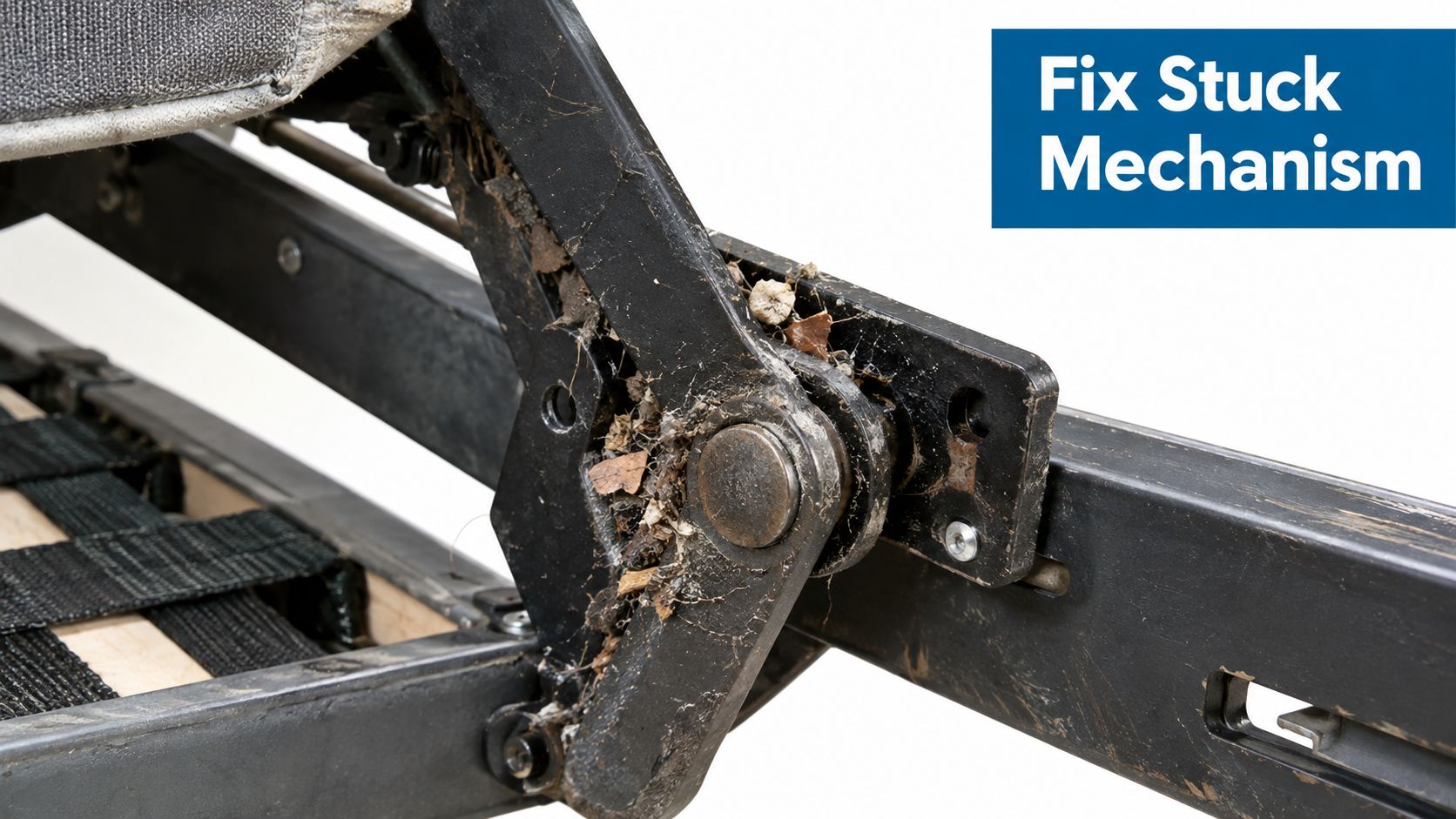
Clear the travel path
Remove bedding, cushions, stored objects, and fabric caught between the folding sections. Vacuum dust and grit from the deck and around the rollers. A small obstruction can make a normally aligned mechanism feel broken, particularly when fabric has been pulled into a hinge or bracket.
Inspect the underside with the bed open. Check whether a cable, cover, staple, or upholstery edge rubs against the moving rail. Don't bend a rail just to create clearance until you know what is contacting it.
Lubricate the correct points
Apply a small amount of dry PTFE or silicone spray to accessible pivot pins, track rollers, springs, and locking points. These products are preferable to oil-based lubricants in dusty furniture cavities because heavy oil can collect grit and turn a clean pivot into an abrasive paste.
Move the mechanism slowly after application so the lubricant reaches the contact surfaces. Wipe away excess spray before closing the bed. If the noise disappears but returns quickly, look for a loose connection or worn bushing rather than repeatedly adding lubricant.
Tighten hardware without overdoing it
Check bolts on locking legs, deck brackets, back hinges, and pivot mounts. Hold the nut or bolt head securely while tightening, and stop when the joint is firm. Over-tightening can distort a bracket or strip a fastener, especially in thin metal.
For loose wood joints, a furniture repair adhesive may help stabilize a separated block after the hardware is corrected. If you're working on a wooden support joint, this guide to building strong CA glue bonds offers useful background on adhesive bonding. Adhesive won't compensate for a cracked rail or a missing mechanical fastener.
Know when straightening isn't repair
With the bed open, sight along each metal rail. A visibly bent link, twisted bracket, or fatigued spring can explain a mid-cycle stall. Gentle straightening may restore movement temporarily, but metal that has already yielded can bend again under load.
Use the sofa bed repair kit as a reference point for the parts and repair categories commonly involved, but match any replacement to the mechanism's original design. Corrosion, a cracked weld, a stripped pivot bushing, or a lock that won't engage reliably means the mechanism may have reached the end of its useful life. At that stage, forcing it risks a sudden collapse and usually costs more than a controlled replacement decision.
Repairing a Sagging or Bar-Filled Sleep Surface
A sleeper sofa can have a serviceable mattress and still feel painful because the support beneath it concentrates weight on bars or gaps. If you feel a rigid line through the mattress, begin by measuring the open deck, not by ordering a mattress based only on its label.
Use a reinforcement board when the deck is sound
A 3/4-inch plywood reinforcement board can redistribute weight across a rigid deck and hide hard ridges. Cut it to the interior deck dimensions, then place it over the stock support so the mattress rests on a flatter plane. The board should bridge the trouble area without interfering with folding geometry.
A different repair guide describes a thinner 1/4-inch plywood sheet as an option for moderate sag between the support and mattress. That sofa-bed frame guidance is useful for understanding the principle, but thickness isn't a universal answer. The right board must remain flat, fit the mechanism, and support the load without blocking movement.
Don't treat a board as a cure for a weak frame. If the empty deck still flexes severely or the frame twists, reinforce the structural failure first.
Correct flexible support
When the deck sags because jute or rubber webbing has stretched, a rigid insert may hide the symptom while leaving the original support under tension. Replace damaged webbing with compatible material and restore its attachment points. Missing staples need secure replacement, and loose slats may need shimming or repositioning so they can't shift during the fold cycle.
Sinuous springs and spring rails require more care. Replace broken clips or damaged springs rather than tying them into a position that changes the deck geometry. A support professional should handle a spring system that is under significant tension or attached to a damaged frame.
Add support where the span needs it
Queen-size sleepers can need additional center support when the stock frame's span allows excessive flex. A center support leg can reduce movement when it bears on the floor correctly, but it must not obstruct the folding sections or transfer force into a weak rail.
Fasten a plywood insert only if the design allows it. Furniture staples can secure edges in suitable wood sections, while short wood screws can help prevent migration during repeated cycles. Keep every fastener short enough to avoid puncturing upholstery, contacting the mechanism, or splitting a narrow rail.
The sleeper sofa support board guidance from Meliusly provides another way to evaluate a removable or foldable support approach. Measure before choosing, and test the complete open and close cycle before allowing anyone to sleep on it.
Avoid oversized panels: A board that fits the open bed but blocks the fold can bend brackets, scrape upholstery, or damage the mechanism when you close the sofa.
When to Repair and When to Replace
Repair makes sense when the frame remains square, the wood is sound, and the mechanism moves with normal hand pressure after cleaning and tightening. It also makes sense when the problem is localized, such as a loose deck rail, a missing fastener, or a support surface that needs bridging.
Replacement becomes more rational when the frame has swollen particleboard, cracked corner blocks, or visible glue-line separation. A permanently bent mechanism, damaged weld, fatigued spring, or bed that stops mid-cycle is also a serious warning. Repairing the foundation beneath a mattress that has already collapsed across its surface only solves half the problem.
Don't rely on age alone, but use it as context. Quality mechanisms can carry roughly 8 to 12 years of regular use, while budget units may fail sooner, according to the repair decision guidance supplied for this topic. Compare the cost of the needed parts and labor with a comparable new sofa bed, including the value of keeping a usable sofa in the room.
Repair vs. Replace Decision Matrix
| Factor | Repair Makes Sense | Replace Makes Sense |
|---|---|---|
| Frame | Solid hardwood, square rails, secure corner joints | Swollen particleboard, cracked blocks, separated joints |
| Mechanism movement | Opens and closes after cleaning or tightening | Requires force, lifts off the floor, or stops mid-cycle |
| Sleep surface | Localized bar pressure or deck sag | Mattress is compressed across the full surface |
| Repair scope | One identifiable component or support zone | Multiple layers fail at the same time |
| Cost | Projected repair remains clearly below replacement | Repair approaches half the cost of a comparable new sofa bed |
Use a furniture repair shop resource when the work involves upholstery removal, loaded springs, or structural joints you can't safely access. The goal isn't to keep an old sleeper alive at any cost. It's to spend where the underlying structure still deserves a longer working life.
Keeping Your Sofa Bed Working for Years to Come
Maintenance works best when it follows the same diagnosis-first logic as repair. Don't wait for a guest to discover a new noise. Run the bed through a complete opening and closing cycle every two to three months, watching for altered resistance, uneven folding, or a latch that no longer engages cleanly.
Use dry PTFE or silicone spray on accessible locking latches and pivot pins, and avoid grease that attracts dust. Vacuum the deck and the cavity under the mattress so debris doesn't wedge into rollers or folding joints. For fabric care, Enky Editorial's sofa-cleaning advice is a useful reference, but keep moisture away from exposed metal and wood joints.
A practical care routine
- Check movement: Open and close the bed slowly, without forcing a tight spot.
- Inspect support: Press the empty deck at the center and edges for new softness or movement.
- Rotate the mattress: Turn it end-to-end to even out compression where the design allows.
- Recheck hardware: Inspect mounting bolts after the first 30 days of ownership, since new hardware can settle.
- Clear storage: Don't store heavy items inside the sofa cavity where they can press against the mechanism.
- Protect the frame: Never stand on the bed frame while converting or making the sleeper.
Tape a short quarterly checklist inside the storage compartment: clear debris, inspect bolts, test the fold, press the bare deck, and check for new sounds. Those small checks help you catch a deck problem before it becomes a mechanism problem, and a loose joint before it damages the frame.
Meliusly has served over 400,000 customers with furniture support solutions for sagging seating and sleeper sofas. Its support range includes sofa supports, sleeper sofa support boards, bunkie boards, and bed slats, giving homeowners, renters, hosts, and caregivers reversible options to extend furniture life when the underlying structure remains sound.
If your sofa bed has a firm frame but a painful bar, dipping deck, or uneven sleep surface, visit Meliusly to compare practical support solutions before replacing the entire sofa. Measure the open deck, identify the failing layer, and choose a support that fits the way your sleeper folds and gets used.