

Couch Seat Supports: Which One Fixes a Sagging Seat
Posted by Meliusly
Your guest settles onto the sofa and keeps sinking. You know the spot, the cushion looks reasonably plump until someone sits down, then the middle drops and getting up becomes an awkward shuffle. Before replacing the couch or ordering extra foam, find out which layer is giving way.
Couch seat supports work when they address the right problem. A reinforcement panel can help a sound sofa with a weakened support deck, but it isn't a substitute for cushion filling or structural repairs. The useful starting point isn't how firm you want the seat. It's where the sag begins.
What a Couch Seat Support Does Under the Cushions
Under that hammock-like seat is a stack of components. From bottom to top, there's the frame, the suspension, the fabric-covered seat deck, and the cushion. Springs or webbing provide resilience, while the frame carries the load through its rails, joints, and legs.
A couch seat support is a rigid or semi-rigid panel beneath the cushions. Think of a plank laid across a sagging hammock: the plank limits the dip, but the hammock's anchors still need to hold. Plywood under a mattress uses a similar principle, changing the foundation rather than adding softness.

Follow the weight through the sofa
When someone sits, weight passes through the cushion into the suspension and frame rails. A panel spreads that force across a broader area and limits downward travel. It changes where the weight lands, not just how hard the cushion feels.
That whole-system view matters. The U.S. General Services Administration's upholstered-seating performance requirements evaluate seating components rather than treating comfort as an isolated cushion property. A reinforcement panel needs sound attachment points and a suitable bearing surface.
There are separate product families for different jobs: cushion support boards for seating or back-cushion applications, and sleeper sofa support boards for the opened pull-out bed. Sleeper-specific panels fit the spaces between metal bars rather than being balanced on top of them; follow the particular product's installation directions.
Know what the panel leaves unchanged
- No added filling: A board doesn't replace missing foam or batting.
- No structural repair: A broken frame still needs repair.
- No shorter seat: A deep cushion remains deep.
Before choosing a support, answer three practical questions: What's failing, what usable space can you measure, and which support belongs in that location?
Diagnose the Sag Before You Buy Anything
Sag symptoms, likely causes and whether a support helps
| Symptom | Likely source | Can a support help? | First check |
|---|---|---|---|
| Seat is flat and low, but the bare deck feels level | Cushion foam compression | No, refill or replace the cushion | Compare cushion height with a new cushion |
| Center dip that stays after cushions are removed | Suspension or deck | Yes, if the frame is sound | Check spring or webbing attachment points |
| Broad hammock-like depression across the seat | Stretched or detached webbing | Yes, as a reinforcing deck after checking attachments | Measure strap gaps; see spacing guidance below |
| Springs pushing through or creaking | Broken or unclipped springs | Partly, a board may only mask it | Inspect spring clips and rails from below |
| Seat wobbles or frame shifts when sat on | Cracked or loose frame joint | No, structural repair first | Check corner blocks and joints |
| Seat sinks the user too deep to rise easily | Seat depth and cushion geometry | Limited, a board cannot shorten depth | Measure loaded seat height and seat depth |
Treat the table as a starting diagnosis, not permission to cover damaged parts. A sound but yielding deck is different from a suspension that has detached from its frame. Our sofa construction guide explains why wire condition, webbing tension, attachments, and frame integrity all affect the same visible symptom.
Run the cushion-off test
First, remove the cushions. Look across the uncovered platform for a central valley, uneven edges, exposed springs, or loose fabric concealing a depression. If anything looks broken or unstable, don't load it further.
Next, press the center and edges. Compare resistance rather than pushing as hard as possible. Only if the platform appears intact, briefly and gently sit on the covered deck to check whether the dip remains without the cushion.
Then, compare cushion positions. Where cushions are interchangeable, move the suspect cushion to another seat. If the low spot moves with it, inspect the filling; if the dip stays in the same place, investigate the deck beneath it.
Inspect the suspension rather than adding padding
Webbing should flex and recover, not hang slack. One upholstery reference on webbing and spring spacing describes approximately 5 to 7 cm between straps as providing more even support, while gaps of 10 cm or more can contribute to hammocking. Spacing is evidence to consider alongside tension and attachment condition, not a diagnosis by itself.
Practical rule: Don't buy a reinforcement panel until you know whether the low spot belongs to the cushion or the sofa beneath it.
For cushion comparisons, use an unused matching cushion if available. A different cushion design isn't a reliable height reference, and an unloaded cushion can look plump despite poor recovery under weight.
The clearest cushion-only diagnosis is a level, stable deck under load paired with flattened filling. In that situation, refill or replace the cushion rather than buying a board to solve a problem beneath it that isn't there.
How Springs and Webbing Fail and Last
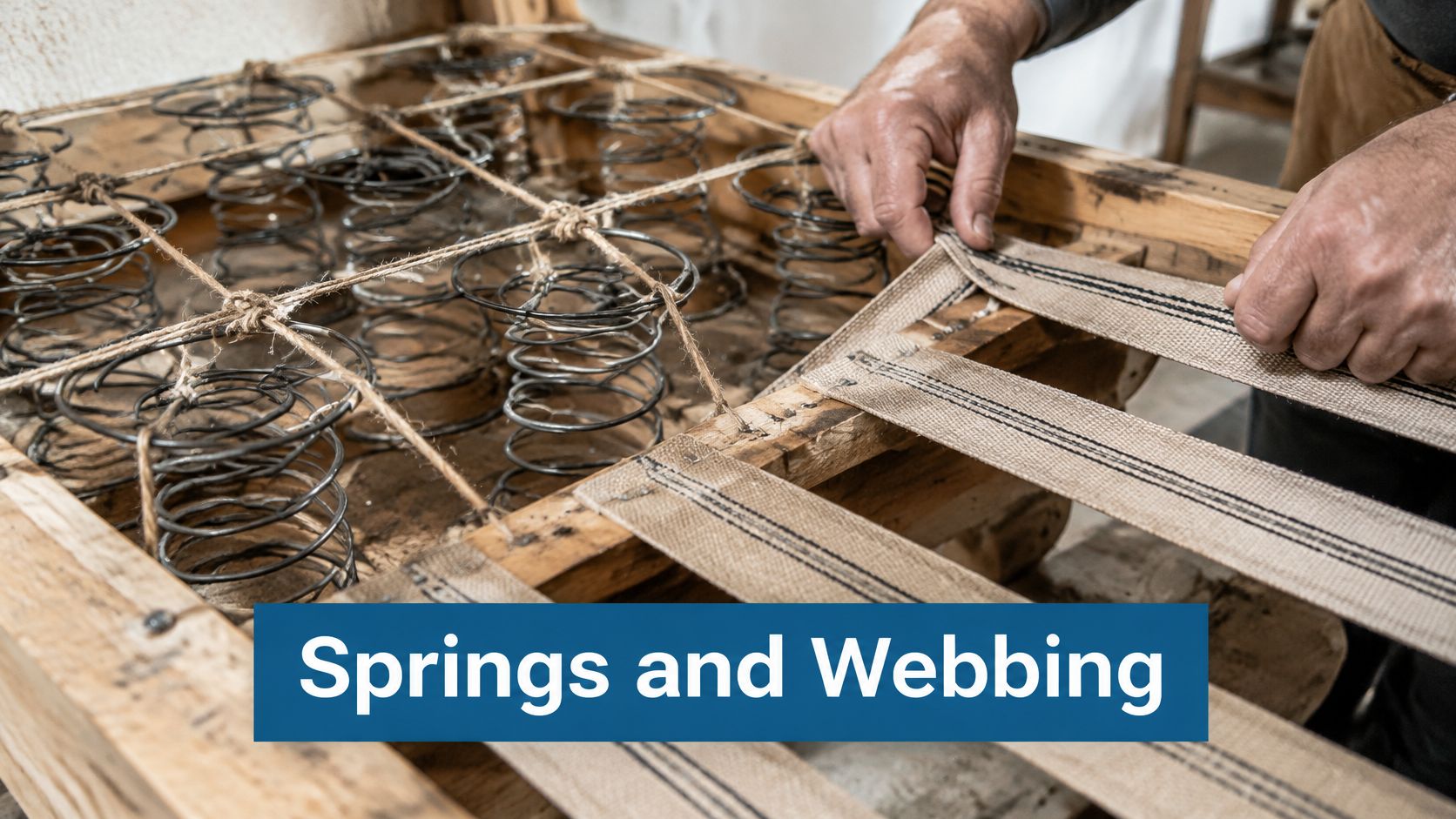
A sofa's suspension behaves differently depending on how it's built. Eight-way hand-tied coils resemble a network of small, individually anchored supports. Sinuous springs behave more like parallel springy bridges, while webbing forms a tensioned sling.
Coil springs became widely used in upholstered furniture during the 19th century, and sinuous springs emerged in the 1950s, becoming common in mid-century furniture. This comparison of suspension technologies provides the historical context: manufacturers developed different ways to combine resilience, available space, materials, and labor.
Compare the construction, not just the label
Eight-way hand-tied construction secures individual coils to neighboring springs and the frame with directional twine ties. Sinuous suspension uses continuous steel wires running front to back, often stabilized by horizontal tie rods. Webbing uses tensioned bands, typically 2 to 3 inches wide, to form a flexible platform, as described in Koala's sofa construction explanation.
The service ranges below come from a furniture-care comparison of suspension lifespan. They're general diagnostic guides, not warranties or scheduled replacement dates.
Suspension types, typical service life and failure pattern
| Suspension system | Typical service range | How it usually fails | Support fit |
|---|---|---|---|
| Eight-way hand-tied coil springs | Roughly 15 to 20-plus years | Ties loosen and springs drift out of alignment | Reinforce only when the frame and ties are sound |
| Sinuous S-shaped steel springs | Roughly 10 to 15 years | Wires lose shape and stabilizing connections shift | A board can bridge a sagging but intact deck |
| Elastic webbing | Roughly 3 to 7 years | Bands stretch permanently or detach | A common reinforcement candidate when attachments remain secure |
Separate wear from breakage
Construction quality, user weight, frequency of use, moisture, and attachment quality can change those expectations. An expensive suspension name doesn't excuse loose connections or poor workmanship.
Webbing is a particularly relevant reinforcement candidate because sustained loading can leave bands permanently stretched. Slack but attached webbing isn't the same as detached webbing: the latter calls for repair before you consider a panel.
If you find damaged spring connections, use our guide to repairing sagging couch springs to understand the repair route. For context on the structure carrying those connections, Groen's Fine Furniture offers a resource to compare wood types for sofa frames.
A solid frame with tired suspension may justify targeted reinforcement. Don't discard the whole sofa merely because its flexible support layer has lost tension.
How to Measure Your Seat for a Support Board
Use a tape measure, straightedge, and notebook. Measure the exposed support area, not the outside upholstery or the sofa's advertised overall width. Keep seating measurements separate from pull-out-bed measurements.
Record the usable footprint
- Remove and label the cushions. Mark their positions so you can return them consistently. This prevents cushion swapping from confusing your before-and-after comparison.
- Measure the usable width at the front and back, from side rail to side rail. For an opened sleeper, measure the intended space between metal bars, not across their tops; record the configuration in which the support will be used.
- Measure deck depth from the front rail toward the rear of the support area, including its deepest usable point. Note any taper or change in shape rather than assuming the footprint is rectangular.
- Compare the cushion footprint with the deck footprint. You can sketch an allowance of at least 2 inches beyond each cushion dimension as a coverage check, but don't automatically order that larger size: the usable deck and product instructions remain the limits, and the board mustn't overhang or be forced into place.
- Check cushion thickness at the center and edge without squeezing the foam. Record where the cushion has lost thickness so you can distinguish a firmer foundation from an unchanged depression in the filling.
Check clearances and the occupied seat
- Look for spring clips, arm mounts, sewn-on skirts, center supports, and sleeper mechanisms. Record where each obstruction sits, because a panel needs to lie as intended without interfering with moving parts.
- Measure loaded seat height while the usual user sits normally. Have a helper measure from the floor to the occupied cushion surface beside the thigh, rather than measuring the unloaded cushion top.
- For an older user, record lower-leg length using seated knee height as a practical reference. Check whether both feet rest flat and whether the user can bring their heels underneath them to prepare for standing.
- Inspect the proposed bearing edges. The panel shouldn't balance on a sharp front rail or small isolated contact point, which concentrates force instead of distributing it.
A larger panel isn't automatically a better support. It must fit the structure that's actually available to carry it.
Keep the sketch and measurements beside you when comparing products. The right size covers the intended usable deck, clears obstructions, and rests on suitable support surfaces, without requiring you to squeeze it into the sofa.
Firmness, Foam and Seat Height Trade-offs
Density, firmness, and recovery describe different things. Density is how much material occupies a given volume, rather like comparing the weight of equally sized sponges. It primarily helps describe durability and weight, not how soft the cushion feels.
IFD or ILD describes resistance to indentation, similar to the effort needed to press into a cushion. Compression set describes the dent left after prolonged compression, the difference between foam that rebounds and foam that stays flattened.
Read foam specifications correctly
The foam specification guide covering density, ILD, and compression set provides the reference values below. These are residential examples, not universal requirements or specifications for any support product.
Reference foam specifications for residential seating
| Measure | What it describes | Reference value | What it means for a support |
|---|---|---|---|
| Density | Mass per volume; durability and weight | About 1.8 lb/ft³ (29 kg/m³) and above for seating; residential example 2.2 to 2.8 lb/ft³ (35 to 45 kg/m³) | Higher-density foam generally offers better durability over a supported base |
| IFD/ILD at 25% | Force to indent a 50-square-inch sample by 25%; firmness | Residential example around 25 to 35 lbf | A board can increase perceived firmness without replacing foam |
| Compression set | Permanent thickness loss after compression | Below 8% in the residential example | Lower compression set indicates better recovery after loading |
The distinction matters when ordering replacement filling. Don't choose by density alone if you're trying to match the original feel; our guide to choosing sofa cushions offers a starting point for that separate decision.
Check the person, not just the cushion
With less downward movement beneath it, the cushion may feel firmer and maintain a higher occupied position. That can be welcome, but it isn't automatically more comfortable.
- Foot contact: Compare the occupied height with your earlier measurements. Excess elevation can leave the user with less secure contact with the floor.
- Pressure and feel: Try the normal sitting position, not a quick perch on the front edge. A rigid foundation can make thin or fatigued cushioning feel noticeably harder.
- Permanent depressions: Foam with substantial compression set will still have a depression above the panel. The board changes the base, not the foam's recovery.
Don't judge the result by appearance alone. The useful outcome is a stable foundation with cushioning and geometry that still suit the person sitting on it.
Three Sofas and Where a Support Stops Helping
The following are illustrative situations, not customer case studies. Each separates the symptom from the component that needs attention.
The family sofa with flattened cushions
Consider a four-year-old family sofa whose favorite seat looks lower than the others. With the cushions removed, the deck feels level and stable; the suspect cushion remains flat when moved to another sound seat.
The appropriate action is cushion refilling or replacement. A board adds no missing filling, and the sofa's age doesn't prove that its suspension has failed.
The sleeper sofa with a noticeable bar
A guest opens the pull-out bed and feels a metal bar through the mattress. The first check is the opened frame: inspect its condition and determine whether the complaint is bar pressure, a damaged platform, or a worn mattress.
A sleeper-specific support can create a more continuous bearing surface beneath the mattress when installed in the intended spaces between the bars. It bridges the uncomfortable transition rather than merely perching on the metalwork, but it can't straighten a bent mechanism or restore a worn-out mattress.
The rental sofa with a broad dip
A rental-property owner finds a hammock-like depression beneath otherwise serviceable cushions. Inspection shows stretched webbing, secure attachments, and a sound frame, making a removable reinforcement a reasonable option.
The limit is ongoing use. Check the straps, attachments, panel position, and bearing surfaces during maintenance, and stop using the arrangement if movement or damage develops.
For hospitality furniture, ask for repeated-load and component-fatigue evidence, not just a static weight claim. The broader seating-testing distinction matters because a brief comfort check doesn't establish durability under frequent guest use.
An older user changes the decision
Across these sofa types, someone with limited strength may struggle with a low, deep seat. Research involving 103 adults aged 60 and over found seating comfort was the most important sofa feature for 70% of respondents, as reported in this study of older adults' sofa preferences.
Comfort preferences aren't a safety certification. Age-friendly seating research also addresses the difficulty of overly soft or deep seating.
A firmer base may preserve standing height, but it doesn't supply missing arm support or make an overly deep seat suitable.
For a user with a fall history, hip restrictions, or neurological impairment, seek an occupational-therapy or medical assessment before changing the seating arrangement. Loaded height, foot placement, reach to the arms, and the ability to move toward the seat edge all deserve attention.
Confirm the Cause, Then Choose Your Support
A support board can only help when the sag comes from the layer it supports. Confirm the cause first, then choose a repair that restores the load path. If the cushion has flattened while the deck remains level and stable, refill or replace the cushion instead.
Use a repair-first decision
- Confirm the cause. Remove the cushion and compare the seat under controlled pressure. Check whether the deck stays level and stable. A flattened cushion points to cushion repair, not a board.
- Match the location and measurements. If the frame is intact but the deck yields, compare its usable footprint with a seat-cushion support board. Back-cushion supports and sleeper sofa support boards serve different locations, so they are not interchangeable.
- Repair broken components first. Cracked rails, loose joints, broken springs, and detached connections need direct repair. A board placed over damage cannot restore a dependable load path.
- Check suitability for the user. For an older person or someone with limited strength, assess loaded seat height and whether their feet reach the floor. Seek professional guidance if falls or medical restrictions affect the choice.
Compare fit before placing the order
For a sound sofa with a yielding deck, a cushion support board may delay replacement. If discomfort occurs in the opened pull-out bed, compare sleeper-specific boards instead.
Check the installation location, usable dimensions, and required clearance against your measurements. A mismatch can prevent a panel from fitting or sitting properly. Resolve it before ordering.
Measure first, confirm the cause, then choose the matching support.
If the frame is sound and you have identified a sagging support layer, visit Meliusly to compare support options against your measurements. The right fit may help extend the useful life of the furniture you already own.
Share this post
- Tags: couch seat supports, sagging couch fix, sagging sofa cushions, sofa seat support, sofa support board