

Comfortable Seating for Small Spaces: Measure First
Posted by Meliusly
You've finally found a sofa that fits the wall, and that's where the trouble starts. Once it's in, there's nowhere to put your feet to stand up, a guest with weak knees sinks too low to get out, and the cushions that felt plush in the store bottom out by the second movie. That's the usual failure with comfortable seating for small spaces. The footprint fit, but the seat didn't fit the person or the room around it.
Judge a compact seat by three things instead. Can you approach it and stand from it without a detour, does its height hold up under your weight, and does the base stay level month after month. Measure those first and you'll fix most small room seating problems before you spend anything.
Measure the Room and Clearances First
Start with clear floor, not furniture dimensions. The ADA clear floor space guidance sets 30 × 48 in (760 × 1220 mm) for a stationary wheelchair user beside seating, 42 × 48 in (1065 × 1220 mm) where that space runs across the front of fixed seats, and knee clearance at a table or counter of 27 in (685 mm) high, 30 in (760 mm) wide and 19 in (485 mm) deep. These aren't home building rules for most readers. They're proven planning benchmarks, and they'll tell you quickly whether a seat can actually be used.
Clearance benchmarks for compact seating
| Space | Imperial | Metric | What it protects |
|---|---|---|---|
| Clear floor beside a seat for a wheelchair user | 30 × 48 in | 760 × 1220 mm | Transfer and approach space |
| Clear floor across the front of fixed seats | 42 × 48 in | 1065 × 1220 mm | Positioning where seating runs in front of other seats |
| Accessible walking route | 36 in minimum width | 914 mm | Keeps the main path open past the seat |
| Knee clearance at a table or counter, height | 27 in | 685 mm | Space under a table or counter |
| Knee clearance at a table or counter, width | 30 in | 760 mm | Side-to-side room for legs |
| Knee clearance at a table or counter, depth | 19 in | 485 mm | Room for legs to reach under |
The Ten Minute Taping Routine
Grab painter's tape and a tape measure. Don't trust the product listing alone.
- Tape the footprint: Mark the sofa or chair outline on the floor at full size, including reclined or open positions.
- Add the approach zone: Tape the space beside and in front of the seat where someone sits down, stands up, or transfers.
- Mark conflicts: Add door swings, radiator clearance, and the main walking path through the room.
- Stand up inside it: Sit on a dining chair placed in the taped area and rise. If your shins hit a table or you sidestep to leave, the layout fails.
Say a sofa fits a wall with two inches to spare. That sounds efficient until you tape the standing zone and find it blocks the only path to the bathroom. The sofa didn't grow. You just measured what was always needed.
Check open dimensions too, especially before ordering a sleeper. Reviewing sleeper sofa dimensions in closed and open positions prevents the common mistake of fitting the couch and trapping the bed.
Practical rule: If the taped outline leaves no honest place to plant both feet and stand, a smaller cushion won't solve it. Change the piece or the layout.
A seat that passes this check has earned consideration. It hasn't yet proved it'll be comfortable for the person using it.
Match Seat Height and Depth to the Person
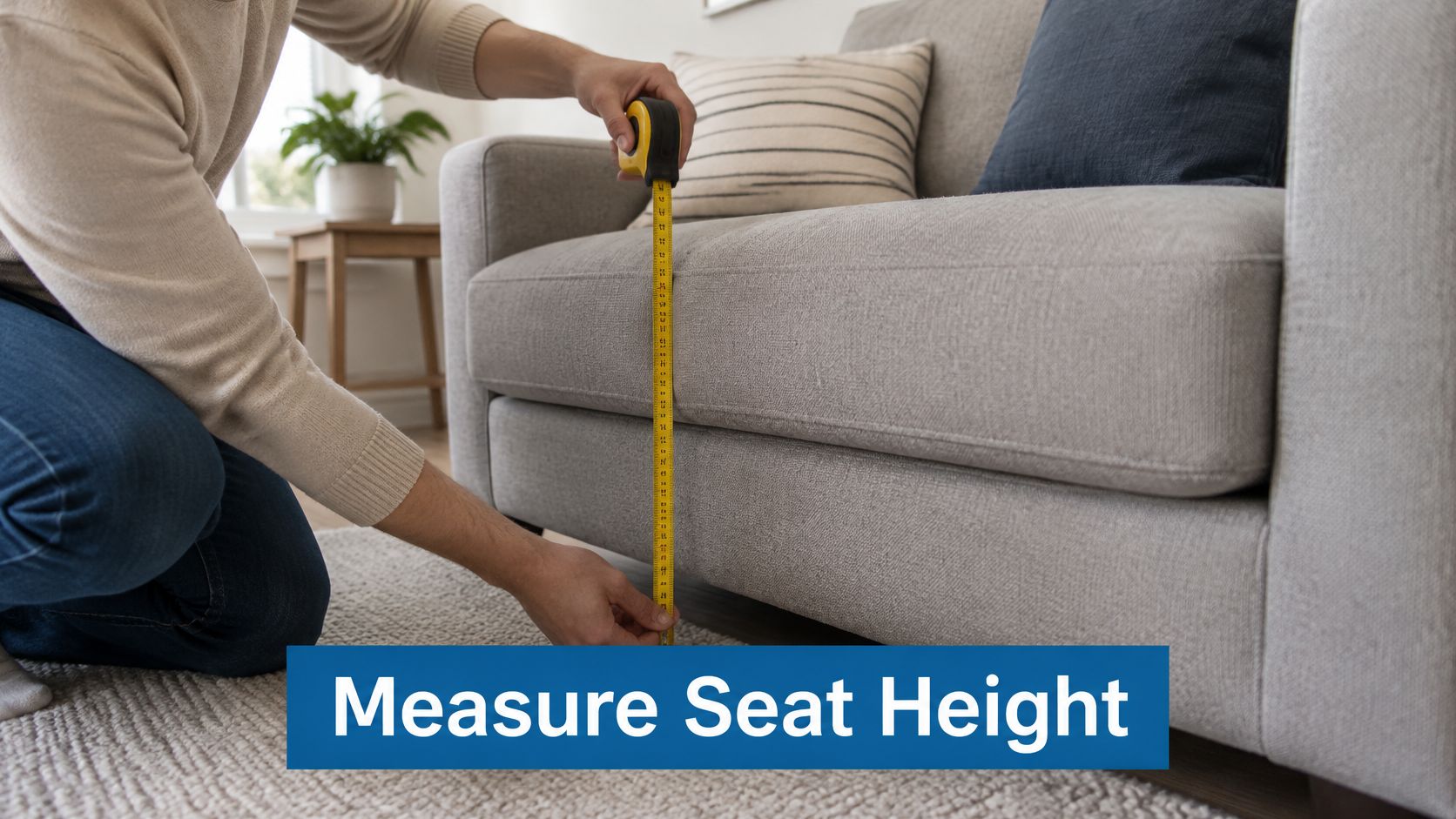
Measure compressed seat height, from the floor to the top of the cushion while someone is sitting on it. An unloaded cushion lies. Sofas and lounge chairs often drop noticeably under weight, and that hidden drop is where standing gets hard.
A 2018 study on seating in aged care reported that seat height is the most important factor in ease of sit-to-stand and defined it as the height from the floor to the compressed cushion, noting that higher seats reduce the hip and knee motion and strength required to stand. The same study found residents, experts, and carers preferred chairs higher than conventional recommendations when easier rising was the priority.
Run the Height Checks in Order
- Measure loaded height: Have the regular user sit normally, feet flat, then measure beside the thigh from floor to the compressed top surface.
- Compare lower-leg length: Measure from the floor to the crease behind the knee while seated on a firm chair. A seat far below that mark forces a deeper knee and hip bend on every rise.
- Test the rise: Ask the user to stand without rocking repeatedly or hauling on a side table. Note whether hands need the armrests, the seat front, or another person.
Depth matters alongside height. If the user can't sit back and keep feet grounded, they'll perch on the front edge and lose back support. The detailed logic behind seat depth and everyday ergonomics is worth checking before you blame cushion softness for what is really a proportion problem.
The Showroom Trap
Say a low lounge chair looks perfect for a tight corner and, for example, sits about 15 inches high once your parent settles into it. It reads as relaxed. In daily use, every exit becomes a strength test, so the chair gets avoided or someone starts pulling on nearby furniture to stand. That isn't comfort. That's a low obstacle with upholstery.
I would choose a firmer, higher, stable seat over a soft, low one for guests, caregivers, and anyone with unreliable knees. Controlled compression preserves the height you measured. Excessive sinking erases it, even when the frame dimensions look right on paper.
Choose Multifunctional Pieces That Earn Their Floor Space
Count functions before you count inches. A piece earns its space when it removes another piece from the room without creating a new circulation or standing problem.
Multifunctional compact seating compared
| Piece | Footprint trade-off | Second function | Best fit | Watch for |
|---|---|---|---|---|
| Sleeper sofa | Full sofa footprint plus sleeping space when open | Guest bed | Occasional guests in a studio or one-bedroom | Bars felt through the mattress and a sagging base |
| Loveseat or armless sofa | Narrower than a three-seater | Two seats that are easier to walk around | Two-person living rooms and narrow walls | Less lounging length |
| Storage ottoman | Small footprint with a floor-level seat | Hidden storage | Extra seat in a corner | Low seat height, which makes rising harder for some users |
| Armchair with slim arms | Single seat with limited depth | Flexible placement and easy to move | Reading corner | Deep seat pans that sink and encourage slumping |
| Modular sofa | Footprint changes with the layout | Reconfigurable seating | Rooms that change use or shape | Seams and joins that can sag or shift |
| Daybed or futon | Frame height varies with design | Sitting plus sleeping | Studio sleeping on a budget | Thin mattress and frame that needs support underneath |
What the Table Can't Show
Features that feel good while you're seated can make leaving the seat harder. A 1996 study of chair design found that lower seats, greater backward seat tilt, more reclined backrests, and highly compressible cushions increased the time and body motion required for older adults to stand, with differences between older and younger adults generally statistically significant at p < 0.001. Under the most difficult conditions, some older participants could not rise from the chair.
That's why a storage ottoman isn't automatic extra seating. It's fine for a teenager putting on shoes. It may fail an older guest completely because there's no height, no back, and nothing stable to push from.
Use this decision rule. List every job the piece must do, measure its footprint in every position, and reject it if the open or reclined position blocks a door, window access, or walkway. Looks come after that filter, and it's useful to compare stylish small-space seating once you've narrowed the shapes that pass.
Say a one-bedroom uses a sleeper sofa to replace both a loveseat and a guest bed. That works only if the open bed doesn't block the sole route to the kitchen. Sleepers have a second predictable failure, bars felt through a thin mattress, which is a support problem under the mattress rather than a reason to buy a thicker one that may not fold away.
How to Test Comfort Before You Buy
Don't test padding with your hand. Your hand doesn't sit for an evening, and it weighs almost nothing compared with your pelvis. Run the test with the body, in order, and write down what you feel.
The Five Part Sit Test
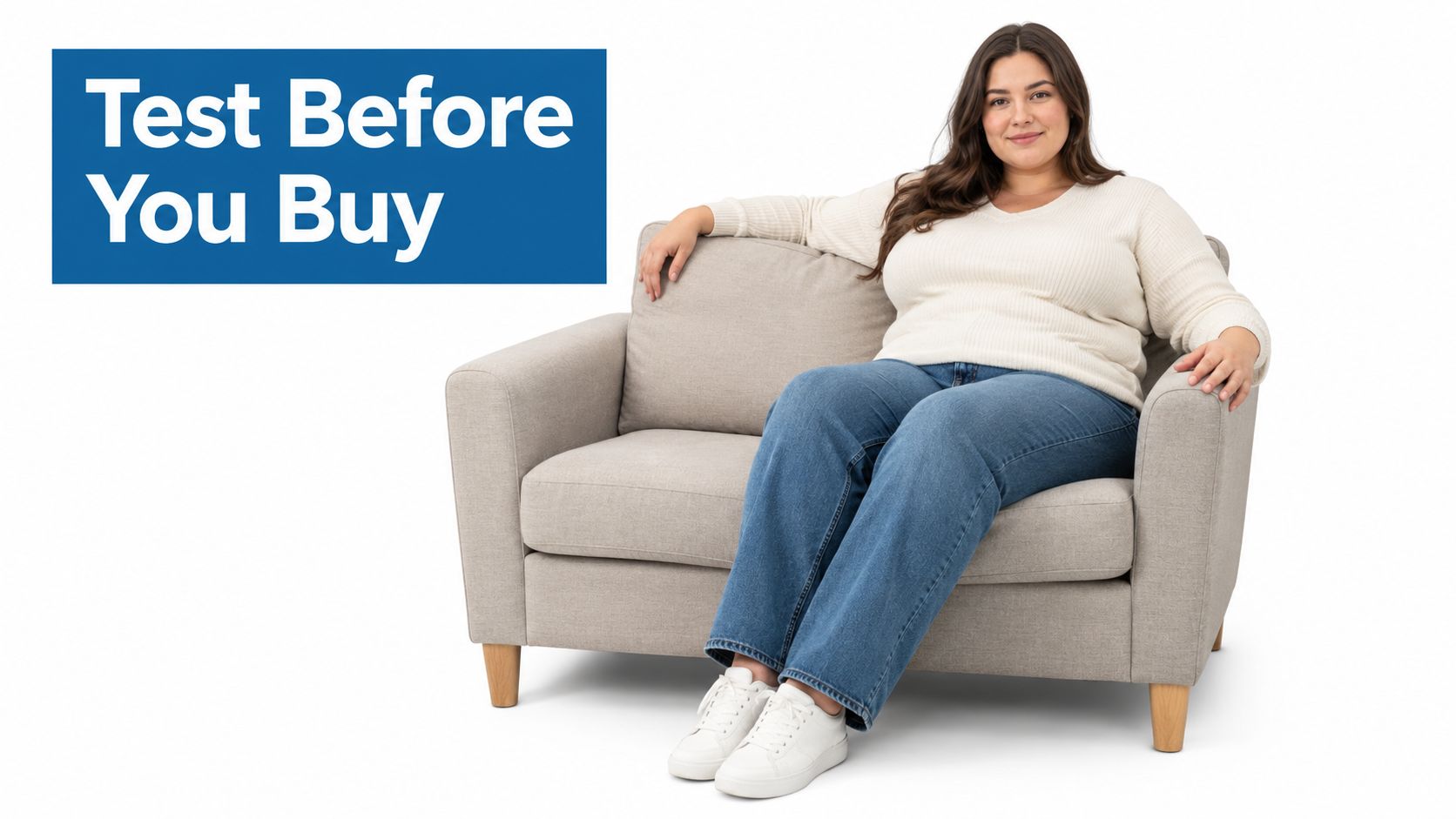
- Sit fully back: Measure seat depth, then sit with your back against the backrest. The front edge shouldn't press hard behind your knees or force you to perch.
- Check pelvis and lower back: The backrest should support a neutral pelvis and lumbar region, not just catch your shoulders while your hips roll backward.
- Sit for three minutes: Stay still in your normal posture and note pressure under the thighs, at the tailbone, or in one narrow band across the seat.
- Repeat later at home: If you're testing a seat you already own or can trial, sit again after a longer session. Discomfort that appears late often comes from pressure concentration or gradual sinking.
- Confirm foot contact: Both feet should stay flat and stable, with knees roughly level with hips rather than lifted by a high front edge or dropped into a hollow.
Laboratory work makes the same point with instruments. The published chair research in PMC uses maximum pressure, average pressure, a pressure exponent, and contact-area index as objective measures, showing that seat-pan and backrest structure and materials materially affect comfort. You can't run pressure mapping in a store, but you can judge its plain-language version. Broad, even contact usually feels sustainable. A sharp ridge, numb thigh, or single hot spot under the pelvis does not.
The Deep Seat Pitfall
An excessively deep, soft seat consumes circulation space and encourages pelvic slumping. You slide forward to reach the floor, your lower back rounds, and then you add throw pillows to chase support that the seat geometry removed. More loose cushioning rarely fixes that sequence.
Say a couple loves a sofa during a brief trial, then at home one partner feels pushed forward and achy after an evening of reading. The foam didn't suddenly fail. The short test never exposed the posture the deep seat created over time.
If you need a stack of pillows to sit upright on day one, you're redesigning the seat at your own expense. Choose thinner, firmer support or a different depth.
Run the test on the person who will use the seat, in the shoes and posture they'll use at home. A partner with longer legs can't certify comfort for someone shorter, and a caregiver shouldn't guess for the person who has to rise from it alone.
Fix Sinking Cushions and Sagging Bases
Separate cushion failure from base failure before buying parts. They feel similar from above, but they need opposite fixes.
Seat symptoms, causes and fixes
| Symptom | Likely cause | Fix |
|---|---|---|
| Hollow dip in the middle of the seat that does not rebound | Foam has compressed or is low density | Replace the cushion core |
| Cushion rebounds well but the base still dips | Deck or support flexing under weight | Add a rigid support board beneath the cushions |
| Bars felt through a sleeper mattress | Metal bars above the mattress support | Fit a sleeper sofa support board between the bars |
| Front edge caves when sat on | Front of the base weakened or uneven | Reinforce the front and re-level the legs |
| Cushions lose shape within days | Low-density foam or settling fill | Replace with higher-density foam and check fabric wear |
Use the Rebound Test First
Press down firmly on the cushion, release it, and watch the recovery. The Coleman Furniture durability guide describes this rebound test as checking whether a cushion returns to its original shape promptly, with delayed rebound or a persistent hollow indicating compression or loss of resilience. The same guide cites 15,000 double rubs or higher as a commonly recommended wear benchmark for residential upholstery fabrics exposed to routine household use.
If the cushion stays hollow, replace the core. If it rebounds well when tested on the floor but still dips on the sofa, stop blaming the foam. The deck, webbing, springs, or sleeper mechanism underneath is flexing, and reinforcement belongs there. That distinction is the core of how to fix sagging sofa cushions without replacing the whole seat.
Density Is Not Firmness
The Charlotte Observer guide to cushion foam cites approximately 1.8 pounds per cubic foot as a minimum benchmark for resisting premature compression in daily-use seating, while foam around 1.5 pounds per cubic foot or less compresses more easily and can lose resilience. A firm-feeling cushion can still be low density, so ask for the density figure rather than squeezing the corner and guessing.
For a sound cushion over a sagging deck, a rigid support board under the cushions spreads load and restores a level seat. Meliusly makes sofa cushion support boards and sleeper sofa support boards for that job, placed beneath the cushions or between sleeper bars rather than piled on top as extra padding.
Measure sleeper and platform gaps correctly. The Yawnder slat spacing guide cites a maximum open gap of 3 inches between bed slats for foam, latex, and hybrid mattresses, with some foam mattresses specifying about 2.75 inches, and stresses measuring clear space between adjacent slats rather than center to center. Wider gaps let a mattress flex downward between supports. Check your mattress maker's foundation rules first, then add support where the clear gap exceeds its limit.
I would start with the cheapest fix that matches the failed layer. A board won't resurrect dead foam, and new foam won't stiffen a bowing deck.
Layout Tricks and Renter-Friendly Fixes
Placement can recover space that a smaller sofa cannot. Pull a seat a few inches out of a trapped corner and you may open a walkway, improve the approach from the side, and make cleaning possible without dragging the frame. Don't angle a chair just for style if the angle steals the standing zone or leaves a dead triangle behind it.
Make the Seat Look and Work Lighter
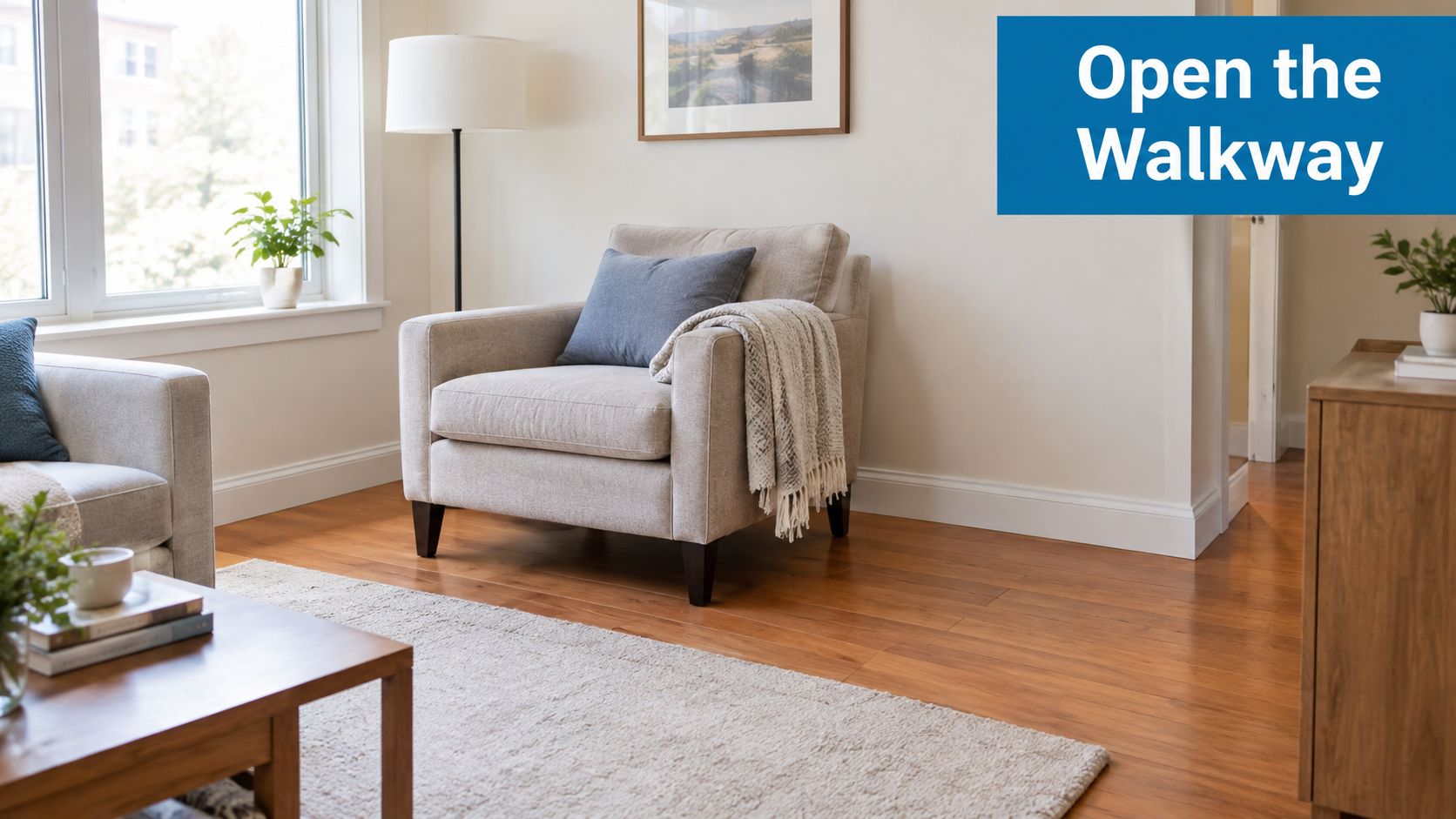
A rug under the front legs anchors the arrangement and defines the seating zone in an open room. It also stops a light chair creeping backward when someone pushes down to stand. Exposed legs and a visible floor line make a compact seat read lighter than a skirted base sitting flush to the floor, even at the same dimensions.
Keep side tables low and just outside the rise path. A table placed where a hand naturally reaches can help someone steady themselves only if it's stable and won't tip. If it wobbles, move it. Furniture shouldn't double as a grab aid by accident.
Reversible Support for Renters
Renters need support that leaves no evidence. Favour a board that rests on the deck and slides under the existing cushions, with no drilling, gluing, stapling, or frame modification. Keep any original thin deck panel or cushion insert you remove, label it, and store it flat so the piece can be restored at move-out.
Check your lease before altering a furnished sofa or bed, even for a repair you consider an improvement. Photograph the seat before and after, and choose fixes you can lift out during inspection. That protects your deposit better than arguing that the sofa sits better now.
Say a renter shares a living room with a sagging loveseat. She keeps it parallel to the long wall, places the front legs on a rug, slides in removable support, and leaves the frame untouched. The room gains a level two-person seat without blocking the door swing or buying replacement furniture she'll have to move later.
Avoid these placements even when they fit on paper:
- Across a radiator or vent: Heat dries materials and makes the seat unpleasant.
- Blocking window access: You still need to reach latches, cords, and cleaning space.
- Inside a door swing: Every entry becomes a negotiation.
- Floating without a stable handhold nearby: Risky for anyone who rises unsteadily.
Choose Your Seating Fix and Confirm Measurements
Pick the fix by failure, not by product category.
Your seat sags but the frame is sound. Run the rebound test on a hard floor. Replace a dead core, or support a good cushion from below when the deck is the layer moving. Don't buy both until the test tells you which one failed.
Your seat is too low for an older user. Measure compressed height and watch a real rise before changing cushions. A higher, firmer, stable seat solves the standing problem. A thicker soft topper can make the surface less predictable and still compress to the same low point.
You're buying a new compact piece. Tape the footprint, approach space, and open position first. Then test depth, back support, and foot contact with the intended user. Order only after both the room check and the body check pass.
You're renting. Keep the walkway open, use reversible support, and retain every original part. Your best upgrade is one you can remove in minutes and take to the next apartment.
Measure the clearance and the compressed seat height first, then fix the base before buying a new piece.
Work through the next actions in this order:
- Tape the approach zone: Confirm sitting, standing, and walking space on the actual floor.
- Test every cushion: Press, release, and record which cushions rebound and which stay hollow.
- Run the comfort test: Use the intended user, normal posture, and enough time for pressure points to show.
- Support the failed layer: Choose a support board when the base dips under a cushion that still recovers.
That sequence turns comfortable seating for small spaces from a guessing game into a measurement exercise. You'll either revive the furniture you have or buy its replacement with proof it fits the room, the person, and the act of standing up again.
If your rebound test shows good cushions over a dipping base, try a rigid sofa or sleeper sofa support board before you budget for a replacement sofa. Meliusly makes removable support boards for sofas, loveseats, armchairs, and sleeper sofas, so you can restore a level seat and extend the life of furniture that already fits your small space.