

Comfortable Seating for Living Room: Fit, Test and Fix
Posted by Meliusly
A sofa can feel generous in a showroom, then have you shifting every twenty minutes at home. The cushions looked plush when you bought it, but now your feet dangle, your back doesn't reach the backrest, or one spot seems to sink lower than the rest. That doesn't always mean you need a new sofa. The problem may be a mismatch in fit, compressed filling, worn foam, or support that has weakened beneath the cushions.
At Meliusly, we know comfort depends on more than a soft surface. A seat is a set of measurements your body has to match, and those measurements shift as the cushions compress and the layers underneath wear down. The right fix starts with identifying which layer has failed. Here's how to assess your sofa's fit, find the source of sagging, and decide whether a simple support repair can restore comfortable seating for your living room.
Why Comfort Depends on Geometry, Not Just Softness
A sofa that feels inviting in a showroom can feel awkward at home. Say you sit down expecting to relax, but your feet don't reach the floor and your back can't touch the back cushion unless you slouch. The seat may be soft, but its geometry isn't working for your body.
Think of a sofa as a set of connected points, not a soft block. It's like a ladder leaning against a wall: move the base and the top shifts too. A change in cushion height can alter your knee position, while a change in seat depth can move your back away from the backrest.
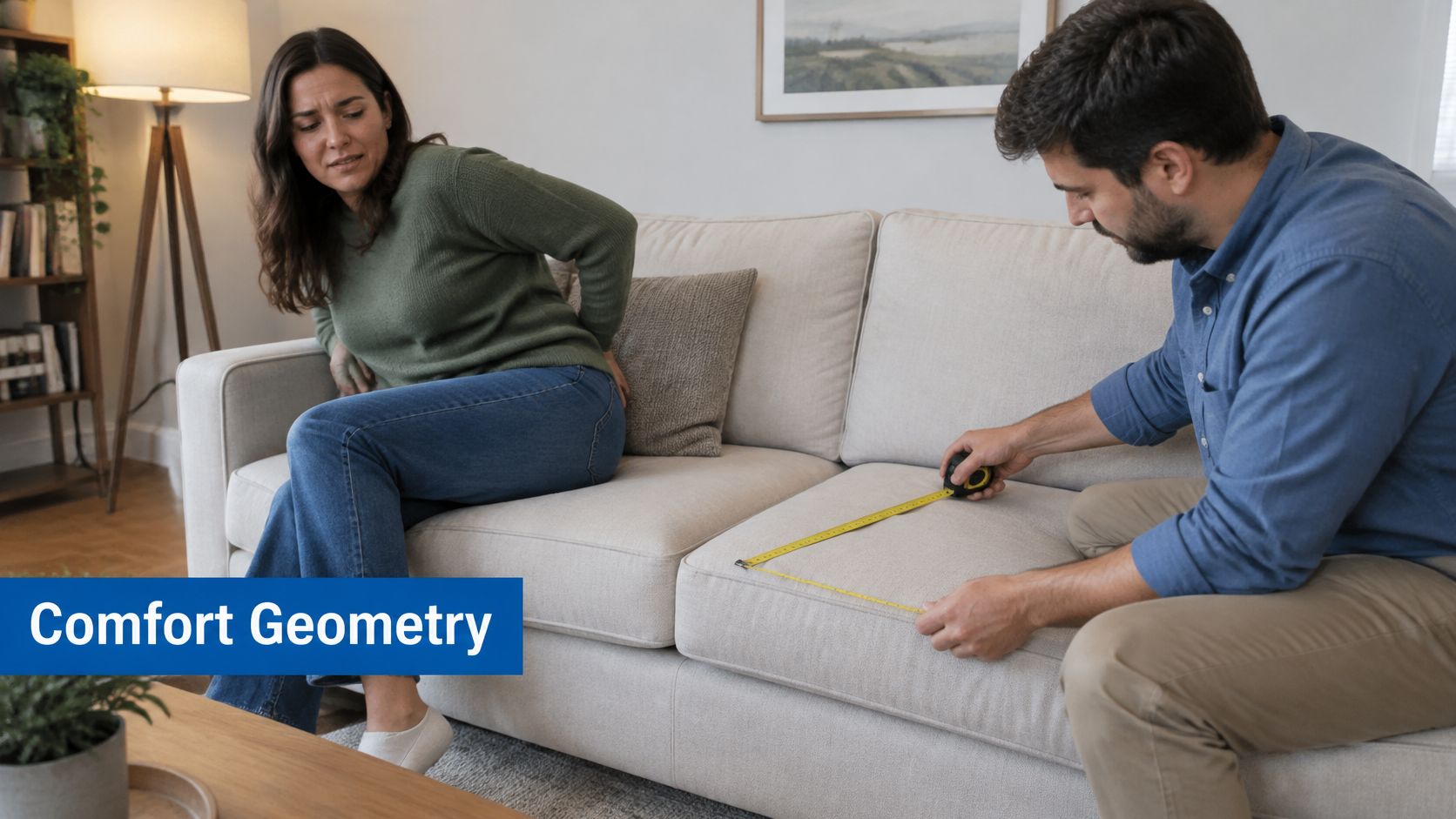
Three measurements do most of the work:
- Seat height determines whether your feet rest on the floor and how easily you can stand.
- Usable seat depth determines whether your back can reach the backrest while your feet stay supported.
- Seat-to-back angle affects how upright or reclined your torso sits.
Softness can make a well-fitted seat feel inviting, but softness alone can't make up for poor support. If the cushion beneath you compresses too far, your pelvis sinks and the geometry changes. A sofa that fitted well when new can gradually become too low or too deep without the frame itself changing.
For a broader look at the relationship between posture, dimensions, and cushion support, Critelli Furniture's guide to choosing an ergonomic sofa offers useful context. When a seat stops feeling comfortable, ask: is the discomfort coming from geometry, filling, or the frame?
Dimension Benchmarks for Every Living-Room Seat
A seat that measures within the typical range on the empty frame can sit lower once someone is on it, because cushion compression changes the geometry. For general-purpose seating, start with a seat height of about 16–18 inches and a usable seat depth of 20–22 inches. A deeper seat of 23–25 inches suits relaxed lounging, though it can leave shorter users without back support. A seat-to-back angle around 100–110 degrees balances upright conversation with reclining comfort, according to Homestyler's sofa dimension guide.
| Seat Type | Seat Height | Usable Seat Depth | Seat-to-Back Angle |
|---|---|---|---|
| General-purpose sofa | 16–18 in | 20–22 in | 100–110° |
| Deep lounging sofa | 16–18 in | 23–25 in | 100–110° |
| Older adults or limited knee mobility | 17–18 in | 20–22 in | 100–110° |
| Mixed-height households | 16–18 in, with individual fit checked | 20–22 in, or a removable lumbar cushion | 100–110° |
Treat these as starting points for fitting, since bodies differ and the same sofa can suit one person while failing another. The upper end of the height range makes standing easier for someone with limited knee mobility. A deep seat works for a taller sitter who wants to lounge; a shorter person can add a lumbar cushion to bring the backrest closer without losing foot support. For more on how depth changes posture and fit, see this guide to seat depth ergonomics.
Backrest angle earns its own column for a reason. Reclining the backrest shifts part of the torso's weight off the seat and onto the back itself, which generally does more for the load on your lower back than softer foam does. A seat can feel plush and still leave you slouched if the angle holds your pelvis in the wrong position. Given the choice, I'd fix the angle before upgrading the foam.
Measure the seat under load
Measure the cushion while someone is sitting on it normally, not on the empty frame. For height, measure from the floor to the top of the compressed seat cushion. For depth, measure from the front edge to the point where the sitter's back contacts the backrest cushion. An unloaded frame overstates height and understates the depth a compressed back cushion creates.
Quick fit check: If your feet can't rest flat while your back touches the cushion, the seat depth or height isn't working for you.
How to Test Your Sofa Fit in Five Minutes
Use this quick test on the sofa as it's used every day. Testing freshly fluffed cushions can hide the compression that matters once the seat has been occupied for a while.
- Sit all the way back. Move your hips until they touch the back cushion. If your back still can't reach it comfortably, the usable seat depth may be too great for you.
- Set your feet on the floor. Keep your knees bent and notice whether the seat front presses behind them. Pressure there can mean the seat is too deep or the sitting height doesn't suit your body.
- Check for bottoming out. Slide a hand between your thigh and the cushion to feel for the frame or deck. If you can feel a hard surface beneath your pelvis, the cushion or the support underneath isn't carrying your weight adequately.

- Measure under your body weight. With someone seated normally, measure from the floor to the cushion top, then from the front of the seat to the backrest contact point. These measurements describe the seat as you use it.
- Check for a dip or tilt. Lay a level across the cushions. A dip can point to compression or failing support; a tilt toward one side suggests the surface isn't staying even.
- Shift from side to side. Pay attention to hard spots under your sitting bones or thighs. A localized pressure point can signal uneven support or a cushion that has lost its shape.
Pass or fail: If your feet can't rest flat with your back against the cushion, or your hand can feel the frame under your pelvis, the seat needs attention before you buy it or decide how to repair it.
Finding Whether the Cushion, Foam or Frame Is at Fault
A sagging seat doesn't automatically mean the cushion is finished. The issue may be loose filling, worn foam, or the foundation beneath the cushion. Match the repair to the failing layer, and you may be able to keep parts that are still usable.
Start with three checks. Press the cushion and watch whether it rebounds; stand up and see if a dent remains; then place the cushion on the floor and compare how it feels there with how it feels installed. This sequence helps separate cushion problems from a weak seat deck, as described in Povison's guide to diagnosing sagging couch cushions.
| Symptom | Likely Cause | Fix |
|---|---|---|
| Cushion looks flat but springs back when pressed | Compressed batting or fill | Refluff or add fill before considering new foam |
| Cushion stays dented after use | Worn or compressed foam | Replace the foam core, or add a firm layer beneath it if the support deck has also lost height |
| Cushion feels firm on the floor but sinks when installed | Worn springs or webbing beneath | Add a firm support board to restore the deck, if the frame is sound |
| Whole seat dips across its width | Frame or deck support failure | Check joints and corner blocks before adding a board |
A flat cushion that springs back often needs its filling or batting redistributed. If it stays dented, the foam is more likely worn. A cushion that feels firm on the floor but sinks on the sofa points toward weakened support below it, such as springs or webbing.
The broad, full-width dip is the case to approach carefully. Inspect the joints and corner blocks before covering the seat with a board. A board can help restore a level foundation, but it won't repair a cracked or unstable frame. If you want to understand the parts beneath the upholstery before deciding what to do, consult this sofa construction guide.
Test in this order: filling first, foam second, deck and frame last. That order helps avoid replacing cushions when the actual fault lies beneath them.
When Support Extends Furniture Life and When to Replace
How long a sofa lasts is not a fixed number. Service life depends on frame quality, joint tightness, upkeep, and foam condition, and the same model can hold up very differently in two households. Solid or kiln-dried hardwood frames, reinforced joints, and corner blocks stay stable longer than particleboard or inexpensive engineered wood. Foam density matters too: a furniture-industry guideline cited by the Charlotte Observer's sofa guidance identifies at least 1.8 pounds per cubic foot as a threshold associated with better resistance to long-term compression.
A support layer makes sense when the frame and foam remain sound but the seat deck has lost height. It can restore the cushion's position and help return the seat to a more supportive shape. If the frame is failing, putting a board over it only shifts where the load lands. My rule of thumb: if the frame shifts or creaks when you press down on the arm, no support layer fixes that.
| Situation | Best Move | Why |
|---|---|---|
| Solid frame, tight joints, cushions sag, foam still holds its shape | Add a support layer | The structure is sound; the deck needs help holding the cushion level |
| Cushion foam is dented and density is below 1.8 lb per cubic foot | Replace the cushion foam | A board can't restore foam that has lost its shape |
| Particleboard frame with loose joints | Repair or replace the frame | A support board won't make an unstable frame sound |
| Several components have failed at once | Replace the sofa | Costs can accumulate across multiple components |
Match the repair to the remaining structure
Say a sofa has a solid hardwood frame and tight joints, but its cushions sag in the middle. If the foam still holds its shape and the deck has lost height, that is a good candidate for support. The same sofa with a cracked frame rail is not: fix or replace the damaged structure before adding a seat support.
When you replace foam, the softest option is rarely the best one. Seat comfort is a geometry problem: a contoured cushion generally distributes weight more evenly than a flat one, and as foam compresses the geometry keeps changing. Two people can sit on the same cushion and get different results, because the depth of the hollow changes how far each pelvis sinks. The practical aim is to spread weight across the seat rather than let the pelvis drop into a deep hollow, where load concentrates around the sitting bones and lumbar support suffers.
Repair becomes harder to justify when several parts have failed and the work adds up. If the frame needs attention, the foam is dented, and the upholstery or other components also need repair, compare the total cost against replacement before you invest in one more partial fix.
Fitting Seats to Different Bodies and Room Layouts
A sofa is shared furniture, but people don't share the same proportions, mobility, or habits. A seat that lets a tall adult stretch out may leave a shorter sitter's back unsupported. A low, deep cushion that feels relaxing to one person may be difficult for someone else to get out of.
For different heights: Deeper seating tends to suit taller sitters. Shorter users can try a removable lumbar cushion to bring the backrest closer; that changes the usable depth without changing the sofa itself. If a household shares one sofa, prioritize a configuration that fits the most frequent users, then use removable support to accommodate the rest.
For mobility: Someone with limited hip or knee movement may find a seat in the upper part of the general-purpose height range easier to rise from. Armrests also matter because they provide a stable place to push up. A neutral ergonomics study reports suitable armrest heights of around 17.3–27 cm, depending on the user, and its upright-seating guidance underscores that body size changes what feels supportive.
For different activities: One deep sofa rarely serves every task well. Lounging can call for a deeper seat, while reading, upright conversation, or working at a laptop often feels easier with a more upright posture. If the main sofa is designed for lounging, add one supportive upright chair rather than expecting every seat in the room to work the same way.

Make the layout work for conversation and movement
A tall adult and a shorter teenager can share a deep sofa more comfortably with a removable lumbar cushion for the shorter sitter and a footrest when needed. Those adjustments let each person change the fit without replacing the sofa.
Leave clear circulation space for a walker or other mobility aid. Arrange seats so people can see one another without twisting or leaning across the room, and avoid placing a low, deep lounger where someone needs to stand often. A 2025 scoping review of 64 empirical studies found that furniture, layout, and accessibility features can affect older adults' well-being. In one care-home study included in the review, residents spent 13.4% of their time interacting, and 2.2% of interaction attempts received no response when furniture obstructed visibility or proximity, according to the review on older adults' environments.
The best seat is the one that works for the person who uses it most, doing the activity that happens most often. Check that everyone seated can see and reach the others without leaning or standing.
Maintenance Habits That Keep Cushions Level
Use a routine that limits uneven wear and catches shifting support before it changes the seat's fit.
- Monthly, vacuum the upholstery. Use a soft brush attachment to lift dust and debris before it settles into the fabric. A furniture life-cycle assessment describes monthly vacuum cleaning for upholstered parts, a practical interval included in its furniture maintenance analysis.
- Periodically, rotate or flip loose cushions. This spreads use across the cushion instead of compressing the same high-use spot every day.
- When you rotate, check the support. Confirm that any support board still sits level, that its corners haven't shifted, and that it clears the sofa frame.
- After use changes, repeat the fit test. A new household member or heavier daily use can change which cushions take the most wear.
Rotation only helps while the other side still holds its shape. Turning a cushion over indefinitely won't restore foam that has compressed on both sides; reassess the foam when the other face also looks or feels worn.
For a fuller care routine, use these practical sofa maintenance tips. Consistent care keeps cushions more even and can delay the point when a support repair or replacement becomes necessary.
Confirm the Fit Before You Buy or Repair
Use this decision path in order. It helps you avoid buying a cushion when the deck is sagging, or adding a board when the frame itself needs repair.
- Check fit: Run the five-minute test. Your feet should rest flat with your back against the cushion, and you shouldn't feel the frame under your pelvis.
- Identify the cushion layer: A flat cushion that rebounds points to fill; a dent that remains points to foam; a cushion that feels firm on the floor but sinks on the sofa points to springs or webbing.
- Inspect the frame: Look for cracks and loose joints, especially if the seat dips across its width.
- Choose the repair: If the frame is sound and only the deck has lost height, a support layer may be the right fix. If the foam or frame has failed, address that part instead.
Meliusly sells support products for beds, sofas, and sleeper sofas. The Heavy Duty Sofa Cushion Support Board, a couch support for sagging cushions, is on sale for $29.99. Before ordering any board, measure the compressed seat from floor to cushion top and from the front edge to the backrest contact point. The right repair depends on which layer has failed.
Meliusly offers support solutions for sagging sofas, sleeper sofas, and beds, including the Heavy Duty Sofa Cushion Support Board for a sofa whose frame is sound but whose seat support has weakened. Check the fit guidance and current product details at Meliusly before choosing a repair.
Share this post
- Tags: living room seating, sagging sofa cushions, seat height guide, sofa seat depth, sofa support board