

Chair Protector Covers: How to Choose the Best
Posted by Meliusly
Your favorite reading chair rarely fails all at once. First, the seat begins to feel lower, then the front edge shows shiny wear, and eventually coffee, pet hair, or a small spill leaves the upholstery looking permanently tired. A chair protector cover can slow that decline, but only when it fits the chair, blocks the right threats, survives washing, and works with the furniture's underlying support.
At Meliusly, we've served over 400,000 customers with practical furniture support solutions, from sofa supports to sleeper sofa support boards, bunkie boards, and bed slats. That experience leads to one straightforward principle: surface protection helps, but it can't compensate for a cushion or frame that's already collapsing.
The Evolution of Furniture Protection
A loose cover thrown over a chair often signals defeat. It slips during use, gathers at the seat corners, and exposes the exact areas that need protection most. Yet the basic idea behind chair protector covers is much older than modern pet-friendly furniture products.
Historical records trace protective covers for upholstered chairs and sofas back to the 18th century. Early covers were often loose and wrinkled, made from fabrics such as baize and serge, and used primarily to keep dust away from valuable furniture. By the second half of the 1700s, washable linens and cottons increasingly replaced those heavier materials, with designs chosen to coordinate with the room's furnishings. The shift shows how furniture protection moved from a purely practical shield toward a recognized home-furnishing accessory. American Furniture's history of protective furniture covers documents that progression.
A modern homeowner faces the same basic problem, just with different sources of wear. A chair may deal with body oils, food, pet claws, children, dust, and repeated friction at the seat front. A properly designed cover adds a replaceable layer between those hazards and the original upholstery.
Practical rule: A cover should protect the chair without hiding a structural problem that needs repair.
For a useful overview of how protective textiles fit into broader furniture care, Lewis and Sheron Textiles offers this guide to fabric protection for furniture. For especially messy environments, a clear plastic option such as these clear plastic sofa protectors takes a more visibly utilitarian approach.
The best chair protector covers now function as engineered barriers. They may combine abrasion resistance, liquid protection, washable construction, elastic recovery, and attachment features that keep the fabric positioned during ordinary use. That's a substantial improvement over placing a spare sheet over the chair and hoping it stays put.
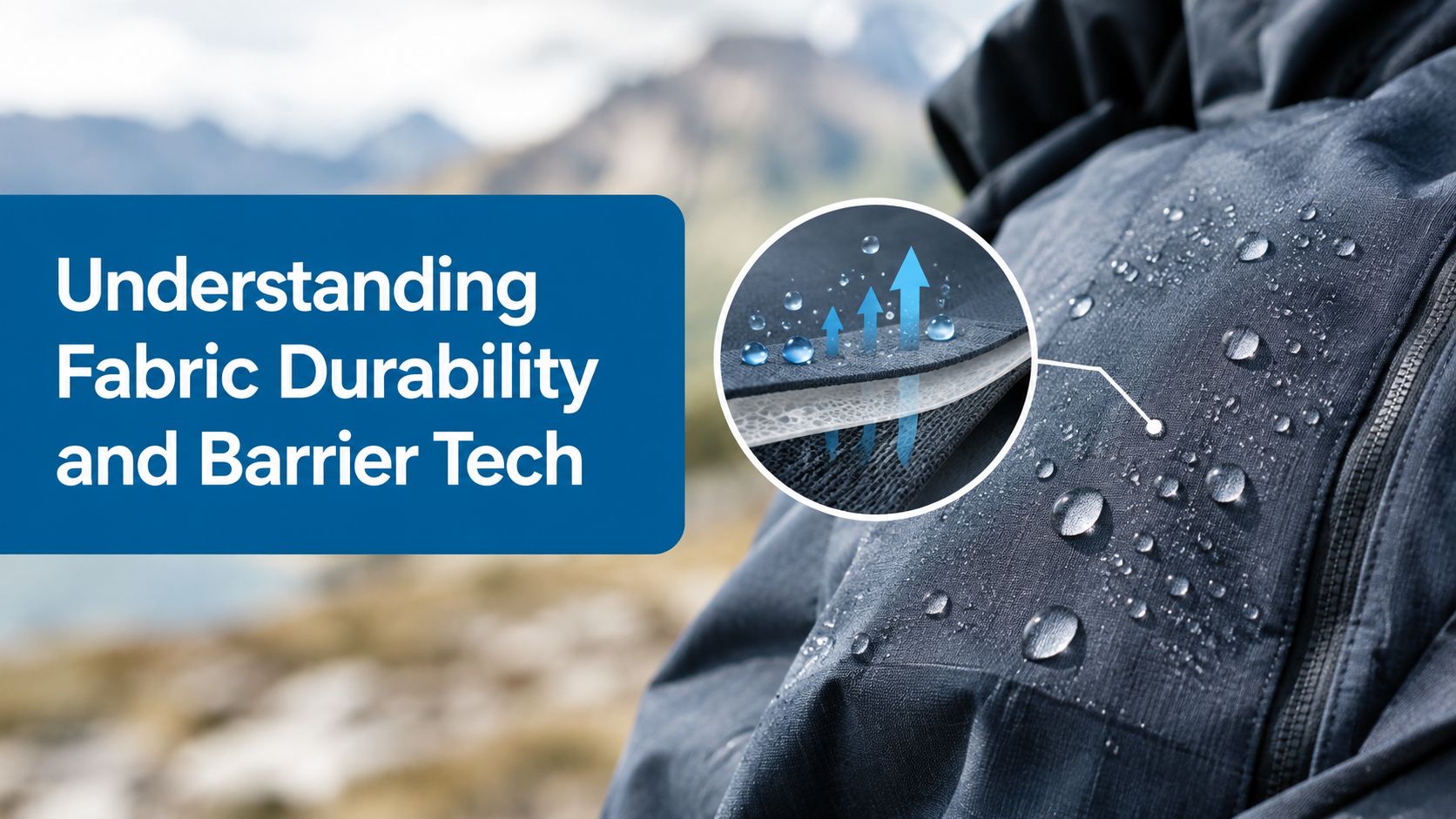
Understanding Fabric Durability and Barrier Tech
A cover's appearance tells you very little about how it will perform. The important specifications concern abrasion resistance, fluid protection, construction, and laundering tolerance.
Manufacturers commonly describe upholstery abrasion with either the Wyzenbeek test, widely used in North America, or the Martindale test, commonly used in Europe. Residential upholstery often falls around 10,000 to 15,000 double rubs, while 30,000 or more double rubs or cycles generally indicates heavy domestic or commercial-grade performance. 50,000 or more is common for high-traffic commercial seating. These reference points are explained in this guide to upholstery fabric durability ratings.
A quiet reading chair and a busy family-room armchair shouldn't receive the same cover. Low abrasion performance tends to reveal itself at the seams, elbows, and front edge of the seat, where movement concentrates tension. A rating suited to the expected use helps reduce premature visible wear, but it won't fix a cover that's too tight or constantly sliding.
Look beyond the face fabric
For spill protection, a decorative polyester surface isn't enough. Technical protector covers often use a tri-layer structure, pairing a polyester microfibre top with a non-woven polypropylene underside. The face can feel soft and remain wipeable, while the underside helps stop liquid from transferring into the chair foam.
Some independent product specifications describe premium protector covers as resisting fluid penetration at about 150 ml per hour. That figure comes from product specifications for a tri-layer chair protector cover, not a universal industry standard, so buyers should treat it as a product-specific rating rather than a guarantee for every cover. These chair protector cover specifications also emphasize the relationship between barrier construction and care.
A barrier can prevent a spill from becoming a deep contamination problem, but it can also trap moisture if the chair remains damp underneath. Remove the cover after a substantial spill, dry both layers, and inspect the original upholstery rather than sealing moisture in place.
Check surface behavior too
Polyester microfibre and polyester-spandex blends are common because they balance cleanability, stretch, and everyday durability. Surface maintenance matters as well. Fabric pilling guidance, including this resource on how to prevent pilling on quilts, is useful when comparing soft, frequently handled textiles.
A proper specification should tell you more than “water resistant.” Look for the face and backing materials, abrasion information, seam construction, attachment method, and washing instructions. If the listing gives none of these details, you're evaluating a decorative textile, not a verified protective system.
For dining chairs exposed to food and drink, this guide to waterproof dining chair covers provides a practical starting point for comparing material and fit considerations.
Mastering the Fit to Avoid Return Hassles
Poor fit is the fastest way to turn a useful cover into a nuisance. A loose cover bunches under the sitter, while an undersized one pulls at the seams and leaves parts of the chair exposed. “Universal” usually means broadly compatible, not perfectly fitted.
Market data for chair covers recorded over 19% of returns in 2023 as size or fit related. That figure is reported in chair-cover market data from ASINSIGHT, and it reflects a practical buying problem: chair shapes vary too much for a single size label to tell the whole story.
Measure the chair before shopping
Use a flexible tape measure and record the dimensions without compressing cushions.
- Measure back height. Start at the floor or the lowest point the cover must reach, then measure to the highest part of the chair back. If the cover is designed for a seat-only application, measure from the seat surface instead.
- Measure overall width. Include the widest fixed point, such as the outside edges of the arms. A narrow back does not make a narrow chair if the armrests project farther outward.
- Measure seat width and depth. Measure between the arms, then from the front edge of the seat to the back cushion or backrest. Note whether the seat cushion is loose, boxed, rounded, or attached.
- Record armrest depth and shape. Deep, rolled, or sharply angled arms need more fabric than slim straight arms. Include the arm height if the product's size chart requests it.
- Compare with the manufacturer's chart. Don't rely on a label such as “one size fits most.” Match your measurements to the actual cover dimensions and check whether the chart refers to the furniture or the finished cover.
A good fit should sit securely without forcing the seams across corners. Tuck-in panels, elastic hems, ties, or straps can help, but they can't compensate for a cover that starts with the wrong dimensions.
Protect the air space beneath the cover
A cover that pools around the base can create dark, poorly ventilated pockets against the upholstery. Upholstered furniture can hold allergens, odors, and bacteria, while moisture trapped beneath an impermeable barrier may contribute to mold or mildew growth. This discussion of chair-leg protectors and upholstery hygiene highlights why protection must include moisture management, not just stain blocking.
Inspect underneath periodically, especially after spills or humid conditions. A secure, correctly sized cover is easier to remove, dry, and reinstall than a loose fabric layer that has twisted around the chair.
Pairing Covers with Structural Support Systems
A chair protector cover can shield upholstery, but it can't restore a collapsed cushion or weakened frame. If the seat sinks low, the cover follows that depression and experiences uneven tension every time someone sits down. The fabric may stretch at the lowest point, pull against the seams, or drag across the front edge.
This is the distinction between surface preservation and structural preservation. The first limits staining and abrasion. The second keeps the seating platform level enough that the cover can do its job without carrying the entire load of a failing cushion.
Diagnose the support problem first
Before buying a cover, press down across the seat and compare the center with the edges. Look for a cushion that bottoms out, a support deck that flexes excessively, broken webbing, or a frame joint that shifts under load. A cover may make the chair look tidier, but it won't make a sagging base comfortable or stable.
For sofas and sleeper sofas, a rigid support board can provide a firmer, flatter foundation beneath the cushions. Meliusly's sofa construction guide explains why the frame, deck, springs, webbing, and cushions all affect the final seating experience.
Meliusly offers heavy-duty sofa cushion support boards and sleeper sofa support boards that sit beneath cushions to reduce the sensation of sagging. Those products apply most directly to sofas and sleeper sofas, but the underlying principle also helps when evaluating a large armchair: stabilize the load-bearing structure before relying on a protective textile.
A cover stretched over a collapsing seat is not preserving the furniture. It's conforming to the failure.
Match the cover to the repaired seat
Once the base is firm and aligned, reinstall the cushions and check the cover. The fabric should lie smoothly across the seating surface, with enough flexibility for normal movement but without deep folds at the front edge. If the cover still shifts, adjust the attachment points and inspect the cushion dimensions again.
Pet owners can also compare practical options when browsing protective covers for pets, but the same test applies to every product. Does it stay positioned, allow the upholstery to dry, and fit the furniture without creating new stress points?
Choosing the Right Cover for Your Lifestyle
The right cover depends less on appearance than on the work your furniture performs. A low-use guest chair needs different construction from a dining chair that handles daily meals, or a rental sofa that must be cleaned between occupants.
Chair-cover listings remain strongly value-oriented, with most listed chair-cover ASINs concentrated in the $20 to $50 range, and one market page placing 74.65% of those ASINs in that band. This chair-cover market listing data supports a useful buying conclusion: many customers want an affordable utility layer, not a custom upholstery project.
| Use Case | Ideal Material | Support Pairing |
|---|---|---|
| Children and pets | Washable polyester or polyester-spandex stretch fabric with a protective backing | Check cushion firmness and repair sagging seats before installation |
| Dining chairs | Wipeable polyester microfibre or a fluid-resistant layered cover | Confirm the seat is level and the cover doesn't catch on the chair frame |
| Renters and apartments | Removable, non-permanent slipcover with secure elastic or ties | Use reversible support changes that don't alter the furniture |
| Guest rooms | Soft washable fabric with moderate abrasion performance | Inspect the cushion and frame during routine cleaning |
| Hospitality and short-term rentals | Higher abrasion performance, strong seams, and fast-cleaning construction | Pair with suitable sofa or sleeper support where cushions bottom out |
Choose stretch with caution
Polyester-spandex can produce a cleaner fit on chairs with curves, but stretch isn't the same as strength. A highly elastic cover may recover well after washing, yet still fail if it remains under constant tension across a sharp corner. Look for reinforced seams and an attachment system that distributes pull instead of concentrating it at one hem.
For households with frequent spills, a fluid-resistant barrier is more useful than a decorative finish. For renters, removability and easy laundering may matter more than a premium hand feel. Hospitality operators should prioritize repeatable cleaning and durable construction over a cover that looks impressive on the product page but takes too long to remove.
The most expensive cover isn't automatically the most appropriate one. Spend on the feature that addresses your actual risk, then correct the chair's support problem separately.
Care Routines That Preserve Seam Strength
Machine washability only helps if the cover retains its shape after laundering. Retail listings commonly describe chair protector covers as machine washable, with instructions that may include cold-water washing, tumble drying, or other product-specific care requirements. This machine-washable chair protector listing illustrates why the care label should be treated as part of the product specification.
Use a simple routine:
- Remove debris first. Shake off crumbs and vacuum pet hair before washing. Grit trapped in the fabric can increase surface abrasion during the cycle.
- Use mild detergent. Strong chemicals may affect coatings, elastic, and thread. Avoid adding products that leave a heavy residue on the barrier surface.
- Follow the cold-water instruction when specified. Cooler washing is generally gentler on synthetic fibers, backing layers, and seam recovery.
- Choose low heat or air drying. Care guidance for slipcovers emphasizes low-heat drying and mild detergent to help preserve seam life. High heat can distort synthetic fibers, weaken elastic, and reduce the cover's ability to return to its original shape.
- Dry completely before reinstalling. Never trap damp fabric against upholstery. Check the underside, hems, and stitched corners before putting the cover back on.
- Inspect after every deep clean. Look for loose thread, stretched elastic, cracked backing, and seam separation. Repair or replace the cover before a small defect becomes a full opening.
Fire safety is another practical consideration. In the UK, upholstered furniture covers fall under the Furniture and Furnishings (Fire) (Safety) Regulations, which require match resistance and, in some cases, cigarette resistance. FIRA's flammability guide explains why replacement covers should be checked for applicable local compliance, especially when the original upholstery had a treated or regulated construction.
Meliusly provides practical support solutions for sagging sofas, sleeper sofas, chairs, and beds, including sofa cushion support boards, sleeper sofa support boards, bunkie boards, and bed slats. Visit Meliusly to pair better surface protection with the firm structural support your furniture needs.
Share this post
- Tags: chair protector covers, furniture protection, sagging couch fix, sofa support boards, upholstery care