

Can You Sleep on a Sofa Bed Every Night?
Posted by Meliusly
Yes, you can physically sleep on a sofa bed every night, but it's risky for spinal health because most sofa beds use mattresses only 5–8 cm thick, usually too thin to maintain neutral spinal alignment through a full 7–8-hour night. The limiting factor isn't whether the bed opens and closes. It's whether the frame, mechanism, and mattress maintain continuous support night after night.
You may have bought a sleeper sofa for guests, then began using it as your main bed. The room still works during the day, but by morning your hips feel compressed, your shoulders ache, or your lower back takes a while to straighten. That pattern points to a structural problem, not just a preference for a softer mattress.
The Short Answer to Nightly Sofa Bed Sleeping
A sofa bed can survive occasional guests yet fail as a primary bed. Nightly use creates a high-cycle structural load: the mattress compresses repeatedly, hinges and center supports take pressure, and the frame must hold a consistent sleeping plane for hours. If any contact point flexes, the problem is support continuity, not just mattress softness.
A UK-based consumer guide from Furl reports that most sofa-bed mattresses measure only 5–8 cm thick. That leaves limited material to spread pressure around the hips and shoulders or mask seams, bars, and mechanism components during a full 7–8-hour night. Its consumer guidance on nightly sofa-bed sleeping links these design limits with discomfort and repeated strain.

Comfort is not the same as support
A sofa bed may feel fine when you first lie down while allowing the pelvis to sink, the torso to tilt, or the spine to curve as the hours pass. Occasional couch sleeping is unlikely to cause lasting harm, but regular nightly use may contribute to chronic back pain and neck pain. Repeated loading gives the furniture little recovery time and gives your body the same unsupported position night after night.
Check the structure before treating the mattress as the only fault. Lie on the opened bed, test the center and edges, and look for a ridge, hollow, loose hinge, or frame movement. If the sleeping surface remains level and supported across its full length, an upgrade may be practical. If the frame bends or support breaks between sections, replacing the mattress alone will not correct the failure.
Guidance on air bed and spine health also illustrates why surface stability and alignment matter more than the product label.
Practical rule: If pain recurs by morning, judge the sofa bed by its support at wake-up, not its comfort during the first few minutes.
Why Nightly Use Damages Your Spine Over Time
Your spine doesn't need a hard surface. It needs continuous, even support that keeps the pelvis, rib cage, and head from falling into different angles. A sofa bed becomes problematic when its thin mattress follows the weak points beneath it instead of smoothing them out.
A soft section over the hips can let the pelvis drop, while a rigid hinge or center bar holds the torso higher. That creates a curved sleeping position and forces muscles to work while you're meant to rest. A mattress that feels firm at first can still fail if the support beneath it is interrupted or if the frame sags between contact points.
The pelvic position matters
Research published in 2026 found that prolonged sofa sitting increased posterior pelvic tilt and worsened low-back pain among people with chronic nonspecific low-back pain. A separate 25-year review reported back-pain prevalence of 61.3% among students sleeping on sofas, compared with 57.6% among those using normal mattresses. The research review and sofa-sitting findings don't prove that every sofa bed causes pain, but they reinforce a practical concern: sofa-based surfaces often provide less anatomical support than a purpose-built bed.
That concern is especially relevant if you already have back symptoms. A useful companion resource from Lake City Physical Therapy on pelvic pain discusses how sleep position can affect the pelvis and surrounding structures. The same principle applies here. When the surface changes your pelvic angle for hours, the problem can show up as morning stiffness, hip pressure, or pain that continues after you stand.
Where the strain starts
The common failure points are predictable:
- Hip sag: The heaviest part of the body sinks into thin foam or a weak support span.
- Hardware pressure: A metal bar or hinge ridge creates a concentrated pressure point beneath the torso.
- Neck compensation: Your shoulders and hips settle unevenly, so your pillow no longer keeps your neck aligned.
- Repeated flexion: Muscles hold the spine against an awkward curve night after night.
The issue isn't that sofa beds are automatically unsafe. It's that nightly use exposes every gap in the support chain.
How to Check Your Sofa Bed Support Before Committing
Open the sofa bed fully and inspect it as a sleeping system, not as a piece of living-room furniture. You can find most serious problems without tools.
Check the deployed surface
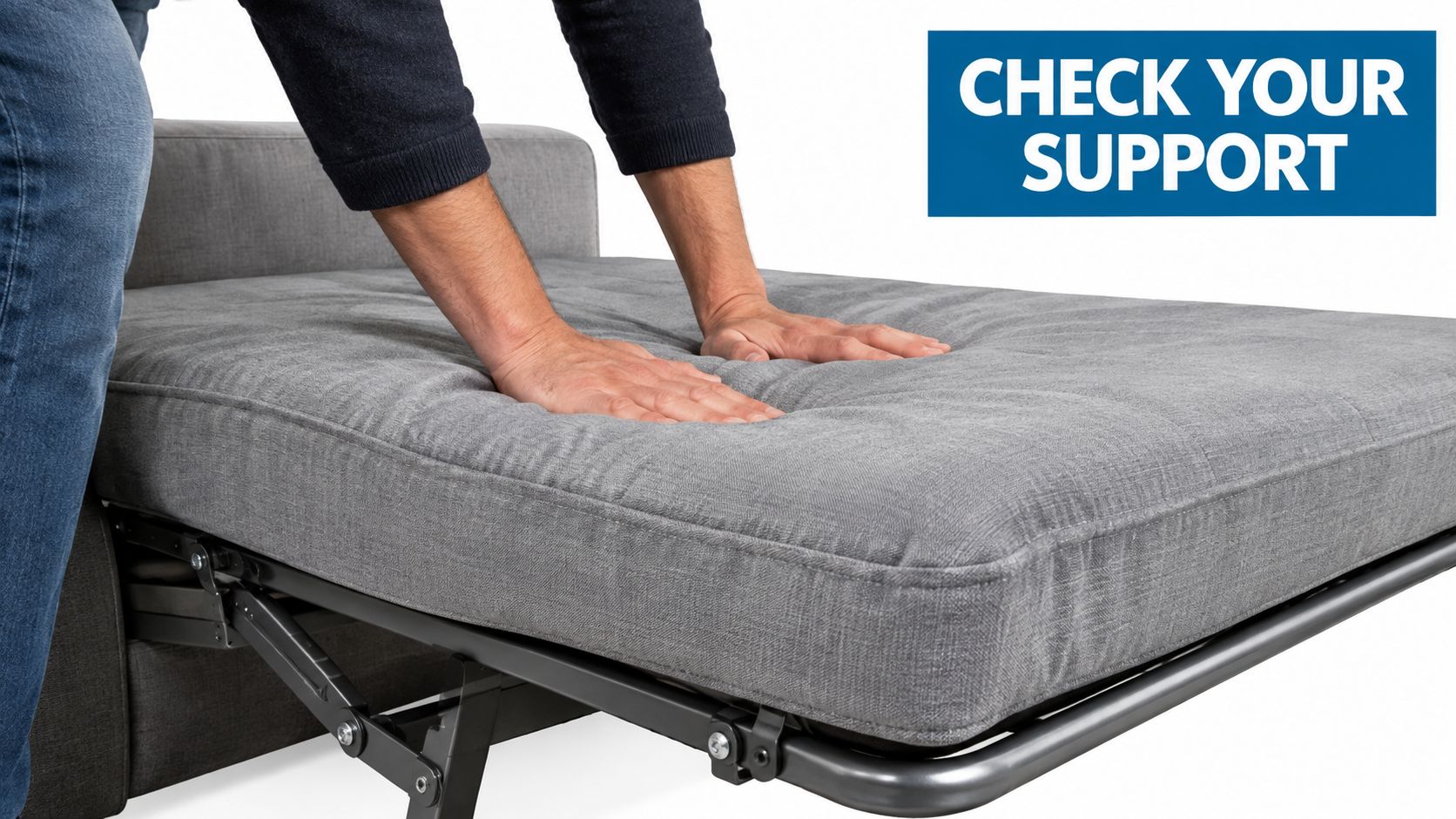
First, place a straight object, such as a long level or a rigid board, across the sleeping surface. Look for a dip through the middle, a raised fold near the hinges, or a transition between mattress sections. The surface should remain flat enough that your torso doesn't bridge a gap while your hips drop into it.
Then lie down in your usual position. Move slowly from your back to your side and notice whether the mattress collapses beneath the shoulders or pelvis. Excessive sink means the mattress isn't distributing your weight evenly.
Find the ridge beneath your torso
Run your hand across the mattress and press down at the center of the sleeping area. A rigid bar or hinge ridge directly below the ribs or lower back will remain noticeable even when the mattress is dressed with bedding. That's a structural interruption, and adding a softer sheet won't remove it.
Assess mattress depth and support
A thin mattress may feel tolerable when you sit on it, but sleeping applies pressure for much longer. Check whether your hips and shoulders compress through the mattress into the frame. Also inspect the slats, straps, and joints for looseness or visible sagging.
For more detailed repair guidance, see Meliusly's sleeper sofa mattress support. If the surface fails the flatness, ridge, or sink test, treat that failure as a reason to improve the support system before making the sofa bed your permanent sleeping surface.
Back-sleepers can place a pillow under the knees, while side-sleepers may benefit from a pillow between the legs. These adjustments can reduce strain, but they won't correct a frame that bends beneath you.
Why Toppers and Temp Fixes Fail Under Nightly Load
A topper changes surface feel, not the load path beneath it. If the frame bends, the slats separate, or the mechanism leaves an unsupported span, the topper moves with that defect.
Nightly use exposes this distinction quickly. Each sleep cycle applies pressure to the same contact areas, then adds movement as you turn, sit up, and get out of bed. Foam can soften and retain a compressed shape, while loose slats and hinges allow the base to flex. The result is a surface that may feel improved at first but still loses support underneath.
A thicker topper can even make diagnosis harder. It may mask a bar or ridge for a short time, yet the added compressible layer lets your hips and shoulders sink farther when the frame gives way. Padding cannot restore continuity across a gap or stop a twisted frame from moving.
What padding can and can't fix
A topper is reasonable when the mattress is intact and the main problem is excessive firmness. It is not a dependable repair for:
- A sagging center span
- Separated or weakened slats
- A hinge ridge under the back
- A frame that twists during movement
- Foam that has permanently lost its shape
Shifting padding creates another nightly failure point. You can go to sleep on an even surface and wake with the material bunched beneath your shoulders or displaced from your hips. That movement changes pressure distribution without addressing the cause.
A pull-out mattress pad can help separate surface comfort from foundation support. Use one to soften a sound sleeping surface, not to compensate for a failing base. Check the frame before buying more padding.
A support board between the mattress and a weak metal frame can reduce bar feel and distribute load across a wider area, provided the sofa bed has enough clearance and still folds correctly. Measure the open and closed positions, then check for interference around hinges and stops.
Padding changes pressure at the surface. A support upgrade changes how the frame carries the load.
Meliusly's SleeperSaver support boards are one example of that approach. They sit between a pull-out mattress and its metal frame to create a more continuous base. Confirm dimensions, clearance, and folding requirements before ordering, because an incorrectly sized board can obstruct the mechanism or create a new pressure point.
True Sleeper Sofas vs Shared-Surface Sofa Beds
The words sleeper sofa, sofa bed, and futon often describe different constructions. That distinction affects whether nightly use is realistic.
A true sleeper sofa contains a separate hidden mattress and frame. When opened, the mattress rests on a dedicated support structure rather than using the sofa's everyday cushions as the entire sleeping surface. A sofa bed or futon may fold its back and seat cushions into one shared surface. That design can be firm and convenient for guests, but it may expose seams, gaps, or uneven compression during nightly use.
| Feature | True Sleeper Sofa | Sofa Bed / Futon |
|---|---|---|
| Sleeping surface | Separate hidden mattress | Shared sofa cushions or folding surface |
| Underlying structure | Dedicated bed frame | Sofa frame and cushion support |
| Common strength | More room to manage mattress support | Simple conversion and firmer feel |
| Main nightly concern | Mattress and mechanism wear | Seams, gaps, thin cushioning, and uneven support |
| Best fit | More suitable for regular sleep when well supported | Often better for occasional guests |
Construction should decide the purchase
A dedicated mattress doesn't guarantee comfort, but it gives the design more opportunity to maintain alignment. You still need to check thickness, foam condition, frame flatness, and the presence of bars beneath the torso.
Shared-surface designs can work in a compact room when the owner accepts their limitations. They're less forgiving because the same cushions must function as seating during the day and as a bed at night. Compression from both uses can produce a surface that feels firm but no longer lies evenly.
If you're shopping for a space-saving configuration, guidance on how to find the perfect sectional bed can help you compare layout and construction before focusing on upholstery. Also review the distinction between a sleeper sofa vs sofa bed so you know what support system you're buying.
A sofa that looks excellent in showroom mode may perform poorly when opened. Test it flat, feel across the entire mattress, and ask how the manufacturer expects the product to handle regular sleeping.
When to Replace Your Sofa Bed Support Instead of the Bed
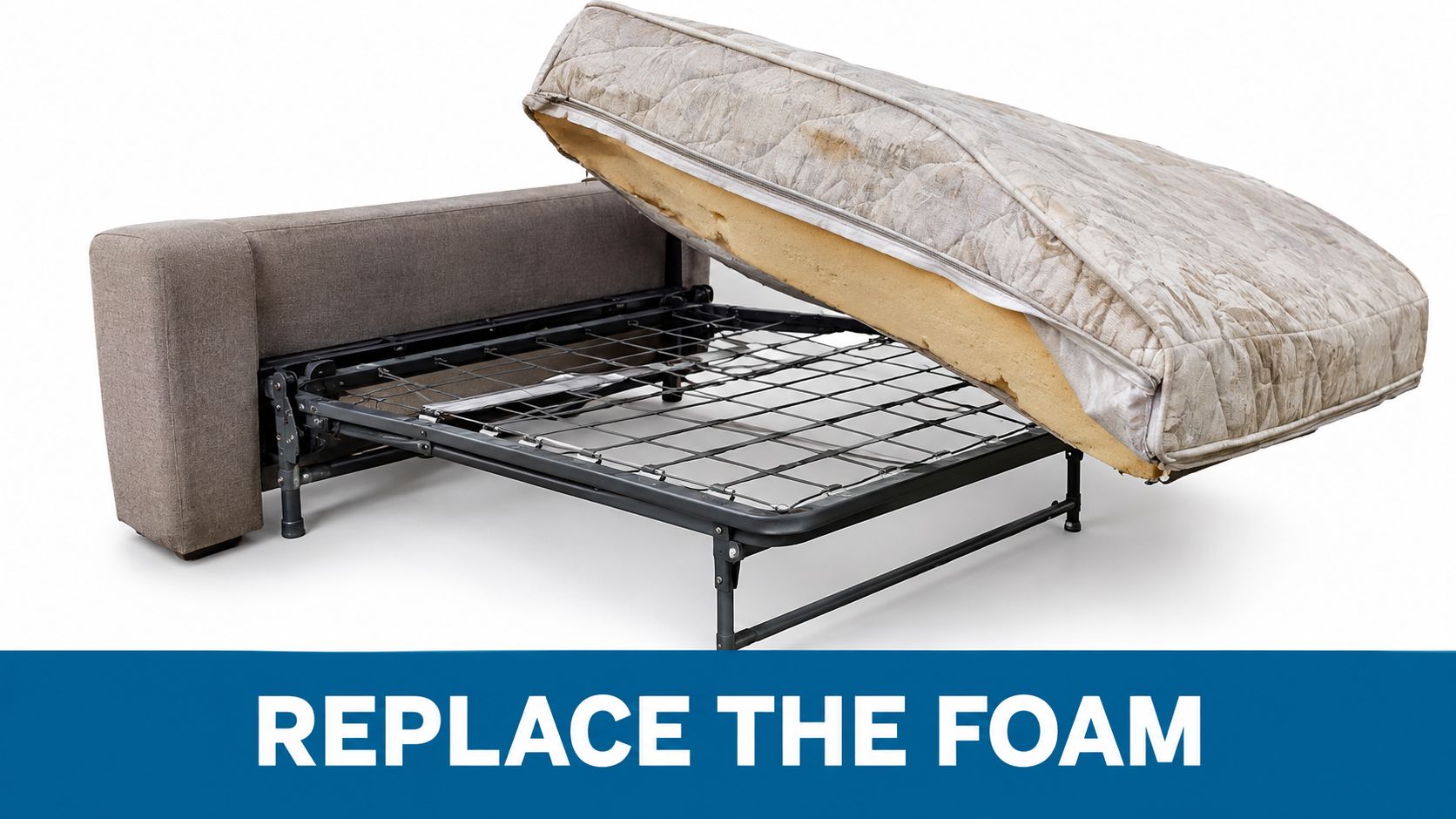
A sofa bed can look structurally healthy while its mattress has already reached the end of its useful life. The frame may still open smoothly, the upholstery may be intact, and the mechanism may appear solid. Meanwhile, the foam has compressed where your hips and shoulders land every night.
A high-quality sofa-bed frame is often estimated to last 10 to 15 years, while mattress or foam elements used nightly may need replacement around 5 to 7 years because compression and sagging develop earlier under daily loading. Sofa-bed durability guidance also notes that frequently used sleeper mechanisms can wear out in as little as 3 to 5 years, while mechanisms used occasionally may last 10 years or more.
Use the failure pattern to choose the repair
If the mattress is lumpy but the frame remains flat, replacing the mattress is the logical first move. If the mattress is reasonably even but you feel a bar or sink through it, improve the foundation instead. If the frame twists, the mechanism sticks, or the sleeping surface can't lie flat, a board may not be enough.
| What you find | Sensible next step |
|---|---|
| Flat frame, worn mattress | Replace the mattress or foam element |
| Firm mattress, bar pressure | Add compatible support between mattress and frame |
| Localized sag over weak slats | Repair or reinforce the support span |
| Bent mechanism or unstable frame | Stop nightly use and assess replacement |
| Good frame and mattress, mild discomfort | Adjust pillow placement and sleeping position |
This decision prevents a common waste of money. Replacing an entire sofa because the mattress or support span has failed can be unnecessary. Conversely, placing a board under a badly bent mechanism won't restore safe, even support.
Inspect the frame after unfolding, tighten accessible fasteners, and check whether any upgrade still allows the bed to close without force. The aim is a stable sleeping surface that preserves the useful parts of the furniture, not a temporary layer that hides a mechanical failure.
Meliusly offers sofa supports, SleeperSaver boards, bunkie boards, and bed slats for homeowners who want to address sagging without replacing sound furniture. Visit Meliusly to compare support options for your sofa bed and choose a solution that matches the frame, mattress, and way you use the furniture.