

Sleeper Sofa Accessories That Fix Sagging and Bar Feel
Posted by Meliusly
Your guest stayed over, and the next morning they said the line everyone dreads: “I could feel the bar.”
That usually sends people looking for a whole new sleeper sofa. Most of the time, that's not the first fix to try. The problem is often much more specific. A thin mattress is spanning metal crossbars, the support underneath has too much open space, or the add-on you tried made the bed softer without making it more supportive.
That's where sleeper sofa accessories earn their keep. The right one can change how weight moves through the frame, how pressure lands on the mattress, and whether the bed still folds closed without a fight. The wrong one can do the opposite. It can bunch, block the mechanism, or add height where the frame can't accept it.
At Meliusly, we build support solutions for furniture that people want to keep using, not throw out. We've served over 400,000 customers with products for sagging couches, pull-out beds, bunkie board setups, and weak bed foundations. The practical goal is simple: make what you already own work better, last longer, and feel more comfortable without turning a guest bed into a furniture project.
Introduction Why Sleeper Sofas Need the Right Accessories
A sleeper sofa has to do two jobs in one frame. It has to feel stable as a couch, then unfold into a sleep surface that still supports a body evenly. That's a harder job than a regular bed has.
Most homeowners first notice the problem at night, not during the day. The sofa looks fine. The mechanism still opens. Then someone lies down and feels a ridge, a bar, or a dip under the hips. That's when people start searching for quick comfort fixes and get flooded with generic advice about toppers, plush bedding, or thicker sheets.
Accessories are functional, not decorative
The useful sleeper sofa accessories are the ones that solve a specific mechanical problem.
- If you feel a bar, you need better load distribution under the mattress.
- If the mattress sags between supports, you need a firmer base or tighter support spacing.
- If the bed closes poorly, you need to check profile, thickness, and fold clearance.
- If guests use it often, you need to think about long-term support, not just one-night softness.
Recent market coverage also suggests sleeper sofas are coming back in more design-forward forms, while product advice still tends to stay broad and style-led instead of mechanism-specific, which leaves buyers without much help on fit, bar layout, or folding clearance in real use (Business of Home on the sleeper sofa comeback).
Softness and support are not the same repair. Softness changes what you feel on top. Support changes what's happening underneath.
That distinction matters if you host family, run a short-term rental, or care for an older parent who needs firmer sleep support. In those situations, a temporary comfort tweak isn't enough. You want an accessory setup that protects the mattress, reduces recurring pressure spots, and helps the mechanism keep working cleanly.
How Sleeper Sofa Support Actually Works
The easiest way to understand a sleeper sofa is to stop thinking about cushions and start thinking about load paths. When someone lies down, their weight doesn't spread itself perfectly across the mattress. It lands harder at the shoulders, hips, and lower back. On a sleeper, those concentrated loads often sit right over bars, gaps, or unsupported spans.
Why bars feel worse than they look
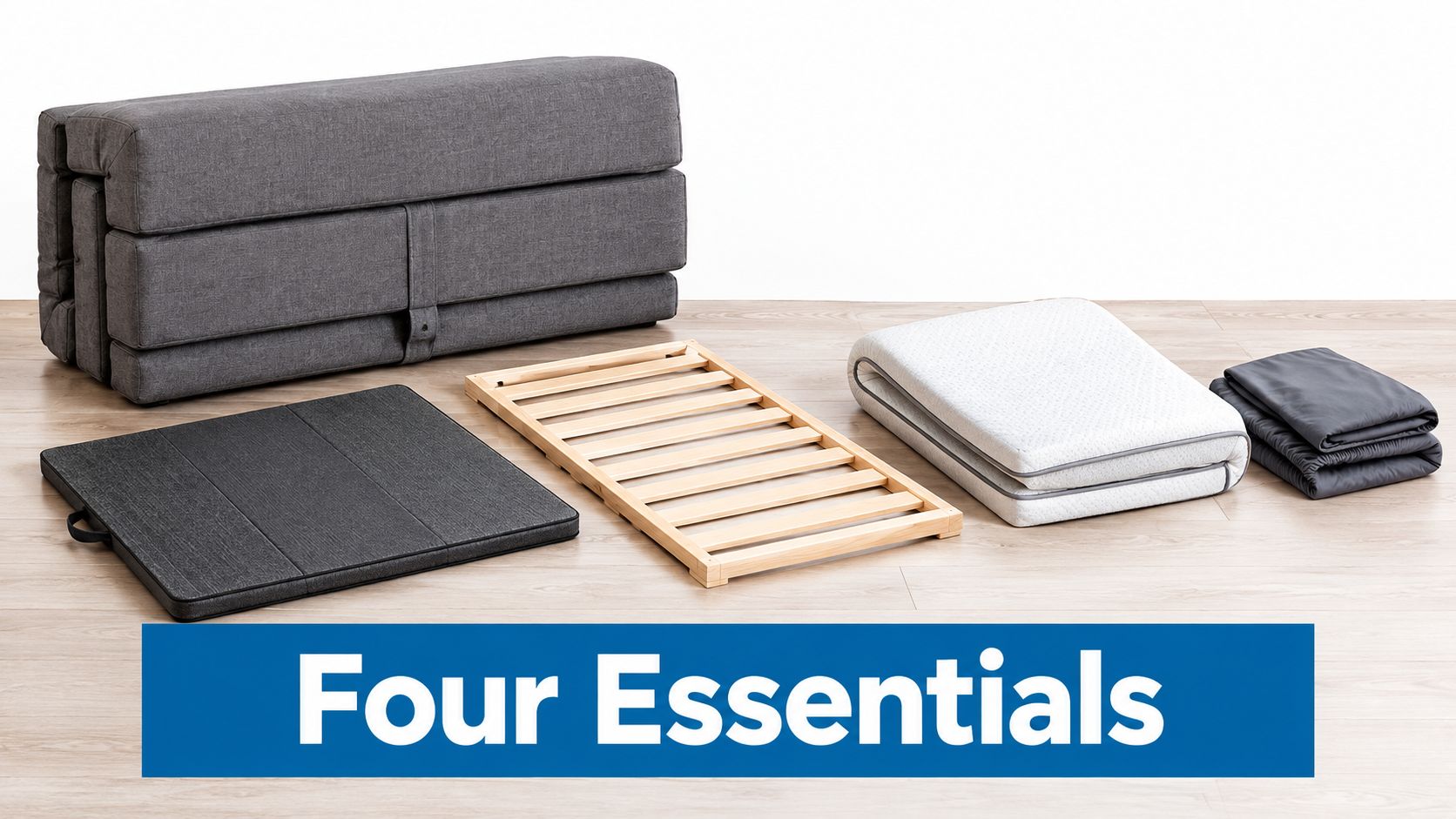
A metal crossbar isn't uncomfortable just because it's metal. It's uncomfortable because it creates a narrow contact line under a relatively thin mattress. That turns body weight into a pressure hotspot.
One engineering-oriented product summary explains the effect clearly. A 0.50-inch reinforced plywood substrate can spread the load enough to reduce peak pressure from over 8 psi to under 3 psi by broadening the bearing area, which helps explain why people notice less “bar feel” when a flat support layer is added (engineering summary on sleeper sofa support board pressure distribution).
A narrow beam carries force in one line. Add a flat layer over it, and the load gets shared over a wider surface.
The support rules that matter under any mattress
A sleeper sofa doesn't need mystery fixes. It needs the same support basics any bed needs, just in a tighter space.
Two thresholds are especially useful when you're diagnosing sag:
| Support detail | What to look for | Why it matters |
|---|---|---|
| Slat or support gap | Tight spacing, especially for foam-heavy sleep surfaces | Wider gaps let the mattress bow between supports |
| Center support contact | Real support where weight is carried | A center rail that doesn't transfer load won't stop sag |
Independent mattress-support guidance commonly puts safe spacing at about 2.5 to 3 inches for memory foam and latex, while innerspring mattresses can often tolerate up to 4 inches (Amerisleep on bed slat spacing). Separate bed-frame guidance also gives a practical maximum slat gap of 7 cm, or about 2.75 inches, for most beds and mattresses (Bensons for Beds on slat spacing).
Practical rule: If a sleeper feels fine for sitting but sags when someone lies still for a few minutes, check the support geometry before you add more padding.
Loose hardware matters too. Industry guidance around sagging support systems consistently recommends tightening what's already there first, then correcting unsupported spans with a flat reinforcement layer or true center support where the weight lands (Biltrite Furniture on sagging mattress support).
The Four Essential Sleeper Sofa Accessories Explained
People often lump all sleeper sofa accessories together. That makes shopping harder than it needs to be. These products do different jobs, and they shouldn't be treated as interchangeable.
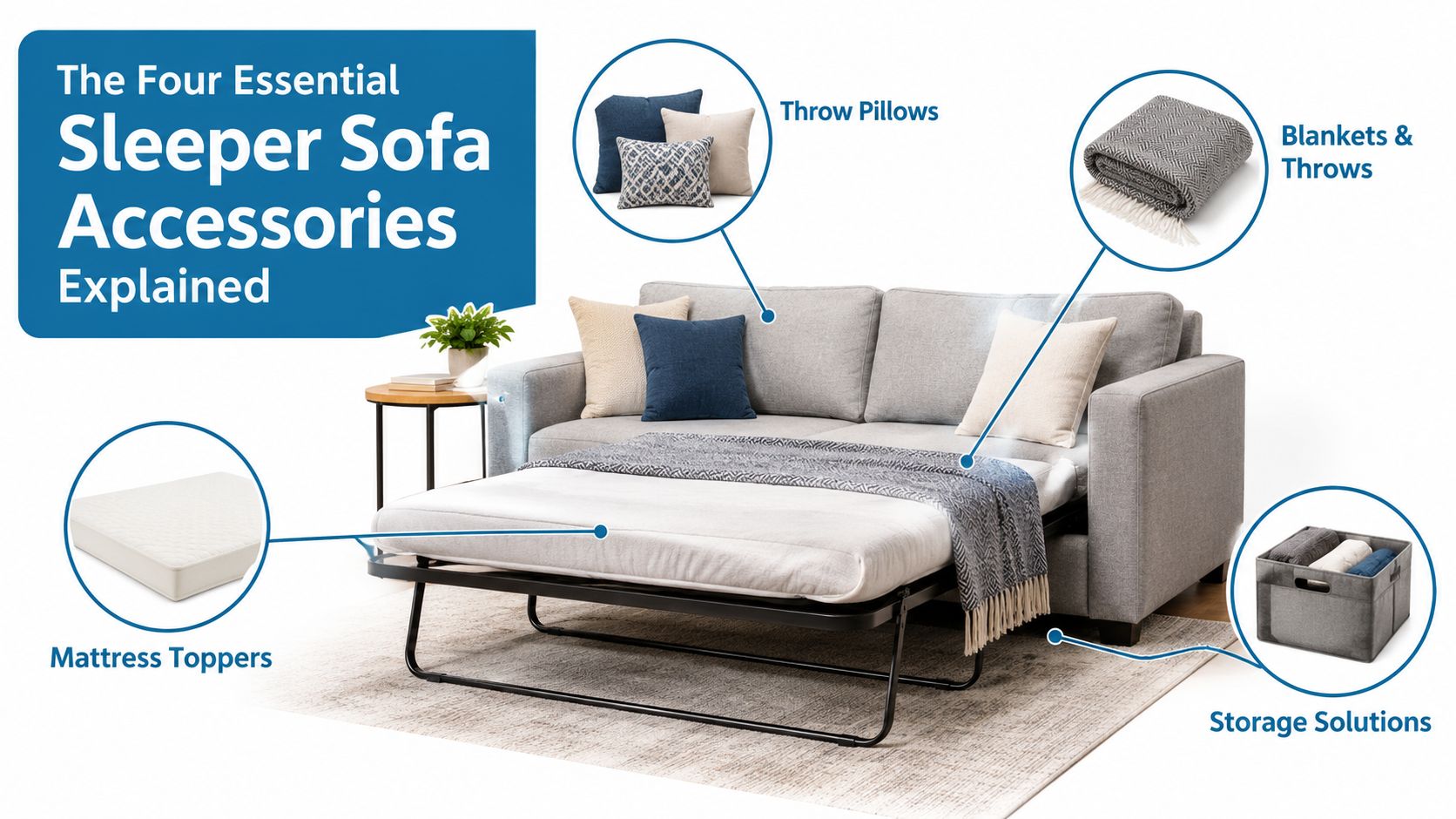
Support boards and bunkie boards
If your main complaint is bar feel, a dip between supports, or a mattress that seems too soft only because the base is uneven, start here.
A bunkie board is typically a thin, rigid panel used under a mattress, most often in the 1 to 2 inch thickness range, with some versions extending to 3 inches. The point is to create a firm, flat base without adding much height (Avocado Green Mattress on bunkie boards).
A sleeper-sofa support board does a similar job in a mechanism-specific format. Some are foldable so they can stay with the bed when it closes. If you want a closer look at how one of these works in practice, this guide to a sleeper sofa bar shield shows the basic idea.
Mattress toppers
A topper changes the surface feel. It can reduce the harshness of a seam or soften a mattress that feels thin. What it doesn't reliably do is solve a structural support problem underneath.
That's why toppers help some guests and disappoint others. If the mattress is bridging over a bar, a topper may mute the sensation without correcting the pressure point. If the support underneath is already fairly even, then a topper can make a real comfort difference.
Use a topper when your complaint is “too firm” or “slightly uneven.” Don't expect it to repair sag by itself.
Covers and encasements
These don't change support much, but they matter more than many homeowners expect. A cover helps with hygiene, friction, and wear. That's especially useful for guest rooms, vacation rentals, and homes where bedding gets stored and reused often.
A good cover choice is usually about fit and handling. You want something that comes off easily for cleaning and doesn't bunch inside the fold.
Add protection when the mattress is in regular rotation. Skip bulky layers that shift every time the mechanism opens.
Replacement hardware and mechanism parts
Sometimes the accessory you need isn't under the sleeper. It's part of the frame itself. Bent linkage, loose fasteners, worn pivot points, or a support element that's no longer level can all make a mattress feel worse than it is.
This is the least glamorous category, but it's often the honest one. If the mechanism twists while opening, drops unevenly, or no longer supports the sleep deck evenly, no topper is going to fix that.
A quick decision cue helps:
- Feeling a bar or ridge: start with a support board.
- Feeling generally too firm: look at a topper.
- Trying to protect a guest mattress: use a cover or encasement.
- Struggling to open, close, or stay level: inspect hardware first.
How to Choose Compatible Accessories for Your Mechanism
Compatibility is where most mistakes happen. A sleeper accessory can be well made and still be wrong for your sofa. The key is to match the accessory to the mechanism type, the bar layout, the mattress thickness, and the clearance needed to fold closed.
Start by identifying how your sleeper converts
Don't shop by upholstery style. Shop by how the bed opens.
A classic pull-out with a folded mattress usually has the highest need for support boards because the sleeper rests over a metal frame with bars and hinge points. Other designs, such as click-clack or fold-flat conversions, may benefit more from surface comfort layers or foundation checks than from a bar-bridging board.
For pull-outs, map the pressure points. Press down across the mattress with your hand and note where you hit resistance lines or dead spots. Those are usually the areas where a board or reinforcement layer matters most.
Measure the frame, not just the mattress
Use the mechanism in the open position and measure what the accessory must fit.
- Measure usable width. Go frame edge to frame edge where the support layer will sit.
- Measure usable length. Don't assume a full bed area is fully usable if hinges or lift points interrupt it.
- Check folded clearance. An accessory can fit when open and still stop the sleeper from closing.
- Check mattress thickness. A thicker mattress plus an added layer may exceed what the mechanism can store.
- Consider load and use pattern. If adults will use it often, avoid relying on softness alone.
Mainstream expert coverage also points out that sleeper sofa weight capacity can range from about 250 to 650 pounds depending on size and build, which reinforces why support strategy should match actual use, not just appearance (Forbes on sleeper sofa capacity and design tradeoffs).
Accessory Fit by Sleeper Mechanism Type
| Mechanism Type | Best Fit Accessory | Key Fit Check |
|---|---|---|
| Pull-out with metal bars | Foldable support board, optionally paired with a thin topper | Confirm the board sits where weight is carried and still allows folding |
| Platform-style pull-out | Low-profile topper or protective cover | Check whether added thickness affects closure |
| Click-clack or fold-flat sofa bed | Topper, cover, or base support check | Look for seam pressure and hinge ridges rather than under-mattress bars |
| Sectional pull-out bed | Support layer sized to the sleeping platform | Measure around chaise hardware and extension rails |
| Older sleeper with loose frame action | Hardware repair first, then support accessory | Don't add layers before the deck opens level |
The best accessory is the one that solves the exact support problem without interfering with the mechanism. That's a fit decision, not a style decision.
One practical example from our own catalog is a foldable support board designed for pull-out sleepers. Meliusly offers versions intended to sit between the frame and mattress to reduce bar feel while preserving foldability. That kind of product makes sense only when the mechanism has enough clearance for it and the support need is underneath, not on top.
Installation and Everyday Use Without Blocking the Fold
Installation usually goes wrong in one of two ways. People either add too much thickness, or they place the support layer in the wrong position. Both can make the sofa harder to close and can stress the mechanism over time.
A clean installation order
Start simple and keep it reversible, especially if you rent or manage a guest room that gets occasional use.
- Tighten loose hardware first. If the frame shifts, every accessory above it will shift too.
- Open the sleeper fully and flatten the sleep deck.
- Place the support layer where the frame creates pressure. For a pull-out, that usually means between the bars and the mattress, not floating on top like a topper.
- Reinstall the mattress and bedding layers in order of thickness. Keep the thickest non-structural layer on top.
- Test one full open-close cycle before making the bed.
If you want a visual walk-through of this kind of setup, this guide to a sofa sleeper support board is useful for seeing how the support layer is positioned relative to the frame.
Use thickness and folding size as real-world checks
A foldable board can only stay inside the sleeper if its folded size matches the storage logic of the mechanism. One verified example of a sleeper support board is a 48 x 48 inch panel weighing 10 pounds, shipped folded to 48 x 16 x 2 inches. Another full-size version is listed at 48 x 60 inches and 10 pounds (verified example of foldable sleeper sofa support board dimensions).
Those numbers are useful because they remind you what to check before buying: open size, folded size, and whether the mechanism has room to close around it.
Common mistake: putting a rigid panel on top of the mattress pad or topper. That reduces comfort and usually creates a folding problem. Structural layers belong below the mattress or directly under the sleep surface they're supporting.
For everyday use, leave only the layers in place that the mechanism can consistently handle. If a topper has to be removed every time the sofa closes, store it nearby instead of forcing it into the fold.
Maintenance Tips to Extend Comfort and Longevity
A sleeper sofa that feels acceptable on day one can drift into sag over time if no one checks the support beneath it. The fix isn't constant adjustment. It's a short routine that catches small issues before they become a guest-room embarrassment.
What to inspect seasonally
Use this checklist every few months, or between heavier guest periods if you host often.
- Check support spacing: Wider gaps under the mattress can invite sagging, especially with foam-heavy sleep surfaces.
- Confirm center support contact: If the middle support isn't carrying load, the mattress will still dip even if the edges seem solid.
- Inspect boards for flatness: A support board should lie flat and unfold cleanly, not bow or twist.
- Rotate removable comfort layers: Toppers and pads wear unevenly when the same person sleeps in the same spot.
- Wash protective layers regularly: Clean covers reduce abrasion, odor, and trapped dust.
Care for the fabric too
Support isn't the only longevity issue. The upholstery around the sleeper also takes extra wear because people sit, sleep, and drag bedding across the same areas. If your sleeper gets regular guest use, this guide to practical fabric couch cleaning is a helpful companion to structural maintenance.
A cleaner fabric surface also helps you spot real support issues faster. Stains and wrinkled covers can hide bunching, uneven folding, or hardware rub marks that tell you the mechanism needs attention.
Focus on durability, not just tonight's comfort
There's a reason this matters beyond convenience. Search results often lean toward instant comfort advice, but there's a real gap around whether support choices help preserve the mattress and reduce recurring pain complaints in frequent-use settings. The broader sofa-bed market also continues to show sustained demand. One estimate values the global sofa beds market at about $8.9 billion in 2024, projected to reach $13.2 billion by 2033 with a 4.4% CAGR from 2025 to 2033 (Deep Market Insights on sofa beds market growth).
That kind of demand doesn't tell you which accessory to buy. It does tell you many households and hospitality spaces are trying to get more out of multifunctional sleep furniture instead of replacing it outright.
Choosing the Right Setup for Your Home Hosting or Caregiving Needs
The right setup depends less on trend talk and more on who's sleeping there.
If the sleeper is for occasional guests
Keep the build simple. A support board handles structural discomfort. A removable pad can add surface comfort if needed. If your main concern is making a pull-out mattress feel less harsh for overnight visitors, a pull-out mattress pad can help as a complement, not a substitute for support underneath.
This is usually the most affordable path because you're targeting the weak point instead of layering on products that solve different problems.
If you host often or run a rental
Prioritize repeatability. You want a setup that opens smoothly, closes without forcing, and cleans easily between stays. Structural support matters more than plushness because frequent use exposes weak spans and pressure lines quickly.
Another market estimate also reflects how much multifunctional furniture continues to pull attention in compact spaces, with one estimate placing sofa beds at $743.53 million in 2025 and $1.147 billion by 2032 with a 6.34% CAGR, while another estimates $15.79 billion in 2025 and $26.05 billion by 2031 with a 5.72% CAGR (Research and Markets sofa bed market estimates).
If the sleeper is for caregiving or older adults
Aim for firmer, more even support. Older guests often notice unstable surfaces more than they notice lack of softness. A stable base under the mattress usually matters more than extra loft on top.
Choose layers conservatively. Too much padding can make transfers harder and can also interfere with closure if the sleeper must be folded away during the day.
Measure first. Then match the accessory to the mechanism, the mattress thickness, and how often the bed gets used. That's the difference between a sleeper sofa that remains a compromise and one that becomes reliably usable.
At Meliusly, we make practical support solutions for sagging sofas, pull-out beds, weak mattress foundations, and furniture that still has good years left in it. If your sleeper sofa needs a more stable base, less bar feel, or a setup that folds correctly, visit Meliusly to find the support option that fits what you already own.
Share this post
- Tags: fix sagging sleeper sofa, mattress topper sleeper sofa, sleeper sofa accessories, sleeper sofa support board, sofa bed accessories