

Pop Up Sofa Bed Guide: Mattress Size and Safety Checks
Posted by Meliusly
The guest bed is your living room sofa. At 10:30 on a Friday night it gets unfolded, a sheet goes over the mattress, and your sister-in-law lies down. Two hours later you can hear the frame shift every time she turns over, and in the morning the complaint is specific: a bar under one hip, a dip in the middle, and a mattress that feels thinner than it looked in the showroom.
A topper arrives the following week. It helps for about one night. The reason it doesn't solve the problem is simple: the topper is doing a mattress job on what is really a structure problem, and the structure sits under the mattress where nobody looks.
Two measurements decide whether a pop up sofa bed will sleep decently: the length and width the frame opens to, and how far the deck flexes under a body's weight. Get both before you spend money on bedding, toppers, or a replacement sofa.
How a Pop Up Sofa Bed Converts and Sets Its Sleep Length
The sleeping surface of a pop up sofa bed is set by its conversion mechanism, not by the word on the tag. Two units can both carry a queen label and still open to different lengths, different widths and different heights off the floor. That gap is where most guest-night complaints begin.
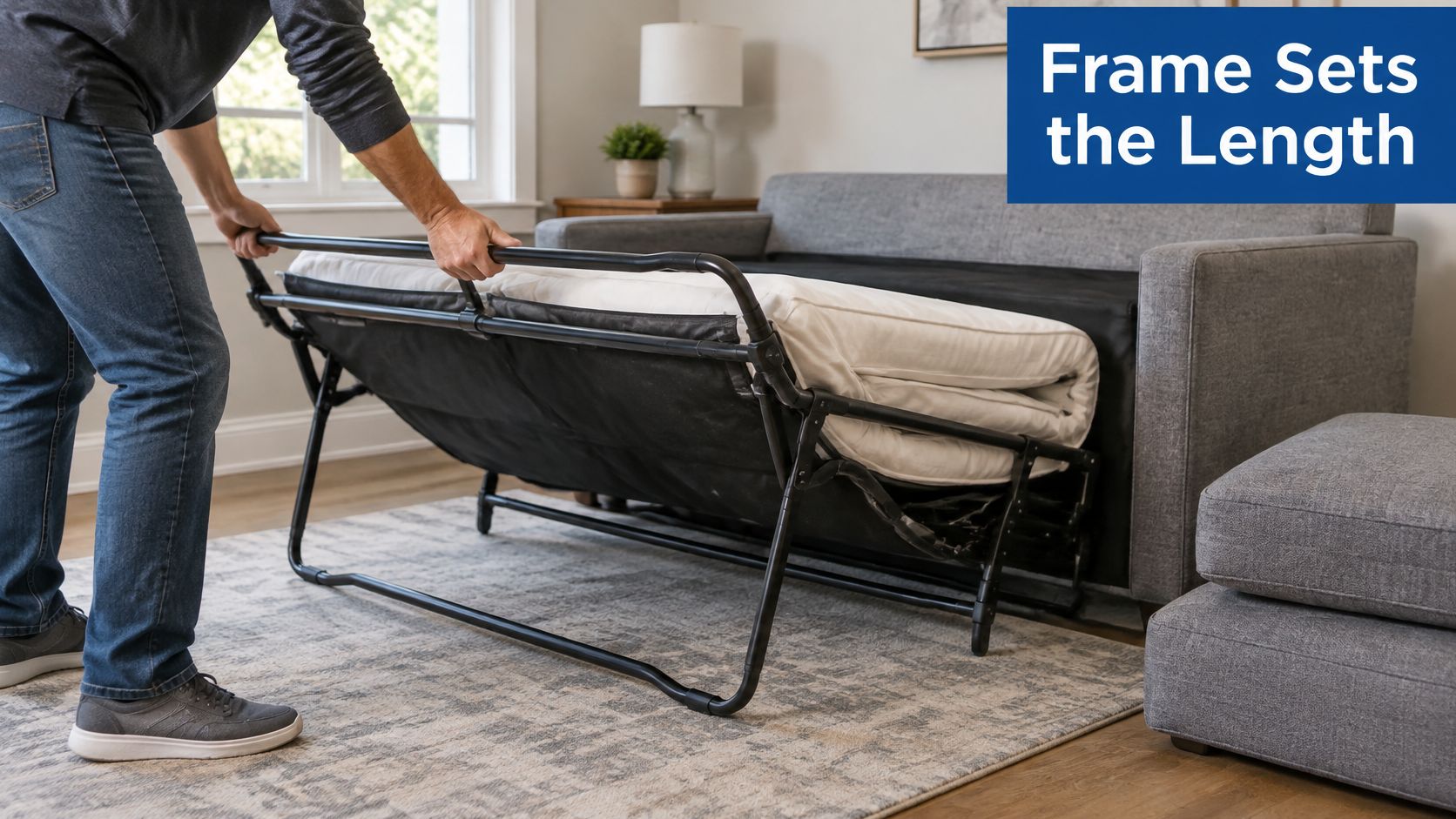
Open depth is the figure most listings leave out. For pull-out designs it comes to roughly 80 to 90 inches with the frame fully extended, and nominal mattress sizes run about 38 × 75 inches for twin, 54 × 75 inches for full and 60 × 80 inches for queen. Sofa-bed mattresses often come shorter or narrower than those standards, particularly in compact models, as Biltrite's guide to small-scale sofa beds sets out.
| Mechanism | How it opens | Typical open depth | Floor space to plan for | What to check |
|---|---|---|---|---|
| Pull-out | Seat cushions removed; frame and folded mattress extend forward | 80 to 90 inches | Full depth in front plus walking clearance | Level across frame transitions |
| Flip-down or click-clack | Back or seat pivots into a flat bed | Approaches conventional bed length | Less floor depth than a pull-out | Hinge locations and whether the surface is level |
| Pop-up | Mattress raised from concealed storage in the frame | Set by the frame footprint, not a published standard | The sofa's own footprint plus clearance to walk past the open bed | Measure the opened depth yourself |
A pull-out removes the cushions and walks a folded mattress forward, which is why it needs the whole floor in front of the sofa clear. A click-clack pivots the back or seat down and gets close to bed length on less floor space, but the surface you sleep on is usually the sofa's own cushions, seams included. A pop-up lifts a mattress out of storage inside the frame, so its closed footprint barely changes and its open depth belongs to the frame it came out of. No spec sheet for that type is trustworthy until you've run a tape over it.
The label on the mattress is not the size of the bed
A 6-foot sleeper measures 72 inches. Put that person on a 70-inch sleeping surface and the feet sit outside the support zone, with the heels dropping into the gap at the foot end of the frame. No amount of bedding fixes that, because the problem is geometry rather than softness.
Bedding fails the same way. A queen topper measures 60 by 80 inches. Lay it on a 58-by-72 deck and it overhangs two edges, which is why it slides, bunches and ends up on the floor by morning. Standard queen sheets behave similarly: the fitted corners have nothing to grip, so the sheet pulls loose the first time the sleeper turns.
Measure the open bed, not the closed sofa. A footprint that fits the wall tells you nothing about whether the room still has a walkway at 11 p.m.
The four measurements that decide everything
Take these with the unit locked open and the bedding off, in this order.
- Fully opened length and width of the sleeping surface. Run the tape from the head end of the frame to the foot bar. Use the frame's dimensions, not the mattress carton.
- Mattress thickness. A 4-inch sofa-bed mattress in a deep tray leaves a lip you'll feel at the hips; a 6-inch mattress in a shallow frame may stop the unit folding shut.
- Hinge and frame transition locations, and whether the surface is level across them. Lay a broom handle across the open deck and look for daylight underneath, then rock it. A step down at a hinge becomes a ridge under the ribs.
- Floor-to-top-of-mattress height when open. This one decides who can get in and out comfortably, and it matters most to older guests.
Write the numbers down before you compare listings, order sheets, or decide the room needs a different sofa. If the same room also has to sleep more than two people, the stacking question comes before the sofa question, and loft bed layouts for small spaces shows how putting one sleeper above the floor changes what else has to fit.
Why Comfort Lags Behind the Mattress
A guest sleeps on the pop up sofa bed, wakes up stiff, and mentions a bar under the hip. The host orders a 3-inch memory foam topper. The next guest says the same thing in slightly different words.
That outcome is predictable once you know what the topper sits on. A sofa bed is a thin sleep surface on a frame that has to fold and has to work as a seat every day. The deck beneath the mattress is usually mesh or a set of bars spanning the gap between two rails. Under a body's weight the middle of that span deflects, the bars press through, and the foam compresses into the dip. A thicker mattress just gives the dip more material to sink into.
What a comfort study actually measured
A 2024 sleep study on recliner use recorded large self-reported gains: comfort up 107%, pressure relief up 240%, perceived weightlessness up 327%. Objectively measured sleep did not improve, as the study abstract in Sleep reports. That's recliner research, not sofa-bed research, so read it narrowly: what a sleeper says about a surface and what a sleep measurement shows can move in opposite directions. A guest telling you the bed felt better is not the same as a guest sleeping through the night.
For a sofa bed, evaluate the structure, not the mattress grade:
- Sleeper weight. Load tells you how much the span has to carry, and it's the first thing to ask about a bed used by adults rather than children.
- Support span. Measure the distance between the rails. A wider unsupported span flexes more, whatever sits on top of it.
- Center-bar pressure. Press two fingers on the bar under the middle of the deck. If it bites, the surface above it is too thin.
- Deck flex. Push down at the center and at each edge and compare. More give in the center means the span is the problem.
- Ease of getting up. A soft edge and a low open height turn a 3 a.m. bathroom trip into a hazard.
Occasional guests need a surface that's acceptable for two nights. Nightly sleepers need a deck that stays flat for years, and for them the repair decision is worth making properly. Same sofa, different requirement.
Test the deck, not the topper. With the mattress off, press the center of the open deck with the heel of your hand, then the edges. If the center gives noticeably more, you've found your problem and it isn't the mattress.
Safety Checks for Fire and Tip-Over Risk
One question decides which fire rules apply to a sofa bed in the United States: is the mattress detachable? A detachable mattress is generally regulated separately under 16 CFR Parts 1632 and 1633, while the remaining upholstered structure may fall under 16 CFR Part 1640. If the mattress is permanently attached, the whole product may instead be treated as upholstered furniture under the relevant rule, as the CPSC upholstered furniture guidance explains.
The detachable mattress question comes first
Part 1633 sets open-flame performance limits on a mattress, capping both how fast it can release heat and how much total heat it can give off during the opening minutes of a standardized burn test. The practical consequence is direct: replacing, adding or modifying a detachable mattress can change the fire-safety profile of the assembled product even when the frame hasn't changed at all.
For hosts and rental operators, that means keeping the manufacturer's mattress specification and retaining compliance documentation for the exact mattress and frame combination. Untested foam toppers and off-spec replacement mattresses are the usual weak point, bought for comfort and never checked against the frame they sit in.
Placement and ignition habits
Tip-over is a stability question. A heavy unit can still go over if the floor is uneven or the frame isn't fully open. A 2024 CPSC analysis estimated an annual average of 17,800 emergency-department-treated injuries from furniture, television and appliance tip-overs during 2020 to 2022, with furniture accounting for 82% of those injuries and children younger than 18 making up 44%, according to the CPSC tip-over announcement.
Set the unit on a level surface and open it fully as the manufacturer directs. Keep children off the back and arms, where a climbing body shifts weight over the hinge line. If the bed will carry more than one adult, how much weight a sleeper sofa can hold explains what the bars and hinges are built for.
Ignition sources deserve the same attention. Upholstered furniture was the first item ignited in an average of 7,040 U.S. home-structure fires per year during 2005 to 2009, and while those fires were 2% of reported home fires they caused 19% of home-fire deaths, per the Illinois State Fire Marshal fact sheet. Keep smoking materials, candles and heaters away from both the folded sofa and the exposed mattress. Never cover ventilation openings or press heat-producing equipment against the upholstery.
Practical rule for hosts: keep the mattress the unit shipped with, and keep the paperwork that proves it matches the frame.
In the United Kingdom, upholstered sofa beds, futons, mattresses and cushions face separate rules covering ignition-resistant fillings, cigarette-resistant upholstery composites, match-resistant covers and permanent labeling, and those rules extend to furniture supplied in rented accommodation. They were amended in 2025, so check the label and the current certification before placing a second-hand unit in a rental, as Darlington Borough Council's trading standards guidance sets out.
Choosing the Right Pop Up Sofa Bed by Use
The right unit is the one that matches how often it opens and who sleeps on it. Buy for the worst night of the year, not the average one.
| Use case | Main priority | First check |
|---|---|---|
| Occasional guests | Quick conversion and acceptable surface | Open depth and how easily the unit folds |
| Nightly sleeper | Deck and center support that stay flat over years | Frame flex and mattress thickness |
| Rental or hospitality | Compliance and durability | Detachable-mattress status and documentation for the exact configuration |
| Heavier or older sleepers | Support span and easy rising | Center-bar pressure and deck flex |
For occasional guests, the trade-off is length against floor space. A pull-out gives the longest sleeping surface of the three types and asks for the most floor in return, which is fine in a guest room and awkward in a studio. A click-clack takes less floor and may hand you a shorter surface, so the honest test is whether your tallest regular guest fits without hanging over the foot end.
If someone sleeps on it nightly, stop shopping for mattresses and start looking at the base. Frame flex and deck flex are what wear a nightly sleeper down, and they're also the two things you can fix without replacing the sofa. A firm deck plus a mattress that matches the frame's folded dimensions is a better combination than a plush mattress on a flexing span.
Rental and hospitality use puts compliance and durability ahead of everything else. A unit in a short-let turns over dozens of times a month, so the mechanism and the documentation both have to survive that cycle. Confirm the detachable-mattress status and keep the records for the exact configuration that's in the room.
Heavier and older sleepers need the same two qualities: a support span that doesn't deflect under load, and a bed they can rise from without help. Favor a firm deck and check the open height. Have the person who'll sleep there lie down, sit up and swing their legs off before you commit.
Whichever case fits you, take the fully opened length first. Everything else is a secondary decision.
How to Restore Support Without Replacing the Whole Unit
A Dutch government-commissioned ecodesign review of furniture puts the expected service life of seating at 7 to 15 years, per the Research Ecodesign for Furniture report. A pop up sofa bed that sags at year four is early compared with that range, which makes the base the economical repair target rather than the landfill.
Frame, foam, mechanism and deck wear at different rates. A sofa can be structurally sound and still sleep badly, and that is the case where support work pays off. Nearly all of the fix happens under the mattress, out of sight once the bed is made. Measure the opened sleeping surface first, then test the deck itself. A new topper over a flexing span buys you softness without support, which is why the deck check comes before any purchase.
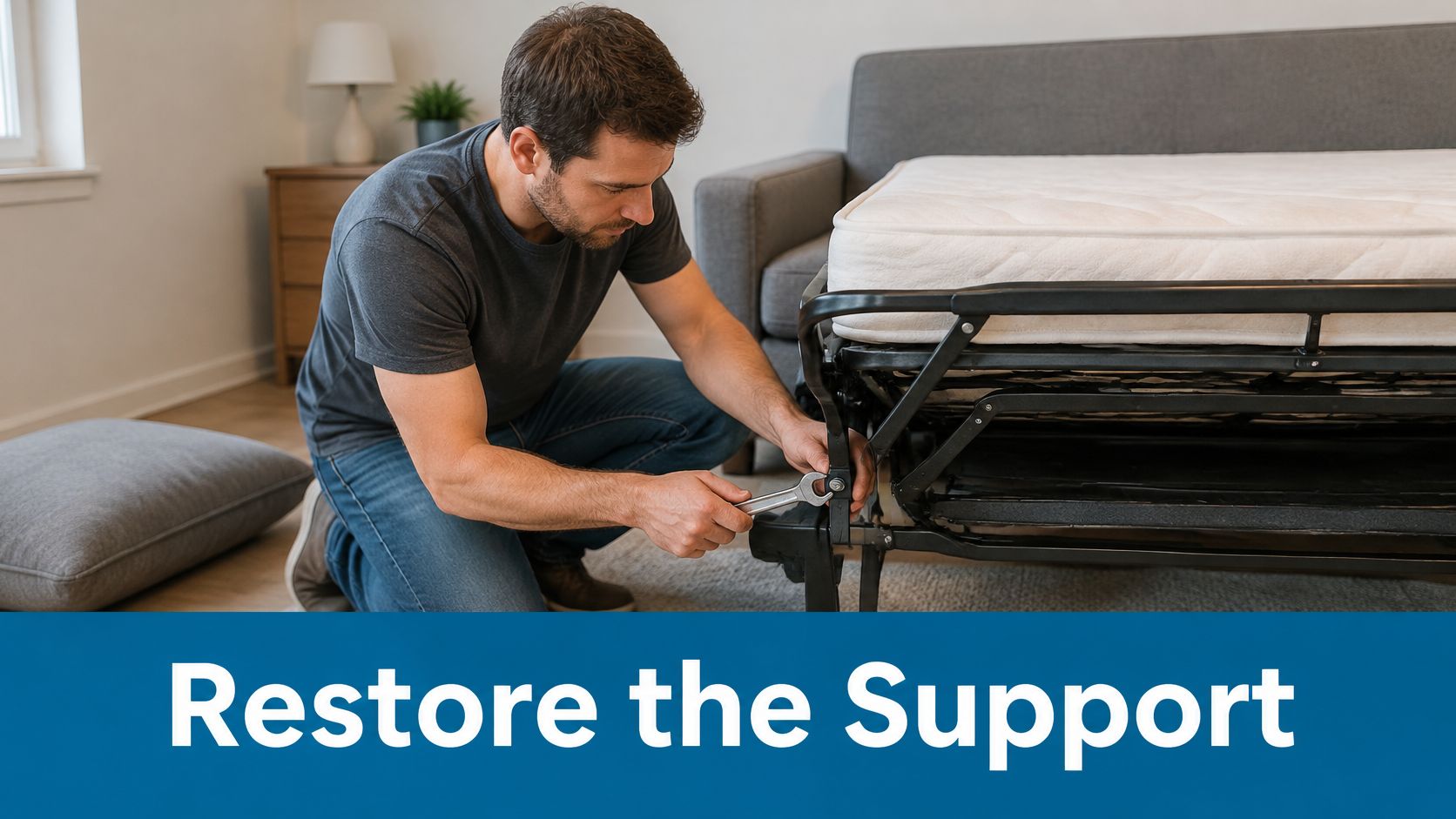
- Strip the bedding and separate the mattress from the frame. You cannot test a deck through foam. The foam hides the exact flex you are trying to locate, so pull the mattress clear before you form an opinion.
- Inspect the frame, hinges, legs, webbing and mattress one at a time. Each part fails differently. A flattened seat cushion tells you about foam, not about whether the rails are still square.
- Press the open deck at the center and at each edge with the heel of your hand. Give in the middle and firmness at the edges means the span is deflecting. Testing over a mattress is the mistake that sends people out to buy a new sofa they did not need.
- Check that the mechanism still locks and folds freely. A bent hinge or a rail pushed out of square defeats any support you add, so this check decides whether the repair is worth starting.
- Add a rigid layer that spreads load across the bars. Size the panel to the frame's inner dimensions so it seats on the rails rather than perching on the bars, and check the thickness against the lock and folding path. The common failure is a board that blocks the mechanism or sits proud enough to create a new ridge.
- Reassemble, then lie down, sit up, and cycle the unit open and closed. The open-and-close cycle reveals interference, and it takes ten seconds.
- Recheck level across each transition. A new support layer can lift the middle above the hinge line, trading a dip for a step.
Before you buy another topper, compare mattress topper benefits with clear eyes. A topper changes how a sound surface feels. It cannot rebuild a deck, and it cannot stop a center bar from pressing through. For the base layer itself, our guide to pull-out mattress support walks through what sits where inside the frame.
If the frame or the conversion mechanism is bent, base repair will not hold. Replace the unit. A support panel cannot straighten steel.
Confirm the Fit Before You Buy or Fix
Three checks settle the decision. First, the opened surface in length, width and height with the unit locked open. Second, the mattress status and the compliance records for the exact frame and mattress pairing. Third, the deck test: press the open deck at the center and at both edges with the mattress off.
If the surface and mechanism are sound but the deck flexes, repair the base and keep the sofa. Our support boards are built for that job. The SleeperSaver Lite unfolds onto the sofa bed frame with no tools and no permanent modifications, and the SleeperSaver™ Pro sits between the sofa frame and the mattress and collapses together with the bed, which is what makes it practical for Airbnb hosts, vacation rentals and anyone who opens the bed regularly.
If the frame or mechanism is bent, or the mattress no longer matches the frame's folded dimensions, replacement is the safer route. No support product fixes a bent frame, and forcing one into a damaged mechanism just moves the failure somewhere less visible. Standard figures by size and mechanism are in our guide to sleeper sofa dimensions if you need a comparison point before measuring.
One thing you can do today: write down the four measurements, run the deck test with the mattress off, and let those two results choose between repair and replacement.
Meliusly builds the support layer that turns a sagging pop up sofa bed back into something a guest will sleep through, from foldable boards that install without tools to permanently installed panels that collapse with the frame. If your deck test showed give in the middle, that's the part worth replacing, not the whole sofa. Take a look at the Meliusly range and match a board to your frame size before the next guest arrives.
Share this post
- Tags: pop up sofa bed, sleeper sofa support, sofa bed mattress size, sofa bed mechanism, sofa bed safety